![Blood in my urine after chip use | Seek medical care promptly [OK Prostate Chip]](/img/a/T0335/eyecatch.svg)
This page is based on entries from "ok-lab's diary" (https://ok-lab.hatenablog.com/), the Japanese development diary written by Mr. Okada, founder of OK Lab, a small company in Japan (Okada Comfortable Life Laboratory). Only the entries about "urethral bleeding and blood in urine" are summarized here, in order of publication. Past prices and sizes are as written at the time. Current prices come from the official product list (retrieved September 4, 2026). Quotations are translated from Japanese.
This article is about blood in urine after chip use, and summarizes reported problems, the maker's responses, and changes over time. It covers the need for prompt medical attention, related products, common questions, and buying from outside Japan.
Note: This page is a personal reading log by someone with no connection to the maker or the seller. It reflects the source entries as of their publication dates and makes no guarantee of accuracy or safety. The product is not a medical device; talk to a doctor about any health decision. Check the official site for current information. This page contains advertising.
In short
- Bleeding appears in reports of injury, difficult chip removal, and illness requiring hospital treatment.
- Mr. Okada discusses friction and damaged connections, and sometimes advises seeing a urologist.
- Later entries record connection changes, a sales suspension, and another hospitalization in May 2026.
If you see blood in your urine, even a small amount or for the first time, do not wait and see. See a urologist right away.
If you suddenly cannot urinate, or the device cannot be removed, do not try to fix it yourself. Go to a medical facility, including emergency care, immediately.
About this product

The OK Prostate Chip is a small device that is placed in the urethra (the urine passage) so that it acts on the prostate; the maker sells it in several shapes, sizes and materials. It is made and sold by OK Lab (Okada Comfortable Life Laboratory), a small company in Japan, through its own online store, and prices are in Japanese yen (JPY). The maker's development diary, "ok-lab's diary", is written in Japanese. This page is an English summary of it, and every quotation is translated. OK Lab ships internationally, so readers outside Japan can order (see "Buying from outside Japan" below). Product names on this page are plain-English descriptions. The official Japanese product name is shown once in the product table so you can find the same item in the store.
Before you read: key terms
| Term | Plain-English meaning |
|---|---|
| Urethra | The urine passage, where the chip is placed to act on the prostate. |
| Prostate | The structure the chip stimulates; the diary does not explain its normal function. |
| Retrieval thread | A thread attached to the chip to help retrieve it. |
| Stopper | An attached part intended to limit chip movement; the diary records failures to prevent bladder entry. |
| Epoxy resin | A hard-setting material used to attach threads and form chip parts. |
| Endoscope | A viewing instrument doctors used to locate and remove trapped chips. |
| Antibiotics | Medicines prescribed for infection in the reported hospital treatments. |
| Urologist | A doctor consulted in these reports for urinary problems or trapped chips. |
What happens: blood in urine after chip use
The OK Prostate Chip is a small device placed in the urethra (the urine passage) to stimulate the prostate. The entries describe blood appearing in urine, on the device, or at the urethral opening during or after use. Some reports involve the chip itself; others concern its retrieval thread (a thread intended to help retrieve it). The accounts include prolonged wear, rough connections, and chips that moved into the bladder.
The maker's early warnings included even small amounts of blood from the urethra
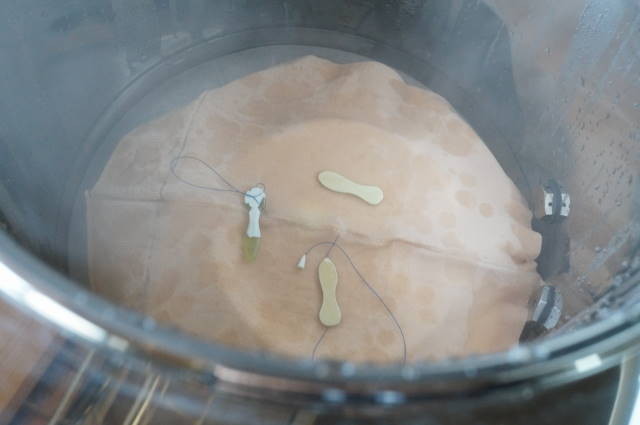
In an entry published in October 2017, Mr. Okada answered a reader worried about injuring the urethra. He said small wounds could produce slight bleeding, sometimes noticed only later.
He distinguished this from flowing bleeding, which he said required bleeding-control measures. Mr. Okada also said glass did not eliminate friction and advised stopping use if discomfort developed.
(Source: ok-lab's diary, published October 2017)
https://ok-lab.hatenablog.com/entry/20171026/1508989298
Mr. Okada warned of muscle injury and retrieval risks associated with the use of long chips
In an entry published in January 2018, Mr. Okada described long chips as intended only for brief use. He believed prolonged wear could damage the muscles holding it around the prostate.
He reported twice being unable to retrieve a long chip, although both incidents resolved. Mr. Okada discouraged purchases by beginners and intermediate users.
(Source: ok-lab's diary, published January 2018)
https://ok-lab.hatenablog.com/entry/20180111/1515662782
Urethral bleeding sometimes became apparent only after prolonged long-chip wear
In an entry published in April 2018, Mr. Okada reported repeated complaints of bleeding after prolonged long-chip wear. One customer found blood coating the chip after 10 days of continuous wear, having noticed no bleeding while it remained inside.
Mr. Okada considered prolonged friction a possible cause. He warned against ordering long chips casually because of the bleeding reports.
(Source: ok-lab's diary, published April 2018)
https://ok-lab.hatenablog.com/entry/20180421/1524299808
Blood in urine preceded hospital removal of a custom chip
In an entry published in May 2018, a customer described bleeding after about 1 hour with a custom semi-long chip. Its retrieval thread detached, and the chip entered the bladder.
Doctors removed it using an endoscope (an internal viewing instrument) and grasping instruments. The customer reported paying about ¥29,000 (about $186 at ¥156 = $1, rate as of 2026-09-04) and receiving 5 days of antibiotics (medicines for infection) after bleeding during the procedure. Mr. Okada gave no advice alongside the customer's report of recovery.
(Source: ok-lab's diary, published May 2018)
https://ok-lab.hatenablog.com/entry/20180511/1526036007
Blood in urine accompanied fever and diagnosed prostate inflammation
In an entry published in June 2018, a single-chip glass model user described 6–7 hours of overnight wear with Menturm ointment. They subsequently developed a fever of 39°C, and a urine test detected blood.
The customer reported eventually receiving a diagnosis of acute prostate inflammation. They suspected overnight wear and excessive stimulation, but the account did not establish a cause. Mr. Okada appended advice against combining chips with ointments from a reader he described as having medical knowledge.
(Source: ok-lab's diary, published June 2018)
https://ok-lab.hatenablog.com/entry/20180609/1528523953
A trapped chip brought blood in urine and hospital treatment
In an entry published in April 2022, a customer described a ceramic double-twist chip (Rabuka) becoming trapped in the bladder. A urologist (a doctor consulted for urinary problems) removed it with difficulty; the customer reported paying about ¥8,000 (about $51 at ¥156 = $1, rate as of 2026-09-04).
The customer reported bloody urine and leakage, expecting these and incomplete emptying to continue for several days. Mr. Okada thought the stopper (a part intended to limit chip movement) might complicate removal after entering the bladder.
(Source: ok-lab's diary, published April 2022)
https://ok-lab.hatenablog.com/entry/2022/04/02/123050
Blood from the urethra preceded a hospitalization reported in May 2026
In an entry published in May 2026, a customer sought another approach after repeated unsuccessful attempts to place the chip ended in bleeding. After 2 days, chills and a fever of 39.4°C led to medical assessment.
The customer reported acute kidney and prostate inflammation, followed by 3 days of hospital antibiotic treatment and discharge. Mr. Okada suggested alternative devices while acknowledging he had not personally tested commercial flexible instruments. His reply also acknowledged that he could not determine which product would suit this customer.
(Source: ok-lab's diary, published May 2026)
https://ok-lab.hatenablog.com/entry/2026/05/16/122906
The maker's answer to blood in urine after chip use
The maker's responses included construction changes, repair offers, a sales suspension, and referral for medical assessment.
Reports of blood from the urethra prompted changes to early stopper prototypes
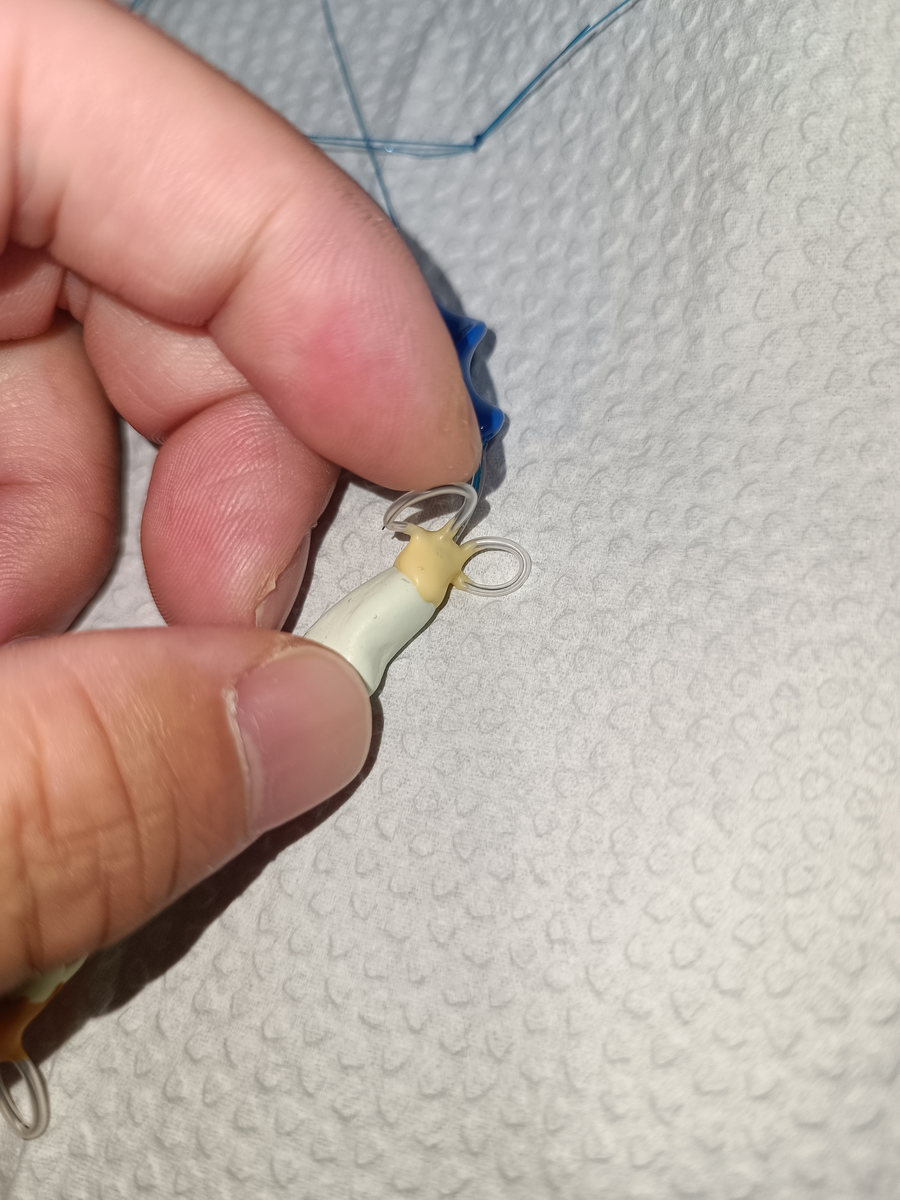
In an entry published in June 2018, a stopper prototype tester reported scraping and bleeding during attempted placement. Mr. Okada acknowledged a possible manufacturing problem and said the construction process needed improvement.
A separate tester reported bleeding after prolonged wear and found a rough projecting edge. Mr. Okada described a revised construction method intended to improve finishing and consistency. He said injury prevention needed attention before an official release.
(Source: ok-lab's diary, published June 2018)
https://ok-lab.hatenablog.com/entry/20180609/1528523953
Mr. Okada suggested several explanations for urethral bleeding linked to the use of homemade chips
In an entry published in March 2019, a beginner asked about bleeding after using a homemade resin chip. Mr. Okada identified possible surface projections, a material producing excessive friction, and excessive chip size.
The diary does not record a confirmed cause or subsequent recovery. His reply cautioned about reopening an injury.
(Source: ok-lab's diary, published March 2019)
https://ok-lab.hatenablog.com/entry/2019/03/30/160657
Repeated blood from the urethra prompted an offer to repair sharp thread connections
In an entry published in April 2020, a customer asked about a sharp thread attachment that reportedly caused bleeding every time. The connection used epoxy resin (a hard-setting material used to bond chip parts).
Mr. Okada discouraged filing because it could damage the thread. He proposed reducing the projection, with return for a rubber repair if the problem remained.
(Source: ok-lab's diary, published April 2020)
https://ok-lab.hatenablog.com/entry/2020/04/25/133218
Blood in urine with clots prompted advice to see a urologist
In an entry published in October 2020, a customer using a ceramic twisted semi-long chip and homemade stopper reported pain and a blood clot. A later health check detected blood and white blood cells in urine.
The customer asked how long to rest before another test. Mr. Okada said he could not judge the clot's cause and raised the possibility of another illness. He advised seeing a urologist instead of relying on rest alone.
(Source: ok-lab's diary, published October 2020)
https://ok-lab.hatenablog.com/entry/2020/10/17/121023
Exposed wire and blood from the urethra prompted a sales suspension
In an entry published in September 2021, Mr. Okada reported bleeding during his own testing of a resin-covered guide wire (Miko wire). He found exposed wire where the resin covering was too thin.
He attributed the injury to that projection. Mr. Okada suspended sales pending a way to ensure safety and canceled existing orders.
(Source: ok-lab's diary, published September 2021)
https://ok-lab.hatenablog.com/entry/2021/09/11/125735
Blood from the urethra prompted a change to an integrated stopper's attachment
In an entry published in November 2025, a customer reported bleeding before discovering exposed wire in an integrated stopper. Mr. Okada initially offered a refund because he could not identify a reliable fix.
Later in that entry, he described bonding the rear stopper's thread along the ceramic body. He asked users to report further slipping or detachment.
(Source: ok-lab's diary, published November 2025)
https://ok-lab.hatenablog.com/entry/2025/11/29/122908
Another report of blood from the urethra prompted changes to future wire fastenings
In an entry published in December 2025, a customer reported pain and bleeding after a wire fragment emerged from a sleeve-style device. Mr. Okada identified a slipped loop fastening.
He offered a refund or rebuild, which the customer declined. Mr. Okada said all future shipments would receive measures against fastening slippage, even though the resin-covered joints would become larger.
(Source: ok-lab's diary, published December 2025)
https://ok-lab.hatenablog.com/entry/2025/12/27/122915
If you see blood in your urine, even a small amount or for the first time, do not wait and see. See a urologist right away.
If you suddenly cannot urinate, or the device cannot be removed, do not try to fix it yourself. Go to a medical facility, including emergency care, immediately.
How blood in urine after chip use changed over time
| Published | What the diary said then |
|---|---|
| Jun 2018 | A stopper failed to prevent bladder entry, prompting reconsideration of its claimed purpose. |
| Aug 2020 | Rubber covers became standard in principle on certain ceramic chips and dual-thread connections. |
| Jun 2021 | Mr. Okada described a new movable thread connection as eliminating sharpness at the joint. |
| Aug 2022 | Roughness was attributed to unidentified deposits, rather than erosion of the resin. |
| Sep 2025 | Plans for protective tubing changed to silicone-coated wire; specifications remained unsettled. |
| Dec 2025 | Wire-loop failures prompted planned reinforcement of every fastening on future shipments. |
| May 2026 | A customer reported hospitalization after bleeding, with fever and diagnosed kidney and prostate inflammation. |
OK Prostate Chip products related to blood in urine after chip use
The current list includes models involved in bleeding reports and an alternative mentioned after a hospitalization.
Chip products featured in these diary entries
| Product (official name) | Price incl. tax | Relation to this topic |
|---|---|---|
| Long chip (OKプロステートチップ ロングタイプ) | ¥6,600 (about $42 at ¥156 = $1, rate as of 2026-09-04) | January 2018 warnings concerned injury during prolonged wear. |
| Single-chip glass model (OKプロステートチップ ガラス素材1チップタイプ) | ¥3,300 (about $21 at ¥156 = $1, rate as of 2026-09-04) | June 2018: overnight wear preceded bloody urine and diagnosed prostate inflammation. |
| Linked resin chips (OKプロステートチップ 樹脂素材2連結タイプ) | ¥4,400 (about $28 at ¥156 = $1, rate as of 2026-09-04) | In March 2018, bloody urine prompted questions about wear limits. |
| Ceramic twisted semi-long chip (OKプロステートチップ 陶器素材セミロングタイプ コブラツイスト) | ¥5,500 (about $35 at ¥156 = $1, rate as of 2026-09-04) | An October 2020 customer reported a clot while using this with a homemade stopper. |
| Ceramic double-twist chip (OKプロステートチップ 陶器素材覚醒タイプ ダブルツイスト(ラブカチップ)) | ¥6,600 (about $42 at ¥156 = $1, rate as of 2026-09-04) | An April 2022 customer reported bloody urine and hospital removal after bladder entry. |
| Flat-curve resin semi-long chip (OKプロステートチップ フラット面カーブ型 セミロングタイプ(生体適合樹脂)) | ¥6,050 (about $39 at ¥156 = $1, rate as of 2026-09-04) | An August 2022 report described bloody urine and rough surface deposits. |
(Source: ok-lab's diary, published January 2018)
https://ok-lab.hatenablog.com/entry/20180111/1515662782
(Source: ok-lab's diary, published March 2018)
https://ok-lab.hatenablog.com/entry/20180324/1521875816
(Source: ok-lab's diary, published June 2018)
https://ok-lab.hatenablog.com/entry/20180609/1528523953
(Source: ok-lab's diary, published October 2020)
https://ok-lab.hatenablog.com/entry/2020/10/17/121023
(Source: ok-lab's diary, published April 2022)
https://ok-lab.hatenablog.com/entry/2022/04/02/123050
(Source: ok-lab's diary, published August 2022)
https://ok-lab.hatenablog.com/entry/2022/08/20/122920
Alternative products mentioned in the chip development diary
| Product (official name) | Price incl. tax | Relation to this topic |
|---|---|---|
| Multipurpose stainless-steel wire (多目的ステンレスワイヤー) | ¥550 (about $4 at ¥156 = $1, rate as of 2026-09-04) | In May 2026, Mr. Okada mentioned it for placement difficulties after hospitalization, while acknowledging uncertainty about suitability. |
(Source: ok-lab's diary, published May 2026)
https://ok-lab.hatenablog.com/entry/2026/05/16/122906
The custom semi-long chip, early stopper prototypes, guide wire, integrated stopper, and sleeve-style device were custom or development items. No matching product can be confirmed on the current list.
Common worries about blood in urine after chip use
Readers asked about warning signs, painless bleeding, and symptoms that continued across several days.
"Can pain warn me before blood in urine appears?"
In an entry published in March 2018, a linked resin chip user asked how to recognize the limit of continuous wear. Blood had appeared during the second afternoon, after wear starting around lunchtime the previous day.
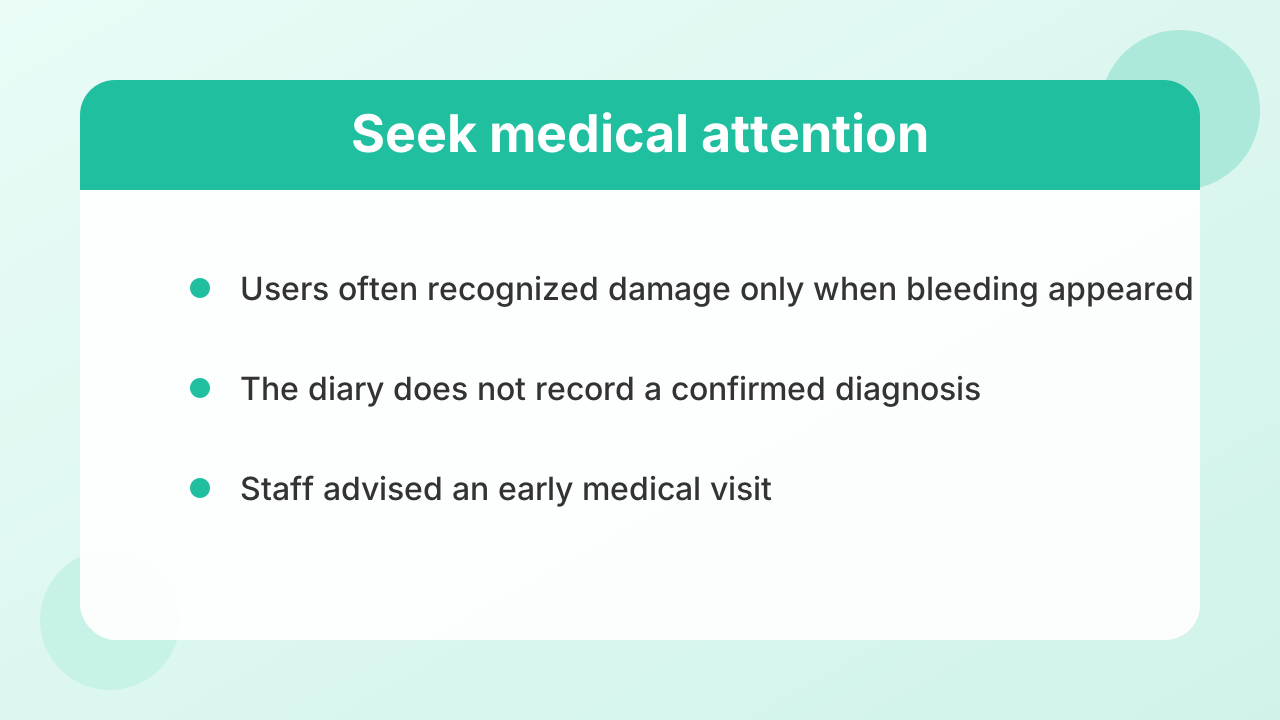
Mr. Okada said there was no outward sign that reliably identified that limit. He wrote that users often recognized damage only when bleeding appeared. His reply favored breaks from prolonged wear to rest the urethra.
(Source: ok-lab's diary, published March 2018)
https://ok-lab.hatenablog.com/entry/20180324/1521875816
"Does painless blood in urine mean the chip fits?"
In an entry published in May 2022, a customer reported bleeding on 3 consecutive occasions with longer chips, but none with a semi-long chip. They asked whether fit, experience, or harmless bleeding explained it.
Mr. Okada considered depth and thickness separately but acknowledged uncertainty about where bleeding began. The diary does not record a confirmed diagnosis. He advised seeking a doctor's judgment if bleeding continued.
(Source: ok-lab's diary, published May 2022)
https://ok-lab.hatenablog.com/entry/2022/05/14/123043
"Does blood in urine lasting several days need medical attention?"
In an entry published in August 2023, a customer asked whether continuing bleeding and severe pain during urination would resolve without medical care. The report followed combined use of an electrode chip and another sexual device.
The customer initially planned a medical visit, but later said bleeding stopped after 3 days. The diary does not record whether an examination took place. Staff advised an early medical visit because they could not assess the situation from a message.
(Source: ok-lab's diary, published August 2023)
https://ok-lab.hatenablog.com/entry/2023/08/05/122956
Buying from outside Japan

OK Lab ships internationally to countries covered by Japan Post's EMS courier service. Overseas orders are paid in advance by PayPal. Each order carries a ¥400 (about $3 at ¥156 = $1, rate as of 2026-09-04) handling fee, and EMS shipping is charged on top. These terms come from OK Lab's official sales-terms page (written here as plain text, not a link: ok-lab.net/docs/law), checked on September 7, 2026; confirm them on the official store before you order, because they can change.
Summary of this article
| What you wanted to know | The answer |
|---|---|
| The short answer? | Blood in urine needs prompt medical attention. |
| The product? | A urethral device from Japan, priced in JPY. |
| The terms? | Threads aid retrieval; stoppers aim to limit movement. |
| The reported problems? | Bleeding, trapped chips, and hospital treatment. |
| The maker's response? | Repairs, design changes, suspended sales, and medical referrals. |
| Changes over time? | Connections changed; bleeding reports continued. |
| Products involved? | Listed models and unconfirmed historical custom builds. |
| Common questions? | Pain, fit, and continuing symptoms. |
| Overseas buying? | Advance PayPal payment, ¥400 (about $3 at ¥156 = $1, rate as of 2026-09-04) handling, plus EMS shipping. |
Source: ok-lab's diary (Okada Comfortable Life Laboratory). The original entries are in Japanese; quotations on this page are translated. Photos and videos are on the original entries.
This article is a summary of the maker's development diary. The product is not a medical device and no result is guaranteed. If anything feels wrong or worries you, see a doctor. Prices, specifications and cautions change, so confirm the latest information on the official blog and the official site. Questions about ordering and shipping go to the seller.