![Are prostate chip charms only decorative? | Some also connect or secure parts [OK Prostate Chip]](/img/a/T0281/eyecatch.svg)
This page is based on entries from "ok-lab's diary" (https://ok-lab.hatenablog.com/), the Japanese development diary written by Mr. Okada, founder of OK Lab, a small company in Japan (Okada Comfortable Life Laboratory). Only the entries about "prostate chip charms and connectors" are summarized here, in order of publication. Past prices and sizes are as written at the time. Current prices come from the official product list (retrieved September 4, 2026). Quotations are translated from Japanese.
Note: This page is a personal reading log by someone with no connection to the maker or the seller. It reflects the source entries as of their publication dates and makes no guarantee of accuracy or safety. The product is not a medical device; talk to a doctor about any health decision. Check the official site for current information. This page contains advertising.
In short
The diary describes jewelry-shaped chips alongside parts that connect assemblies or keep a locking key attached.
Mr. Okada changed designs to address lost keys, incompatible threads, and uncertain earring strength.
Some related components appear on the current list; the custom connectors have no confirmed match.
About this product
The OK Prostate Chip is a small device that is placed in the urethra (the urine passage) so that it acts on the prostate; the maker sells it in several shapes, sizes and materials. It is made and sold by OK Lab (Okada Comfortable Life Laboratory), a small company in Japan, through its own online store, and prices are in Japanese yen (JPY).
The maker's development diary, "ok-lab's diary", is written in Japanese. This page is an English summary of it, and every quotation is translated. OK Lab ships internationally, so readers outside Japan can order (see "Buying from outside Japan" below).
Product names on this page are plain-English descriptions. The official Japanese product name is shown once in the product table so you can find the same item in the store.
Before you read: key terms
| Term | Plain-English meaning |
|---|---|
| Urethra | The urine passage; the internal location described for the chip and cage. |
| Auxiliary chip | An additional smaller chip; the blue screw-shaped version was the part enclosed within the cage. |
| Chip cage | An enclosure made with threads; it holds the small auxiliary chip described as a blue bird. |
| Gatekeeper | A device at the penis head; these entries describe it as controlling an attached assembly's position. |
| Tethered locking charm | A gatekeeper key kept connected to its cord; the connection was intended to prevent loss. |
| Shape-memory connector | A wire linking part; Mr. Okada tested it between device parts and separately with a tail attachment. |
| Connecting extension | The projecting part called an antenna in the diary; it links a chip or loop-based device to other parts. |
| Two-thread safety chip | A resin part designed for two threads; a customer proposed using these parts to form a cage. |
What happens: prostate chip charms and connectors
The OK Prostate Chip is a small device placed in the urethra (the urine passage) to act on the prostate. The diary's charms and connectors have different jobs, including decoration, locking, and joining parts. They include jewelry-shaped chips, a cage around an auxiliary chip inside the urethra, and connectors associated with a gatekeeper at the penis head. The later designs also serve as working components of the assemblies.
Comma-shaped prostate chip charms were proposed as jewelry in March 2019
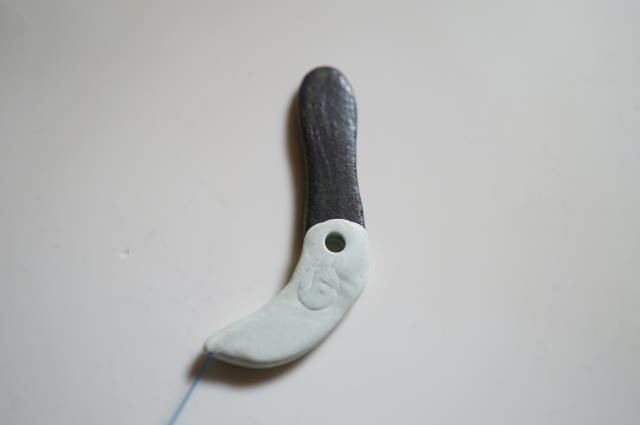
In an entry published in March 2019, Mr. Okada proposed comma-shaped chips that could also become earrings or necklace pendants. The idea covered resin, glass, and ceramic prototypes, with different planned prices. Short versions were priced at ¥4,000 (about $26 at ¥156 = $1, rate as of 2026-09-04) in resin and ¥5,000 (about $32 at ¥156 = $1, rate as of 2026-09-04) in either glass or ceramic, all tax excluded.
Glass and ceramic semi-long versions were each planned at ¥6,000, (about $38 at ¥156 = $1, rate as of 2026-09-04) tax excluded. For other versions, the proposal added ¥2,000, (about $13 at ¥156 = $1, rate as of 2026-09-04) tax excluded, to the existing chip price. Mr. Okada suggested offering these designs as jewelry with a chain.
(Source: ok-lab's diary, published March 2019)
https://ok-lab.hatenablog.com/entry/2019/03/30/160657
An assembled chip cage carried a separate processing charge in December 2021
In an entry published in December 2021, a customer requested a small blue auxiliary chip enclosed within a cage. The requested position put the back of the cage 14 cm from the back of the main chip. The order named a resin main chip, screw-shaped auxiliary chips, and nylon thread with loops at both ends.
Mr. Okada recorded ¥3,300 (about $21 at ¥156 = $1, rate as of 2026-09-04) already paid as an adjustment for the cage assembly work. The diary does not record how this customer's cage felt in use.
(Source: ok-lab's diary, published December 2021)
https://ok-lab.hatenablog.com/entry/2021/12/04/124140
One fixed chip connector test ended after Mr. Okada felt unwell
In an entry published in July 2025, Mr. Okada described testing a petal-shaped loop with a 10 cm connecting extension. He paired it with the shape-memory gatekeeper and connector for about 3 days of continuous wear. He wrote that the fixation was so complete that his prostate seemed tired and he felt as though he had heart failure.
Mr. Okada reported stopping the test after feeling unwell. The diary does not record a medical assessment of those symptoms. Mr. Okada cautioned that the continuous pressure might be too demanding for someone in his state of health.
(Source: ok-lab's diary, published July 2025)
https://ok-lab.hatenablog.com/entry/2025/07/05/122905
A shape-memory chip connector also appeared in a tail-support prototype
In an entry published in July 2025, Mr. Okada described a larger loop-based device designed for rectal or vaginal use. His tail test used the shape-memory connector between a commercially sold tail and the prototype's external end loop. He also suggested a tied cord or commercial earring as possible alternatives for that connection.
He said a simpler single-loop version might suit tail-only use, but he had not tested it. Mr. Okada cautioned that the tail's weight might pull that untested version out.
(Source: ok-lab's diary, published July 2025)
https://ok-lab.hatenablog.com/entry/2025/07/19/122907
One custom chip connector was quoted at ¥4,400 (about $28 at ¥156 = $1, rate as of 2026-09-04) in February 2026
In an entry published in February 2026, a customer requested a custom ceramic chip with an external stopper and related accessories. That request included a shape-memory connector priced at ¥4,400 (about $28 at ¥156 = $1, rate as of 2026-09-04). The diary does not record whether this connector had the same specification as the earlier prototype. It also does not record how the connector performed for that customer.
(Source: ok-lab's diary, published February 2026)
https://ok-lab.hatenablog.com/entry/2026/02/14/121602
The maker's answer to prostate chip charms and connectors
Mr. Okada addressed particular connection problems through attached keys, compatibility limits, and a purpose-made wire connector.
A tethered prostate chip charm addressed the risk of losing its key
In an entry published in July 2022, an illustrator suggested keeping the gatekeeper's locking key attached to prevent loss. Mr. Okada made a charm connected to the gatekeeper's cord and sent the prototype to the illustrator.
He wrote that an unlocked gatekeeper allowed position changes and could shift with changes during an erection. He also reported that it could unexpectedly project far outward. Mr. Okada therefore suggested that keeping it locked during ordinary use might be better.
(Source: ok-lab's diary, published July 2022)
https://ok-lab.hatenablog.com/entry/2022/07/23/123014
Store-bought earring connectors came with an explicit warning about possible breakage
In an entry published in July 2025, Mr. Okada wanted a detachable connection so a gatekeeper could serve different assemblies. He tried commercially sold earrings with a blue chip carrying a connecting extension. He thought the ring-shaped items were intended for earlobes and acknowledged having no knowledge of earrings.
The assortment he tried cost around ¥1,000 (about $6 at ¥156 = $1, rate as of 2026-09-04) for 10 pieces. He said those earrings might break. Mr. Okada therefore said he could not advise readers about commercial earrings.
(Source: ok-lab's diary, published July 2025)
https://ok-lab.hatenablog.com/entry/2025/07/05/122905
An in-house shape-memory connector was offered for concerns about commercial earrings
Mr. Okada introduced his own wire connector in an entry published in July 2025. He demonstrated it with a slim ceramic chip fitted with a connecting extension.
The specified length was about 4 cm, with a price of ¥2,000, (about $13 at ¥156 = $1, rate as of 2026-09-04) tax excluded. The prototype examples covered connections to those extensions. Mr. Okada offered this design to people concerned about commercially sold earrings.
(Source: ok-lab's diary, published July 2025)
https://ok-lab.hatenablog.com/entry/2025/07/05/122905
How prostate chip charms and connectors changed over time
| Published | What the diary said then |
|---|---|
| Mar 2019 | Mr. Okada could not make the jewelry-style hole in glass; ceramic was easier. |
| Aug 2021 | Mr. Okada said the cage partly resisted expulsion during urination. |
| Dec 2021 | Substituting the conventional cage reduced one customer's quoted charge by ¥1,100 (about $7 at ¥156 = $1, rate as of 2026-09-04). |
| Jul 2022 | The recipient reported that the tethered key also fitted an older gatekeeper. |
| Jul 2025 | Extension connections covered blue, stainless-steel, ceramic, and loop-based devices. |
OK Prostate Chip products related to prostate chip charms and connectors
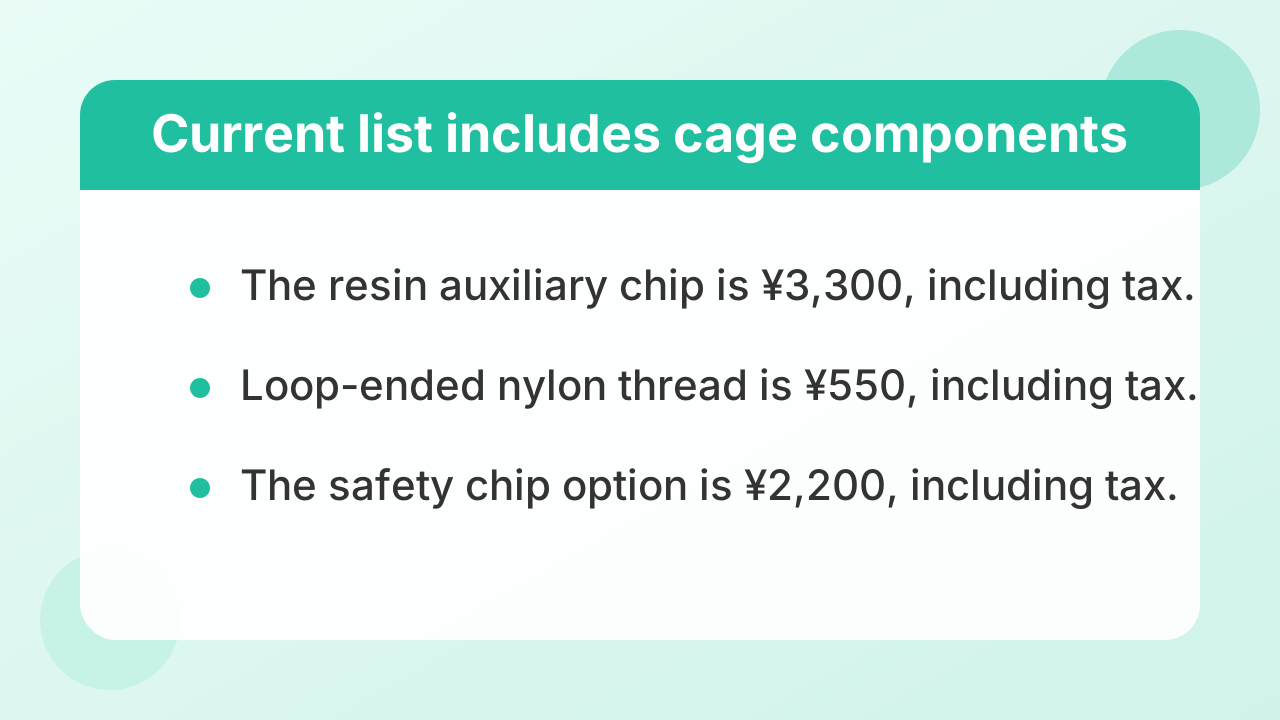
The current list includes components from the cage cases, without confirming the complete historical custom assemblies.
Products that appear in these entries
| Product (official name) | Price incl. tax | Relation to this topic |
|---|---|---|
| Resin screw-shaped auxiliary chip (スクリュー型補助チップ追加オプション(生体適合樹脂)) | ¥3,300 (about $21 at ¥156 = $1, rate as of 2026-09-04) | In December 2021, the customer requesting a small blue chip inside a cage ordered this auxiliary-chip option. |
| Loop-ended nylon thread (両端ループナイロン糸) | ¥550 (about $4 at ¥156 = $1, rate as of 2026-09-04) | In December 2021, this thread appeared in the order that included payment for the blue-chip cage assembly. |
| Two-thread resin safety chip with connection option (二本糸用セーフティチップ(生体適合樹脂)接続オプション込み) | ¥2,200 (about $14 at ¥156 = $1, rate as of 2026-09-04) | In December 2021, a customer proposed these parts for a cage, but Mr. Okada rejected that substitution. |
(Source: ok-lab's diary, published December 2021)
https://ok-lab.hatenablog.com/entry/2021/12/04/124140
Products the diary mentioned as alternatives
The diary names no alternative.
The historical designs include comma-shaped prototypes, assembled cages, tethered locking charms, and the shape-memory connector. The slim ceramic test assembly, petal-loop assembly, and large tail-support prototype were also custom or experimental configurations. No matching product can be confirmed on the current list.
Common worries about prostate chip charms and connectors
The customer exchanges concern which chip fits, whether safety parts can substitute, and how a custom order was arranged.
"Can a chip cage hold any model?"
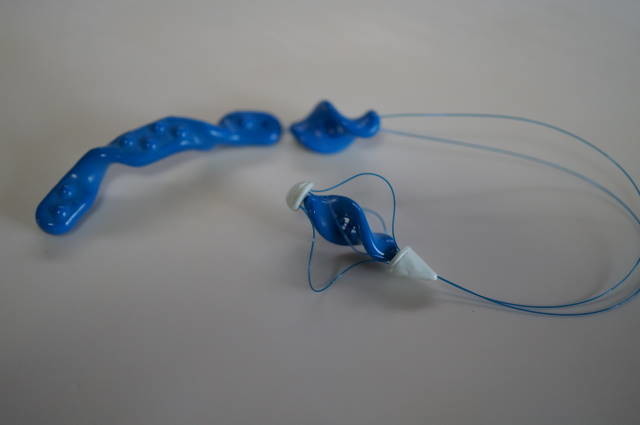
In an entry published in August 2021, a customer asked whether a chip could go inside a cage. Mr. Okada made a prototype and said only the blue screw-shaped auxiliary chip fitted inside. The published prices were ¥3,000 (about $19 at ¥156 = $1, rate as of 2026-09-04) for the blue chip, ¥2,000 (about $13 at ¥156 = $1, rate as of 2026-09-04) for the cage, and ¥1,000 (about $6 at ¥156 = $1, rate as of 2026-09-04) for assembly, all tax excluded.
He described both manual and stainless-steel-wire retrieval as features of that design. He also said the labor limited production to fewer than one assembly a day. For the main chip at the other end, Mr. Okada allowed any type but required 2 threads.
(Source: ok-lab's diary, published August 2021)
https://ok-lab.hatenablog.com/entry/2021/08/28/125823
"Can two-thread safety parts replace a chip cage?"
In an entry published in December 2021, a customer proposed a cage with a safety chip on either side of a screw-shaped auxiliary chip. The proposed safety parts were designed for 2 threads, but Mr. Okada said a bird-containing cage needed 4 threads.
He said the two-thread parts were difficult to substitute in that construction. Mr. Okada proposed the conventional cage instead, and the customer accepted that change.
(Source: ok-lab's diary, published December 2021)
https://ok-lab.hatenablog.com/entry/2021/12/04/124140
"How did someone order a custom chip connector?"
In an entry published in August 2025, a customer could not work out how to order a custom assembly through OK Lab's own online store. They requested a ceramic chip, an adjustable connecting extension, a gatekeeper, and a shape-memory connector. OK Lab's staff gave a provisional quote that listed the connector at ¥2,200 (about $14 at ¥156 = $1, rate as of 2026-09-04).
After further questions about length, staff proposed a 10 cm section plus a 20 cm adjustable section. The customer accepted that arrangement and an L-size gatekeeper, and the entry shows the finished build. Staff favored the longer adjustable section to give more adjustment range.
(Source: ok-lab's diary, published August 2025)
https://ok-lab.hatenablog.com/entry/2025/08/02/123058
Buying from outside Japan
OK Lab ships internationally to countries covered by Japan Post's EMS courier service. Overseas orders are paid in advance by PayPal. Each order carries a ¥400 (about $3 at ¥156 = $1, rate as of 2026-09-04) handling fee, and EMS shipping is charged on top.
These terms come from OK Lab's official sales-terms page (written here as plain text, not a link: ok-lab.net/docs/law), checked on September 7, 2026; confirm them on the official store before you order, because they can change.
Summary of this article
| What you wanted to know | The answer |
|---|---|
| Are these parts only decorative? | Some were jewelry concepts; others connected assemblies or kept a locking key attached. |
| What is the base product? | The OK Prostate Chip is a urethral device made and sold by OK Lab in Japan. |
| What do the part names mean? | A cage encloses an auxiliary chip; a connector links parts; the gatekeeper controls position. |
| What happened in the recorded cases? | The diary covers jewelry prototypes, assembly charges, a stopped personal test, and later custom quotes. |
| What changes did the maker propose? | He attached the locking key and offered a wire connector for concerns about commercial earrings. |
| What changed over time? | The entries added material limits, cage specifications, an attached key, and extension-based connections. |
| Which related components appear on the current list? | The resin auxiliary chip, loop-ended nylon thread, and two-thread safety chip with connection option. |
| What did customers ask? | Which chip fitted the cage, whether safety parts could replace it, and how to arrange a custom build. |
| How can someone outside Japan buy? | The stated terms use advance PayPal payment, Japan Post's EMS courier service, and a ¥400 (about $3 at ¥156 = $1, rate as of 2026-09-04) handling fee. |
Source: ok-lab's diary (Okada Comfortable Life Laboratory). The original entries are in Japanese; quotations on this page are translated. Photos and videos are on the original entries.
This article is a summary of the maker's development diary. The product is not a medical device and no result is guaranteed. If anything feels wrong or worries you, see a doctor. Prices, specifications and cautions change, so confirm the latest information on the official blog and the official site. Questions about ordering and shipping go to the seller.