![Can the resin coating be removed? | The maker reports difficult repairs and breakage [OK Prostate Chip]](/img/a/T0277/eyecatch.svg)
This page is based on entries from "ok-lab's diary" (https://ok-lab.hatenablog.com/), the Japanese development diary written by Mr. Okada, founder of OK Lab, a small company in Japan (Okada Comfortable Life Laboratory). Only the entries about "resin coating and epoxy removal" are summarized here, in order of publication. Past prices and sizes are as written at the time. Current prices come from the official product list (retrieved September 4, 2026). Quotations are translated from Japanese.
Note: This page is a personal reading log by someone with no connection to the maker or the seller. It reflects the source entries as of their publication dates and makes no guarantee of accuracy or safety. The product is not a medical device; talk to a doctor about any health decision. Check the official site for current information. This page contains advertising.
In short
Resin coatings can be difficult to separate, and the diary reports ceramic breakage beneath them.
Mr. Okada describes workshop repairs and advises stopping use when the coating cracks.
The reported short ceramic twist chip remains on the September 2026 product list at ¥4,400 (about $28 at ¥156 = $1, rate as of 2026-09-04) including tax.
About this product

The OK Prostate Chip is a small device that is placed in the urethra (the urine passage) so that it acts on the prostate; the maker sells it in several shapes, sizes and materials. It is made and sold by OK Lab (Okada Comfortable Life Laboratory), a small company in Japan, through its own online store, and prices are in Japanese yen (JPY). The maker's development diary, "ok-lab's diary", is written in Japanese. This page is an English summary of it, and every quotation is translated. OK Lab ships internationally, so readers outside Japan can order (see "Buying from outside Japan" below). Product names on this page are plain-English descriptions. The official Japanese product name is shown once in the product table so you can find the same item in the store.
Before you read: key terms
| Term | Plain-English meaning |
|---|---|
| Resin coating | Material covering part of a chip; the entries describe it protecting connections and joining components. |
| Epoxy | A hard resin used to bond parts or cover a connection; Mr. Okada describes difficult removal and possible cracking. |
| Resin collar | A ring of resin around a narrow chip section, connecting it to the resin-covered rear. |
| Twin build | A bonded pair of chips, made to provide greater thickness. |
| Retrieval thread | A cord attached to a chip so it can be withdrawn. |
| Silicone | A flexible resin used beneath epoxy as a cushion at a wire connection. |
| Spring wire | Flexible wire used to connect a chip in the assembly discussed in June 2024. |
| Baseplate | An external support part with an opening around the penis tip, discussed in April 2023. |
What happens: resin coating removal
The OK Prostate Chip is a small device placed in the urethra, where the maker intends it to act on the prostate. Resin coating (material covering parts of the device) protects motor or thread connections and can join components in the diary's examples. Its position and shape vary: some entries concern glass surfaces, others ceramic parts or connections between chips and wire. Mr. Okada's repair accounts describe coating removal becoming difficult, sometimes with a risk of breaking the ceramic underneath.
Partial resin coating exposed more glass on the redesigned vibrating chip
In an entry published in March 2019, Mr. Okada introduced Version 2 of his glass vibrating chip with revised resin coverage. He explained that the earlier design completely covered the final raised glass section to secure the connection. The new covering resembled a sleeveless top, leaving the bulging glass surfaces exposed.
Resin still covered the motor and formed part of the connection. The entry applied this change to short, semi-long, long, and single-raised-section designs. Mr. Okada presented the exposed glass as an improvement to sliding compared with the earlier fully covered surface.
(Source: ok-lab's diary, published March 2019)
https://ok-lab.hatenablog.com/entry/2019/03/23/173222
Twin-chip epoxy removal was described as destructive work on the coating
In an entry published in February 2021, Mr. Okada reported ceramic twin prototypes responding to a request for extra thickness. A twin build (a bonded pair of chips) reached about 13 mm, although he could not test it in his own urethra. Epoxy (a hard resin for joining and covering parts) bonded the ceramic pieces together.
Based on his repair experience, Mr. Okada described that bond as effectively permanent and coating removal as destructive work on the resin. He expected little chance of the bond separating unless the resin itself cracked. His proposed safeguard was a separate retrieval thread (a cord for withdrawing the device) for each chip.
(Source: ok-lab's diary, published February 2021)
https://ok-lab.hatenablog.com/entry/2021/02/20/130830
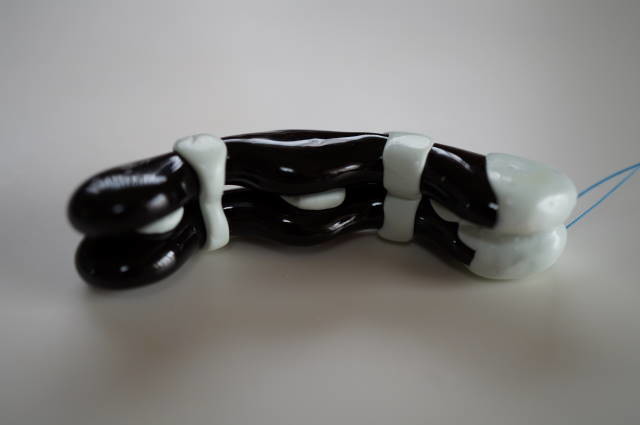
An altered baseplate broke, raising concerns about epoxy strength
In an entry published in April 2023, a customer reported that an altered flat baseplate (an external support part) had broken. The customer requested the newly discussed baseplate design and another wired vibrating device. Mr. Okada replied that his own altered prototype had not broken.
He suspected an imbalance involving the smaller opening, without confirming the cause. The diary does not record whether this customer's replacement arrived. Mr. Okada encouraged owners to request the replacement version, without returning their earlier plate.
(Source: ok-lab's diary, published April 2023)
https://ok-lab.hatenablog.com/entry/2023/04/29/123107
A ceramic chip broke inside its resin coating before use
A September 2025 entry describes a short ceramic twist chip producing bubbles during boiling, then breaking under light handling before use. The break was inside the white thread-protection coating, after about 4 months and roughly 10 uses. The customer suspected water entering tiny cracks; Mr. Okada instead suggested trapped air expanding within already cracked ceramic.
The customer had discarded the chip without photographs, so the entry contains no image of the break. Mr. Okada considered bubbles during boiling a useful warning of possible ceramic breakage concealed beneath resin.
(Source: ok-lab's diary, published September 2025)
https://ok-lab.hatenablog.com/entry/2025/09/20/122912
The maker's answer to resin coating removal
Mr. Okada's accounts describe different workshop approaches, increasing repair difficulty with age, and a warning against excessive force.
Resin coating removal depended on how the connection was made
In an entry published in February 2020, Mr. Okada contrasted resin anchored inside a hole with a hole-free connection. A resin collar (a ring around a narrow chip section) linked that section to the resin-covered rear. He described resin embedded in holes as especially difficult to detach.
For the collar design, he described pressurized-steam treatment as part of destructive workshop removal of the coating. This was his account of motor repairs; he thought ordinary use would not soften the resin enough for separation. Mr. Okada favored a hole-anchored resin connection as the most secure design.
(Source: ok-lab's diary, published February 2020)
https://ok-lab.hatenablog.com/entry/2020/02/01/151232
Epoxy removal became harder as the material aged
In an entry published in June 2024, Mr. Okada said epoxy normally hardens in 1-2 days. However, he said full strength takes at least several months, based on his experience replacing threads. He reported comparatively easier coating removal during the first few months, but destructive resin removal after half a year or more.
His advice concerned products finished with epoxy, including owners hoping to keep them for a long time. Mr. Okada advised treating roughly 3 months as a settling-in period and avoiding excessive force.
(Source: ok-lab's diary, published June 2024)
https://ok-lab.hatenablog.com/entry/2024/06/15/123132
Chemical epoxy removal was chosen for an already thinned ceramic chip
In an entry published in August 2024, a customer requested replacement threads with an overall width below 9 mm. Staff initially replied that the structure probably prevented that width, although they would aim for a thin coating. Mr. Okada recognized that the medium four-point ceramic twist chip had already been narrowed by the customer.
He chose chemical epoxy removal because his usual repair approach risked breaking the thinned ceramic. The exposed rear measured 8.4 mm; he reported a coated width around 8.9 mm, versus the usual 10 mm or more. Mr. Okada offered resin coverage matched to such previously narrowed ceramic chips.
(Source: ok-lab's diary, published August 2024)
https://ok-lab.hatenablog.com/entry/2024/08/31/122909
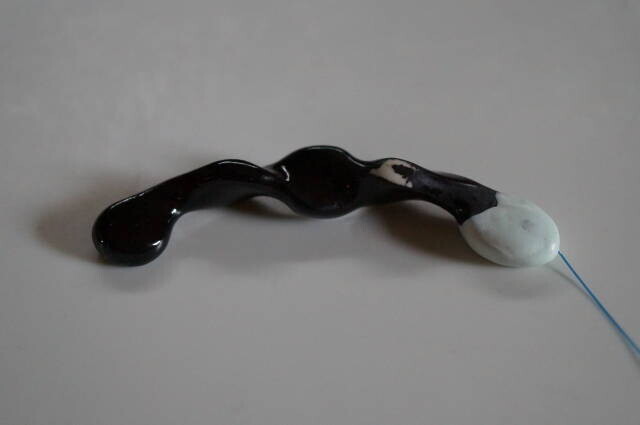
Resin coating removal sometimes ended with ceramic breaking during thread repairs
In an entry published in September 2025, Mr. Okada described a recurring difficulty with ceramic-chip thread replacement. He said coatings older than a year could become extremely hard, making removal laborious. He had experienced ceramic breaking when the resin was almost completely removed.
These failures occurred during his repair work, separate from the customer's breakage report in that entry. He had previously thought attached resin prevented the covered ceramic from breaking. The customer report led him to acknowledge that an outside impact could break ceramic even with its resin covering attached.
(Source: ok-lab's diary, published September 2025)
https://ok-lab.hatenablog.com/entry/2025/09/20/122912
How resin coating removal changed over time
| Published | What the diary said then |
|---|---|
| Mar 2019 | Partial coverage exposed raised glass surfaces; Mr. Okada reported improved sliding. |
| Feb 2020 | Hole-free ceramic motor prototypes appeared, with custom processing charges. |
| Feb 2021 | Twin ceramic prototypes relied on epoxy bonds Mr. Okada considered highly resistant to separation. |
| Apr 2023 | A customer reported a broken altered plate; Mr. Okada acknowledged brittleness. |
| Jun 2024 | Mr. Okada linked repair difficulty to age and warned about cracked epoxy. |
| Aug 2024 | A thinned ceramic chip received chemical epoxy removal and a smaller replacement coating. |
| Sep 2025 | A customer reported ceramic breakage beneath its resin cover. |
The diary does not say what the current state is.
OK Prostate Chip products related to resin coating removal
The short ceramic twist chip in the breakage report appears on the current product list.
Products that appear in these entries
| Product (official name) | Price incl. tax | Relation to this topic |
|---|---|---|
| Short ceramic twist chip (OKプロステートチップ 陶器素材ショートタイプ ツイスト) | ¥4,400 (about $28 at ¥156 = $1, rate as of 2026-09-04) | In September 2025, a customer reported this model breaking inside the resin protecting its thread connection. |
The short ceramic twist chip is sold through OK Lab's own online store.
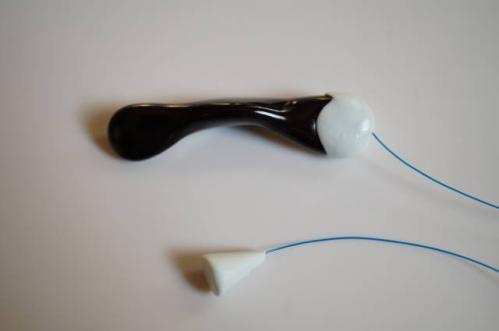
(Source: ok-lab's diary, published September 2025)
https://ok-lab.hatenablog.com/entry/2025/09/20/122912
Products the diary mentioned as alternatives
The diary names no alternative.
The Version 2 glass design, motor conversions, twin builds, modified baseplates, spring-wire assembly, and narrowed repair are historical configurations. No matching product can be confirmed on the current list.
Common worries about resin coating removal
Readers asked about motor conversions, baseplate strength, and the durability of resin-covered wire connections.
"Can resin coating attach a motor to a ceramic twist chip?"
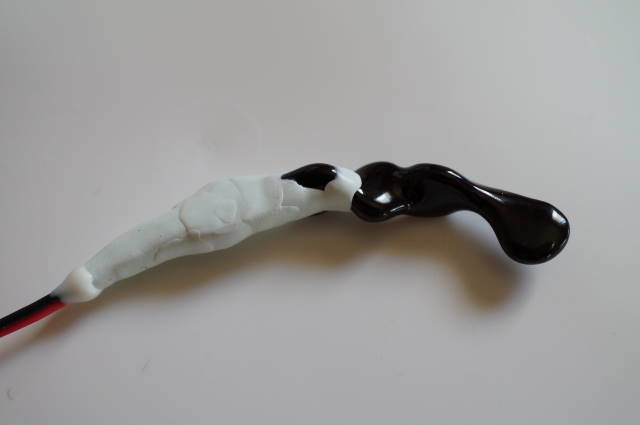
In an entry published in February 2020, a customer wanted a small four-point ceramic twist chip converted into a vibrating model. Mr. Okada initially considered a drilled connection, then chose a hole-free design after earlier difficulties obtaining holes in thinner ceramic. He showed ceramic twist motor prototypes as possible responses.
Custom conversion cost the base chip's price plus ¥2,000 (about $13 at ¥156 = $1, rate as of 2026-09-04) tax excluded, as published in February 2020. He also described the price as a non-twisted vibrating chip plus ¥1,000 (about $6 at ¥156 = $1, rate as of 2026-09-04) tax excluded for twist processing. Mr. Okada requested custom inquiries by email; the diary does not record whether this customer's order was completed.
(Source: ok-lab's diary, published February 2020)
https://ok-lab.hatenablog.com/entry/2020/02/01/151232
"Does a wider opening make an epoxy baseplate weaker?"
In an entry published in April 2023, a customer asked whether a larger opening left the flat baseplate weaker. Mr. Okada replied that epoxy was brittle and could break under a strong or unexpected load. He considered narrow sections between the earlier version's smaller holes potential weak points.
The wider-opening version also had a larger central area, which he thought avoided particularly narrow sections. He expected fewer breakage opportunities in that layout, but still acknowledged that a plate could break. Staff proposed trying both versions; the diary does not record the customer's later experience with the wider plate.
(Source: ok-lab's diary, published April 2023)
https://ok-lab.hatenablog.com/entry/2023/04/29/123107
"Can cracked epoxy affect a spring-wire chip connection?"
In an entry published in June 2024, a customer worried about the narrow part of a resin chip. Mr. Okada described spring wire (flexible connecting wire) attached at one point, with silicone (a flexible resin cushion) beneath an epoxy cover. He thought silicone reduced movement at the joint, while epoxy protected that softer layer.
He acknowledged that force beyond the covering's strength could crack it, despite the cushion. He thought silicone might hold the connection temporarily after a crack, presenting this as his judgment from experience. For the ceramic version, Mr. Okada advised stopping use if cracks or similar damage appeared in the epoxy.
(Source: ok-lab's diary, published June 2024)
https://ok-lab.hatenablog.com/entry/2024/06/15/123132
Buying from outside Japan

OK Lab ships internationally to countries covered by Japan Post's EMS courier service. Overseas orders are paid in advance by PayPal. Each order carries a ¥400 (about $3 at ¥156 = $1, rate as of 2026-09-04) handling fee, and EMS shipping is charged on top. These terms come from OK Lab's official sales-terms page (written here as plain text, not a link: ok-lab.net/docs/law), checked on September 7, 2026; confirm them on the official store before you order, because they can change.
Summary of this article
| What you wanted to know | The answer |
|---|---|
| What is the main concern? | The diary describes difficult coating removal and ceramic damage beneath resin. |
| What is this product? | OK Lab in Japan makes a device placed in the urethra, with prices in JPY. |
| What do the material names mean? | Epoxy forms hard bonds or coverings; silicone cushions a wire connection. |
| Why did coating designs change? | Mr. Okada sought exposed glass surfaces and ways to attach motors or join ceramic chips. |
| What did the maker do about removal? | His workshop approaches varied with the connection, coating age, and condition of the ceramic. |
| What changed over time? | Later entries added age-related repair difficulties and a report of concealed ceramic breakage. |
| Which current product appears here? | The short ceramic twist chip costs ¥4,400 (about $28 at ¥156 = $1, rate as of 2026-09-04) including tax on the supplied list. |
| What concerns did readers raise? | They asked about motor conversions, plate strength, and narrow sections near wire connections. |
| How can overseas readers order? | International orders use advance PayPal payment, with a ¥400 (about $3 at ¥156 = $1, rate as of 2026-09-04) handling fee plus EMS shipping. |
Source: ok-lab's diary (Okada Comfortable Life Laboratory). The original entries are in Japanese; quotations on this page are translated. Photos and videos are on the original entries.
This article is a summary of the maker's development diary. The product is not a medical device and no result is guaranteed. If anything feels wrong or worries you, see a doctor. Prices, specifications and cautions change, so confirm the latest information on the official blog and the official site. Questions about ordering and shipping go to the seller.