![Can the chip break or lose its coating? | Reinforcement has limits [OK Prostate Chip]](/img/a/T0276/eyecatch.svg)
This page is based on entries from "ok-lab's diary" (https://ok-lab.hatenablog.com/), the Japanese development diary written by Mr. Okada, founder of OK Lab, a small company in Japan (Okada Comfortable Life Laboratory). Only the entries about "wire cores and resin reinforcement" are summarized here, in order of publication. Past prices and sizes are as written at the time. Current prices come from the official product list (retrieved September 4, 2026). Quotations are translated from Japanese.
Note: This page is a personal reading log by someone with no connection to the maker or the seller. It reflects the source entries as of their publication dates and makes no guarantee of accuracy or safety. The product is not a medical device; talk to a doctor about any health decision. Check the official site for current information. This page contains advertising.
In short
Resin peeling, cracks, deformation, and exposed metal appear in the diary despite reinforcement changes.
Mr. Okada introduced thicker coatings, embedded metal, and stronger connections, while acknowledging their limits.
The current list includes the angled anal chip and sliding lock holder discussed in these entries.
If you see blood in your urine, even a small amount or for the first time, do not wait and see. See a urologist right away. If you suddenly cannot urinate, or the device cannot be removed, do not try to fix it yourself. Go to a medical facility, including emergency care, immediately.
About this product

The OK Prostate Chip is a small device that is placed in the urethra (the urine passage) so that it acts on the prostate; the maker sells it in several shapes, sizes and materials. It is made and sold by OK Lab (Okada Comfortable Life Laboratory), a small company in Japan, through its own online store, and prices are in Japanese yen (JPY). The maker's development diary, "ok-lab's diary", is written in Japanese. This page is an English summary of it, and every quotation is translated. OK Lab ships internationally, so readers outside Japan can order (see "Buying from outside Japan" below). Product names on this page are plain-English descriptions. The official Japanese product name is shown once in the product table so you can find the same item in the store.
Before you read: key terms
| Term | Plain-English meaning |
|---|---|
| Epoxy resin | A hardening material used for coatings, attachments, and some chip bodies. |
| Retrieval thread | A line attached to the chip to allow removal. |
| Wire core | Metal embedded inside a part to support its shape or resist breakage. |
| Silicone tube | A soft tubular attachment connected to a chip to form supporting loops. |
| Sliding lock holder | An external holder around the head of the penis, designed to secure a tube. |
What happens: chip reinforcement
The OK Prostate Chip is a device placed in the urethra (urine passage) near the prostate. Epoxy resin (a hardening coating material) secures its retrieval thread (the line provided for removal), while some designs have resin bodies. Wire reinforcement supports parts from inside, including anal chips and an external holder around the head of the penis. These entries describe stronger attachments alongside peeling, deformation, cracks, and problems caused by reinforcement itself.
Resin peeling prompted thicker coatings after two linked-chip failures
In an entry published in February 2018, Mr. Okada reported 2 cases of resin peeling on linked chips. He attributed the damage to forces acting against the thread attachment during placement. Coatings had gradually become thicker around that month's shipments.
For affected January shipments, he offered replacement after receiving a photograph. He said another replacement would not follow if the reinforced version peeled again. Mr. Okada cautions that thicker resin can still break under excessive force.
(Source: ok-lab's diary, published February 2018)
https://ok-lab.hatenablog.com/entry/20180214/1518601774
Added resin reinforcement may have contributed to painful catching
In an entry published in June 2018, a customer reported a catching area on a long chip, with pain and occasional bleeding. Mr. Okada suspected that substantially increased resin, added against thread detachment and peeling, might contribute. He said returning to thinner coatings would undermine those earlier measures.
He had no settled solution, and the diary does not record whether this customer's discomfort was resolved. Mr. Okada cautions that replacing the whole thread attachment could still leave a similar catching area.
(Source: ok-lab's diary, published June 2018)
https://ok-lab.hatenablog.com/entry/20180630/1530342059
Wire reinforcement did not prevent deformation of the large spiral prototype
In an entry published in October 2018, a customer reported that an anal spiral prototype changed from 90mm to 80mm in diameter. Mr. Okada initially attributed stretching mainly to incomplete hardening. The customer's follow-up described a crack 2.5cm from the tip after an attempt to restore its shape.
The customer asked whether it should still be used. Mr. Okada concluded that large spirals were impractical and apologized for the disappointing result. He proposed limiting spiral sales to diameters of 4cm or less, with more than one month of drying.
(Source: ok-lab's diary, published October 2018)
https://ok-lab.hatenablog.com/entry/20181027/1540618195
Thicker wire reinforcement was introduced for the angled anal chip
In an entry published in December 2018, the angled anal chip's wire core (embedded metal support) changed from 1.6mm to 2mm. Mr. Okada described this as a 56% increase by volume. He presented the change as a response to possible deformation under force. Mr. Okada cautions that larger wire alone cannot prevent deformation while the resin is still hardening.
(Source: ok-lab's diary, published December 2018)
https://ok-lab.hatenablog.com/entry/20181201/1543652709
Raised resin coating prompted a refund instead of replacement
In an entry published in February 2020, a customer requested an exchange because the white resin felt like it caught. Mr. Okada initially offered replacement if inspection found a manufacturing fault, or a refund if it met the standard. After receiving the item, he judged it typical of the company's finish.
He explained that using more resin for strength had also increased visible unevenness. His view that the coating would not harm body linings was expressly based on his own experience. Mr. Okada offered a return and refund because remaking it would produce a similar finish.
(Source: ok-lab's diary, published February 2020)
https://ok-lab.hatenablog.com/entry/2020/02/15/144151
Flexible spring prototypes revealed another limit of chip reinforcement
In an entry published in March 2021, Mr. Okada reported bleeding during the previous week's testing of an expanding stainless steel spring. He wrote that stretched coils could trap the body lining and become difficult to free. Even a smaller prototype with 3.7mm outer diameter and 0.5mm wire needed considerable force to remove.
He contrasted those prototypes with the existing ring design, whose resin prevented the spring from expanding or contracting. Mr. Okada concluded that freely expanding springs were unsuitable against body linings.
(Source: ok-lab's diary, published March 2021)
https://ok-lab.hatenablog.com/entry/2021/03/06/125456
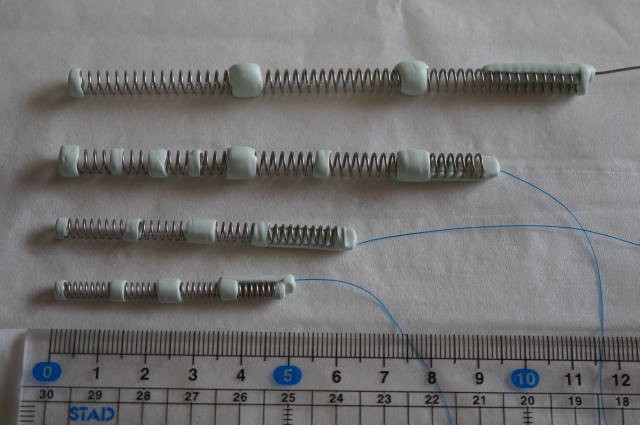
Narrower tubing required extra resin reinforcement at the connection
In an entry published in August 2022, the silicone tube (a soft tubular attachment) changed from 3mm to 2mm outer diameter. Its narrower connecting part needed extra resin reinforcement, according to Mr. Okada. The new connection required full bonding between tube and chip, making production more difficult.
The published connection-processing prices were ¥2,000 (about $13 at ¥156 = $1, rate as of 2026-09-04) for ceramic chips and ¥2,500 (about $16 at ¥156 = $1, rate as of 2026-09-04) for blue chips, tax excluded. Tube connection up to 20cm cost ¥1,000 (about $6 at ¥156 = $1, rate as of 2026-09-04), tax excluded, in that entry. Mr. Okada directed customers to this revised schedule because the connection work had changed.
(Source: ok-lab's diary, published August 2022)
https://ok-lab.hatenablog.com/entry/2022/08/13/122909
The maker's answer to chip reinforcement
Mr. Okada changed coatings and internal supports, but reported limitations and new problems with those changes.
Resin reinforcement using adhesive carried an added charge and caution
In an entry published in May 2018, Mr. Okada proposed reinforcing the thread attachment with an additional adhesive layer within the resin. The optional treatment cost ¥1,000, (about $6 at ¥156 = $1, rate as of 2026-09-04) tax excluded, as published then, and substantially extended delivery time. He invited requests for certain oversized or custom long chips. Mr. Okada cautioned that a stronger attachment could introduce new risks, including bladder injury when excessive force was applied.
(Source: ok-lab's diary, published May 2018)
https://ok-lab.hatenablog.com/entry/20180513/1526181573
Stainless wire reinforcement was built into every anal chip
In an entry published in October 2018, Mr. Okada said all anal chips contained embedded stainless steel wire. He described this as protection against complete breakage, based on his view that anal chips faced greater forces than urethral chips. He estimated that difficult builds would cost ¥10,000 (about $64 at ¥156 = $1, rate as of 2026-09-04) or more. Mr. Okada cautioned that forced bending could still crack the resin.
(Source: ok-lab's diary, published October 2018)
https://ok-lab.hatenablog.com/entry/20181005/1538740535
Resin reinforcement exposed metal that the maker offered to repair
In an entry published in August 2019, a customer asked about a small silver projection at a ceramic chip's resin connection. The customer reported substantial irritation during use. Mr. Okada identified exposed thread-fixing metal as a missed defect and offered repair.
He said aluminum reinforcement had reduced resin peeling, but the metal could rise toward the surface during drying. The diary does not record whether the repair was completed. Mr. Okada asks customers to report exposed aluminum.
(Source: ok-lab's diary, published August 2019)
https://ok-lab.hatenablog.com/entry/2019/08/31/131337
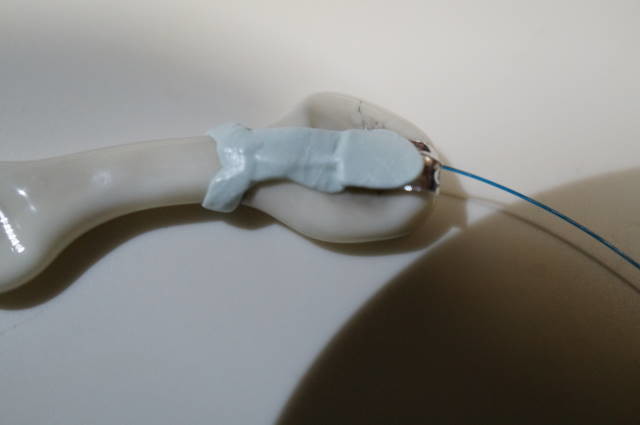
Wire reinforcement supported the holder after another drainage hole was added
In an entry published in October 2023, the sliding lock holder (an external tube holder) gained another opening for urine drainage. The number of holes increased from 2 to 3. Mr. Okada described concern about strength after that change. Wire was embedded between the center hole and the third hole to reinforce that area.
(Source: ok-lab's diary, published October 2023)
https://ok-lab.hatenablog.com/entry/2023/10/28/122832
If you see blood in your urine, even a small amount or for the first time, do not wait and see. See a urologist right away. If you suddenly cannot urinate, or the device cannot be removed, do not try to fix it yourself. Go to a medical facility, including emergency care, immediately.
How chip reinforcement changed over time
| Published | What the diary said then |
|---|---|
| May 2018 | About double the resin thickness over the thread was considered. |
| Oct 2018 | After about two months, prototypes barely bent but could crack under force. |
| Dec 2018 | Resin could remain incompletely hardened for 1–2 months after manufacture. |
| Feb 2019 | An experimental reinforcement treatment added about five production days. |
| Aug 2019 | Mr. Okada planned to extend aluminum reinforcement across all products. |
| Sep 2019 | Motor coatings needed about 0.5mm minimum, reaching roughly 1mm in thicker areas. |
| Oct 2023 | The holder's silicone tube ends gained wire fixation and a rubber coating. |
| Oct 2023 | The holder's two gate projections gained additional rear fasteners. |
| Dec 2023 | The tail attachment changed to an embedded wire anchor protruding about 3mm. |
The diary does not say what the current state is.
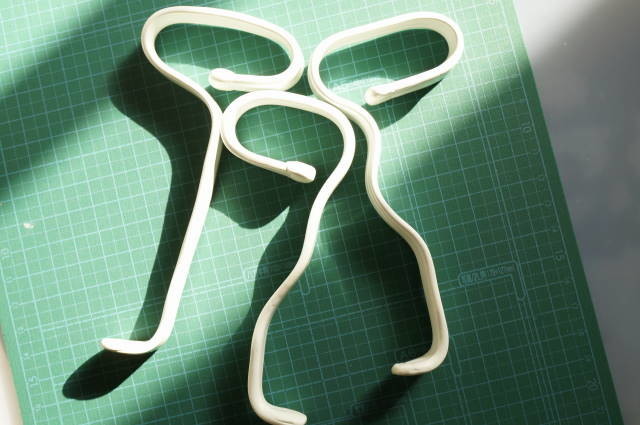
OK Prostate Chip products related to chip reinforcement
The current list includes these products; the dated entries describe their reinforcement history.
Products that appear in these entries
| Product (official name) | Price incl. tax | Relation to this topic |
|---|---|---|
| Angled resin anal chip (OKプロステートお尻チップ 樹脂素材尸の字型) | ¥7,700 (about $49 at ¥156 = $1, rate as of 2026-09-04) | The December 2018 entry announces a thicker wire core for this shape. |
| Sliding lock urethral holder (スライドロック式尿道ゲートキーパー) | ¥6,600 (about $42 at ¥156 = $1, rate as of 2026-09-04) | The October 2023 entry describes reinforcement after an additional drainage hole raised strength concerns. |
(Source: ok-lab's diary, published December 2018)
https://ok-lab.hatenablog.com/entry/20181201/1543652709
(Source: ok-lab's diary, published October 2023)
https://ok-lab.hatenablog.com/entry/2023/10/28/122832

Products the diary mentioned as alternatives
The diary names no alternative.
Oversized spiral prototype, custom resin build, and freely expanding spring prototypes: No matching product can be confirmed on the current list.
Common worries about chip reinforcement
The replies distinguish attachment failure, resin breakage, and the limits of custom construction.
"Can resin peeling be fixed by replacing the thread?"
In an entry published in February 2019, a customer requested repair or replacement for a custom resin chip with a peeling attachment. Mr. Okada explained that resin chips generally could not have their embedded thread replaced, unlike glass chips. His initial reply proposed repair, while warning that a remake could suffer the same problem.
He then reconsidered and produced a reinforced prototype using another resin within the coating. The diary does not record how that prototype performed for the customer. Mr. Okada sought feedback before deciding whether to sell the reinforcement treatment.
(Source: ok-lab's diary, published February 2019)
https://ok-lab.hatenablog.com/entry/2019/02/02/153358
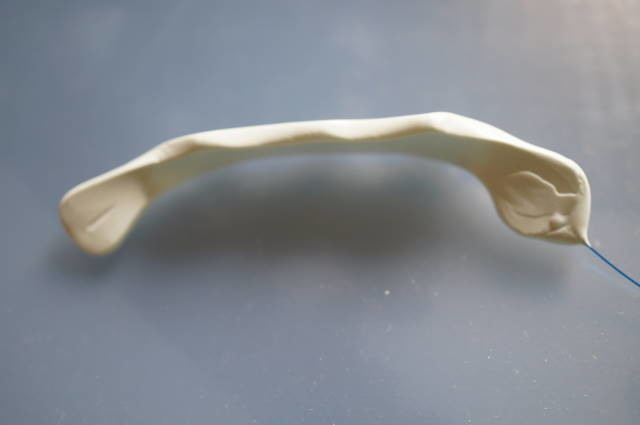
"Can wire reinforcement stop the resin itself from breaking?"
In an entry published in January 2021, a customer asked whether stainless steel could separate from its resin attachment. Mr. Okada believed the bond would rarely fail in ordinary handling, but said the epoxy itself could break under strong force. He described the ring structure and nylon thread passing through the resin as additional support. Mr. Okada cautions that the bond cannot be described as absolutely inseparable.
(Source: ok-lab's diary, published January 2021)
https://ok-lab.hatenablog.com/entry/2021/01/02/123619
"Can a custom holder omit wire reinforcement?"
In an entry published in December 2023, a customer requested a closer-fitting holder and offered to accept one without a wire core. Mr. Okada had previously declined a bespoke connection for the customer's larger tube because it would require repeated prototypes. He had instead supplied a 4mm tube holder with only one hole.
For the new request, he explained that resin could change shape during drying, making exact dimensions difficult. He considered the wire essential because bending the resin without it changed its length. Mr. Okada requested a dimensioned drawing for a custom quote; the diary does not record a completed replacement.
(Source: ok-lab's diary, published December 2023)
https://ok-lab.hatenablog.com/entry/2023/12/23/122035
Buying from outside Japan

OK Lab ships internationally to countries covered by Japan Post's EMS courier service. Overseas orders are paid in advance by PayPal. Each order carries a ¥400 (about $3 at ¥156 = $1, rate as of 2026-09-04) handling fee, and EMS shipping is charged on top. These terms come from OK Lab's official sales-terms page (written here as plain text, not a link: ok-lab.net/docs/law), checked on September 7, 2026; confirm them on the official store before you order, because they can change.
Summary of this article
| What you wanted to know | The answer |
|---|---|
| In short | Reinforcement changed repeatedly, with limitations still recorded. |
| About this product | OK Lab makes the device in Japan; prices are in JPY. |
| Key terms | Resin holds attachments; embedded wire supports parts. |
| What happens | The diary reports peeling, cracks, deformation, exposed metal, and difficult spring removal. |
| The maker's answer | Thicker coatings and internal supports addressed different weaknesses. |
| Changes over time | The entries document changes from 2018 through 2023. |
| Related products | The angled anal chip and sliding lock holder appear on the current list. |
| Common worries | Thread replacement, resin breakage, and custom shape requests have different limitations. |
| Buying from outside Japan | International orders use PayPal, with handling and EMS shipping charges. |
Source: ok-lab's diary (Okada Comfortable Life Laboratory). The original entries are in Japanese; quotations on this page are translated. Photos and videos are on the original entries.
This article is a summary of the maker's development diary. The product is not a medical device and no result is guaranteed. If anything feels wrong or worries you, see a doctor. Prices, specifications and cautions change, so confirm the latest information on the official blog and the official site. Questions about ordering and shipping go to the seller.