![Should the chip wire have a tube cover? | Thicker joints, little reported difference in feel [OK Prostate Chip]](/img/a/T0280/eyecatch.svg)
This page is based on entries from "ok-lab's diary" (https://ok-lab.hatenablog.com/), the Japanese development diary written by Mr. Okada, founder of OK Lab, a small company in Japan (Okada Comfortable Life Laboratory). Only the entries about "chip wire cover" are summarized here, in order of publication. Past prices and sizes are as written at the time. Current prices come from the official product list (retrieved September 4, 2026). Quotations are translated from Japanese.
Note: This page is a personal reading log by someone with no connection to the maker or the seller. It reflects the source entries as of their publication dates and makes no guarantee of accuracy or safety. The product is not a medical device; talk to a doctor about any health decision. Check the official site for current information. This page contains advertising.
In short
- The maker reported little difference in feel between covered and bare connecting wire.
- He favored bare wire for thinner joints, but raised allergy concerns about exposed metal.
- The current product list includes components used in covered custom pairs.
If you see blood in your urine, even a small amount or for the first time, do not wait and see. See a urologist right away. If you suddenly cannot urinate, or the device cannot be removed, do not try to fix it yourself. Go to a medical facility, including emergency care, immediately.
About this product
The OK Prostate Chip is a small device that is placed in the urethra (the urine passage) so that it acts on the prostate; the maker sells it in several shapes, sizes and materials. It is made and sold by OK Lab (Okada Comfortable Life Laboratory), a small company in Japan, through its own online store, and prices are in Japanese yen (JPY). The maker's development diary, "ok-lab's diary", is written in Japanese. This page is an English summary of it, and every quotation is translated. OK Lab ships internationally, so readers outside Japan can order (see "Buying from outside Japan" below). Product names on this page are plain-English descriptions. The official Japanese product name is shown once in the product table so you can find the same item in the store.
Before you read: key terms
| Term | Plain-English meaning |
|---|---|
| Paired chip | Two chip sections joined by wire, intended to act together at different positions in the urine passage. |
| Shape-memory wire | The connecting wire, described by the maker as spring-like; it links the two chip sections. |
| Tube cover | Tubing around the connecting wire, discussed as a covering for otherwise exposed metal. |
| Nickel-titanium alloy | The metal mixture used for the connecting wire; Mr. Okada raised possible allergy concerns about direct exposure. |
| Nylon thread | A thread attached to the device for retrieval; its attachment against tubing was discussed in November 2024. |
| Thread hole | An opening in a chip for the thread; the November 2024 discussion concerned an additional attachment arrangement. |
| Six-hole stopper | A thread-mounted accessory that Mr. Okada thought might limit the paired device's movement farther inward. |
| Parallel cable | Paired wires serving a motorized chip; these were discussed separately from the paired chip's connecting wire. |
What happens: chip wire cover
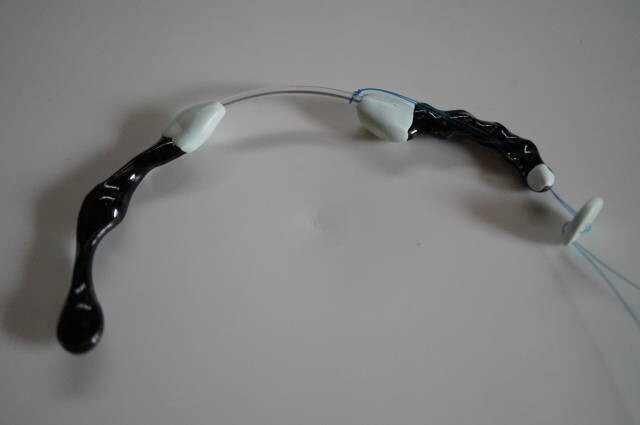
The OK Prostate Chip is a device placed in the urethra, the urine passage, to act on the prostate. In the paired design, shape-memory wire (the spring-like connecting wire) joins a prostate-side chip to another farther along the passage. A tube cover (tubing around that wire) covers the metal between the chips and extends into their connections. The diary compares that covered connection with bare wire, including differences in joint thickness, quoted price and the maker's own experience.
Choosing a tube cover made the connection thicker in May 2024
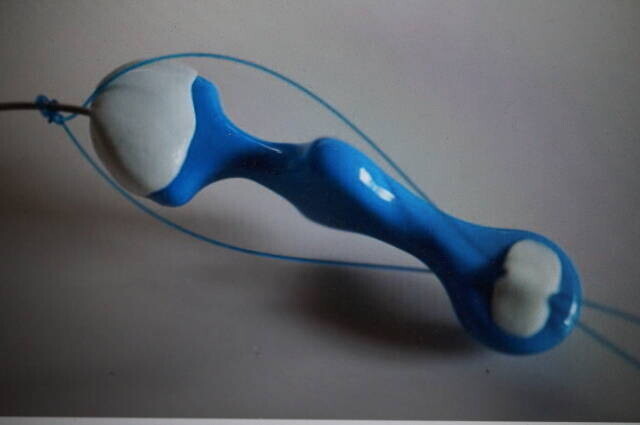
In an entry published in May 2024, Mr. Okada said the connecting wire could be supplied bare or covered with tubing. With tubing, the connection became at least 1mm thicker than the wire-only version.
The specified increase was at the joint where wire and chip met. For someone seeking a thinner connection, Mr. Okada recommended bare wire.
(Source: ok-lab's diary, published May 2024)
https://ok-lab.hatenablog.com/entry/2024/05/04/122911
Bare wire cost less under the May 2024 connection price schedule
The May 2024 entry priced the connection separately from the two chips. Bare-wire connection work cost ¥3,000 (about $19 at ¥156 = $1, rate as of 2026-09-04) tax excluded, while the tube-covered connection cost ¥4,000 (about $26 at ¥156 = $1, rate as of 2026-09-04) tax excluded. In either case, the prices of both chips were additional.
These were charges published for the custom connection, not a single price covering a finished pair. Mr. Okada invited requests for combinations he could make, while acknowledging that he had not settled how to organize every possible combination for sale.
(Source: ok-lab's diary, published May 2024)
https://ok-lab.hatenablog.com/entry/2024/05/04/122911
A tube cover felt much the same in November 2024 tests
In an entry published in November 2024, a customer considering a paired chip asked whether tubing changed its feel or price. The customer had noticed examples with uncovered wire and wondered whether the choice was largely personal preference. Mr. Okada replied that his own tests showed little difference in feel.
He reported no digging-in sensation with either version, which he attributed to the wire's thickness and the short length between chips. The diary does not record that customer's comparison of the two finishes in use. His reply nevertheless cautioned that exposed metal could pose an allergy concern.
(Source: ok-lab's diary, published November 2024)
https://ok-lab.hatenablog.com/entry/2024/11/02/122858
A tube cover accompanied the first thread-hole order in November 2024
A follow-up published in November 2024 explicitly identifies the earlier questioner as the customer now requesting a covered ceramic pair. The request combined a double-twist ceramic chip with a custom semi-long ceramic chip, a 3cm covered wire and a thread hole. A thread hole is an opening for the thread, here requested in the chip on the side farther from the prostate.
Staff accepted the requested build, and the customer confirmed the order after further discussion. Mr. Okada described it as the first order with this hole in that part of the paired design. He cautioned that the extra bulk around the opening might irritate the urine passage.
(Source: ok-lab's diary, published November 2024)
https://ok-lab.hatenablog.com/entry/2024/11/16/122924
A tube cover connection was quoted at ¥4,400 (about $28 at ¥156 = $1, rate as of 2026-09-04) in November 2025
In an entry published in November 2025, a customer wanted two resin chips connected together. Mr. Okada proposed the paired-wire design using a long second-generation resin chip and a flat curved semi-long second-generation resin chip. The quote specified a 3cm covered connection at ¥4,400 (about $28 at ¥156 = $1, rate as of 2026-09-04).
A thread-hole modification on the flat curved component was separately quoted at ¥1,100 (about $7 at ¥156 = $1, rate as of 2026-09-04). The diary does not record how this proposed combination felt in use. For that requested resin combination, Mr. Okada proposed the paired-wire arrangement.
(Source: ok-lab's diary, published November 2025)
https://ok-lab.hatenablog.com/entry/2025/11/29/122908
The maker's answer to chip wire cover
Mr. Okada described a tradeoff between a thinner connection and covering metal that might cause an allergic reaction.
A tube cover addressed Mr. Okada's concern about exposed nickel
In his November 2024 reply, Mr. Okada identified the exposed wire as nickel-titanium alloy (a mixture of nickel and titanium). He wrote that some people might have an allergic reaction to the bare metal. This was a possibility he raised, not an account of that customer developing an allergy.
His favorable comparison of the covered version concerned this possible metal exposure, rather than a stronger sensation during use. On that basis, Mr. Okada considered a tube cover potentially safer.
(Source: ok-lab's diary, published November 2024)
https://ok-lab.hatenablog.com/entry/2024/11/02/122858
A tube cover increased connection thickness and production difficulty
The November 2024 reply also explained why covering the wire carried an extra charge. The tube became part of the connection with the chip, making that area bulkier and the work more difficult. Mr. Okada quoted an additional ¥1,000 (about $6 at ¥156 = $1, rate as of 2026-09-04) tax excluded for the covered version.
This was an explanation of the extra connection work, separate from his report about how the device felt. His answer therefore tied the surcharge to construction difficulty, while acknowledging the thicker joint.
(Source: ok-lab's diary, published November 2024)
https://ok-lab.hatenablog.com/entry/2024/11/02/122858
A tube cover still allowed the requested chip thread hole
In November 2024, the customer also asked whether a hole at the chip's tip depended on choosing covered or bare wire. Mr. Okada replied that both versions could accommodate it. The requested hole was therefore a separate design feature from the choice of wire covering.
He said the thread opening would measure 1mm and warned that its entrance might rub the lining of the urine passage. That warning concerned the hole itself, even though the surrounding question was about tubing. Mr. Okada cautioned that this could matter particularly to the customer who had already described pain from rubbing cables.
(Source: ok-lab's diary, published November 2024)
https://ok-lab.hatenablog.com/entry/2024/11/02/122858
If you see blood in your urine, even a small amount or for the first time, do not wait and see. See a urologist right away. If you suddenly cannot urinate, or the device cannot be removed, do not try to fix it yourself. Go to a medical facility, including emergency care, immediately.
How chip wire cover changed over time
| Published | What the diary said then |
|---|---|
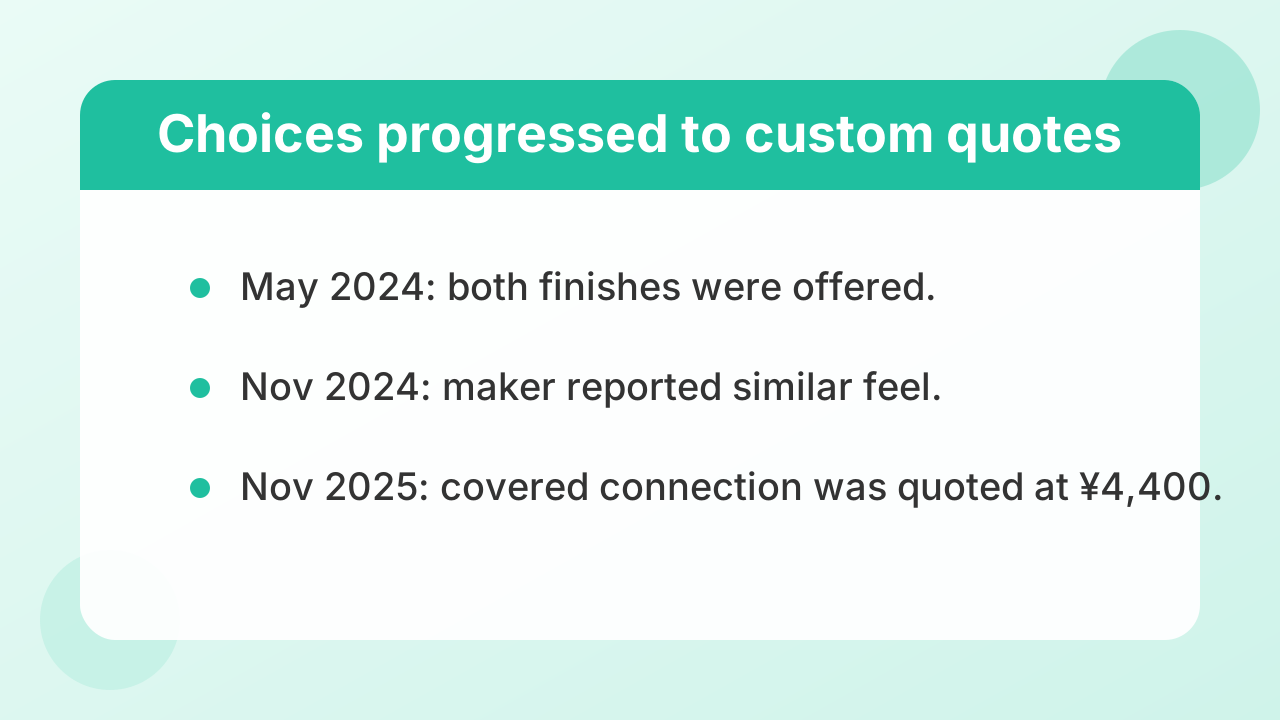
| May 2024 | Both finishes offered; tubing made connections at least 1mm thicker. |
| May 2024 | Connection charges: bare ¥3,000 (about $19 at ¥156 = $1, rate as of 2026-09-04); covered ¥4,000 (about $26 at ¥156 = $1, rate as of 2026-09-04); both tax excluded, chips additional. |
| Nov 2024 | Maker reported similar feel, while raising possible allergy concerns about bare metal. |
| Nov 2024 | Tip thread holes were possible with either wire finish. |
| Nov 2024 | First paired-design order combined a thread hole with a stopper; irritation remained a concern. |
| Nov 2025 | A resin pairing proposal quoted a 3cm covered connection at ¥4,400 (about $28 at ¥156 = $1, rate as of 2026-09-04). |
The diary does not say what the current state is.
OK Prostate Chip products related to chip wire cover
Current listings include chip components and a stopper discussed in these covered-wire cases.
Products that appear in these entries
| Product (official name) | Price incl. tax | Relation to this topic |
|---|---|---|
| Double-twist ceramic chip (OKプロステートチップ 陶器素材覚醒タイプ ダブルツイスト(ラブカチップ)) | ¥6,600 (about $42 at ¥156 = $1, rate as of 2026-09-04) | In November 2024, the customer selected this model as one component of the covered ceramic pair. |
| Six-hole stopper (六穴方式オプションチップ(括約筋ストッパーチップ)) | ¥2,200 (about $14 at ¥156 = $1, rate as of 2026-09-04) | In November 2024, staff accepted this accessory as part of the customer's covered pair with a thread hole. |
| Long second-generation resin chip (OKプロステートチップ ロング凶悪ゾロ(第二世代生体適合樹脂)) | ¥9,350 (about $60 at ¥156 = $1, rate as of 2026-09-04) | In November 2025, Mr. Okada proposed this component for the customer's tube-covered resin pair. |
| Flat curved semi-long second-generation resin chip (OKプロステートチップ フラット面カーブ型 セミロングタイプ(第二世代生体適合樹脂)) | ¥6,600 (about $42 at ¥156 = $1, rate as of 2026-09-04) | In November 2025, Mr. Okada proposed this as the other component and separately quoted its thread-hole work. |
(Source: ok-lab's diary, published November 2024)
https://ok-lab.hatenablog.com/entry/2024/11/16/122924
(Source: ok-lab's diary, published November 2025)
https://ok-lab.hatenablog.com/entry/2025/11/29/122908
Products the diary mentioned as alternatives
The diary names no alternative.
Complete custom pairs, the reshaped ceramic component and separate wire-cover work: No matching product can be confirmed on the current list.
Common worries about chip wire cover
The reader questions also concerned thread movement, a stopper and painful cables on a different device.
"Can a tube cover affect the requested thread position?"
In the November 2024 follow-up, the customer requested the nylon thread (the retrieval thread) slightly toward the custom ceramic component. Staff replied that its attachment was movable, so they did not assign a fixed initial position.
The earlier November 2024 reply addressed the effect of tubing at that attachment. Mr. Okada cautioned that firmly fastened thread would not slide freely against the tube cover.
(Source: ok-lab's diary, published November 2024)
https://ok-lab.hatenablog.com/entry/2024/11/02/122858
(Source: ok-lab's diary, published November 2024)
https://ok-lab.hatenablog.com/entry/2024/11/16/122924
"Can the tube cover accompany a detachable stopper?"
In the November 2024 follow-up, the customer asked whether the six-hole stopper (a thread-mounted accessory) would be easy to detach. Staff described it as detachable, and the customer kept it in the order. Staff also said the custom ceramic shape needed no separate change because the wire connection would alter its rear shape anyway.
Mr. Okada thought the stopper might prevent both chips from moving as far inward as the bladder. The diary does not record whether it achieved that result in this customer's use. His assessment remained qualified by the possible irritation from the additional thread-hole feature.
(Source: ok-lab's diary, published November 2024)
https://ok-lab.hatenablog.com/entry/2024/11/16/122924
"Does a tube cover address severe pain from motor cables?"
The November 2024 questioner separately reported severe rubbing pain from a motorized chip's parallel cable (paired wires serving its motors). The customer asked whether that cable could receive a covering. This concerned a different part from the short wire joining the paired chips.
Mr. Okada said a cable covering could be possible, with the approach depending on the length involved. No result for that proposed cable work is recorded. He cautioned that waterproofing and a complex arrangement of motors could increase its cost.
(Source: ok-lab's diary, published November 2024)
https://ok-lab.hatenablog.com/entry/2024/11/02/122858
Buying from outside Japan
OK Lab ships internationally to countries covered by Japan Post's EMS courier service. Overseas orders are paid in advance by PayPal. Each order carries a ¥400 (about $3 at ¥156 = $1, rate as of 2026-09-04) handling fee, and EMS shipping is charged on top. These terms come from OK Lab's official sales-terms page (written here as plain text, not a link: ok-lab.net/docs/law), checked on September 7, 2026; confirm them on the official store before you order, because they can change.
Summary of this article
| What you wanted to know | The answer |
|---|---|
| What is the main difference? | The maker reported similar feel, with thicker covered connections and a possible metal-allergy tradeoff. |
| What is the product? | A urethral device made by OK Lab in Japan. |
| What does the cover cover? | The wire connecting the paired chip sections, including their joints. |
| What happened in the entries? | Choices and prices were explained; later cases added thread holes and proposed covered combinations. |
| What did the maker advise? | Bare wire for thinner joints; a cover might reduce his concern about exposed metal. |
| What changed over time? | The entries progressed from finish choices to compatibility replies and specific custom quotes. |
| What is listed today? | Named chip components and the six-hole stopper, with current prices in Japanese yen. |
| What else concerned customers? | Thread movement, stopper compatibility and painful cables on a separate motorized device. |
| How are overseas orders handled? | Advance PayPal payment, a ¥400 (about $3 at ¥156 = $1, rate as of 2026-09-04) handling fee and additional Japan Post EMS shipping. |
Source: ok-lab's diary (Okada Comfortable Life Laboratory). The original entries are in Japanese; quotations on this page are translated. Photos and videos are on the original entries.
This article is a summary of the maker's development diary. The product is not a medical device and no result is guaranteed. If anything feels wrong or worries you, see a doctor. Prices, specifications and cautions change, so confirm the latest information on the official blog and the official site. Questions about ordering and shipping go to the seller.