![Which gatekeeper size fits? | The design and connection matter [OK Prostate Chip]](/img/a/T0270/eyecatch.svg)
This page is based on entries from "ok-lab's diary" (https://ok-lab.hatenablog.com/), the Japanese development diary written by Mr. Okada, founder of OK Lab, a small company in Japan (Okada Comfortable Life Laboratory). Only the entries about "gatekeeper names, sizes and improvements" are summarized here, in order of publication. Past prices and sizes are as written at the time. Current prices come from the official product list (retrieved September 4, 2026). Quotations are translated from Japanese.
Note: This page is a personal reading log by someone with no connection to the maker or the seller. It reflects the source entries as of their publication dates and makes no guarantee of accuracy or safety. The product is not a medical device; talk to a doctor about any health decision. Check the official site for current information. This page contains advertising.
In short
- Gatekeeper sizing changed from custom frames to measured frame sizes and, later, wire-loop circumferences.
- The maker changed tube sizes and fasteners after fit and breakage reports.
- The current list includes a slide-lock gatekeeper; its latest recorded order excluded ordinary nylon-thread compatibility.
About this product

The OK Prostate Chip is a small device that is placed in the urethra (the urine passage) so that it acts on the prostate; the maker sells it in several shapes, sizes and materials. It is made and sold by OK Lab (Okada Comfortable Life Laboratory), a small company in Japan, through its own online store, and prices are in Japanese yen (JPY).
The maker's development diary, "ok-lab's diary", is written in Japanese. This page is an English summary of it, and every quotation is translated. OK Lab ships internationally, so readers outside Japan can order (see "Buying from outside Japan" below).
Product names on this page are plain-English descriptions. The official Japanese product name is shown once in the product table so you can find the same item in the store.
Before you read: key terms
| Term | Plain-English meaning |
|---|---|
| Gatekeeper | A restraint intended to limit unwanted chip movement; the original frame sat around the penis head. |
| Inside and outside diameter | The width of a tube's opening and its outer width, distinguishing passage size from overall thickness. |
| Urethral sound | An instrument mentioned as a size reference for the original gatekeeper; the diary does not explain its design. |
| Lock key | A small fixing part intended to keep a tube in position within the gatekeeper. |
| Floating four-wire connection | A wire-based connection joining the chip to the gatekeeper, offered alongside a silicone-tube connection. |
| Thread guide | A small tube guiding nylon thread, called a pulley in the diary. |
| Ceramic underwear | The maker's ceramic garment, whose opening determined compatible gatekeeper dimensions. |
| Shape-memory gatekeeper | A wire-loop restraint around the penis head, developed to connect with chip attachments. |
| Motorized chip | A chip containing a motor, connected by a cable that the gatekeeper can accommodate in the recorded case. |
What happens: gatekeeper sizes and compatibility
The OK Prostate Chip is a small device placed in the urethra (urine passage) to act on the prostate. The original gatekeeper surrounded the penis head, with a short tube extending into the urethral opening. In April 2022, Mr. Okada described its purpose as preserving a urine passage while limiting unwanted chip movement. Later entries changed its shape, connections, and sizing, so the same general name covers different designs.
(Source: ok-lab's diary, published April 2022)
https://ok-lab.hatenablog.com/entry/2022/04/16/123037
The original gatekeeper tube size imposed a clear fit limit
An entry published in April 2022 launched the custom gatekeeper at ¥5,000 (about $32 at ¥156 = $1, rate as of 2026-09-04) tax excluded. Its tube had a 4 mm inside diameter and a 6 mm outside diameter.
The standard tube length was 20 mm, with 30 mm as the maximum. Mr. Okada warned that a shorter tube might come loose. He excluded anyone unable to accommodate a 6 mm urethral sound (his instrument-based size reference).
(Source: ok-lab's diary, published April 2022)
https://ok-lab.hatenablog.com/entry/2022/04/23/123121
A smaller gatekeeper tube answered discomfort but excluded some electrical setups
In an entry published in July 2022, a customer requested a narrower tube because the 6 mm outside diameter sometimes hurt. Staff initially declined because they could not find a thinner tube retaining the existing opening. Mr. Okada then developed a 4 mm outside-diameter version secured by a lock key (a small tube-fixing part).
Mr. Okada reported urine passage through its 3 mm opening; the diary does not record this customer's experience with it. However, it could not accommodate the 4 detachable connector pins required by 2 cable circuits. He excluded those electrical configurations from the smaller version.
(Source: ok-lab's diary, published July 2022)
https://ok-lab.hatenablog.com/entry/2022/07/09/123142
The unicorn gatekeeper moved its rigid tube housing outside
An entry published in July 2022 introduced the single-horn gatekeeper (unicorn), with its rigid tube housing facing outward. The inward-facing resin projection disappeared, leaving silicone tubing on the body side.
The six-hole gatekeeper was discontinued because, according to Mr. Okada, the lock key now secured both tube and nylon thread. Mr. Okada suggested a spare key because the small part could be lost.
(Source: ok-lab's diary, published July 2022)
https://ok-lab.hatenablog.com/entry/2022/07/16/123031
The bicorn gatekeeper added another tube and a different price
An entry published in August 2022 introduced the two-horn gatekeeper (bicorn) after Mr. Okada judged wire-containing tubing too narrow for urine drainage. That tubing had a 3 mm outside diameter and a 2 mm inside diameter.
The unicorn price became ¥5,500 (about $35 at ¥156 = $1, rate as of 2026-09-04) tax excluded, including its lock key. The bicorn cost ¥7,000 (about $45 at ¥156 = $1, rate as of 2026-09-04) tax excluded, with tubing charged separately. Mr. Okada also said the wire-containing tubing did not require a bicorn gatekeeper.
(Source: ok-lab's diary, published August 2022)
https://ok-lab.hatenablog.com/entry/2022/08/06/123150
The grid-frame gatekeeper offered chip connections at different prices
An entry published in November 2022 described a grid-frame gatekeeper, supported by crossing tubes. Its silicone-tube chip connection replaced the thread and was described as effectively free.
The floating four-wire connection (a wire-based chip connection) cost ¥6,000 (about $38 at ¥156 = $1, rate as of 2026-09-04) tax excluded because it required more manufacturing work. Mr. Okada presented the choice as personal preference, with advantages and drawbacks on both sides.
(Source: ok-lab's diary, published November 2022)
https://ok-lab.hatenablog.com/entry/2022/11/12/122932
The side-entry gatekeeper price fell after decorative rings were dropped
In an entry published in October 2023, a side-entry gatekeeper replaced the earlier decorative ring attachment with silicone tubing. Removing that attachment reduced the price by ¥1,000 (about $6 at ¥156 = $1, rate as of 2026-09-04) tax excluded, bringing it to ¥4,000 (about $26 at ¥156 = $1, rate as of 2026-09-04) tax excluded.
Its side opening accommodated cables without requiring their terminal plugs to pass through the central hole. Mr. Okada cautioned that the thin attachment tubing could still come loose.
(Source: ok-lab's diary, published October 2023)
https://ok-lab.hatenablog.com/entry/2023/10/21/123054
The slide-lock gatekeeper introduced frame sizes instead of individual dimensions
In a later entry published in October 2023, the side-entry design became the slide-lock gatekeeper. Mr. Okada changed the name after adopting a sideways arch, making the earlier directional label misleading.
The slot narrowed to 2 mm, increasing friction according to the diary. Both center-to-attachment-hole and attachment-hole-to-attachment-hole distances were 3 cm for S, 3.5 cm for M, and 4 cm for L. Mr. Okada initially limited sales to those sizes.
(Source: ok-lab's diary, published October 2023)
https://ok-lab.hatenablog.com/entry/2023/10/28/122832

Shape-memory gatekeeper sizes referred to loop circumference instead of frame distances
An entry published in July 2025 introduced the shape-memory gatekeeper (a wire-loop restraint) at ¥4,000 (about $26 at ¥156 = $1, rate as of 2026-09-04) tax excluded. M had an approximately 12 cm loop circumference; L was 2 cm longer.
Its structure used 0.2 mm wire inside 1 mm tubing, forming a rim loop and a twisted vertical section. Mr. Okada cautioned that he could not advise on third-party jewelry used as connectors.
(Source: ok-lab's diary, published July 2025)
https://ok-lab.hatenablog.com/entry/2025/07/05/122905
A movable thread guide raised the shape-memory gatekeeper price
Another entry published in July 2025 added a thread guide (called a pulley in the diary) to the shape-memory gatekeeper. The guide used tubing with a 0.5 mm internal diameter.
The fixed-guide version cost ¥4,000 (about $26 at ¥156 = $1, rate as of 2026-09-04) tax excluded; the movable-guide version cost ¥5,000 (about $32 at ¥156 = $1, rate as of 2026-09-04) tax excluded. For the single-chip example, Mr. Okada thought an additional stopper might be needed because the thread could slip free.
(Source: ok-lab's diary, published July 2025)
https://ok-lab.hatenablog.com/entry/2025/07/12/122911
The maker's answer to gatekeeper sizes and compatibility
The maker addressed fit and durability through design changes, while acknowledging limits to strength and custom sizing.
A thicker gatekeeper addressed cracking but could fit less closely
In an entry published in June 2022, a customer requested a replacement after their gatekeeper cracked. Staff offered a thicker frame, and the customer accepted.
Mr. Okada planned thicker construction for future pieces but warned that reduced flexibility could prevent close contact with the penis head. The diary does not record the replacement's durability. Mr. Okada invited existing buyers to request a wider or narrower curve based on their original piece.
(Source: ok-lab's diary, published June 2022)
https://ok-lab.hatenablog.com/entry/2022/06/18/123201
The ribbon-style gatekeeper matched particular openings in ceramic underwear
An entry published in January 2024 introduced a ribbon-style slide-lock gatekeeper for ceramic underwear (the maker's ceramic garment). It removed the gate and used tunnel-shaped tube connections.
The version described was about 35 mm wide and cost ¥6,000 (about $38 at ¥156 = $1, rate as of 2026-09-04) tax excluded. Larger matching garment openings were unavailable then, limiting what Mr. Okada could supply for that purpose. He recommended openings labeled 36-34 mm, 40-34 mm, or 45-34 mm for this version.
(Source: ok-lab's diary, published January 2024)
https://ok-lab.hatenablog.com/entry/2024/01/27/123012
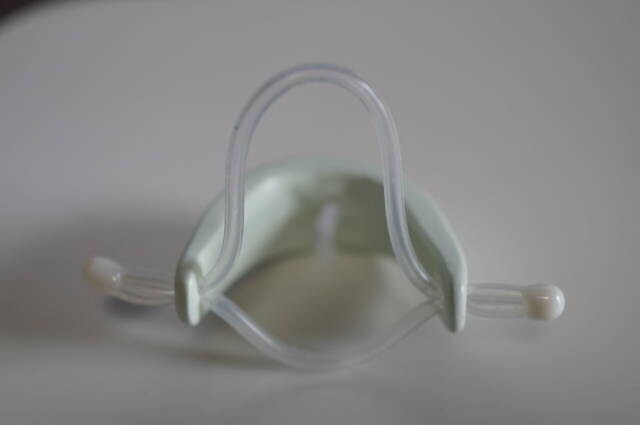
A loose gatekeeper pin prompted plans for bent anchors
An entry published in December 2024 described a retaining pin coming out after about 8 or 9 uses. The customer asked whether boiling was responsible and requested an adhesive recommendation.
Mr. Okada apologized and said adhesive-only fastening could fail under force. He planned embedded, U-shaped pins instead. The diary does not record a later durability result for that change. Mr. Okada acknowledged that adhesive might not hold reliably.
(Source: ok-lab's diary, published December 2024)
https://ok-lab.hatenablog.com/entry/2024/12/07/122832
How gatekeeper sizes and compatibility changed over time
| Published | What the diary said then |
|---|---|
| Apr 2022 | All frames were custom-made; manufacturing accuracy was targeted within about 3 mm. |
| Jul 2022 | Customer requests prompted plans to position the tube closer to the underside. |
| Aug 2022 | A 2 mm wire-containing tube removed the practical need for the bicorn design. |
| Oct 2022 | Development of the recessed gatekeeper paused; its shape was expected to change. |
| Nov 2022 | General sale of the testicle-binding design was abandoned; a cross-frame version followed. |
| Oct 2023 | Drainage holes increased from 2 to 3, with embedded wire added for strength. |
| Dec 2025 | An internal heart-shaped stopper remained experimental; dimensions and loop counts were still under review. |
OK Prostate Chip products related to gatekeeper sizes and compatibility
The supplied current list includes the slide-lock gatekeeper at ¥6,600 (about $42 at ¥156 = $1, rate as of 2026-09-04) including tax.
Products that appear in these entries
| Product (official name) | Price incl. tax | Relation to this topic |
|---|---|---|
| Slide-lock urethral gatekeeper (スライドロック式尿道ゲートキーパー) | ¥6,600 (about $42 at ¥156 = $1, rate as of 2026-09-04) | In December 2025, a purchase intended for ordinary nylon thread was redirected to the customer's motorized-chip connection. |
The slide-lock gatekeeper is listed in OK Lab's own online store.

(Source: ok-lab's diary, published December 2025)
https://ok-lab.hatenablog.com/entry/2025/12/20/123000
Products the diary mentioned as alternatives
The diary names no alternative.
No longer sold: The six-hole gatekeeper was discontinued in July 2022.
(Source: ok-lab's diary, published July 2022)
https://ok-lab.hatenablog.com/entry/2022/07/16/123031
Original custom, unicorn, bicorn, recessed, grid-frame, cross-frame, ribbon-style, and shape-memory gatekeepers, and the experimental heart-shaped stopper: No matching product can be confirmed on the current list.
Common worries about gatekeeper sizes and compatibility
The recorded questions concern thread compatibility, custom shape, and which size label applies.
"Was the gatekeeper only for cable-connected chips?"
In an entry published in May 2022, a reader asked whether the gatekeeper also worked with ordinary nylon-thread chips. Mr. Okada responded by developing a six-hole version intended to restrain those threads.
The extra holes cost ¥1,000 (about $6 at ¥156 = $1, rate as of 2026-09-04) tax excluded. He refused changes to already placed orders because hardened resin could not be given those holes. Mr. Okada required the six-hole option to be specified when ordering.
(Source: ok-lab's diary, published May 2022)
https://ok-lab.hatenablog.com/entry/2022/05/07/123013
"Could the slide-lock gatekeeper follow a custom shape?"
An entry published in December 2023 concerned a customer seeking a closer-fitting frame for a larger tube. Mr. Okada had declined to develop the larger-tube structure because it would require repeated prototypes. He supplied a standard model for 4 mm tubing with fewer drainage holes, after the customer proposed adapting it themselves.
For the follow-up shape request, he offered approximate custom work but said the wire core remained necessary. The diary does not record whether that later custom order was completed. Mr. Okada requested a dimensioned drawing and warned that exact reproduction was impossible.
(Source: ok-lab's diary, published December 2023)
https://ok-lab.hatenablog.com/entry/2023/12/23/122035
"Which shape-memory gatekeeper size suited a 12 cm circumference?"
In an entry published in August 2025, a customer reported an erect penile circumference of 12 cm and asked about M versus L. Staff described the choice as partly personal preference.
The customer chose L; the diary does not record how it felt in use. In this exchange, staff advised that the larger size was safer.
(Source: ok-lab's diary, published August 2025)
https://ok-lab.hatenablog.com/entry/2025/08/02/123058
"Does the slide-lock gatekeeper work with ordinary nylon thread?"
In an entry published in December 2025, a customer bought the slide-lock gatekeeper as a stopper for an ordinary nylon-thread chip. Staff explained that it did not support that connection.
The customer changed the intended use to an existing motorized chip (a chip containing a motor). A compatible tube was supplied with the order. Staff directed this purchase toward the customer's motorized-chip connection.
(Source: ok-lab's diary, published December 2025)
https://ok-lab.hatenablog.com/entry/2025/12/20/123000
Buying from outside Japan

OK Lab ships internationally to countries covered by Japan Post's EMS courier service. Overseas orders are paid in advance by PayPal. Each order carries a ¥400 (about $3 at ¥156 = $1, rate as of 2026-09-04) handling fee, and EMS shipping is charged on top. These terms come from OK Lab's official sales-terms page (written here as plain text, not a link: ok-lab.net/docs/law), checked on September 7, 2026; confirm them on the official store before you order, because they can change.
Summary of this article
| What you wanted to know | The answer |
|---|---|
| What is the short answer? | Size labels and compatible connections changed between gatekeeper designs. |
| What is the base product? | A urethral device made by OK Lab in Japan. |
| Which terms matter? | Tube diameter, frame dimensions, and loop circumference describe different measurements. |
| What happened to the designs? | Tube, frame, attachment, and thread-guide designs changed across the dated entries. |
| How did the maker respond? | Thicker frames, revised connections, and bent-pin plans addressed reported problems. |
| What changed over time? | Custom frames led to named sizes; some designs were paused or abandoned. |
| What is currently listed? | The slide-lock urethral gatekeeper costs ¥6,600 (about $42 at ¥156 = $1, rate as of 2026-09-04) including tax on the supplied list. |
| What did readers ask? | Whether thread connections worked, custom shapes were possible, and M or L would fit. |
| How does overseas buying work? | Advance PayPal payment, a ¥400 (about $3 at ¥156 = $1, rate as of 2026-09-04) handling fee, and additional EMS shipping. |
Source: ok-lab's diary (Okada Comfortable Life Laboratory). The original entries are in Japanese; quotations on this page are translated. Photos and videos are on the original entries.
This article is a summary of the maker's development diary. The product is not a medical device and no result is guaranteed. If anything feels wrong or worries you, see a doctor. Prices, specifications and cautions change, so confirm the latest information on the official blog and the official site. Questions about ordering and shipping go to the seller.