![Can an Omron massager work with it? | Custom connections are unverified [OK Prostate Chip]](/img/a/T0262/eyecatch.svg)
This page is based on entries from "ok-lab's diary" (https://ok-lab.hatenablog.com/), the Japanese development diary written by Mr. Okada, founder of OK Lab, a small company in Japan (Okada Comfortable Life Laboratory). Only the entries about "using a low-frequency massager" are summarized here, in order of publication. Past prices and sizes are as written at the time. Current prices come from the official product list (retrieved September 4, 2026). Quotations are translated from Japanese.
Note: This page is a personal reading log by someone with no connection to the maker or the seller. It reflects the source entries as of their publication dates and makes no guarantee of accuracy or safety. The product is not a medical device; talk to a doctor about any health decision. Check the official site for current information. This page contains advertising.
In short
Electrode chips (chips with electrical contacts) worked with Omron massagers, but reports also described bleeding and connection failures.
Mr. Okada describes unverified builds and warns that this use conflicts with Omron's instructions.
The current list includes a related cable stopper; matching complete electrode chips cannot be confirmed.
If you see blood in your urine, even a small amount or for the first time, do not wait and see. See a urologist right away. If you suddenly cannot urinate, or the device cannot be removed, do not try to fix it yourself. Go to a medical facility, including emergency care, immediately.
About this product
The OK Prostate Chip is a small device that is placed in the urethra (the urine passage) so that it acts on the prostate; the maker sells it in several shapes, sizes and materials. It is made and sold by OK Lab (Okada Comfortable Life Laboratory), a small company in Japan, through its own online store, and prices are in Japanese yen (JPY). The maker's development diary, "ok-lab's diary", is written in Japanese. This page is an English summary of it, and every quotation is translated. OK Lab ships internationally, so readers outside Japan can order (see "Buying from outside Japan" below). Product names on this page are plain-English descriptions. The official Japanese product name is shown once in the product table so you can find the same item in the store.
Before you read: key terms
| Term | Plain-English meaning |
|---|---|
| Urethra | The urine passage; the base chip is placed here to act on the prostate. |
| Low-frequency massager | An electrical device normally used with skin pads; these experiments used it to supply stimulation through chip electrodes. |
| Electrode chip | A chip carrying electrical contacts, intended to deliver stimulation where those contacts meet tissue. |
| Mucosa | Internal tissue lining; it is the contact surface discussed in the electrode experiments. |
| Internal body resistance | Resistance to electrical current within the body; Mr. Okada wanted it to limit current between electrodes. |
| Snap-button connector | A press-stud connection used to attach a chip or skin pad to the massager cable. |
| Parallel cable | Two insulated wires joined together; it carries current and links parts of some custom chips. |
| Resin | The chip-body material that holds embedded electrode parts in place. |
What happens: using a low-frequency massager
The OK Prostate Chip is a small device placed in the urethra (the urine passage) to act on the prostate. The entries describe custom electrode chips (chips carrying electrical contacts) connected to low-frequency massagers, devices normally used with skin pads. Those contacts appeared on urethral chips and separate rectal chips, with the massager supplying electrical stimulation. The diary records experiments and customer reports, including limits on what OK Lab could test.
An early Omron massager trial did not end the development pause
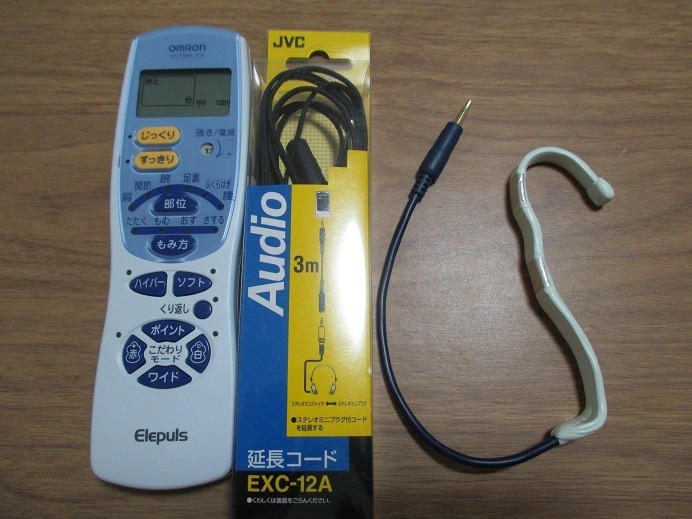
In an entry published in December 2018, a customer reported testing a rectal electrode-chip prototype with an Omron Elepuls HV-F900-JE4. The customer described prickling whose cause remained unclear. Mr. Okada stopped development because he considered direct contact between metal terminals and moist mucosa (internal tissue lining) unsuitable.
The same customer's follow-up described a wider, 18mm aluminum-foil lower electrode and said the earlier prickling had disappeared. OK Lab still suspended routine supply, while allowing custom builds made to customer specifications. Mr. Okada cautioned that prickling could still depend on contact area, personal sensitivity and conditions.
(Source: ok-lab's diary, published December 2018)
https://ok-lab.hatenablog.com/entry/20181215/1544857573
An electrode chip report described bleeding followed by urinary symptoms
In an entry published in May 2019, a customer described a first trial with an electrode chip and an existing Omron massager. Afterward, the customer reported blood in the lubricant and a dull ache during urination. They later suspected a bladder infection after urinary discomfort continued for several days.
The customer said the symptoms subsided after several days; the diary does not record a confirmed diagnosis. Mr. Okada's reply suggested that smaller chips might suffice for electrical stimulation.
(Source: ok-lab's diary, published May 2019)
https://ok-lab.hatenablog.com/entry/2019/05/25/144939
An electrode chip quote separated the body, electrical work and fees
In an entry published in April 2020, a customer asked whether a medium-length resin chip could carry electrodes. OK Lab agreed, and the customer confirmed a 44mm chip with a 70cm cable. The quote listed ¥2,200 (about $14 at ¥156 = $1, rate as of 2026-09-04) for the body, ¥4,400 (about $28 at ¥156 = $1, rate as of 2026-09-04) for electrode work, ¥1,100 (about $7 at ¥156 = $1, rate as of 2026-09-04) for the plug and ¥400 (about $3 at ¥156 = $1, rate as of 2026-09-04) handling.
The stated total was ¥8,100 (about $52 at ¥156 = $1, rate as of 2026-09-04), as published in April 2020. The diary does not record how this build felt in use. OK Lab warned that its smaller electrode area could not be tested for effectiveness beforehand.
(Source: ok-lab's diary, published April 2020)
https://ok-lab.hatenablog.com/entry/2020/04/04/152310
Mr. Okada's electrode chip testing stopped after a heart-related reaction
In an entry published in February 2021, Mr. Okada described trying an electrical test at his fingertips while reporting good recovery from surgery. At control level 3, he says he felt something wrong in his heart before sensing stimulation in his fingertips. He reported recovering after about 10 minutes. He concluded that his heart could no longer tolerate electrode testing.
(Source: ok-lab's diary, published February 2021)
https://ok-lab.hatenablog.com/entry/2021/02/13/121440
An electrode chip cable fault prompted a replacement request
In an entry published in May 2022, a customer praised a custom chip combining 3 motors and 2 electrodes. They then requested another because electrical stimulation had become intermittent when the wire moved near the chip. Mr. Okada suspected a broken cable but could not explain why it had failed.
He considered the requested support-cable arrangement impractical and discussed a different design still under study. The diary does not record whether the replacement was completed. Mr. Okada said the alternative cable design remained under study because suitable materials had not been found.
(Source: ok-lab's diary, published May 2022)
https://ok-lab.hatenablog.com/entry/2022/05/28/123218
An Omron massager shutdown cleared without a confirmed cause
In an entry published in March 2024, a customer reported that an Omron HV-F128 switched off without delivering current through a new electrode chip. The massager still worked with its ordinary pads. The same customer's follow-up reported restored operation after changes in position, without establishing why the shutdown happened.
Staff said their checks could also require 2–3 restarts before they confirmed current flow. Mr. Okada cautioned that normal wear could still lead to cable breaks.
(Source: ok-lab's diary, published March 2024)
https://ok-lab.hatenablog.com/entry/2024/03/23/122837
The maker's answer to using a low-frequency massager
Mr. Okada restricted production, changed the construction method and later warned that these devices were not necessarily safe.
A simpler electrode chip construction method reduced historical processing charges
In an entry published in March 2019, OK Lab changed from embedding electrodes during molding to attaching them to finished chips. The new processing charges were ¥3,000 (about $19 at ¥156 = $1, rate as of 2026-09-04) for one electrode and ¥5,000 (about $32 at ¥156 = $1, rate as of 2026-09-04) for two, excluding tax. The diary says the change reduced labor but made the finish less tidy.
Mr. Okada expected electrical function to remain largely unchanged. He still stressed that he could not personally test these prototypes.
(Source: ok-lab's diary, published March 2019)
https://ok-lab.hatenablog.com/entry/2019/03/16/165528
The electrode chip policy sought a minimum internal resistance
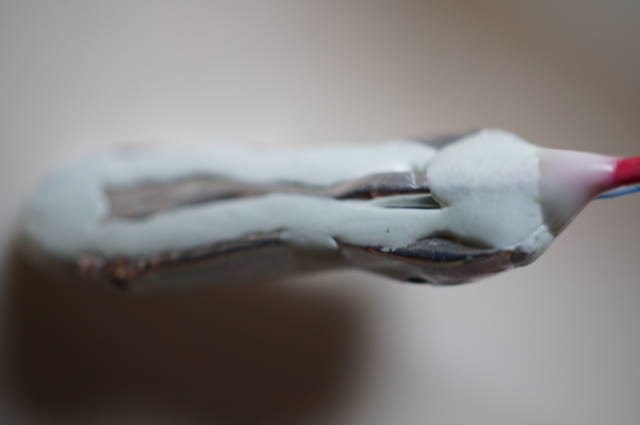
In an entry published in April 2019, Mr. Okada adopted a production rule limiting each internal tissue site to one electrode. He wanted at least 500Ω of internal body resistance (resistance to electrical current within the body) between electrodes. His stated concern was a controller malfunction when its original terminals were not being used.
Snap-button connector processing (a press-stud cable connection) added ¥4,000 (about $26 at ¥156 = $1, rate as of 2026-09-04) excluding tax to the relevant chip price, with cable choices of 20cm, 25cm or 30cm. At that time, OK Lab accepted orders only under the new electrode rule. Mr. Okada recommended the massager maker's own pads for skin contact.
(Source: ok-lab's diary, published April 2019)
https://ok-lab.hatenablog.com/entry/2019/04/13/150233
An Omron massager report led to an explicit safety warning
In an entry published in April 2022, a customer reported switching to an Omron HV-F125 after finding a different controller too harsh. They reported no abnormalities by the time of that follow-up. Mr. Okada emphasized individual differences in sensitivity.
He warned that these devices were not necessarily safe and could be life-threatening for someone with severe heart failure. He urged caution because he could not test electrode chips himself.
(Source: ok-lab's diary, published April 2022)
https://ok-lab.hatenablog.com/entry/2022/04/09/123458
If you see blood in your urine, even a small amount or for the first time, do not wait and see. See a urologist right away. If you suddenly cannot urinate, or the device cannot be removed, do not try to fix it yourself. Go to a medical facility, including emergency care, immediately.
How using a low-frequency massager changed over time
| Published | What the diary said then |
|---|---|
| Feb 2019 | Electrode processing cost ¥8,000 (about $51 at ¥156 = $1, rate as of 2026-09-04) for two electrodes or ¥5,000 (about $32 at ¥156 = $1, rate as of 2026-09-04) for one, excluding tax. |
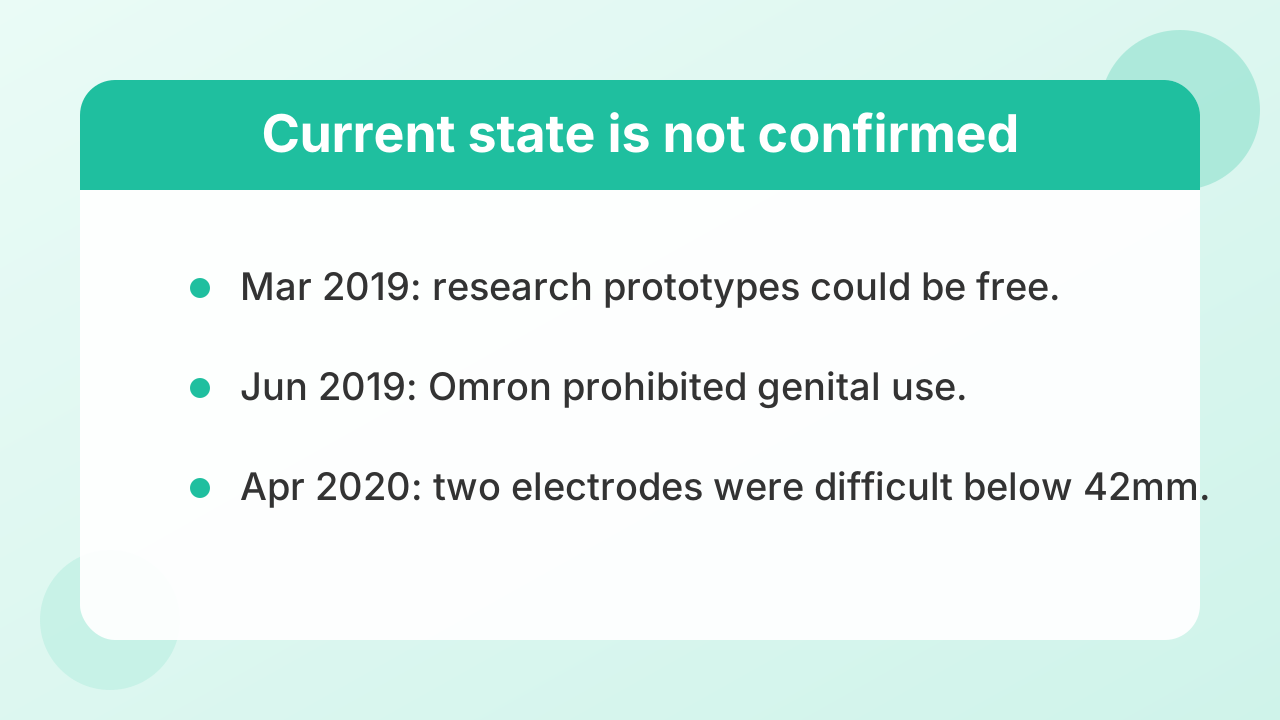
| Mar 2019 | Research prototypes could be free; customers had to buy their own massager. |
| Apr 2019 | Mr. Okada called his approach a compromise using ordinary massager controls. |
| Jun 2019 | Mr. Okada highlighted Omron's prohibition on genital use. |
| Apr 2020 | The stated chip-length range was 42–48mm; two electrodes were difficult below 42mm. |
| Apr 2022 | Mr. Okada noted that fingertip checks differed from the customer's experience of internal stimulation. |
| Aug 2024 | OK Lab described doubled parallel cable as approximately 2.5mm × 2.5mm. |
The diary does not say what the current state is.
OK Prostate Chip products related to using a low-frequency massager
The current list confirms a cable stopper mentioned in an electrode-chip inquiry, but no matching complete electrode-chip product.
Products that appear in these entries
| Product (official name) | Price incl. tax | Relation to this topic |
|---|---|---|
| Parallel-cable stopper option (平行ケーブル用ストッパー追加(オプション)) | ¥1,100 (about $7 at ¥156 = $1, rate as of 2026-09-04) | In February 2021, OK Lab offered this option when an electrode-chip customer asked about preventing movement into the bladder. |
The parallel-cable stopper option is listed in OK Lab's own online store.
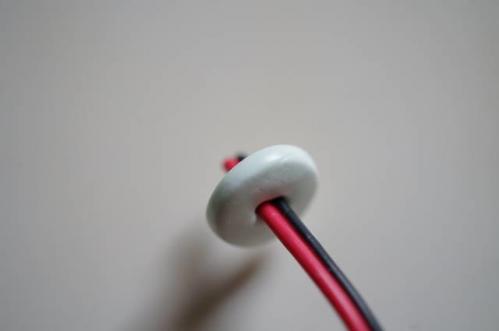
(Source: ok-lab's diary, published February 2021)
https://ok-lab.hatenablog.com/entry/2021/02/13/121440
Products the diary mentioned as alternatives
The diary names no alternative.
Historical electrode-chip prototypes and custom builds: No matching product can be confirmed on the current list.
Common worries about using a low-frequency massager
The questions cover controller choice, chip material, connector compatibility and cable thickness.
"Which Omron massager controller did Mr. Okada identify?"
In an entry published in June 2019, a customer considering an electrode chip asked which controller it required. Mr. Okada named the Omron Elepuls range and cited low-priced models at about ¥3,000 (about $19 at ¥156 = $1, rate as of 2026-09-04) then. He explained that this setup carried current intended for external skin into internal tissue.
He also pointed out that Omron's manual prohibited genital use. Mr. Okada directed the customer toward the manufacturer's instructions.
(Source: ok-lab's diary, published June 2019)
https://ok-lab.hatenablog.com/entry/2019/06/08/144200
"Can an electrode chip be made from ceramic?"
In an entry published in February 2021, a customer asked whether the electrode-chip designs could be made in ceramic. OK Lab said both required embedded electrode parts and could only be made with resin. It explained that Mr. Okada's health prevented testing, and that OK Lab could not explain how these builds should be used.
The diary does not record whether that customer placed an order. OK Lab warned that customer-specified builds were supplied without verification or warranty.
(Source: ok-lab's diary, published February 2021)
https://ok-lab.hatenablog.com/entry/2021/02/13/121440
"Can an electrode chip have a 2.5mm connector?"
In an entry published in August 2024, a correspondent relayed a question about an Omron device requiring a 2.5mm connector. OK Lab said it did not support that connector as standard because suitable standalone parts were unavailable. It offered paid connection work if a customer supplied a commercially made connector.
The diary does not record completion of that proposed work. OK Lab asked readers to share information about suitable loose parts.
(Source: ok-lab's diary, published August 2024)
https://ok-lab.hatenablog.com/entry/2024/08/17/122842
"Can an electrode chip cable be made thinner?"
In an entry published in August 2024, a customer asked whether a linked aluminum electrode pair could have a thinner cable. Mr. Okada said separating parallel cable (two joined insulated wires) had made it much weaker in his experience. He said single wires were therefore used only when fully enclosed in resin.
He described added nylon thread between the chips and expected it to reduce breakage. Mr. Okada favored joined cable for exposed links between chips, based on its previous service history.
(Source: ok-lab's diary, published August 2024)
https://ok-lab.hatenablog.com/entry/2024/08/17/122842
Buying from outside Japan
OK Lab ships internationally to countries covered by Japan Post's EMS courier service. Overseas orders are paid in advance by PayPal. Each order carries a ¥400 (about $3 at ¥156 = $1, rate as of 2026-09-04) handling fee, and EMS shipping is charged on top. These terms come from OK Lab's official sales-terms page (written here as plain text, not a link: ok-lab.net/docs/law), checked on September 7, 2026; confirm them on the official store before you order, because they can change.
Summary of this article
| What you wanted to know | The answer |
|---|---|
| What is the short answer? | Customers reported working connections, but OK Lab described unverified builds and warned about risks. |
| What is the product? | A small urethral device made and sold by OK Lab in Japan. |
| What do the terms mean? | Custom electrodes carry current from a massager to tissue; cables and connectors link the parts. |
| What happened in the reports? | Reports included prickling, bleeding, a heart-related reaction, cable trouble and a shutdown that later cleared. |
| What did the maker change? | Construction, processing prices and production rules changed; later replies stressed testing limits. |
| How did the situation develop? | The entries record changing designs and customer feedback, without establishing today's custom-build terms. |
| Which current product is related? | The listed cable stopper appeared in an electrode-chip inquiry; it is not a complete electrode chip. |
| What did customers ask? | They asked about massagers, ceramic construction, connector sizes and thinner cables. |
| How do overseas orders work? | Advance PayPal payment, a handling fee and separate EMS shipping apply under the stated terms. |
Source: ok-lab's diary (Okada Comfortable Life Laboratory). The original entries are in Japanese; quotations on this page are translated. Photos and videos are on the original entries.
This article is a summary of the maker's development diary. The product is not a medical device and no result is guaranteed. If anything feels wrong or worries you, see a doctor. Prices, specifications and cautions change, so confirm the latest information on the official blog and the official site. Questions about ordering and shipping go to the seller.