![What does the battery box controller do? | It changes motor power, with important cautions [OK Prostate Chip]](/img/a/T0253/eyecatch.svg)
This page is based on entries from "ok-lab's diary" (https://ok-lab.hatenablog.com/), the Japanese development diary written by Mr. Okada, founder of OK Lab, a small company in Japan (Okada Comfortable Life Laboratory). Only the entries about "battery box controllers" are summarized here, in order of publication. Past prices and sizes are as written at the time. Current prices come from the official product list (retrieved September 4, 2026). Quotations are translated from Japanese.
Note: This page is a personal reading log by someone with no connection to the maker or the seller. It reflects the source entries as of their publication dates and makes no guarantee of accuracy or safety. The product is not a medical device; talk to a doctor about any health decision. Check the official site for current information. This page contains advertising.
In short
- The battery box supplies motor power, with several voltage choices documented in the diary.
- Mr. Okada favored lower voltage for prolonged vibration and warned about extended 6V operation.
- The current list includes a battery-box controller change option priced at ¥1,100 (about $7 at ¥156 = $1, rate as of 2026-09-04) including tax.
About this product

The OK Prostate Chip is a small device that is placed in the urethra (the urine passage) so that it acts on the prostate; the maker sells it in several shapes, sizes and materials. It is made and sold by OK Lab (Okada Comfortable Life Laboratory), a small company in Japan, through its own online store, and prices are in Japanese yen (JPY). The maker's development diary, "ok-lab's diary", is written in Japanese. This page is an English summary of it, and every quotation is translated. OK Lab ships internationally, so readers outside Japan can order (see "Buying from outside Japan" below). Product names on this page are plain-English descriptions. The official Japanese product name is shown once in the product table so you can find the same item in the store.
Before you read: key terms
| Term | Plain-English meaning |
|---|---|
| Urethra | The urine passage, where the chip is placed to act on the prostate. |
| Battery box controller | An external battery holder supplying power to the vibrating chip's motor. |
| Electronic controller | A unit offering preset vibration patterns to control the motor. |
| 0V dummy cell | A battery-shaped component marked 0V, included to make lower-voltage settings possible. |
| Mini plug | A small detachable connector allowing the chip and its power source to be replaced separately. |
| USB connection | A connector arrangement used for power cables and interchangeable motors in the diary. |
| Branch cable | A cable providing multiple motor connections, included in the April 2023 system. |
| 14500 battery | A battery type described as AA-sized, mentioned in a reply about stronger motor rotation. |
What happens: battery box controllers
The OK Prostate Chip is a small device placed in the urethra (the urine passage) to act on the prostate. The vibrating models contain motors powered through a cable from a battery box controller (an external holder supplying battery power). An entry published in June 2019 describes a cable long enough for the box to sit in a pocket. Later entries describe plugs and switches for controlling power or changing the connected equipment.
Battery box controllers offered voltage choices beyond electronic control
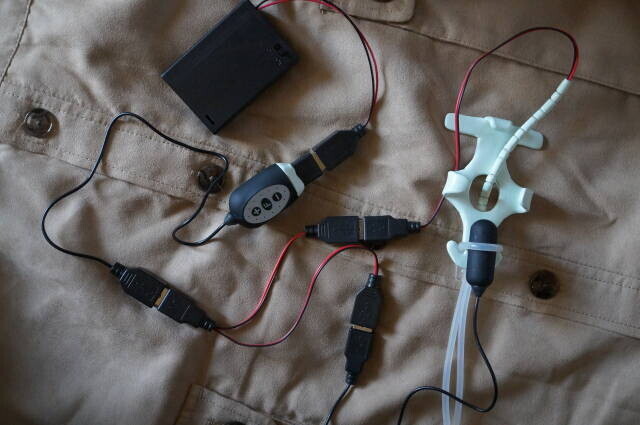
In an entry published in June 2019, Mr. Okada introduced a battery box covering 1.5V, 3V, 4.5V, and 6V. The compared electronic controller (a unit offering preset vibration patterns) had 20 modes, with a maximum of 3V. The new box focused on voltage changes.
The launch package cost ¥1,000 (about $6 at ¥156 = $1, rate as of 2026-09-04) excluding tax, with room for 4 AA batteries and 3 dummy cells marked 0V (battery-shaped components supplying no voltage). Ordinary AA batteries were not included. Mr. Okada favored the lowest setting for the faint vibration he wanted.
(Source: ok-lab's diary, published June 2019)
https://ok-lab.hatenablog.com/entry/2019/06/29/143536
Three motors changed how battery box controllers felt in hand
In an entry published in July 2019, Mr. Okada described testing a customer's three-motor chip in his hand. He wrote that single-motor tests revealed speed changes without much change in the perceived weight of vibration. With adjacent motors rotating in opposite directions, he reported a surging sensation at 4.5V and above.
His account concerned a hand test, and he expressly said he had not tested the customer's device in his urethra. Mr. Okada wrote that the three-motor arrangement was too intense for him to want one for his own use.
(Source: ok-lab's diary, published July 2019)
https://ok-lab.hatenablog.com/entry/2019/07/27/130537
Plugs let battery box controllers change without replacing chips
In an entry published in August 2019, Mr. Okada introduced mini plugs (small detachable connectors) for the chip and its controller. He said this allowed different power sources to share a chip, including controllers introduced later. The stated benefit was avoiding another chip purchase whenever the controller changed.
The planned controller-side plug addition cost ¥1,000 (about $6 at ¥156 = $1, rate as of 2026-09-04) excluding tax, while a plug-equipped battery box was ¥1,500 (about $10 at ¥156 = $1, rate as of 2026-09-04). He also listed a ¥1,000 (about $6 at ¥156 = $1, rate as of 2026-09-04) excluding tax charge for adding a plug to the chip's cable. Mr. Okada presented separate replacement of chips and controllers as the reason to consider the plug-equipped arrangement.
(Source: ok-lab's diary, published August 2019)
https://ok-lab.hatenablog.com/entry/2019/08/03/145816
The miniature chip's battery box controller began as a planned package
In an entry published in August 2019, a customer asked to buy a tiny vibrating model discussed previously. Mr. Okada replied that development was still underway and sales might begin soon. The proposed miniature chip measured about 20mm long, with a maximum thickness of 5mm and width of 9mm.
The entry announced a planned chip-and-battery-box package at ¥3,000 (about $19 at ¥156 = $1, rate as of 2026-09-04) excluding tax, without a battery. The diary does not record whether that customer's purchase was completed. Mr. Okada asked the customer to wait for further development updates.
(Source: ok-lab's diary, published August 2019)
https://ok-lab.hatenablog.com/entry/2019/08/24/125858
The twisted-cable model brought a switch to its battery box controller
In an entry published in March 2020, Mr. Okada introduced a custom miniature model with a twisted cable. Its 3V battery box had a switch, unlike the earlier miniature model's 1.5V switchless box. He explained that the change aimed to make ordinary vibration perceptible to a broader audience.
The twisted-cable model was initially offered as a custom order of the miniature chip. For customers who already owned a portable power bank, Mr. Okada also offered a USB connection (a power-cable connector) for ¥500 (about $3 at ¥156 = $1, rate as of 2026-09-04) extra.
(Source: ok-lab's diary, published March 2020)
https://ok-lab.hatenablog.com/entry/2020/03/07/152901
A USB battery box controller system supported interchangeable motors
In an entry published in April 2023, Mr. Okada described a motor system for an external support plate and belt. He wanted both battery and USB power because he found existing arrangements short-lived or insufficiently powerful. The design had a 3-battery box and a 120-mode controller with USB connections at both ends.
These connections allowed motor changes and branch cables (cables providing multiple motor connections). The basic set contained the box, controller, and a cylindrical motor for ¥5,000 (about $32 at ¥156 = $1, rate as of 2026-09-04) excluding tax. Mr. Okada specified a cylindrical motor because egg-shaped motors slipped from the support.
(Source: ok-lab's diary, published April 2023)
https://ok-lab.hatenablog.com/entry/2023/04/29/123107
A custom quote listed the battery box controller change separately
In an entry published in April 2025, a customer requested a twisted resin chip with three motors and a simple battery-box controller. The requested motor sizes were 8mm, 8mm, and 10mm, with the middle motor positioned sideways. The maker's quote priced the controller change at ¥1,100 (about $7 at ¥156 = $1, rate as of 2026-09-04).
The diary does not record how this customer's controller felt in use. Mr. Okada's reply offered the requested controller change as a separate item in the custom build.
(Source: ok-lab's diary, published April 2025)
https://ok-lab.hatenablog.com/entry/2025/04/12/122910
The maker's answer to battery box controllers
Mr. Okada separated supply reliability from vibration strength, and warned that stronger power could bring unwanted effects.
Supply concerns kept the basic battery box controller as standard
In an entry published in February 2019, the standard vibrating chip included a battery box with on/off control only. An electronic controller was an optional extra costing ¥2,000 (about $13 at ¥156 = $1, rate as of 2026-09-04) excluding tax. Mr. Okada explained that he adapted controllers from commercially sold vibrating products because he could not manufacture the electronic units himself.
He expected battery boxes to remain obtainable as parts. If the source electronic product disappeared, however, he said he would be unable to supply its controller. His answer was to retain the simple box as standard and offer electronic control separately.
(Source: ok-lab's diary, published February 2019)
https://ok-lab.hatenablog.com/entry/2019/02/16/171153
Higher battery box controller voltage brought heat and a warning
In an entry published in June 2019, Mr. Okada reported heat tests on the motor in air. He recorded about 40°C at 4.5V, and about 65°C after five minutes at 6V. He reported that the latter temperature did not rise further during 10 hours of operation.
The diary does not record a measured temperature inside the body. Mr. Okada also speculated that 6V could cause emotional instability. He concluded that prolonged operation at 6V carried risks.
(Source: ok-lab's diary, published June 2019)
https://ok-lab.hatenablog.com/entry/2019/06/29/143536
Sensitivity concerns led to lower battery box controller voltage advice
In an entry published in March 2020, Mr. Okada warned that people especially sensitive to prostate stimulation might develop headaches. He listed this concern among the drawbacks of the miniature vibrating model with a twisted cable. For longer use, Mr. Okada favored lower voltage and partly used batteries.
(Source: ok-lab's diary, published March 2020)
https://ok-lab.hatenablog.com/entry/2020/03/07/152901
How battery box controllers changed over time
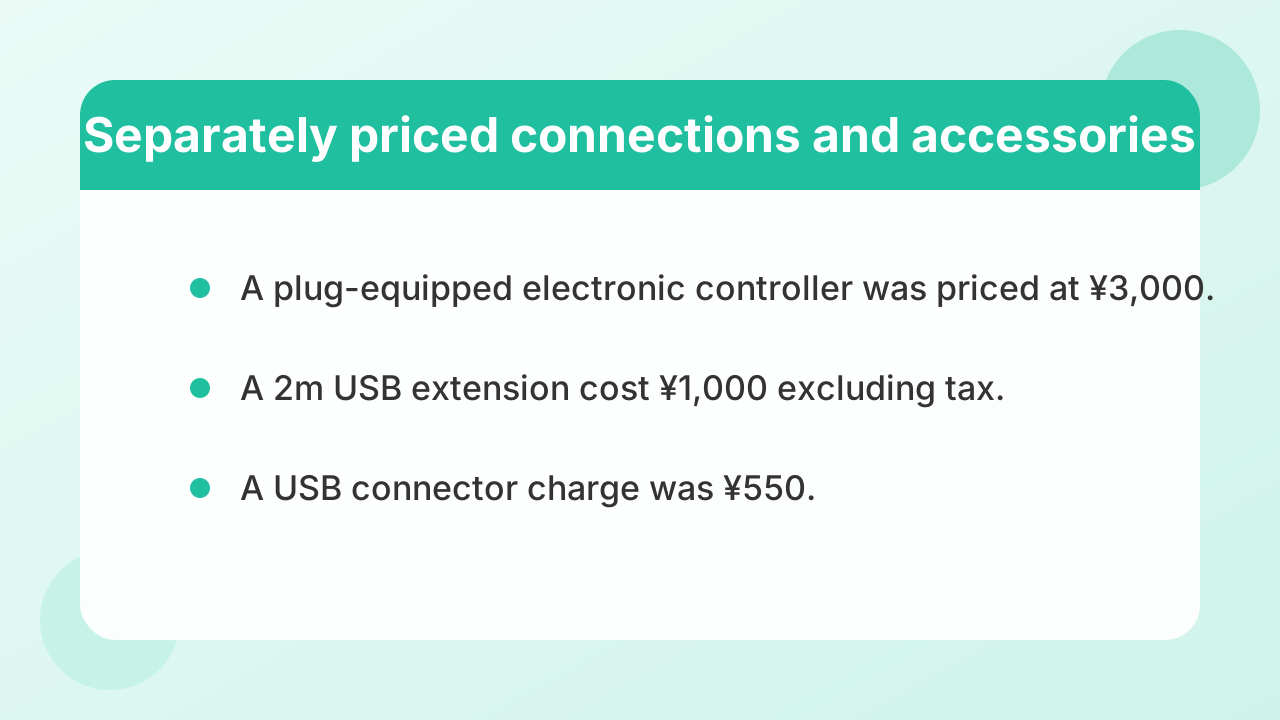
| Published | What the diary said then |
|---|---|
| Feb 2019 | Adapted electronic controllers required reinforcement of their connections. |
| Jun 2019 | Cable lengths: chip side about 75cm, box side about 15cm; total 90cm. |
| Aug 2019 | Battery boxes alone were listed at ¥500 (about $3 at ¥156 = $1, rate as of 2026-09-04) excluding tax, before plug additions. |
| Aug 2019 | A plug-equipped electronic controller was priced at ¥3,000 (about $19 at ¥156 = $1, rate as of 2026-09-04). |
| Mar 2020 | The twisted-cable miniature model was offered for ¥3,000 (about $19 at ¥156 = $1, rate as of 2026-09-04). |
| Apr 2023 | A 2m USB extension cost ¥1,000 (about $6 at ¥156 = $1, rate as of 2026-09-04) excluding tax; a branch cable, ¥1,500 (about $10 at ¥156 = $1, rate as of 2026-09-04) excluding tax. |
| Apr 2025 | A USB connector charge was ¥550, (about $4 at ¥156 = $1, rate as of 2026-09-04) separate from the battery-box option. |
OK Prostate Chip products related to battery box controllers
The current product list includes a simple battery-box controller change and an electronic-controller change.
Products that appear in these entries
| Product (official name) | Price incl. tax | Relation to this topic |
|---|---|---|
| Battery-box controller change (ローテクコントローラに変更(核振チップオプション)) | ¥1,100 (about $7 at ¥156 = $1, rate as of 2026-09-04) | April 2025 quoted this type of controller change for a custom three-motor chip. |
| Electronic-controller change (ICコントローラに変更(核振チップオプション)) | ¥2,200 (about $14 at ¥156 = $1, rate as of 2026-09-04) | February 2019 explained the extra price and supply limits of an electronic-controller option. |
The battery-box controller change is listed in OK Lab's own online store.
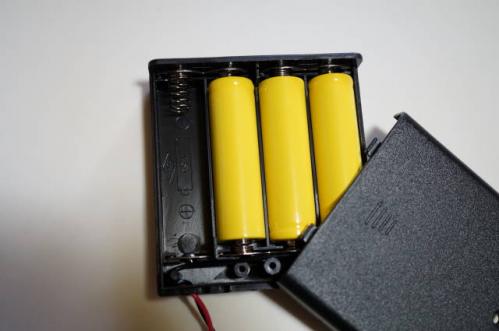
The electronic-controller change is listed in OK Lab's own online store.

(Source: ok-lab's diary, published February 2019)
https://ok-lab.hatenablog.com/entry/2019/02/16/171153
(Source: ok-lab's diary, published April 2025)
https://ok-lab.hatenablog.com/entry/2025/04/12/122910
Products the diary mentioned as alternatives
The diary names no alternative.
Historical miniature models, plug-equipped battery boxes, and custom motor assemblies: No matching product can be confirmed on the current list.
Common worries about battery box controllers
The miniature model's published questions concerned voltage, stronger power, and the absence of a switch.
"Why did the miniature chip use a 1.5V battery box?"
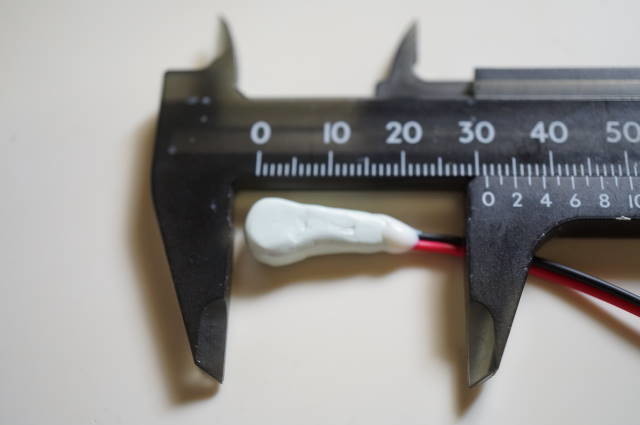
In the entry published in August 2019, a question asked why the miniature model used 1.5V. Mr. Okada replied that strong vibration was not the purpose of that design. He favored a single battery because he thought stronger movement would defeat the intended effect.
(Source: ok-lab's diary, published August 2019)
https://ok-lab.hatenablog.com/entry/2019/08/24/125858
"Could the miniature battery box provide 3V?"
In the entry published in August 2019, a question asked whether 3V was possible. Mr. Okada mentioned a 14500 battery (a battery type he described as AA-sized), stating 3.6V for one cell. The diary does not record testing results for that suggested battery. His reply presented it as a way to obtain stronger rotation.
(Source: ok-lab's diary, published August 2019)
https://ok-lab.hatenablog.com/entry/2019/08/24/125858
"Why did the miniature battery box have no switch?"
In the entry published in August 2019, a question asked why the dedicated box lacked an on/off switch. Mr. Okada described a design whose electrical contact could change when the box received a knock. He favored unpredictable motor starts as part of the miniature model's intended effect.
(Source: ok-lab's diary, published August 2019)
https://ok-lab.hatenablog.com/entry/2019/08/24/125858
Buying from outside Japan

OK Lab ships internationally to countries covered by Japan Post's EMS courier service. Overseas orders are paid in advance by PayPal. Each order carries a ¥400 (about $3 at ¥156 = $1, rate as of 2026-09-04) handling fee, and EMS shipping is charged on top. These terms come from OK Lab's official sales-terms page (written here as plain text, not a link: ok-lab.net/docs/law), checked on September 7, 2026; confirm them on the official store before you order, because they can change.
Summary of this article
| What you wanted to know | The answer |
|---|---|
| What is the short answer? | Battery boxes supply motor power; the maker warned about prolonged high-voltage operation. |
| What is the base product? | A small urethral device made by OK Lab in Japan. |
| What do the terms mean? | Battery boxes supply power; plugs and USB connections link components. |
| What do the cases show? | Voltage choices, detachable connections, switched variants, and custom quotes appeared at different dates. |
| What did the maker suggest? | A simple standard box for supply reliability, with lower voltage favored for prolonged vibration. |
| What changed over time? | The entries added power-box choices, connector arrangements, and separately priced accessories. |
| Which current products relate directly? | The product list includes controller-change options; historical custom assemblies remain unconfirmed. |
| What did readers ask? | Why the miniature model used low voltage, allowed stronger power, or lacked a switch. |
| How can overseas readers buy? | International orders use advance PayPal payment, with handling and EMS shipping charges. |
Source: ok-lab's diary (Okada Comfortable Life Laboratory). The original entries are in Japanese; quotations on this page are translated. Photos and videos are on the original entries.
This article is a summary of the maker's development diary. The product is not a medical device and no result is guaranteed. If anything feels wrong or worries you, see a doctor. Prices, specifications and cautions change, so confirm the latest information on the official blog and the official site. Questions about ordering and shipping go to the seller.