![Why do electrode size and placement matter? | Contact area and construction both matter [OK Prostate Chip]](/img/a/T0261/eyecatch.svg)
This page is based on entries from "ok-lab's diary" (https://ok-lab.hatenablog.com/), the Japanese development diary written by Mr. Okada, founder of OK Lab, a small company in Japan (Okada Comfortable Life Laboratory). Only the entries about "electrode width, placement, and structural changes" are summarized here, in order of publication. Past prices and sizes are as written at the time. Current prices come from the official product list (retrieved September 4, 2026). Quotations are translated from Japanese.
Note: This page is a personal reading log by someone with no connection to the maker or the seller. It reflects the source entries as of their publication dates and makes no guarantee of accuracy or safety. The product is not a medical device; talk to a doctor about any health decision. Check the official site for current information. This page contains advertising.
In short
- Customers reported that electrode width and contact position affected discomfort and electrical sensation.
- Mr. Okada changed electrode layouts, connections, and protective coatings in response to those reports.
- The current list includes related base chips, but does not confirm the historical custom electrode assemblies.
If you see blood in your urine, even a small amount or for the first time, do not wait and see. See a urologist right away. If you suddenly cannot urinate, or the device cannot be removed, do not try to fix it yourself. Go to a medical facility, including emergency care, immediately.
About this product
The OK Prostate Chip is a small device that is placed in the urethra (the urine passage) so that it acts on the prostate; the maker sells it in several shapes, sizes and materials.
It is made and sold by OK Lab (Okada Comfortable Life Laboratory), a small company in Japan, through its own online store, and prices are in Japanese yen (JPY). The maker's development diary, "ok-lab's diary", is written in Japanese. This page is an English summary of it, and every quotation is translated.
OK Lab ships internationally, so readers outside Japan can order (see "Buying from outside Japan" below). Product names on this page are plain-English descriptions. The official Japanese product name is shown once in the product table so you can find the same item in the store.
Before you read: key terms
| Term | Plain-English meaning |
|---|---|
| Urethra | The urine passage, where the urethral version of the chip sits. |
| Electrode | A metal contact on the device, intended to carry electrical stimulation to tissue. |
| Pole | An electrical contact in the circuit; separate metal sheets can form one continuous pole. |
| Resin | Material used for chip bodies and protective coatings around electrical connections. |
| Parallel cable | Wires running side by side, used for electrical connections between components. |
| AWG32 | The size designation of the fine conducting wire discussed here. The diary does not explain this. |
| Snap-button connector | A press-stud fitting used to connect an electrode cable. |
| Follower chip | A separate rear chip proposed as an additional electrode-bearing component. |
What happens: electrode size and placement
The OK Prostate Chip is a urethral device intended to act on the prostate. An electrode (a metal electrical contact) adds electrical stimulation, with versions discussed for urethral chips and separate anal chips. These contacts occupy exposed device surfaces, while resin (the chip's molded material or protective coating) covers other parts. The entries explore how contact width, position, connecting wires, and protective structures affect the amount of exposed metal.
An early electrode width request linked narrow exposure with pain
In an entry published in December 2018, a customer asked whether electrodes could be built into an anal chip. They reported very painful tingling with exposed widths of 1cm or less, while overly wide areas weakened stimulation.
Mr. Okada made a prototype, but the electrical unit had not arrived for testing. He said acceptance of custom work depended on checking how the materials bonded.
(Source: ok-lab's diary, published December 2018)
https://ok-lab.hatenablog.com/entry/20181208/1544250742
Electrode width changes eased one customer's tingling, but general supply paused
In an entry published in December 2018, the prototype's customer reported tingling and proposed different upper and lower electrode widths. The suggested widths were 1.2–1.4cm above and 1.8–2.0cm below. A follow-up described an 18mm lower electrode widened with aluminum foil, after which the customer reported that the earlier tingling disappeared.
Mr. Okada recalled his earlier conclusion that direct metal contact with moist internal lining was unsuitable. He still suspended general supply of electrode chips, while allowing custom builds made to a customer's specifications. His response cautioned that contact area, individual differences, and conditions could still affect tingling.
(Source: ok-lab's diary, published December 2018)
https://ok-lab.hatenablog.com/entry/20181215/1544857573
Electrode placement across two sheets still formed one continuous pole
In an entry published in April 2019, a customer requested an L-size single-bump electrode chip with a 30cm cable. Mr. Okada made almost the whole chip an electrode, using two aluminum sheets that formed one continuous pole (electrical contact). The diary does not record how this custom build felt in use.
(Source: ok-lab's diary, published April 2019)
https://ok-lab.hatenablog.com/entry/2019/04/20/144337
Electrode design ruled out a shared cable because of strength concerns
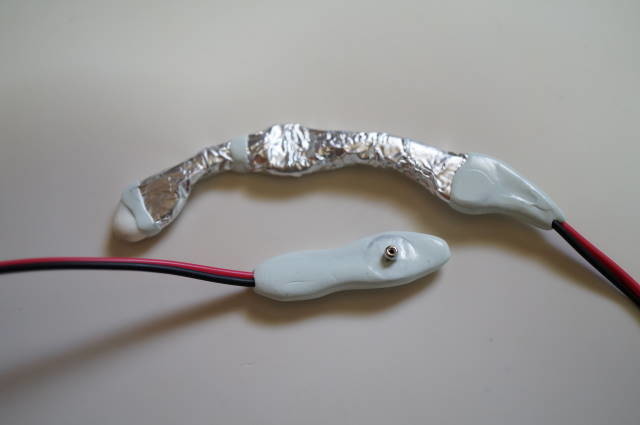
In an entry published in May 2022, a customer requested electrodes on a two-bump resin anal chip. Mr. Okada quoted for that build, but explained why an earlier arrangement had been abandoned. A single cable connecting one urethral electrode and one anal electrode had raised strength concerns.
The entry presented the requested build, without a report of how it felt in use. Mr. Okada said custom anal builds with 2 electrodes on 1 chip could be accepted.
(Source: ok-lab's diary, published May 2022)
https://ok-lab.hatenablog.com/entry/2022/05/07/123013
Thin electrodes became possible, while cable lifespan remained uncertain
In an entry published in August 2023, Mr. Okada described smaller electrodes enabled by finer cables. The reported dimensions were 40mm or less long, 7–8mm wide, and 3–4mm thick. His cable combined nylon thread with two fine wires and measured about 1mm across.
He warned that AWG32 wire (the wire-size designation) might fail electrically sooner than the earlier parallel cable (side-by-side wires). There were no long-term test results, and the failure probability was unknown. He made order acceptance conditional on a further trial.
(Source: ok-lab's diary, published August 2023)
https://ok-lab.hatenablog.com/entry/2023/08/19/123214
Electrode design plans changed after an accessory's retaining pin came loose
In an entry published in December 2024, an electrode user reported a retaining pin coming out around the 8th or 9th use. They asked about adhesive and proposed a U-shaped pin; the diary does not record a result from a revised accessory. Mr. Okada apologized, said adhesive alone might not hold securely, and proposed U-shaped pins for future builds.
(Source: ok-lab's diary, published December 2024)
https://ok-lab.hatenablog.com/entry/2024/12/07/122832
Electrode repairs followed earlier reports of exposed aluminum edges
In an entry published in November 2025, a customer reported a prickly junction between aluminum and its protective resin. Staff said an exposed cut edge would be a manufacturing fault; the customer later reported two uses without pain or bleeding. Mr. Okada separately recorded 2 earlier exposed-edge reports and said those chips had been reinforced.
He explained that resin thinner than the aluminum's 0.1mm thickness could leave an edge uncovered, so edge coatings were now thicker. He advised contacting OK Lab about suspected exposed edges; staff offered returns for inspection.
(Source: ok-lab's diary, published November 2025)
https://ok-lab.hatenablog.com/entry/2025/11/15/122921
The maker's answer to electrode size and placement
Mr. Okada's responses balanced exposed metal, connection strength, manufacturing limits, and the customer's requested layout.
Simpler electrode design reduced the published manufacturing charges in March 2019
An entry published in March 2019 announced charges of ¥3,000 (about $19 at ¥156 = $1, rate as of 2026-09-04) for 1 pole and ¥5,000 (about $32 at ¥156 = $1, rate as of 2026-09-04) for 2 poles, both excluding tax. A change from embedded electrodes to electrodes attached to completed chips reduced the production work. Mr. Okada said electrode function was almost unchanged, although appearance was slightly worse.
The earlier prices had reflected the difficulty of embedding wires and electrodes while the resin remained soft. Mr. Okada proposed the simpler construction for subsequent builds.
(Source: ok-lab's diary, published March 2019)
https://ok-lab.hatenablog.com/entry/2019/03/16/165528
Electrode placement policy favored one pole per body opening in April 2019
In an entry published in April 2019, Mr. Okada adopted one pole per body opening as his supply policy. This meant one electrical contact for each separate internal lining, rather than two poles sharing that site. The snap-button version (a press-stud connection) added ¥4,000 (about $26 at ¥156 = $1, rate as of 2026-09-04) excluding tax to the applicable chip price.
For urethral models, that base price excluded the thread; anal versions used the anal chip price. Mr. Okada favored semi-long or longer urethral chips because he wanted a larger contact area.
(Source: ok-lab's diary, published April 2019)
https://ok-lab.hatenablog.com/entry/2019/04/13/150233
Shorter electrode spacing remained possible, with a warning about durability
In an entry published in May 2019, a customer proposed a separate resin follower chip (a rear component) after misunderstanding the one-pole policy. Mr. Okada clarified that he would still accept an experienced customer's specified two-pole build with 2mm spacing. The customer withdrew the initial proposal and instead requested linked electrode chips.
For gaps within 10mm, Mr. Okada described finer wiring or electrodes positioned over wiring, while warning about reduced durability. The resulting prototype achieved that gap, but he still questioned the connecting cable's durability. He asked the customer to weigh spacing against strength.
(Source: ok-lab's diary, published May 2019)
https://ok-lab.hatenablog.com/entry/2019/05/11/152432
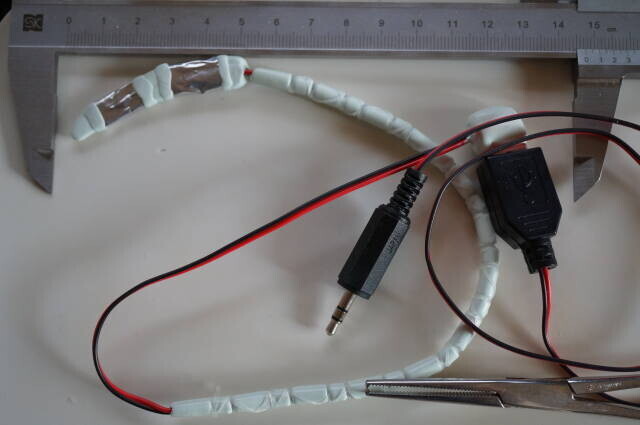
Thin electrodes required moving the joint beyond the chip body
In an entry published in April 2023, a customer needed an electrode chip no thicker than 7mm. The joint alone measured about 6mm, while the completed tail exceeded 7mm. Mr. Okada initially said the requested combination was impossible.
After a follow-up question, he offered a design with the joint outside the chip body. The customer accepted; Mr. Okada reported that an added rubber cover improved connection stability. He presented this as an option for customers considering jointed electrode cables.
(Source: ok-lab's diary, published April 2023)
https://ok-lab.hatenablog.com/entry/2023/04/01/122841
If you see blood in your urine, even a small amount or for the first time, do not wait and see. See a urologist right away. If you suddenly cannot urinate, or the device cannot be removed, do not try to fix it yourself. Go to a medical facility, including emergency care, immediately.
How electrode size and placement changed over time
| Published | What the diary said then |
|---|---|
| Feb 2019 | Electrode work cost ¥8,000 (about $51 at ¥156 = $1, rate as of 2026-09-04) for two poles or ¥5,000 (about $32 at ¥156 = $1, rate as of 2026-09-04) for one, excluding tax. |
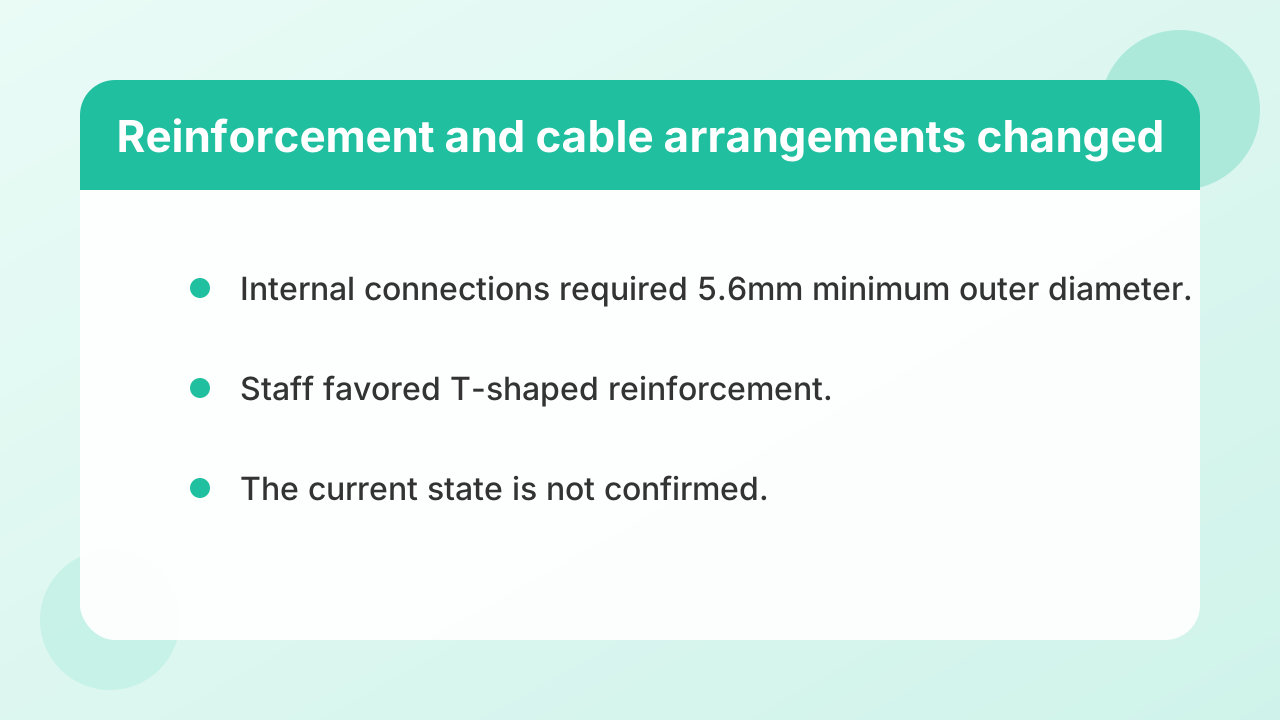
| Mar 2021 | Internal connections required 5.6mm minimum outer diameter, with ¥500 (about $3 at ¥156 = $1, rate as of 2026-09-04) excluding tax added per chip. |
| Aug 2024 | Staff favored T-shaped reinforcement because cross-shaped resin coverage left much less metal exposed. |
| Sep 2024 | Mr. Okada favored parallel cable between chips, then tube-covered twisted cable beyond them. |
| Jul 2025 | A 50mm anal design required a different shape; the original version proved unbuildable. |
| Oct 2025 | A new integrated stopper used the electrode's resin to secure its wire. |
The diary does not say what the current state is.
OK Prostate Chip products related to electrode size and placement
The current list includes base chips from these discussions, without confirming the historical electrode assemblies.
Products that appear in these entries
| Product (official name) | Price incl. tax | Relation to this topic |
|---|---|---|
| Separate rear resin chip (OKプロステートチップ 樹脂素材セパレートタイプ♀チップ) | ¥2,750 (about $18 at ¥156 = $1, rate as of 2026-09-04) | In May 2019, a customer proposed this component for electrode work, then withdrew that proposal after Mr. Okada clarified his policy. |
| Two-bump resin anal chip (OKプロステートお尻チップ 樹脂素材2コブUターン型) | ¥6,600 (about $42 at ¥156 = $1, rate as of 2026-09-04) | In May 2022, an electrode-build quotation named this base chip separately from its electrical additions. |
(Source: ok-lab's diary, published May 2019)
https://ok-lab.hatenablog.com/entry/2019/05/11/152432
(Source: ok-lab's diary, published May 2022)
https://ok-lab.hatenablog.com/entry/2022/05/07/123013
Products the diary mentioned as alternatives
The diary names no alternative.
Historical custom electrode assemblies and the retaining accessory: No matching product can be confirmed on the current list.
Common worries about electrode size and placement
The diary's replies identify limits involving exposed surface area, component size, and connections between chips.
"Can electrode design eliminate the gap between paired chips?"
In an entry published in October 2023, a customer asked whether filling a stainless-steel pair's gap would make cleaning easier. Mr. Okada said he had deliberately left metal exposed to preserve the conducting surface.
The entry says the gap had not been filled at that point. Mr. Okada offered gap filling for ¥2,000 (about $13 at ¥156 = $1, rate as of 2026-09-04) excluding tax, explaining that it required additional finishing work.
(Source: ok-lab's diary, published October 2023)
https://ok-lab.hatenablog.com/entry/2023/10/21/123054
"Can a tiny auxiliary chip provide enough electrode contact?"
In an entry published in July 2024, a customer proposed small flat stainless-steel auxiliary chips as electrodes. Mr. Okada said each chip was about 15mm long, with about 5mm at each end needed for protective resin. The central opening also reduced the metal available for contact.
He could not accept the requested auxiliary-chip arrangement, although he considered a different two-electrode build possible. The diary does not record whether that revised proposal became an order. He advised a component at least as large as a short chip.
(Source: ok-lab's diary, published July 2024)
https://ok-lab.hatenablog.com/entry/2024/07/27/122927
"Would a linked electrode design conduct along its entire length?"
In an entry published in March 2025, a customer requested electrical contact along a 15cm urethral device. Mr. Okada declined the requested external-contact features, but considered an internal assembly divided into 5 linked sections possible. He outlined either one pole throughout or two poles divided between 4 inner sections and 1 outer section.
The joints would not conduct, and the diary does not record a completed build. Mr. Okada requested a detailed drawing specifying the electrical arrangement before considering the order further.
(Source: ok-lab's diary, published March 2025)
https://ok-lab.hatenablog.com/entry/2025/03/15/122925
Buying from outside Japan
OK Lab ships internationally to countries covered by Japan Post's EMS courier service. Overseas orders are paid in advance by PayPal. Each order carries a ¥400 (about $3 at ¥156 = $1, rate as of 2026-09-04) handling fee, and EMS shipping is charged on top. These terms come from OK Lab's official sales-terms page (written here as plain text, not a link: ok-lab.net/docs/law), checked on September 7, 2026; confirm them on the official store before you order, because they can change.
Summary of this article
| What you wanted to know | The answer |
|---|---|
| In short: what affects this worry? | Reports connect electrode width and contact position with discomfort and electrical sensation. |
| About this product: what is it? | A device made by OK Lab in Japan, with urethral and separate anal designs discussed here. |
| Key terms: what counts as an electrode? | An exposed electrical contact; separate metal sheets can form one pole. |
| What happens: what problems were reported? | Tingling, uncertain cable lifespan, loose retaining hardware, and exposed aluminum edges. |
| The maker's answer: what changed? | Manufacturing methods, pole arrangements, connection positions, and protective coatings. |
| Changed over time: did the designs stay fixed? | Later entries describe different reinforcement, cable arrangements, shapes, and stopper connections. |
| Related products: what is listed today? | Related base chips appear on the current list; historical custom electrode assemblies remain unconfirmed. |
| Common worries: what limits the design? | Protective resin reduces exposed metal, small parts constrain contact area, and linked joints do not necessarily conduct. |
| Buying abroad: what are the stated terms? | Advance PayPal payment, a ¥400 (about $3 at ¥156 = $1, rate as of 2026-09-04) handling fee, and additional EMS shipping charges. |
| Overall answer: what does this history establish? | Specific customer reports and maker responses, including unresolved outcomes and changing construction limits. |
Source: ok-lab's diary (Okada Comfortable Life Laboratory). The original entries are in Japanese; quotations on this page are translated. Photos and videos are on the original entries.
This article is a summary of the maker's development diary. The product is not a medical device and no result is guaranteed. If anything feels wrong or worries you, see a doctor. Prices, specifications and cautions change, so confirm the latest information on the official blog and the official site. Questions about ordering and shipping go to the seller.