![Can an anal chip have electrodes? | Custom builds have unresolved risks [OK Prostate Chip]](/img/a/T0260/eyecatch.svg)
This page is based on entries from "ok-lab's diary" (https://ok-lab.hatenablog.com/), the Japanese development diary written by Mr. Okada, founder of OK Lab, a small company in Japan (Okada Comfortable Life Laboratory). Only the entries about "anal chip electrodes" are summarized here, in order of publication. Past prices and sizes are as written at the time. Current prices come from the official product list (retrieved September 4, 2026). Quotations are translated from Japanese.
Note: This page is a personal reading log by someone with no connection to the maker or the seller. It reflects the source entries as of their publication dates and makes no guarantee of accuracy or safety. The product is not a medical device; talk to a doctor about any health decision. Check the official site for current information. This page contains advertising.
In short
Anal chip electrodes add electrical stimulation, but early prototypes produced painful tingling.
Mr. Okada changed designs and restricted some builds because of electrical and cable concerns.
Current listings include base chips; electrode work appears in separate historical custom quotations.
If you see blood in your urine, even a small amount or for the first time, do not wait and see. See a urologist right away. If you suddenly cannot urinate, or the device cannot be removed, do not try to fix it yourself. Go to a medical facility, including emergency care, immediately.
About this product

The OK Prostate Chip is a small device that is placed in the urethra (the urine passage) so that it acts on the prostate; the maker sells it in several shapes, sizes and materials. It is made and sold by OK Lab (Okada Comfortable Life Laboratory), a small company in Japan, through its own online store, and prices are in Japanese yen (JPY). The maker's development diary, "ok-lab's diary", is written in Japanese. This page is an English summary of it, and every quotation is translated. OK Lab ships internationally, so readers outside Japan can order (see "Buying from outside Japan" below). Product names on this page are plain-English descriptions. The official Japanese product name is shown once in the product table so you can find the same item in the store.
Before you read: key terms
| Term | Plain-English meaning |
|---|---|
| Anal chip | The rectal device discussed in these entries, used as the base for electrical stimulation. |
| Electrode | A metal contact on the chip that carries current for electrical stimulation. |
| Low-frequency stimulator | The separate electrical device supplying stimulation through the chip's contacts. |
| Mucosa | The moist lining discussed inside the rectum and urethra; it is the tissue contacting internal electrodes. |
| Internal resistance | The body's resistance between electrical contacts; Mr. Okada wanted it as protection during controller failure. |
| Capacitor | A component the diary describes as blocking direct current, with a protective role if the controller fails. |
| Parallel cable | Two wires running alongside each other; the maker considered this construction for electrical connection and strength. |
| Snap-button connector | A fastening electrical contact used to connect the chip's cable to the stimulator connection. |
| Resin | Material used for chip bodies and for covering electrical wiring. |
What happens: anal chip electrodes
The OK Prostate Chip is a small device placed in the urethra (urine passage) to act on the prostate. The anal chip discussed here is a separate rectal device that appeared in requests for electrical stimulation. Its electrodes (metal contacts that carry current) sit on the chip and connect by cable to a low-frequency stimulator (the separate electrical device).
Anal chip electrodes began with a customer's narrow-width proposal
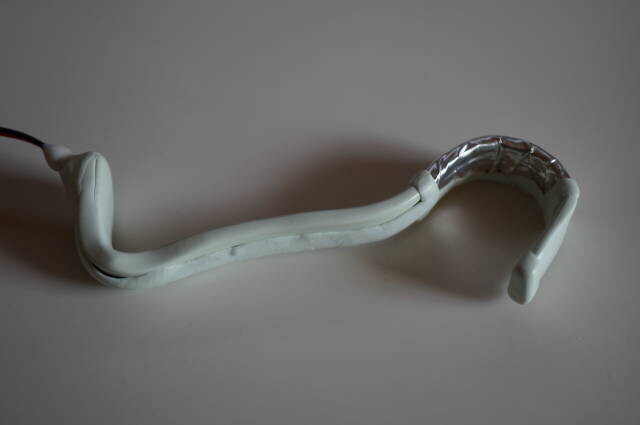
In an entry published in December 2018, a requester asked whether OK Lab could make an anal chip with electrical contacts. They reported that their homemade prototype kept stimulation in the intended place and felt comfortable.
Their proposed exposed width was 1cm–1.5cm; they reported severe pain at 1cm or less, and weaker stimulation with wider exposure. Mr. Okada made a prototype, but his newly ordered stimulator had not arrived for testing. He made acceptance of the request conditional on checking whether the wiring could be bonded to the chip.
(Source: ok-lab's diary, published December 2018)
https://ok-lab.hatenablog.com/entry/20181208/1544250742
Anal chip electrodes caused prickling despite a promising follow-up
An entry published in December 2018 reported prickling from the maker's prototype; the metal, electrode width, and overall shape were possible explanations. Mr. Okada initially suspended development, recalling his earlier conclusion that direct metal contact with moist mucosa (the tissue lining) was unsuitable. The requester's follow-up reported no prickling under unchanged test conditions with an 18mm lower electrode.
That revision involved aluminum foil and concerned this particular prototype. He still considered prickling possible because conditions, individual differences, and actual contact area could vary. His final position was to withhold general supply while accepting custom work made to a customer's specifications.
(Source: ok-lab's diary, published December 2018)
https://ok-lab.hatenablog.com/entry/20181215/1544857573
Anal chip electrodes became cheaper after the production method changed
An entry published in March 2019 announced lower electrode-fitting prices after a change in production. For one electrode per chip, the charge fell from ¥5,000 (about $32 at ¥156 = $1, rate as of 2026-09-04) to ¥3,000 (about $19 at ¥156 = $1, rate as of 2026-09-04), excluding tax. For two electrodes per chip, it fell from ¥8,000 (about $51 at ¥156 = $1, rate as of 2026-09-04) to ¥5,000 (about $32 at ¥156 = $1, rate as of 2026-09-04), excluding tax.
The entry attributed the reduction to easier work on already completed chips. Mr. Okada said electrical function was largely unchanged, although the appearance would be slightly worse. He offered requests outside his chosen research samples as paid custom work.
(Source: ok-lab's diary, published March 2019)
https://ok-lab.hatenablog.com/entry/2019/03/16/165528
Anal chip electrodes gained snap connections with separate fitting charges
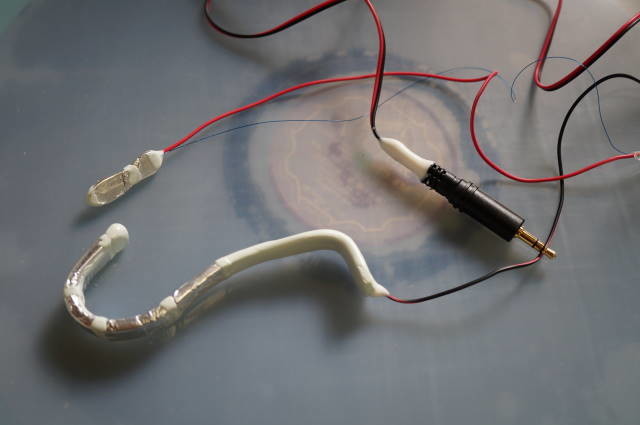
In an entry published in April 2019, Mr. Okada described snap-button connectors (fastening electrical contacts) for electrode chips. The anal-chip price was the base price plus ¥4,000 (about $26 at ¥156 = $1, rate as of 2026-09-04) excluding tax. The published total for a one-bulge anal chip was ¥9,000 (about $58 at ¥156 = $1, rate as of 2026-09-04) excluding tax.
The listed cable lengths were 20cm, 25cm, and 30cm. Those were the choices in that entry, not sizes supplied by the current product list. Mr. Okada asked interested customers to send their requests by email.
(Source: ok-lab's diary, published April 2019)
https://ok-lab.hatenablog.com/entry/2019/04/13/150233
Anal chip electrodes remained possible after a single-cable proposal failed
In an entry published in May 2022, a customer requested two electrodes on a two-bulge resin U-turn anal chip. Mr. Okada said an earlier proposal had been dropped because a single cable seemed too thin to provide adequate strength.
The diary does not record how this customer's chip felt in use. Mr. Okada accepted the two-electrode request as custom work, explaining that the cable concern had caused earlier refusals.
(Source: ok-lab's diary, published May 2022)
https://ok-lab.hatenablog.com/entry/2022/05/07/123013
Anal chip electrodes gained an accepted single-contact design using parallel wires
In an entry published in February 2024, a customer requested one electrode on a one-bulge resin U-turn anal chip. Mr. Okada accepted after reconsidering a parallel cable (two wires running alongside each other) with a snap-button connection. He described this as his first accepted request of its kind, after earlier refusals over cable strength.
The quotation listed ¥5,500 (about $35 at ¥156 = $1, rate as of 2026-09-04) for the body and ¥2,200 (about $14 at ¥156 = $1, rate as of 2026-09-04) for electrode work. Cable work was ¥1,100 (about $7 at ¥156 = $1, rate as of 2026-09-04), and snap-button work was ¥2,200 (about $14 at ¥156 = $1, rate as of 2026-09-04). Mr. Okada cautioned that he could not test the arrangement himself and described its use as the customer's responsibility.
(Source: ok-lab's diary, published February 2024)
https://ok-lab.hatenablog.com/entry/2024/02/10/123023
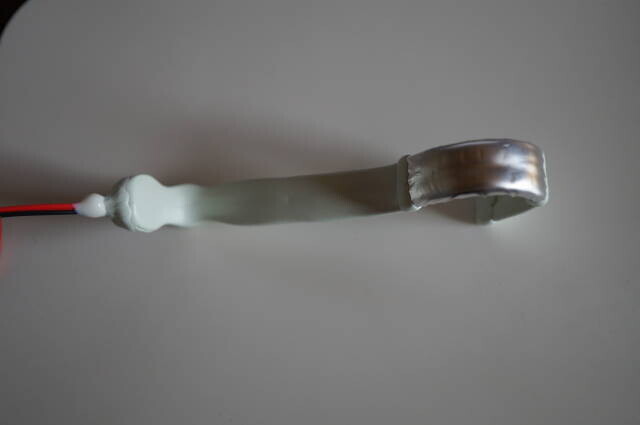
The maker's answer to anal chip electrodes
Mr. Okada's responses addressed electrode arrangement, controller faults, and whether a requested shape could be manufactured.
Anal chip electrodes received a resistance requirement in April 2019
In an entry published in April 2019, Mr. Okada adopted a one-electrode-per-mucosal-cavity principle. He wanted at least 500Ω of internal resistance (the body's resistance between contacts) in case the controller failed. He believed separated contacts would spread current more broadly than nearby contacts on the same moist lining.
The diary does not record whether that resistance was measured for a particular customer. For a skin-side contact accompanying an internal anal electrode, Mr. Okada specified the stimulator manufacturer's adhesive pad.
(Source: ok-lab's diary, published April 2019)
https://ok-lab.hatenablog.com/entry/2019/04/13/150233
Anal chip electrodes still carried a warning about controller failure
An entry published in August 2023 proposed a resin anal chip with a 3cm aluminum electrode and snap-button connection. Mr. Okada said the proposed urethral-and-rectal pairing lacked a capacitor (a component he described as blocking direct current).
He regarded arrangements retaining a manufacturer's pad differently because, in his explanation, the pad provided that protective function. Mr. Okada warned that controller failure could cause a strong shock in the pairing without that protection.
(Source: ok-lab's diary, published August 2023)
https://ok-lab.hatenablog.com/entry/2023/08/26/122534
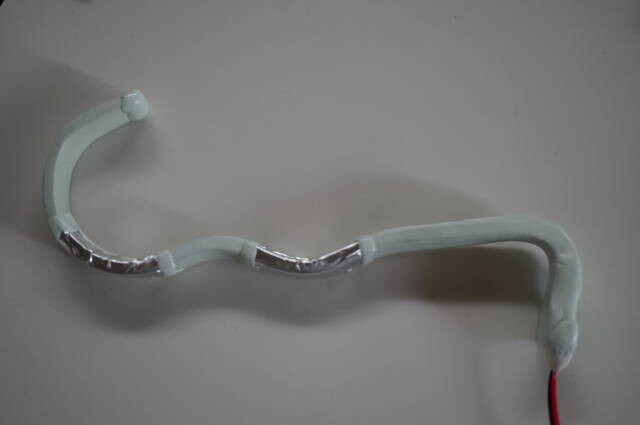
Wider anal chip electrodes required a shape the maker could finish
An entry published in July 2025 described a request for an anal electrode chip 50mm wide. Mr. Okada initially thought it feasible, then declined because the folded shape prevented completion of the resin covering (protective material over wiring). The customer proposed a version without the folded-back section, which he accepted.
He contrasted the request with the standard 30mm width. For substantially larger builds, he quoted an extra ¥1,000 (about $6 at ¥156 = $1, rate as of 2026-09-04) excluding tax per additional 20mm of chip length before bending. Mr. Okada said he would consider this larger shape through custom requests.
(Source: ok-lab's diary, published July 2025)
https://ok-lab.hatenablog.com/entry/2025/07/19/122907
If you see blood in your urine, even a small amount or for the first time, do not wait and see. See a urologist right away. If you suddenly cannot urinate, or the device cannot be removed, do not try to fix it yourself. Go to a medical facility, including emergency care, immediately.
How anal chip electrodes changed over time
| Published | What the diary said then |
|---|---|
| Dec 2018 | Prototype prickling prompted a development pause and limits on general supply. |
| Mar 2019 | A production change reduced electrode-fitting prices. |
| Apr 2019 | Mr. Okada adopted one electrode per mucosal cavity and a resistance requirement. |
| Aug 2019 | A custom-order reply said electrode chips could tolerate boiling disinfection. |
| May 2022 | Cable-strength concerns excluded an earlier proposal; a two-electrode anal build was accepted. |
| Aug 2023 | A proposed pairing came with a warning about strong shocks during controller failure. |
| Feb 2024 | Parallel wires and snap connections enabled acceptance of a single-electrode request. |
| Jul 2025 | A wider folded shape was refused; a revised shape and extra-length pricing were offered. |
| Aug 2026 | A customer asking about electrode fitting received an itemized custom quotation. |
The diary does not say what the current state is.
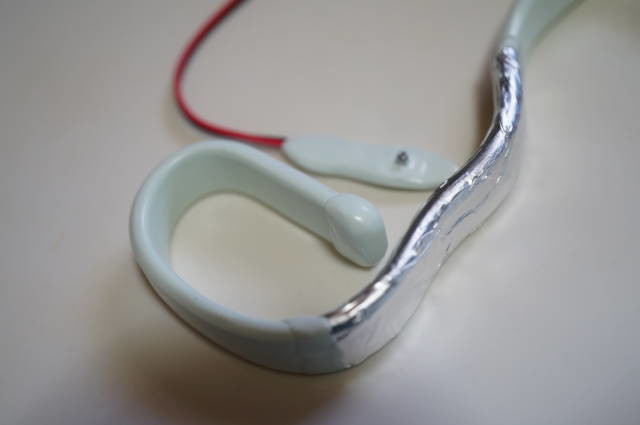
OK Prostate Chip products related to anal chip electrodes
The current list includes resin base chips, while the electrode work discussed here was quoted separately.
Products that appear in these entries
| Product (official name) | Price incl. tax | Relation to this topic |
|---|---|---|
| One-bulge resin U-turn anal chip (OKプロステートお尻チップ 樹脂素材1コブUターン型) | ¥5,500 (about $35 at ¥156 = $1, rate as of 2026-09-04) | The February 2024 customer requested this base chip with a single electrode. |
| Two-bulge resin U-turn anal chip (OKプロステートお尻チップ 樹脂素材2コブUターン型) | ¥6,600 (about $42 at ¥156 = $1, rate as of 2026-09-04) | The August 2026 customer asked whether electrodes could be added to this base chip. |
The one-bulge resin U-turn anal chip is listed in OK Lab's own online store.
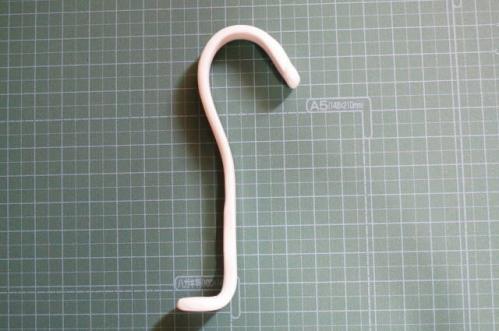
The two-bulge resin U-turn anal chip is listed in OK Lab's own online store.

(Source: ok-lab's diary, published February 2024)
https://ok-lab.hatenablog.com/entry/2024/02/10/123023
(Source: ok-lab's diary, published August 2026)
https://ok-lab.hatenablog.com/entry/2026/08/01/122916
Products the diary mentioned as alternatives
The diary names no alternative.
Early electrode prototypes and the enlarged custom build:
No matching product can be confirmed on the current list.
Common worries about anal chip electrodes
The recorded questions concern cleaning tolerance, the separate stimulator, and charges for custom electrode work.
"Does an anal chip electrode quote include the stimulator?"
An entry published in March 2019 includes a customer's question about cost with a low-frequency stimulator included. Mr. Okada offered a research prototype free because it matched work he was investigating. He explained that he could not personally test it.
The diary does not record this customer's later experience. Mr. Okada told the customer to obtain the stimulator separately.
(Source: ok-lab's diary, published March 2019)
https://ok-lab.hatenablog.com/entry/2019/03/16/165528
"Can anal chip electrodes withstand boiling?"
In an entry published in August 2019, a customer asked whether electrode-equipped chips could tolerate boiling disinfection. Mr. Okada replied that this was possible.
The diary does not record results from disinfection testing or later use. For the customer's requested pair, Mr. Okada also required matching snap-button connections because of the stimulator's specifications.
(Source: ok-lab's diary, published August 2019)
https://ok-lab.hatenablog.com/entry/2019/08/31/131337
"Can anal chip electrodes be added by custom order?"
In an entry published in August 2026, a customer asked about electrodes for a two-bulge resin U-turn anal chip. The quote listed a ¥6,600 (about $42 at ¥156 = $1, rate as of 2026-09-04) base chip and ¥2,200 (about $14 at ¥156 = $1, rate as of 2026-09-04) for each of two electrodes. Cable work was ¥1,100 (about $7 at ¥156 = $1, rate as of 2026-09-04), and plug work was ¥1,100 (about $7 at ¥156 = $1, rate as of 2026-09-04).
The diary does not record how that customer's finished chip performed. Mr. Okada answered the request with a quotation for this particular custom build.
(Source: ok-lab's diary, published August 2026)
https://ok-lab.hatenablog.com/entry/2026/08/01/122916
Buying from outside Japan

OK Lab ships internationally to countries covered by Japan Post's EMS courier service. Overseas orders are paid in advance by PayPal. Each order carries a ¥400 (about $3 at ¥156 = $1, rate as of 2026-09-04) handling fee, and EMS shipping is charged on top. These terms come from OK Lab's official sales-terms page (written here as plain text, not a link: ok-lab.net/docs/law), checked on September 7, 2026; confirm them on the official store before you order, because they can change.
Summary of this article
| What you wanted to know | The answer |
|---|---|
| What is the short answer? | Custom anal electrodes appear in the diary, alongside unresolved problems and restrictions. |
| What is the underlying product? | OK Lab's Japanese product range includes urethral chips and separate anal chips. |
| What do the technical terms mean? | Electrodes carry current; cables and connectors link them to a separate stimulator. |
| What happened in the cases? | Prototypes led to reports of prickling, revised designs, and separate charges for electrode work. |
| What was the maker's answer? | Mr. Okada changed construction and warned about controller failure and contact arrangements. |
| What changed over time? | Acceptance depended on the proposed cable, electrode arrangement, and shape. |
| Which current products are related? | The current list includes the one-bulge and two-bulge resin U-turn base chips. |
| What did customers ask? | Questions covered boiling tolerance, stimulator supply, and custom electrode fitting. |
| How do overseas purchases work? | The stated terms use advance PayPal payment, an order handling fee, and EMS shipping. |
Source: ok-lab's diary (Okada Comfortable Life Laboratory). The original entries are in Japanese; quotations on this page are translated. Photos and videos are on the original entries.
This article is a summary of the maker's development diary. The product is not a medical device and no result is guaranteed. If anything feels wrong or worries you, see a doctor. Prices, specifications and cautions change, so confirm the latest information on the official blog and the official site. Questions about ordering and shipping go to the seller.