![How much do custom electrodes cost? | The chip, wiring, and connectors determine the quote [OK Prostate Chip]](/img/a/T0259/eyecatch.svg)
This page is based on entries from "ok-lab's diary" (https://ok-lab.hatenablog.com/), the Japanese development diary written by Mr. Okada, founder of OK Lab, a small company in Japan (Okada Comfortable Life Laboratory). Only the entries about "custom electrodes and pricing" are summarized here, in order of publication. Past prices and sizes are as written at the time. Current prices come from the official product list (retrieved September 4, 2026). Quotations are translated from Japanese.
Note: This page is a personal reading log by someone with no connection to the maker or the seller. It reflects the source entries as of their publication dates and makes no guarantee of accuracy or safety. The product is not a medical device; talk to a doctor about any health decision. Check the official site for current information. This page contains advertising.
In short
- Custom electrode quotes separate the chip, electrode work, cables, and connectors.
- Mr. Okada described construction limits and electrical risks, including effects he could not verify beforehand.
- The current list includes a related rectal base chip; the diary's electrode builds carry historical custom quotes.
About this product
The OK Prostate Chip is a small device that is placed in the urethra (the urine passage) so that it acts on the prostate; the maker sells it in several shapes, sizes and materials. It is made and sold by OK Lab (Okada Comfortable Life Laboratory), a small company in Japan, through its own online store, and prices are in Japanese yen (JPY). The maker's development diary, "ok-lab's diary", is written in Japanese. This page is an English summary of it, and every quotation is translated. OK Lab ships internationally, so readers outside Japan can order (see "Buying from outside Japan" below). Product names on this page are plain-English descriptions. The official Japanese product name is shown once in the product table so you can find the same item in the store.
Before you read: key terms
| Term | Plain-English meaning |
|---|---|
| Urethra | The urine passage; the urethral chip is placed there to act on the prostate. |
| Electrode | An electrical contact on a chip, intended to deliver electrical stimulation. |
| Low-frequency stimulator | The separate electrical stimulation device that the customized chip connects to. |
| Snap fastener | A button-style electrical connector used to join the chip's cable to the stimulation equipment. |
| Miniature plug | A connector that joins both electrode leads to the stimulation equipment. |
| Semi-long | An intermediate chip length used as a base for some custom electrodes. |
| Electrical resistance | Opposition to current; Mr. Okada cited it as part of his proposed protection against equipment failure. |
| Short circuit | An unintended electrical connection; the diary discusses it as a problem between wet electrode contacts. |
| Capacitor | A component Mr. Okada described as blocking direct current, with a protective role if the controller failed. |
| Nylon-twisted cable | A conductive cable incorporating nylon thread, developed to carry current while providing strength. |
| Silicone-covered parallel cable | Paired wires enclosed in a silicone tube; the tube covers part of the cable assembly. |
| Cable stopper | A separately priced cable part. Its purpose in these electrode quotes: The diary does not explain this. |
What happens: custom electrodes and pricing
The OK Prostate Chip is a small device placed in the urethra (the urine passage) to act on the prostate. Electrode customization adds electrical contacts to a chip, with cables and connectors for a low-frequency stimulator (the separate device supplying electrical stimulation). The diary describes these attachments on urethral and rectal models, including resin and stainless steel versions. Requests covered contact numbers, chip dimensions, cable construction, connector choice, and separate charges for those parts.
A simpler manufacturing method lowered electrode prices in March 2019
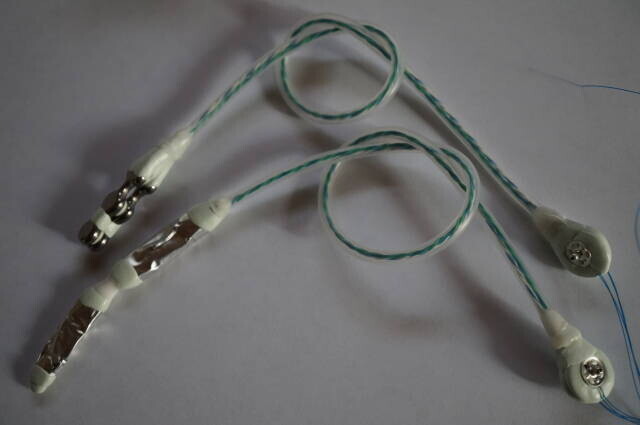
In an entry published in March 2019, Mr. Okada announced lower electrode customization fees. Electrodes and wires attached to finished chips replaced the earlier construction with those parts embedded in resin. He attributed the price reduction to easier manufacturing.
For 1 chip, fees fell from ¥5,000 (about $32 at ¥156 = $1, rate as of 2026-09-04) to ¥3,000 (about $19 at ¥156 = $1, rate as of 2026-09-04) for 1 electrode and ¥8,000 (about $51 at ¥156 = $1, rate as of 2026-09-04) to ¥5,000 (about $32 at ¥156 = $1, rate as of 2026-09-04) for 2 electrodes, excluding tax. Mr. Okada said electrical function would be almost unchanged. He also warned that the appearance would be slightly worse.
(Source: ok-lab's diary, published March 2019)
https://ok-lab.hatenablog.com/entry/2019/03/16/165528
Connector choice changed the paired resin electrode quote in May 2019
In an entry published in May 2019, Mr. Okada explained revised charges through a custom connected resin pair. The base chips were priced without threads, while electrode attachment and cable attachment each cost ¥1,000 (about $6 at ¥156 = $1, rate as of 2026-09-04) per electrode. A miniature plug (a connector joining both electrode leads to the stimulation equipment) cost ¥1,000 (about $6 at ¥156 = $1, rate as of 2026-09-04).
The quoted resin pair totaled ¥7,000 (about $45 at ¥156 = $1, rate as of 2026-09-04) with that plug. Separate snap fasteners (button-style electrical connectors) were priced at ¥2,000 (about $13 at ¥156 = $1, rate as of 2026-09-04) per electrode. Mr. Okada specified a ¥3,000 (about $19 at ¥156 = $1, rate as of 2026-09-04) increase if those connectors were chosen for this build.
(Source: ok-lab's diary, published May 2019)
https://ok-lab.hatenablog.com/entry/2019/05/11/152432
Stainless steel electrodes switched connectors for trial sales in August 2023
In an entry published in August 2023, Mr. Okada reported finding the proposed USB connector bulky and inconvenient. He switched to snap fasteners after considering how the connector suited a nylon-twisted cable (a conductive cable incorporating nylon thread). The decision whether to sell the USB arrangement was put on hold.
The trial specification had a 25cm cable, a snap fastener connection, and then two threads measuring 10cm. The stated surcharge was the ordinary stainless steel chip price plus ¥4,000 (about $26 at ¥156 = $1, rate as of 2026-09-04) excluding tax. Mr. Okada favored the snap fastener because he considered it better suited to the thin cable.
(Source: ok-lab's diary, published August 2023)
https://ok-lab.hatenablog.com/entry/2023/08/26/122534
The covered electrode cable had a manufacturing limit in October 2025
In an entry published in October 2025, a custom quote specified a resin semi-long chip (an intermediate-length model), 44mm long and 8mm wide. It listed a ¥2,200 (about $14 at ¥156 = $1, rate as of 2026-09-04) body, ¥4,400 (about $28 at ¥156 = $1, rate as of 2026-09-04) two-electrode work, a ¥1,100 (about $7 at ¥156 = $1, rate as of 2026-09-04) connection plug, and a ¥2,200 (about $14 at ¥156 = $1, rate as of 2026-09-04) covered cable. The silicone-covered parallel cable (paired wires enclosed in a silicone tube) had a manufacturing limit of 25cm.
Mr. Okada explained that approximately 15cm beyond that covered section would be ordinary parallel cable. The diary does not record how this cable arrangement felt in use.
(Source: ok-lab's diary, published October 2025)
https://ok-lab.hatenablog.com/entry/2025/10/04/122910
Both requested electrode layouts were completed with covered cables in February 2026
In an entry published in February 2026, one customer requested both electrode layouts described in the diary, each with covered nylon-twisted cables. The first quote listed short M stainless steel chips at ¥7,700 (about $49 at ¥156 = $1, rate as of 2026-09-04) × 2 and nylon-twisted cables at ¥4,400 (about $28 at ¥156 = $1, rate as of 2026-09-04) × 2. It also listed joining work at ¥1,100 (about $7 at ¥156 = $1, rate as of 2026-09-04) and tube coating at ¥4,400 (about $28 at ¥156 = $1, rate as of 2026-09-04).
The other layout listed each chip's body, cable, and electrode work as ¥1,100 (about $7 at ¥156 = $1, rate as of 2026-09-04) + ¥1,100 (about $7 at ¥156 = $1, rate as of 2026-09-04) + ¥2,200 (about $14 at ¥156 = $1, rate as of 2026-09-04). Its remaining items were resin between chips at ¥1,100, (about $7 at ¥156 = $1, rate as of 2026-09-04) nylon-twisted cables at ¥4,400 (about $28 at ¥156 = $1, rate as of 2026-09-04) × 2, and tube coating at ¥4,400 (about $28 at ¥156 = $1, rate as of 2026-09-04). Mr. Okada reported completing both, but the diary does not record their performance in use.
(Source: ok-lab's diary, published February 2026)
https://ok-lab.hatenablog.com/entry/2026/02/07/122919
Resin electrode quotes separated body and attachment charges in August 2026
In an entry published in August 2026, a quotation covered a resin rectal electrode chip and a resin long M electrode chip. The two-bulb U-turn rectal body cost ¥6,600 (about $42 at ¥156 = $1, rate as of 2026-09-04), with electrode work at ¥2,200 (about $14 at ¥156 = $1, rate as of 2026-09-04) × 2. Its cable and plug each cost ¥1,100 (about $7 at ¥156 = $1, rate as of 2026-09-04).
The long M body cost ¥4,400 (about $28 at ¥156 = $1, rate as of 2026-09-04), with two-electrode work at ¥4,400 (about $28 at ¥156 = $1, rate as of 2026-09-04). A cable stopper (a separately priced cable part), cable work, and plug work each cost ¥1,100 (about $7 at ¥156 = $1, rate as of 2026-09-04) for that model. The diary does not record how either quoted device performed in use.
(Source: ok-lab's diary, published August 2026)
https://ok-lab.hatenablog.com/entry/2026/08/15/122912
The maker's answer to custom electrodes and pricing
Mr. Okada described ordering restrictions, contact-area concerns, and electrical risks alongside the custom options.
Custom electrodes were limited to one contact per opening in April 2019
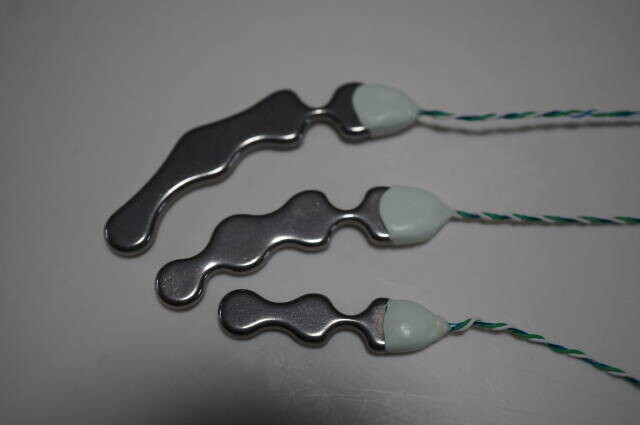
In an entry published in April 2019, Mr. Okada adopted one electrode per internal lining, expressed as one per opening. He wanted at least 500Ω of internal electrical resistance (opposition to current) between electrodes if the controller failed. He presented that requirement as a precaution against equipment failure, including when nonstandard contacts were involved.
The diary does not record measurements confirming that resistance. Mr. Okada requested email inquiries and limited acceptance to his stated condition of one electrode per opening.
(Source: ok-lab's diary, published April 2019)
https://ok-lab.hatenablog.com/entry/2019/04/13/150233
Urine changed electrode behavior in Mr. Okada's April 2019 explanation
In an entry published in April 2019, Mr. Okada discussed urine passing a urethral electrode chip. He wrote that wetting could cause a short circuit (an unintended electrical connection) between the contacts of a two-electrode chip. For a single-electrode chip, he said urine increased conduction between the electrode and the urethra. Mr. Okada also favored semi-long or longer chips because he considered the urethral contact area limited.
(Source: ok-lab's diary, published April 2019)
https://ok-lab.hatenablog.com/entry/2019/04/13/150233
Internal electrode pairs prompted a warning about equipment failure in August 2023
In an entry published in August 2023, Mr. Okada warned about paired urethral electrodes and combinations of urethral and rectal electrodes. He said these lacked a capacitor (a component he described as blocking direct current). According to his explanation, controller failure could then cause a strong electrical shock. He believed a manufacturer's adhesive electrode pad provided that protection when included in an arrangement.
(Source: ok-lab's diary, published August 2023)
https://ok-lab.hatenablog.com/entry/2023/08/26/122534
How custom electrodes and pricing changed over time
| Published | What the diary said then |
|---|---|
| Mar 2019 | Mr. Okada described electrode stimulation as adjustable to individual preferences. |
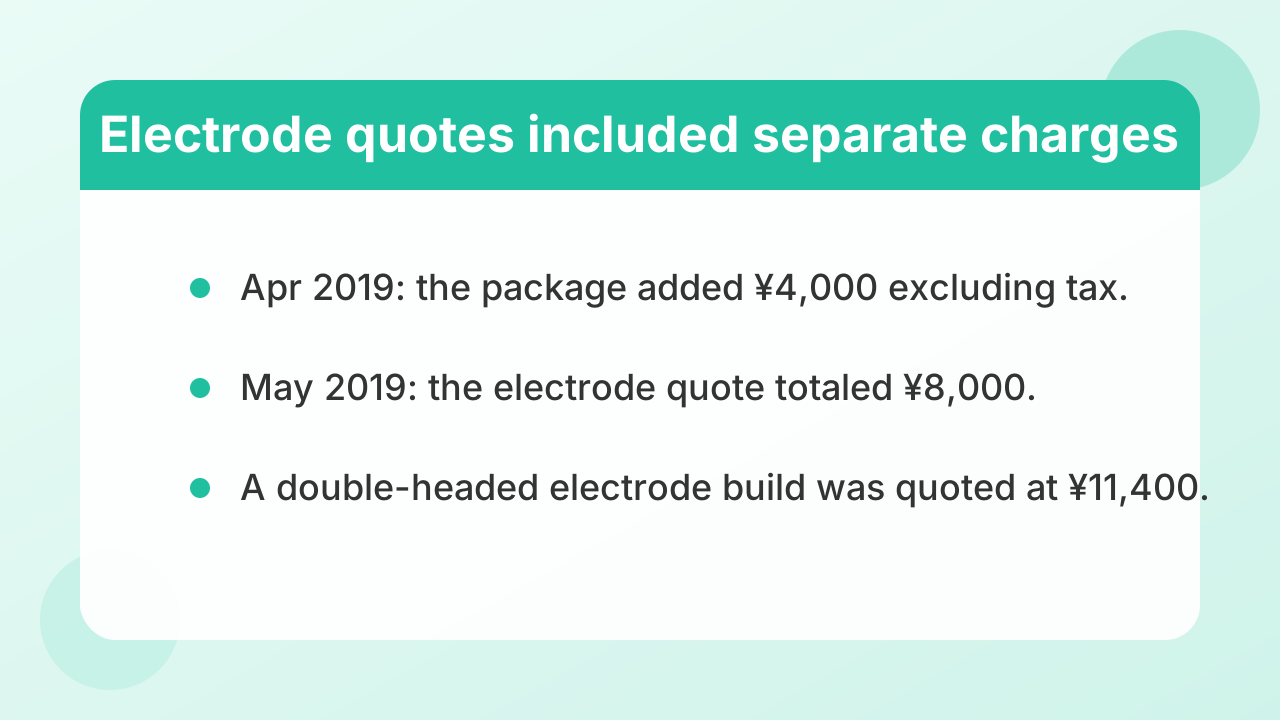
| Apr 2019 | The snap-connected electrode package added ¥4,000 (about $26 at ¥156 = $1, rate as of 2026-09-04) excluding tax to the relevant base price. |
| May 2019 | An electrode quote with a ¥4,000 (about $26 at ¥156 = $1, rate as of 2026-09-04) base chip totaled ¥8,000 (about $51 at ¥156 = $1, rate as of 2026-09-04). |
| Feb 2020 | A motor-free, double-headed electrode build was quoted at ¥11,400 (about $73 at ¥156 = $1, rate as of 2026-09-04). |
| Aug 2023 | Mr. Okada reported establishing a reliable connection between stainless steel chips and nylon-twisted cables. |
OK Prostate Chip products related to custom electrodes and pricing
The current list prices the two-bulb U-turn resin rectal base chip at ¥6,600 (about $42 at ¥156 = $1, rate as of 2026-09-04) including tax.
Products that appear in these entries
| Product (official name) | Price incl. tax | Relation to this topic |
|---|---|---|
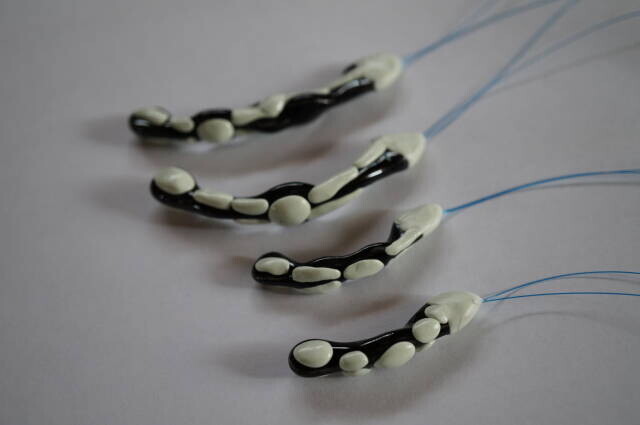
| Two-bulb U-turn resin rectal chip (OKプロステートお尻チップ 樹脂素材2コブUターン型) | ¥6,600 (about $42 at ¥156 = $1, rate as of 2026-09-04) | An August 2026 electrode quotation priced this base separately from its electrode work, cable, and plug. |
(Source: ok-lab's diary, published August 2026)
https://ok-lab.hatenablog.com/entry/2026/08/15/122912
Products the diary mentioned as alternatives
The diary names no alternative.
The resin, stainless steel, and aluminum electrode assemblies discussed here are custom builds. No matching product can be confirmed on the current list.
Common worries about custom electrodes and pricing
Customer questions concerned the separate stimulator, smaller chips, aluminum pricing, and individually wired contacts.
"Does custom electrode pricing include the stimulation device?"

In an entry published in March 2019, a customer seeking stronger stimulation asked about an electrode chip together with the stimulation device. Mr. Okada offered a research prototype free of charge. He said his heart condition prevented him from testing electrode chips himself.
He therefore described his assessment as dependent on user reports and placed responsibility for use on the customer. The diary does not record the customer's experience with the proposed sample. Mr. Okada asked the customer to purchase the low-frequency stimulator separately.
(Source: ok-lab's diary, published March 2019)
https://ok-lab.hatenablog.com/entry/2019/03/16/165528
"Can a shorter resin chip receive custom electrodes?"
In an entry published in April 2020, a customer requested electrodes on a resin semi-long chip. Mr. Okada agreed but noted the smaller electrode area, adding that he could not verify the effect beforehand. He offered lengths of 42-48mm and said two-electrode work was difficult below 42mm.
The quote listed a ¥2,200 (about $14 at ¥156 = $1, rate as of 2026-09-04) body, ¥4,400 (about $28 at ¥156 = $1, rate as of 2026-09-04) electrode work, a ¥1,100 (about $7 at ¥156 = $1, rate as of 2026-09-04) plug, and a ¥400 (about $3 at ¥156 = $1, rate as of 2026-09-04) fee: ¥8,100 (about $52 at ¥156 = $1, rate as of 2026-09-04). The customer accepted and selected 44mm with the standard 70cm cable; the diary does not record the resulting sensation. Mr. Okada noted that customers supplying their own extension cable sometimes requested 50cm.
(Source: ok-lab's diary, published April 2020)
https://ok-lab.hatenablog.com/entry/2020/04/04/152310
"What did the paired aluminum electrodes cost?"
In an entry published in October 2025, a customer requested a quote for the paired aluminum electrodes. Mr. Okada repeated the earlier advertised price of ¥10,000 (about $64 at ¥156 = $1, rate as of 2026-09-04), or ¥11,000 (about $70 at ¥156 = $1, rate as of 2026-09-04) including tax. The diary does not record whether this order was completed.
(Source: ok-lab's diary, published October 2025)
https://ok-lab.hatenablog.com/entry/2025/10/04/122910
"Can custom electrodes have separate snap fastener leads?"
In an entry published in August 2026, a customer requested a two-bulb U-turn resin rectal chip with two electrodes and snap fasteners. Its quote listed a ¥6,600 (about $42 at ¥156 = $1, rate as of 2026-09-04) base and electrode work at ¥2,200 (about $14 at ¥156 = $1, rate as of 2026-09-04) × 2. Two 35cm parallel cables cost ¥2,200 (about $14 at ¥156 = $1, rate as of 2026-09-04), and two snap fasteners cost ¥2,200 (about $14 at ¥156 = $1, rate as of 2026-09-04). The diary does not record whether this separately wired order was completed.
(Source: ok-lab's diary, published August 2026)
https://ok-lab.hatenablog.com/entry/2026/08/22/122905
Buying from outside Japan
OK Lab ships internationally to countries covered by Japan Post's EMS courier service. Overseas orders are paid in advance by PayPal. Each order carries a ¥400 (about $3 at ¥156 = $1, rate as of 2026-09-04) handling fee, and EMS shipping is charged on top. These terms come from OK Lab's official sales-terms page (written here as plain text, not a link: ok-lab.net/docs/law), checked on September 7, 2026; confirm them on the official store before you order, because they can change.
Summary of this article
| What you wanted to know | The answer |
|---|---|
| In short: what determines the quote? | The chip, electrode work, cables, and connectors. |
| About this product: what is the device? | A chip made in Japan, placed in the urine passage to act on the prostate. |
| Key terms: what does customization involve? | Electrical contacts, wiring, connectors, and sometimes additional cable coverings. |
| What happens: why do quotes differ? | Construction methods, contact numbers, cable specifications, and connector choices differ. |
| The maker's answer: what limits did he describe? | Ordering restrictions, limited contact area, and concerns about equipment failure. |
| Changes over time: what developed? | Fees were revised, and new cable and connector arrangements appeared. |
| Related products: what is listed currently? | The two-bulb U-turn resin rectal base chip; its listed price does not include historical custom work. |
| Common worries: what did customers ask? | Whether equipment was included, smaller-chip feasibility, aluminum prices, and separate leads. |
| Buying internationally: what terms are stated? | Advance PayPal payment, EMS delivery, and separate handling and shipping charges. |
Source: ok-lab's diary (Okada Comfortable Life Laboratory). The original entries are in Japanese; quotations on this page are translated. Photos and videos are on the original entries.
This article is a summary of the maker's development diary. The product is not a medical device and no result is guaranteed. If anything feels wrong or worries you, see a doctor. Prices, specifications and cautions change, so confirm the latest information on the official blog and the official site. Questions about ordering and shipping go to the seller.