![Can a connector stay inside the urethra? | The maker warned against some plug designs [OK Prostate Chip]](/img/a/T0258/eyecatch.svg)
This page is based on entries from "ok-lab's diary" (https://ok-lab.hatenablog.com/), the Japanese development diary written by Mr. Okada, founder of OK Lab, a small company in Japan (Okada Comfortable Life Laboratory). Only the entries about "connectors intended to remain inside the urethra" are summarized here, in order of publication. Past prices and sizes are as written at the time. Current prices come from the official product list (retrieved September 4, 2026). Quotations are translated from Japanese.
Note: This page is a personal reading log by someone with no connection to the maker or the seller. It reflects the source entries as of their publication dates and makes no guarantee of accuracy or safety. The product is not a medical device; talk to a doctor about any health decision. Check the official site for current information. This page contains advertising.
In short
- Some early urethral connectors were intended to stay inside, but the maker later discouraged internal use of certain plugs.
- Mr. Okada's replies distinguish connector designs, waterproofing limits, and cable-strength problems.
- The current product list includes related vibrating chips and controllers.
About this product

The OK Prostate Chip is a small device that is placed in the urethra (the urine passage) so that it acts on the prostate; the maker sells it in several shapes, sizes and materials. It is made and sold by OK Lab (Okada Comfortable Life Laboratory), a small company in Japan, through its own online store, and prices are in Japanese yen (JPY). The maker's development diary, "ok-lab's diary", is written in Japanese. This page is an English summary of it, and every quotation is translated. OK Lab ships internationally, so readers outside Japan can order (see "Buying from outside Japan" below). Product names on this page are plain-English descriptions. The official Japanese product name is shown once in the product table so you can find the same item in the store.
Before you read: key terms
| Term | Plain-English meaning |
|---|---|
| Urethra | The urine passage; the chip and some experimental connectors were intended to remain inside it. |
| Controller | The unit connected to a vibrating chip to operate its motor. |
| Mini DC connector | A small electrical connection developed so a vibrating chip could be separated from its controller. |
| Male and female connectors | The projecting and receiving halves of a connection, used to join electrical parts. |
| Electrode | A contact intended to carry electrical stimulation; these entries discuss contacts incorporated into chips. |
| Snap-button connector | A button-style electrical connection used between an electrode chip's cable and stimulation equipment. |
| Separate pins | Individual electrical contacts developed for a detachable connection small enough for a gatekeeper's opening. |
| Gatekeeper | An accessory intended to help keep a chip in place, with an opening for its cable. |
| USB plug | An electrical plug used here to connect a vibrating chip's cable to its controller. |
| Auxiliary chip | A secondary chip intended to help keep the main chip in place. |
| Perineum | The diary does not explain this. Mr. Okada mentions it as a location for the battery box. |
What happens: urethral connectors
The OK Prostate Chip is a small device placed in the urethra to act on the prostate. Urethral connectors separate a vibrating chip from its controller (the unit operating its motor). Other designs connect an electrode (a contact for electrical stimulation) to an external device. Some early connectors were intended to remain inside the urethra when disconnected. Mr. Okada discouraged some later plugs for internal placement; other designs provided detachable connections for cables outside the body.
Detachable connectors initially seemed less convenient than the small battery box
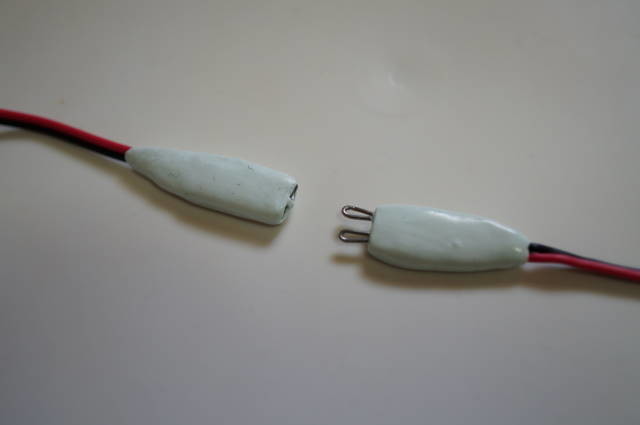
In an entry published in January 2019, a customer wanted a detachable power connection for different power sources and vibration patterns. Mr. Okada found the small, light battery box convenient at the perineum (a body location the diary does not explain). His reply favored keeping that arrangement because he thought separating the connection would make it less convenient.
(Source: ok-lab's diary, published January 2019)
https://ok-lab.hatenablog.com/entry/20190112/1547275441
The mini DC connector had different waterproofing on each side
An entry published in April 2019 introduced a handmade mini DC connector, roughly the size of an auxiliary chip (a secondary retaining piece). Mr. Okada described the chip-side male connector (the projecting half) as fully waterproof, but the controller-side female connector (the receiving half) was not. The planned connection charges were ¥2,000 (about $13 at ¥156 = $1, rate as of 2026-09-04) for each half, or ¥4,000 (about $26 at ¥156 = $1, rate as of 2026-09-04) for the usual set, all excluding tax.
Mr. Okada wanted the controller detachable because he sometimes preferred the chip without its motor running. The connector was custom-only, including additions to completed chips, with about 5 days needed for the resin to dry. For poor electrical contact, Mr. Okada suggested adjustment of the connector.
(Source: ok-lab's diary, published April 2019)
https://ok-lab.hatenablog.com/entry/2019/04/06/151323
Snap-button connectors brought a chip-shaped connection to electrode builds
An entry published in April 2019 introduced a snap-button connector (a button-style electrical connection) with the outer shape of a short resin chip. Cable options were 20cm, 25cm, and 30cm. Electrode work cost ¥4,000 (about $26 at ¥156 = $1, rate as of 2026-09-04) above the threadless chip price, excluding tax.
The published examples were ¥7,000 (about $45 at ¥156 = $1, rate as of 2026-09-04) for a semi-long glass electrode chip and ¥5,000 (about $32 at ¥156 = $1, rate as of 2026-09-04) for a short resin electrode chip, excluding tax. For urethral electrode chips, Mr. Okada favored semi-long or longer shapes because he wanted a larger contact area.
(Source: ok-lab's diary, published April 2019)
https://ok-lab.hatenablog.com/entry/2019/04/13/150233
Later detachable plugs came with a warning against internal use
In an entry published in September 2019, a customer asked whether a vibrating chip with a detachable plug could be ordered. Mr. Okada said regular sales would take time, but custom conversion was available for ¥2,160 (about $14 at ¥156 = $1, rate as of 2026-09-04) extra. The customer requested the glass-chip assembly with a selected connection point along its 70cm cable; completion is not recorded.
This design had the female connector on the chip side and the male connector on the controller side. Mr. Okada warned that the unconnected male end could hurt inside the urethra, and cavities in both halves were difficult to clean. His reply therefore discouraged urethral use of these plugs as a general rule.
(Source: ok-lab's diary, published September 2019)
https://ok-lab.hatenablog.com/entry/2019/09/07/135854
Detachable connectors did not guarantee compatibility with outside controllers
In an entry published in November 2019, a customer wanted an extended ceramic vibrating chip with interchangeable electronic and basic controllers. Plug work cost ¥1,100 (about $7 at ¥156 = $1, rate as of 2026-09-04) for 1 connection, with 3 connections for the chip and 2 controllers adding ¥3,300 (about $21 at ¥156 = $1, rate as of 2026-09-04). The diary does not record whether that customer's order was completed.
The entry's corrected account says the third-party R-1 controller required its dedicated cable despite using only 2 wires. OK Lab consequently put the launch of R-1-compatible products on hold. Mr. Okada's corrected reply withdrew that proposed compatibility option.
(Source: ok-lab's diary, published November 2019)
https://ok-lab.hatenablog.com/entry/2019/11/23/162919
Separate-pin connectors addressed an opening too narrow for existing plugs
An entry published in April 2022 introduced separate pins (individual electrical contacts) for a gatekeeper, an accessory with a cable opening. Its inner diameter was 4mm; Mr. Okada had found no suitable commercial plug measuring 6mm or less. He also considered a homemade two-contact plug of 5mm or less too weak.
The individual pins had an outer diameter of 3mm, with a special USB plug (an electrical plug for the controller connection). Published prices were ¥3,000 (about $19 at ¥156 = $1, rate as of 2026-09-04) excluding tax for the dedicated 4-wire vibrating-chip USB plug and ¥2,000 (about $13 at ¥156 = $1, rate as of 2026-09-04) excluding tax for separate-pin processing. Mr. Okada described the adapter as a shared component for compatible chips and controllers.
(Source: ok-lab's diary, published April 2022)
https://ok-lab.hatenablog.com/entry/2022/04/30/123451
A detachable connector quote separated pin work from the USB adapter
In an entry published in June 2022, a customer requested a vibrating ceramic chip with a removable gatekeeper arrangement. For the 4-wire assembly, the quote listed ¥2,200 (about $14 at ¥156 = $1, rate as of 2026-09-04) for separate-pin work and ¥3,300 (about $21 at ¥156 = $1, rate as of 2026-09-04) for the removable USB connection. The diary does not record how that customer's detachable assembly felt in use.
(Source: ok-lab's diary, published June 2022)
https://ok-lab.hatenablog.com/entry/2022/06/04/123036
A later snap-button connector quote priced the cable and covering separately
In an entry published in May 2025, a customer requested a semi-long surgical stainless steel chip with a snap-button connection. The quote listed ¥4,400 (about $28 at ¥156 = $1, rate as of 2026-09-04) for the conductive twisted-thread cable assembly and ¥2,200 (about $14 at ¥156 = $1, rate as of 2026-09-04) for silicone-tube work. The diary does not record whether this quoted order was completed.
(Source: ok-lab's diary, published May 2025)
https://ok-lab.hatenablog.com/entry/2025/05/31/122940
The maker's answer to urethral connectors
OK Lab's later changes addressed exposed pins, fragile cables, and connector fit through specific design revisions.
Separate-pin connectors gained a tube covering after skin irritation

An entry published in May 2022 shortened the dedicated four-wire USB plug compared with an ordinary USB-A plug. Mr. Okada wrote that the narrow pins could feel irritating against skin. He proposed a covering tube with 4mm inner diameter and 6mm outer diameter as the response to that irritation.
(Source: ok-lab's diary, published May 2022)
https://ok-lab.hatenablog.com/entry/2022/05/07/123013
Snap-button connectors on thin cables raised concerns about breakage
In an entry published in July 2024, a customer asked for a resin electrode chip with twisted-thread cable and snap buttons. OK Lab warned about increased breakage risk with thin cable and said parallel cable could not be attached to that resin electrode. The customer asked whether a tube-covered cable with joined terminal buttons would match the strength of a stainless steel chip's arrangement.
Mr. Okada reported that a prototype passed an electrical connection test, establishing that the build was possible. The diary does not record a test confirming the customer's proposed strength comparison. OK Lab favored tube covering for added strength and warned that separated terminal buttons also raised strength concerns.
(Source: ok-lab's diary, published July 2024)
https://ok-lab.hatenablog.com/entry/2024/07/20/123059
Double snap-button connectors required more than a larger button
In an entry published in October 2024, a customer supplied snap buttons for a double-sided connection on a stainless steel chip. The button portion measured 4mm, rather than the 3.5mm size discussed in earlier correspondence. The customer confirmed the fit and clarified that both buttons were intended to connect to the same electrode.
OK Lab first explained that its usual resin-backed construction did not readily allow both button faces to remain open. The entry later presented a result and video, but did not report an electrical performance test of the proposed arrangement. OK Lab's reply asked for the intended purpose and confirmation that the buttons fitted the customer's equipment.
(Source: ok-lab's diary, published October 2024)
https://ok-lab.hatenablog.com/entry/2024/10/26/122649
How urethral connectors changed over time

| Published | What the diary said then |
|---|---|
| Apr 2019 | A handmade mini connector introduced detachable operation with unequal waterproofing between its halves. |
| Apr 2019 | A snap-button terminal used the outer shape of a short resin chip. |
| Sep 2019 | A later plug design prompted cautions about pain and difficult internal cleaning. |
| Nov 2019 | R-1 compatibility plans were suspended after dedicated-cable requirements emerged. |
| Apr 2022 | Individual pins addressed the gatekeeper opening's size limit. |
| May 2022 | A shorter USB plug and pin-covering tube revised the design. |
| Dec 2022 | Six-wire production had stopped; two-wire builds could not support separate controllers. |
| Jul 2024 | A resin electrode prototype with twisted-thread cable passed an electrical connection test. |
The diary does not say what the current state is.
OK Prostate Chip products related to urethral connectors
The current list includes chips and controllers from these cases; the quoted connector work was custom work.
Products that appear in these entries
| Product (official name) | Price incl. tax | Relation to this topic |
|---|---|---|
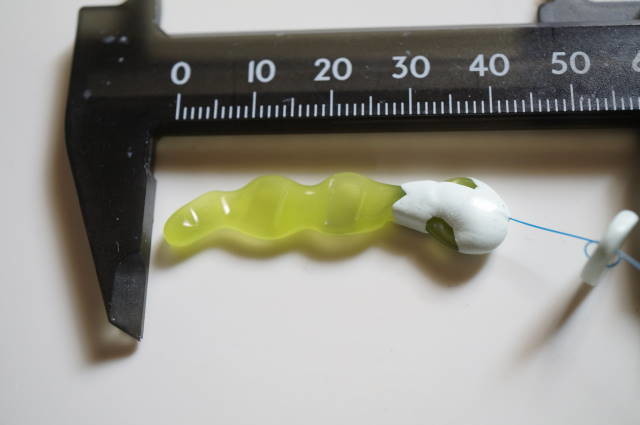
| Semi-long glass vibrating chip (OKプロステート核振チップ ガラス素材セミロングタイプ) | ¥6,600 (about $42 at ¥156 = $1, rate as of 2026-09-04) | The September 2019 customer requested this chip with a custom detachable connection. |
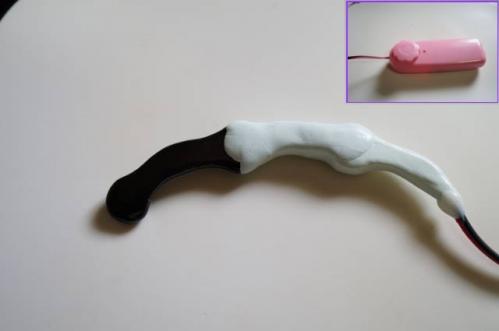
| Extended ceramic vibrating chip (OKプロステート核振チップ 陶器素材覚醒タイプ) | ¥7,700 (about $49 at ¥156 = $1, rate as of 2026-09-04) | The November 2019 customer requested this chip with interchangeable controllers. |
| Electronic controller upgrade (ICコントローラに変更(核振チップオプション)) | ¥2,200 (about $14 at ¥156 = $1, rate as of 2026-09-04) | The November 2019 request included this controller in the custom plug-work quote. |
| Basic controller upgrade (ローテクコントローラに変更(核振チップオプション)) | ¥1,100 (about $7 at ¥156 = $1, rate as of 2026-09-04) | The November 2019 customer requested this as the other interchangeable controller. |
The semi-long glass vibrating chip is listed in OK Lab's own online store.
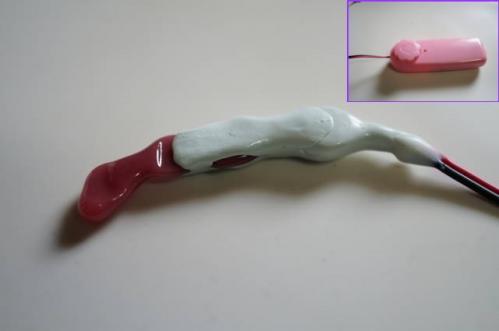
The extended ceramic vibrating chip is listed in OK Lab's own online store.
(Source: ok-lab's diary, published September 2019)
https://ok-lab.hatenablog.com/entry/2019/09/07/135854
(Source: ok-lab's diary, published November 2019)
https://ok-lab.hatenablog.com/entry/2019/11/23/162919
Products the diary mentioned as alternatives
The diary names no alternative.
Custom mini DC connectors, electrode assemblies, and separate-pin USB assemblies: No matching product can be confirmed on the current list.
Common worries about urethral connectors
Readers asked about awkward controllers, exposed cable, and whether separate pins were needed.
"Could a detachable connector make the controller less awkward?"

In an entry published in April 2019, a customer found their existing chip comfortable but the attached controller inconvenient. They requested a twisted glass vibrating chip with a mini DC connector and a 25cm cable. Mr. Okada said he had not made that vibrating shape before, but would attempt it. He offered to report the result the following week if successful; the supplied material does not confirm completion.
(Source: ok-lab's diary, published April 2019)
https://ok-lab.hatenablog.com/entry/2019/04/20/144337
"Could a connector inside the urethra replace exposed cable?"
In an entry published in July 2019, a customer wanted a non-vibrating curved ceramic chip without cable projecting outside the body. They asked which cable-end design would stay in place during urination. Mr. Okada proposed a hybrid with an auxiliary chip and nylon retrieval thread; both it and the connector-shaped proposal were ¥7,000 (about $45 at ¥156 = $1, rate as of 2026-09-04) excluding tax.
The version without an auxiliary chip was ¥5,000 (about $32 at ¥156 = $1, rate as of 2026-09-04) excluding tax. The diary does not record which design the customer chose or how it performed. Mr. Okada favored retaining the nylon thread because he considered retrieval easier and safer.
(Source: ok-lab's diary, published July 2019)
https://ok-lab.hatenablog.com/entry/2019/07/27/130537
"Does every detachable connector need separate pins?"
In an entry published in December 2022, a customer asked what separate-pin work meant and whether additional motors needed more USB connections. Mr. Okada explained that separate pins were needed only for a vibrating-chip arrangement using a gatekeeper, whose opening could not accommodate the USB connector. He also said six-wire production had stopped, while ordinary two-wire cable could still serve multiple motors.
That two-wire arrangement supported only one controller, unlike the earlier six-wire design. Mr. Okada therefore saw little benefit in adding USB connections simply because the chip had two motors.
(Source: ok-lab's diary, published December 2022)
https://ok-lab.hatenablog.com/entry/2022/12/24/122944
Buying from outside Japan

OK Lab ships internationally to countries covered by Japan Post's EMS courier service. Overseas orders are paid in advance by PayPal. Each order carries a ¥400 (about $3 at ¥156 = $1, rate as of 2026-09-04) handling fee, and EMS shipping is charged on top. These terms come from OK Lab's official sales-terms page (written here as plain text, not a link: ok-lab.net/docs/law), checked on September 7, 2026; confirm them on the official store before you order, because they can change.
Summary of this article
| What you wanted to know | The answer |
|---|---|
| What is the short answer? | Some connectors were intended for internal placement; the maker discouraged it for later plugs. |
| What is the product? | A urethral device made by OK Lab in Japan, with prices in Japanese yen. |
| Which terms matter? | Mini connectors, snap buttons, and separate pins describe different connection designs. |
| What happened in the entries? | Detachable connections evolved through prototypes, custom quotes, and cautions about particular designs. |
| What did the maker change? | Pin covering, cable reinforcement, and construction details addressed specific problems. |
| What changed over time? | Later entries introduced separate pins and revised cables; six-wire production stopped. |
| What is listed today? | Related chips and controllers appear on the supplied list; custom connectors have no confirmed match. |
| What did customers ask? | They asked about awkward controllers, hidden cable, and separate pins. |
| How do overseas purchases work? | Orders use PayPal, with a ¥400 (about $3 at ¥156 = $1, rate as of 2026-09-04) handling fee plus EMS shipping. |
Source: ok-lab's diary (Okada Comfortable Life Laboratory). The original entries are in Japanese; quotations on this page are translated. Photos and videos are on the original entries.
This article is a summary of the maker's development diary. The product is not a medical device and no result is guaranteed. If anything feels wrong or worries you, see a doctor. Prices, specifications and cautions change, so confirm the latest information on the official blog and the official site. Questions about ordering and shipping go to the seller.