![Why does this device have different names? | Formal names and nicknames serve different purposes [OK Prostate Chip]](/img/a/T0933/eyecatch.svg)
This page is based on entries from "ok-lab's diary" (https://ok-lab.hatenablog.com/), the Japanese development diary written by Mr. Okada, founder of OK Lab (Okada Comfortable Life Laboratory). Only the entries about "official names and nicknames" are summarized here, in order of publication. Past prices and sizes are as written at the time. Current prices come from the official product list (retrieved September 4, 2026). Quotations are translated from Japanese.
Note: This page is a personal reading log by someone with no connection to the maker or the seller. It reflects the source entries as of their publication dates and makes no guarantee of accuracy or safety. The product is not a medical device; talk to a doctor about any health decision. Check the official site for current information. This page contains advertising.
In short
OK Lab, a small company in Japan, uses formal product names alongside nicknames.
Mr. Okada uses descriptive names to clarify features while keeping some familiar nicknames.
The latest naming decision in these entries separates February 2026 formal names from internal slang.
About this product
The OK Prostate Chip is a small device that is placed in the urethra (the urine passage) so that it acts on the prostate; the maker sells it in several shapes, sizes and materials. It is made and sold by OK Lab (Okada Comfortable Life Laboratory), a small company in Japan, through its own online store, and prices are in Japanese yen (JPY).
The maker's development diary, "ok-lab's diary", is written in Japanese. This page is an English summary of it, and every quotation is translated. OK Lab ships internationally, so readers outside Japan can order (see "Buying from outside Japan" below).
Product names on this page are plain-English descriptions. The official Japanese product name is shown once in the product table so you can find the same item in the store.
Before you read: key terms
| Term | Plain-English meaning |
|---|---|
| Formal name | The label Mr. Okada selects as a product's official name, used to identify it or describe its features. |
| Nickname | An informal label used alongside a formal name, sometimes to describe appearance, distinguish a particular design, or simplify internal conversation. |
| Urethra | The urine passage, where the diary describes the device and its components as being placed. |
| Metal shaft | The wire core carrying the beads in the June 2023 design; it forms the chip's bendable structure. |
| Shape-memory wire | Wire used to connect components; the April 2024 design uses a curved section between its main and support chips. |
| Support chip | A component connected to the main chip by wire; the April 2024 entry describes its role in transferring force through that wire. |
| Nitinol | The material name Mr. Okada distinguishes from his invented labels; it is used for wire or thread in these assemblies. |
| Nylon thread | A strand included alongside nitinol in one silicone-covered assembly; the diary also discusses nylon thread in connection with retrieval. |
| Silicone tubing | A covering around wire, or wire and nylon thread, used to form the assemblies named in August 2025. |
| Shape-memory horn | A wire projection named in March 2025 that Mr. Okada associates with stimulation during his personal tests. |
| Cool Biz | The expression Mr. Okada says appeared when searching for his bead-chip nickname. Its meaning and purpose: The diary does not explain this. |
What happens: OK Prostate Chip names
The OK Prostate Chip is a device placed in the urethra (the urine passage), with designs that reach the prostate. The naming issue concerns what Mr. Okada calls the device, its different designs, and its separate parts in the development diary. Across these entries, formal names describe construction or function, while nicknames can describe appearance, identify a narrower version, or reflect language used inside the company.
The OK Prostate Chip gained a formal name without losing its shorthand
In an entry published in December 2017, Mr. Okada reports receiving feedback that the earlier milking microchip name caused misunderstanding. He adopted replacement formal names in Japanese and English, giving the English form as OK's Prostate Microchip.
Mr. Okada linked his decision to retain the earlier wording with personal tests in which he reported increased fluid release. He thought the connected-chip design might have a role as a milking aid, which explained his continued attachment to that description. No matching product can be confirmed on the current list. Mr. Okada says the earlier name (milking microchip) would remain in use as shorthand alongside the replacement formal name.
(Source: ok-lab's diary, published December 2017)
https://ok-lab.hatenablog.com/entry/20171231/1514712104
June 2023 chip names distinguished bendable construction from bead-like appearance
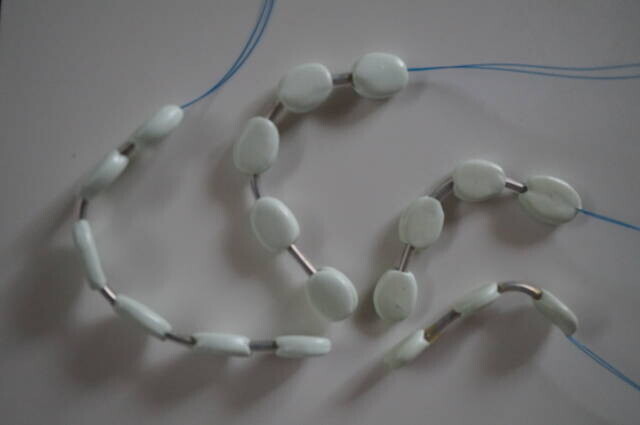
In an entry published in June 2023, Mr. Okada introduced the bendable metal-shaft prostate chip (Cool Beads Chip). Its formal name described the bendable metal shaft, while the nickname reflected pale blue flat beads and transparent covering between them. Mr. Okada says the spaced beads gave the device the cool-looking appearance he wanted the nickname to convey.
Prices published that month were ¥5,000, (about $32 at ¥156 = $1, rate as of 2026-09-04) ¥6,000, (about $38 at ¥156 = $1, rate as of 2026-09-04) ¥7,000 (about $45 at ¥156 = $1, rate as of 2026-09-04) and ¥8,000 (about $51 at ¥156 = $1, rate as of 2026-09-04), excluding tax, for versions with 3, 4, 5 and 6 beads, respectively. No matching product can be confirmed on the current list. Mr. Okada avoided stainless steel in the formal name because a planned surgical stainless-steel chip needed a distinct identity.
(Source: ok-lab's diary, published June 2023)
https://ok-lab.hatenablog.com/entry/2023/06/24/123110
August 2025 chip names separated invented assembly labels from established nitinol
In an entry published in August 2025, Mr. Okada distinguished invented assembly names from nitinol, the material name used for the wire. He called tubing containing nitinol wire a silicone-covered nitinol assembly (siliconitinol), identifying the combined word as an OK Lab invention. Tubing containing both nylon thread and nitinol wire had another coined name: the silicone-covered nylon-and-nitinol assembly (siliconylonitinol).
Nitinol alone, he explained, was an established material name used outside the company, rather than another word he had invented. He also argued that thread could describe a fine, flexible strand made as one piece, without requiring several strands twisted together. Mr. Okada advises allowing for possible breakage with either nylon or nitinol thread, because the likelihood depends on the conditions of use.
(Source: ok-lab's diary, published August 2025)
https://ok-lab.hatenablog.com/entry/2025/08/09/122924
February 2026 chip names kept coarse workshop slang outside formal descriptions
In an entry published in February 2026, Mr. Okada selected plain formal names for an easier-bending movable chip and a long movable chip. His internal names were the easier-bending movable chip (damn easy-to-bend movable) and long movable chip (damn long movable). He connected that rougher language with his interest in rap-like poetry and the mood it had put him in.
Mr. Okada described the long version as partly playful, while suggesting that the easier-bending version might be manageable for beginners. No matching product can be confirmed on the current list. Mr. Okada says the coarse versions would be internal nicknames, with the straightforward descriptions retained as the formal names.
(Source: ok-lab's diary, published February 2026)
https://ok-lab.hatenablog.com/entry/2026/02/07/122919
The maker's answer to OK Prostate Chip names
Mr. Okada clarifies names through descriptive wording, narrower definitions, and labels that identify a particular material or part.
June 2023 chip names kept descriptive wording despite confusing nickname searches
In another passage published in June 2023, Mr. Okada says searches for the bendable metal-shaft chip (Cool Beads Chip) returned Cool Biz instead. He suspected AI systems were treating his new word as nonexistent because the similar-sounding expression was already so widely recognized. The diary does not record whether those searches later began recognizing his nickname.
He acknowledged that the formal metal-shaft description explained the feature clearly, and regarded the bendable construction as a major improvement. However, he wanted to introduce the product through its unusual curved shape and bead-like appearance, which inspired the informal name. Mr. Okada's stated choice was to keep the descriptive formal name while presenting the chip through its appearance-based nickname.
(Source: ok-lab's diary, published June 2023)
https://ok-lab.hatenablog.com/entry/2023/06/24/123110
April 2024 chip names made shape-memory broader than one bladder-linked nickname
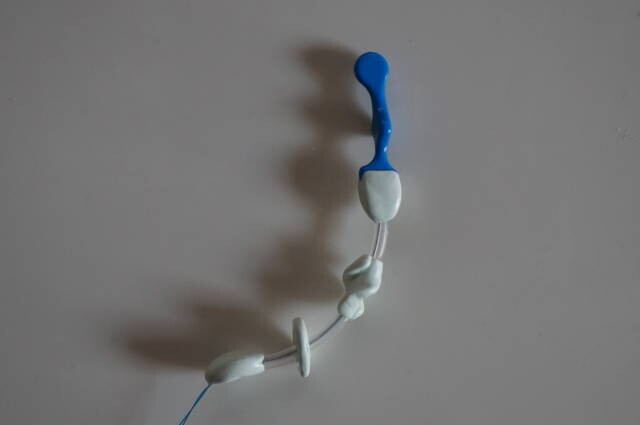
In an entry published in April 2024, Mr. Okada chose shape-memory prostate chip because he thought the name made its function easier to understand. The design connected a main chip at the prostate with a support chip farther along the urethra, using wire curved roughly 90 degrees. He distinguished its tube-covered wire from an earlier assembly (tail), which contained soft thread inside the tubing.
The planned conversion charge was ¥3,000 (about $19 at ¥156 = $1, rate as of 2026-09-04) excluding tax, covering shape-memory wire and a support chip added to a regular chip, as published in April 2024. No matching product can be confirmed on the current list. Within that category, Mr. Okada reserves the bladder-linked assembly (Prostate Alien) nickname for versions also connecting a bladder chip through shape-memory wire.
(Source: ok-lab's diary, published April 2024)
https://ok-lab.hatenablog.com/entry/2024/04/13/123053
March 2025 chip names identified the horn by its shape-memory wire
In an entry published in March 2025, Mr. Okada says he needed a more specific label because he had used horn for earlier parts. He formally named the new wire projection a shape-memory horn, identifying what distinguished it from those previous uses of the word. The name referred to a projection within the penile section of the urethra, which he associated with pleasurable stimulation during his personal tests.
Mr. Okada reported that the sensation had become less striking and then stronger again, and he suspected changes in cold weather were involved. No matching product can be confirmed on the current list. Mr. Okada recommends the feature for all chips using shape-memory wire, based on the pleasure he reported during his own testing.
(Source: ok-lab's diary, published March 2025)
https://ok-lab.hatenablog.com/entry/2025/03/22/122906
How OK Prostate Chip names changed over time
| Published | What the diary said then |
|---|---|
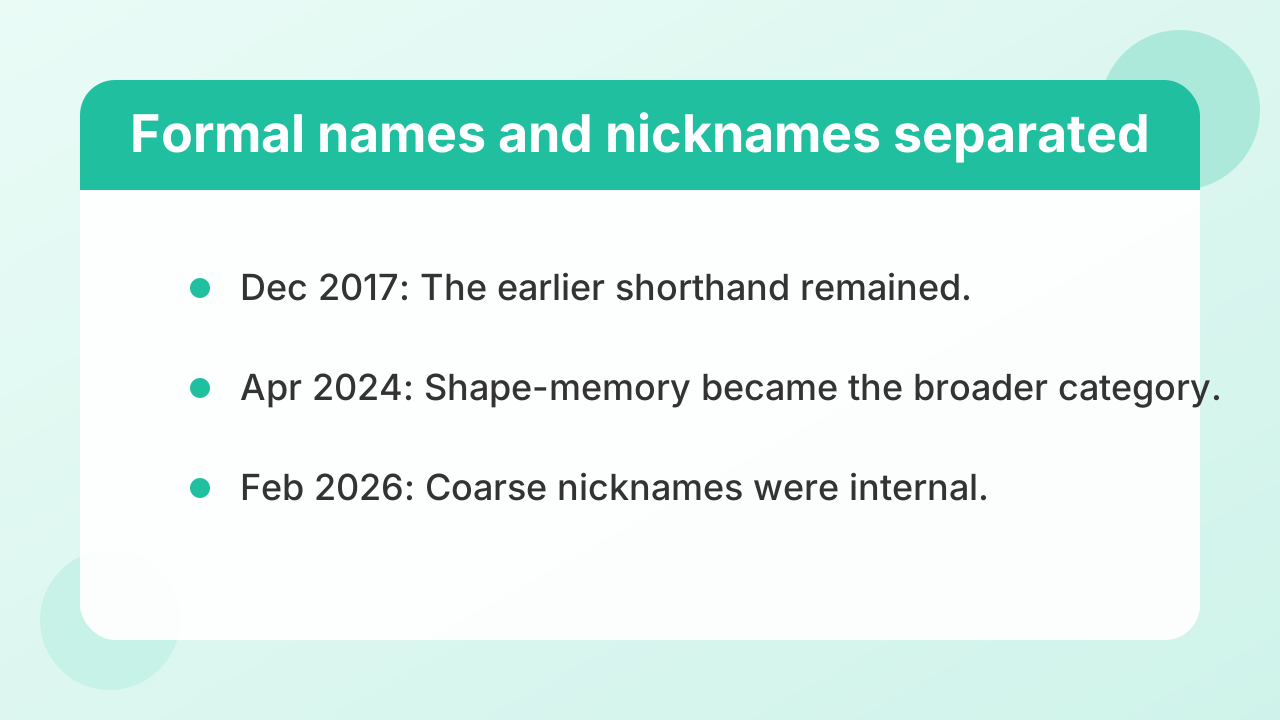
| Dec 2017 | A new formal name addressed reported misunderstanding; the earlier shorthand remained. |
| Jun 2023 | A bendable metal-shaft description accompanied an appearance-based bead nickname. |
| Apr 2024 | Shape-memory became the broader category; the bladder-linked assembly had a narrower nickname. |
| Mar 2025 | The wire projection received a specific shape-memory horn name. |
| Aug 2025 | Invented assembly labels were distinguished from the established material name nitinol. |
| Feb 2026 | Plain formal names were separated from coarse internal nicknames. |
OK Prostate Chip products related to OK Prostate Chip names
No current product is directly tied to this topic.
Common worries about OK Prostate Chip names
(The material contains no questions from readers.)
Buying from outside Japan
OK Lab ships internationally to countries covered by Japan Post's EMS courier service. Overseas orders are paid in advance by PayPal. Each order carries a ¥400 (about $3 at ¥156 = $1, rate as of 2026-09-04) handling fee, and EMS shipping is charged on top. These terms come from OK Lab's official sales-terms page (written here as plain text, not a link: ok-lab.net/docs/law), checked on September 7, 2026; confirm them on the official store before you order, because they can change.
Summary of this article
| What you wanted to know | The answer |
|---|---|
| Why does the diary use different names? | Formal names and nicknames coexist; some earlier wording remained after a formal rename. |
| What is the product, and who makes it? | The OK Prostate Chip is a urethral device made and sold by OK Lab in Japan. |
| What do the different terms identify? | They can identify a whole device, its construction, a separate component, or the material used inside an assembly. |
| Which naming distinctions appear in the cases? | The entries distinguish formal descriptions, appearance-based nicknames, invented assembly labels, and internal slang. |
| How did Mr. Okada make names more precise? | He described construction directly, restricted one nickname to a narrower design, and named a wire projection more specifically. |
| When were these distinctions published? | The supplied naming announcements run from December 2017 through February 2026. |
| Which current product is directly tied to this topic? | No current product is directly tied to this topic. |
| What naming questions did readers ask? | The material contains no questions from readers. |
| How does buying from outside Japan work? | The stated terms are advance PayPal payment, a ¥400 (about $3 at ¥156 = $1, rate as of 2026-09-04) handling fee, and additional Japan Post EMS shipping charges. |
Source: ok-lab's diary (Okada Comfortable Life Laboratory). The original entries are in Japanese; quotations on this page are translated. Photos and videos are on the original entries.
This article is a summary of the maker's development diary. The product is not a medical device and no result is guaranteed. If anything feels wrong or worries you, see a doctor. Prices, specifications and cautions change, so confirm the latest information on the official blog and the official site. Questions about ordering and shipping go to the seller.