![Why do these chips have unusual names? | Most nicknames describe their shape [OK Prostate Chip]](/img/a/T0928/eyecatch.svg)
This page is based on entries from "ok-lab's diary" (https://ok-lab.hatenablog.com/), the Japanese development diary
written by Mr. Okada, founder of OK Lab (Okada Comfortable Life Laboratory). Only the entries about "appearance-based nicknames"
are summarized here, in order of publication. Past prices and sizes are as written at the time. Current prices come from
the official product list (retrieved September 4, 2026). Quotations are translated from Japanese.
Note: This page is a personal reading log by someone with no connection to the maker or the seller. It reflects the source entries as of their publication dates and makes no guarantee of accuracy or safety. The product is not a medical device; talk to a doctor about any health decision. Check the official site for current information. This page contains advertising.
In short
Names such as Fishbone and Cool Beads describe the maker's visual impressions of particular designs.
Mr. Okada of OK Lab, a small company in Japan, describes design limits and problems behind the names.
By April 2026, a customer's suggested Skyfish nickname had joined the diary's changing vocabulary.
If you see blood in your urine, even a small amount or for the first time, do not wait and see. See a urologist right away.
If you suddenly cannot urinate, or the device cannot be removed, do not try to fix it yourself. Go to a medical facility, including emergency care, immediately.
About this product
The OK Prostate Chip is a small device that is placed in the urethra (the urine passage) so that it acts on the prostate; the maker sells it in several shapes, sizes and materials. It is made and sold by OK Lab (Okada Comfortable Life Laboratory), a small company in Japan, through its own online store, and prices are in Japanese yen (JPY). The maker's development diary, "ok-lab's diary", is written in Japanese. This page is an English summary of it, and every quotation is translated. OK Lab ships internationally, so readers outside Japan can order (see "Buying from outside Japan" below). Product names on this page are plain-English descriptions. The official Japanese product name is shown once in the product table so you can find the same item in the store.
Before you read: key terms
| Term | Plain-English meaning |
|---|---|
| Urethra | The urine passage; the chip is placed within it to act on the prostate. |
| Resin (chip-forming material) | A material used to form chip bodies or enlarge ceramic sections. |
| Nitinol (shape-memory wire) | Wire used for loops and connections that retain a set shape. |
| Bougie | The diary does not explain this. |
| Glaze | A ceramic surface coating; its purpose is not explained in these entries. |
What happens: OK Prostate Chip nicknames
The OK Prostate Chip is a small device placed in the urethra (the urine passage) to act on the prostate. The names describe shapes that reminded Mr. Okada of animals, objects, or written characters. They identify whole designs or features, including beadlike sections, winglike loops intended for the bladder, and rounded rubber joints. A separate device for use through the anus appears too, so the nicknames do not all indicate the same location.
The Nautilus nickname began as a comparison between two images
In an entry published in October 2017, Mr. Okada compared a microchip illustration with an image of nautilus sperm. The resemblance prompted a proposed name for the illustrated microchip (Nautilus Sperm Microchip). No matching product can be confirmed on the current list.
(Source: ok-lab's diary, published October 2017)
https://ok-lab.hatenablog.com/entry/20171026/1508989298
The Shikabane nickname described rounded contours resembling part of a written character
In an entry published in November 2018, Mr. Okada named a device for the anus after part of a Japanese character. This character-shaped device (Shikabane) was about 11 cm long, with widths of 3 cm, 4 cm, or 5 cm. Its downward loop depth was 3 cm.
The 4 cm model was ¥7,000 (about $45 at ¥156 = $1, rate as of 2026-09-04) excluding tax, as published in November 2018. The diary listed an additional ¥350 (about $2 at ¥156 = $1, rate as of 2026-09-04) for each 1 cm of extra resin sheet used in custom work. Mr. Okada offered other dimensions by custom request.
(Source: ok-lab's diary, published November 2018)
https://ok-lab.hatenablog.com/entry/20181123/1542963370
The Cobra Twist entry gave a separate price for custom twisting
An entry published in December 2018 listed a custom twisted chip (Cobra Twist) for ¥6,000 (about $38 at ¥156 = $1, rate as of 2026-09-04) excluding tax. That comprised a ¥5,000 (about $32 at ¥156 = $1, rate as of 2026-09-04) base price and a ¥1,000 (about $6 at ¥156 = $1, rate as of 2026-09-04) twisting charge. The diary described this version as custom-order only. No matching product can be confirmed on the current list.
(Source: ok-lab's diary, published December 2018)
https://ok-lab.hatenablog.com/entry/20181229/1546064791
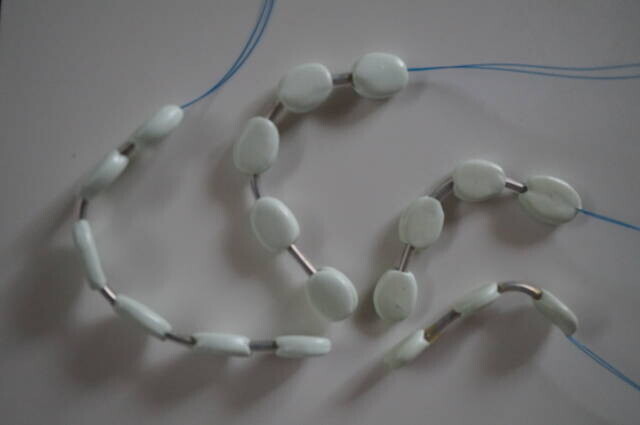
The Cool Beads nickname accompanied several lengths and a trapping warning
In an entry published in June 2023, Mr. Okada named a wire-core design with spaced, flat beads (Cool Beads). Prices, excluding tax, were ¥5,000 (about $32 at ¥156 = $1, rate as of 2026-09-04) for 3 beads under 4 cm and ¥6,000 (about $38 at ¥156 = $1, rate as of 2026-09-04) for 4 beads under 5 cm.
Other versions were ¥7,000 (about $45 at ¥156 = $1, rate as of 2026-09-04) for 5 beads under 6.5 cm, and ¥8,000 (about $51 at ¥156 = $1, rate as of 2026-09-04) for 6 beads under 8 cm. No matching product can be confirmed on the current list.
He warned that an extremely curved chip forced into the bladder with an instrument might become trapped. He cautioned that retrieval by thread or natural passage might fail, making hospital care necessary.
(Source: ok-lab's diary, published June 2023)
https://ok-lab.hatenablog.com/entry/2023/06/24/123110
The Pregnant Chip nickname came with a serious personal health report
In an entry published in January 2024, Mr. Okada compared an enlarged ceramic design (Pregnant Chip) to a fish carrying eggs or young. He described an episode he called heart failure shortly after going to bed with a large prototype in place. He attributed it to the device and reported recovery within hours after its removal.
The published enlargement charge was ¥2,000 (about $13 at ¥156 = $1, rate as of 2026-09-04) excluding tax, covering slim or thick shark-shaped ceramic chips and the central-bulge ceramic model. No matching product can be confirmed on the current list. The diary does not record whether a doctor confirmed his explanation of the episode.
(Source: ok-lab's diary, published January 2024)
https://ok-lab.hatenablog.com/entry/2024/01/20/122910
Nichicopter described wing-shaped loops intended to sit in the bladder
In an entry published in September 2025, Mr. Okada introduced wing-shaped bladder loops (Nichicopter) made from nitinol (shape-memory wire). He compared their outline to dragonfly wings and a helicopter. Wings up to 40 mm cost ¥3,000 (about $19 at ¥156 = $1, rate as of 2026-09-04) excluding tax, or ¥4,000 (about $26 at ¥156 = $1, rate as of 2026-09-04) excluding tax with a connection incorporating the chip's reinforcement wire.
Each extra 10 mm carried a ¥500 (about $3 at ¥156 = $1, rate as of 2026-09-04) excluding tax surcharge. No matching product can be confirmed on the current list. Mr. Okada also suggested the simpler name nitinol dragonfly while introducing the unfamiliar nickname.
(Source: ok-lab's diary, published September 2025)
https://ok-lab.hatenablog.com/entry/2025/09/20/122912
The House Centipede prototypes differed in wire thickness and leg count
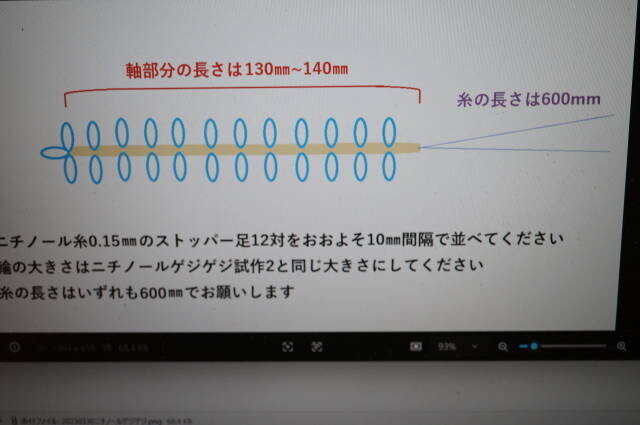
In an entry published in October 2025, Mr. Okada described a device resembling clustered legs (House Centipede). The base structure cost ¥2,000 (about $13 at ¥156 = $1, rate as of 2026-09-04), plus ¥1,500 (about $10 at ¥156 = $1, rate as of 2026-09-04) per pair for designs with 4 or more pairs; these prices excluded tax.
His listed prototype prices were ¥17,000 (about $109 at ¥156 = $1, rate as of 2026-09-04), ¥14,000 (about $90 at ¥156 = $1, rate as of 2026-09-04), and ¥11,000 (about $70 at ¥156 = $1, rate as of 2026-09-04), respectively, excluding tax. These used 10 pairs of 0.1 mm wire, 8 pairs of 0.15 mm wire, and 6 pairs of 0.1 mm wire, respectively.
No matching product can be confirmed on the current list. He cautioned that 0.15 mm wire felt too harsh for use beyond half a day or during sleep.
(Source: ok-lab's diary, published October 2025)
https://ok-lab.hatenablog.com/entry/2025/10/18/122911
The Apple Alien name expanded alongside a report of bleeding during testing
In an entry published in January 2026, Mr. Okada described the articulated chip's New Year Special prototype (Apple Alien). It failed to bend as expected; he reported forcing it inward and finding a faint film of blood across the chip. He suspected friction as the cause.
The nickname now included rounded rubber joints, because a ceramic-tipped version lacked the original small apple-shaped tip. No matching product can be confirmed on the current list. Mr. Okada preferred the familiar word apple to a technical name.
(Source: ok-lab's diary, published January 2026)
https://ok-lab.hatenablog.com/entry/2026/01/03/122924
The maker's answer to OK Prostate Chip nicknames
The diary records design changes, rejected ideas, and cautions behind several nicknames.
The Pistol shape followed discomfort from a sharply angled connection
In an entry published in November 2020, Mr. Okada reported testing a short chip with a 90-degree horn-shaped connection. He described strong spring-back pressure spreading the prostate and discomfort lasting about a day after removal. He then made an angled spring-chip prototype (Pistol), with an attachment at 45 degrees.
The reported trial had lasted only about 3 hours. No matching product can be confirmed on the current list. Mr. Okada suggested 45–60 degrees might suit short connections better, with longer testing still to follow.
(Source: ok-lab's diary, published November 2020)
https://ok-lab.hatenablog.com/entry/2020/11/28/121505

The Halo ring replaced an abandoned net but moved during testing
In an entry published in June 2023, Mr. Okada abandoned an external net because contact with the urine outlet caused spraying. Its replacement, an external ring (Halo), got its nickname from its position above the head of the penis. Mr. Okada initially reported easier chip placement.
During an overnight trial, however, the ring moved with a bougie (an instrument the diary does not explain). No matching product can be confirmed on the current list. He cautioned that the ring might not function effectively when combined with that instrument.
(Source: ok-lab's diary, published June 2023)
https://ok-lab.hatenablog.com/entry/2023/06/17/123116
The Prostate Alien head gained openings after a sphere blocked urination
In an entry published in February 2024, Mr. Okada reported that a spherical bladder component blocked urine flow completely. He wrote that he could urinate again after the prototype was removed from the bladder. He next developed a head with at least 2 openings, because a single opening gave poor flow.
The resulting head and body suggested a figure-shaped design (Prostate Alien). No matching product can be confirmed on the current list. He cautioned that larger versions placed greater demands on the body during placement and removal.
(Source: ok-lab's diary, published February 2024)
https://ok-lab.hatenablog.com/entry/2024/02/17/123013
If you see blood in your urine, even a small amount or for the first time, do not wait and see. See a urologist right away.
If you suddenly cannot urinate, or the device cannot be removed, do not try to fix it yourself. Go to a medical facility, including emergency care, immediately.
How OK Prostate Chip nicknames changed over time
| Published | What the diary said then |
|---|---|
| Jul 2018 | Curved long and semi-long Cobra versions entered sale. |
| Dec 2018 | Glass, resin, and a vibrating rear section formed a hybrid chip (Little Mermaid). |
| Jul 2020 | Thick glaze (ceramic coating) hid twists on the bulky chip (Donko). |
| Oct 2020 | Chips with rubber-coated nylon threads (Horn) became available through a new service. |
| Oct 2021 | A slimmer chip (Fishbone) arrived with a thicker center and thinner edges. |
| Jun 2023 | A single wire-core chip reduced thickness from about 5 mm to 4 mm. |
| Feb 2025 | A separate ceramic hybrid (Prostate Pistol) reached about 60 mm overall. |
| Sep 2025 | Wing attachments became possible on ceramic chips without tip holes. |
| Apr 2026 | Requested leg pairs increased from 8 to 12, with approximately 10 mm spacing. |
OK Prostate Chip products related to OK Prostate Chip nicknames
No current product is directly tied to this topic.
Common worries about OK Prostate Chip nicknames
Readers asked about custom shapes and names, with different answers for each request.
"Could a Cobra chip have alternating bulge directions?"
In an entry published in July 2018, a customer requested a long glass chip with alternating directions across 3 bulges. Mr. Okada declined because his burner heated a broad area, preventing the precise localized bends requested. Testing produced only screw-like bends, leading him to offer flattened, hoodlike bulges on a different design (Cobra).
The diary does not record whether the customer's original order was completed. No matching product can be confirmed on the current list. Mr. Okada explained that individually directed bends required a more focused burner.
(Source: ok-lab's diary, published July 2018)
https://ok-lab.hatenablog.com/entry/20180721/1532152353
"Could the Pregnant Chip have a marble-shaped central bulge?"
In an entry published in January 2024, a customer wanted a ceramic chip's central bulge enlarged to 16 mm. Mr. Okada explained that a marble-like addition was difficult, but a flattened round enlargement was possible. He accepted the shape after reviewing a drawing.
The first build used the wrong ceramic base, which Mr. Okada kept for his own testing. The diary does not record whether the customer received a corrected version. Mr. Okada offered to assess other drawings and explain when a requested shape was impractical.
(Source: ok-lab's diary, published January 2024)
https://ok-lab.hatenablog.com/entry/2024/01/20/122910
"Could the custom House Centipede be called Skyfish?"
In an entry published in April 2026, a customer requested changes to an earlier many-legged wire design. They proposed the name Skyfish Version 1, comparing the requested build to an imaginary flying creature. Mr. Okada accepted that name for the custom piece.
The diary does not record whether the revised order was completed. No matching product can be confirmed on the current list.
(Source: ok-lab's diary, published April 2026)
https://ok-lab.hatenablog.com/entry/2026/04/04/122916
Buying from outside Japan
OK Lab ships internationally to countries covered by Japan Post's EMS courier service. Overseas orders are paid in advance by PayPal. Each order carries a ¥400 (about $3 at ¥156 = $1, rate as of 2026-09-04) handling fee, and EMS shipping is charged on top. These terms come from OK Lab's official sales-terms page (written here as plain text, not a link: ok-lab.net/docs/law), checked on September 7, 2026; confirm them on the official store before you order, because they can change.
Summary of this article
| What you wanted to know | The answer |
|---|---|
| What do the nicknames mean? | They describe the maker's impressions of shapes. |
| Who makes the base product? | OK Lab makes and sells it in Japan, with prices in JPY. |
| What is nitinol? | Shape-memory wire used in loops and connections. |
| Which shapes inspired names? | Animals, beads, wings, rounded joints, and part of a written character. |
| Did the maker report problems? | Yes, including discomfort, urine blockage, bleeding, and his account of a heart-failure episode. |
| Did the vocabulary change? | Names accompanied new materials, altered shapes, and custom requests. |
| Is there a current product recommendation for nicknames? | No current product is directly tied to this topic. |
| What did customers ask? | They asked about custom shapes, dimensions, and naming a requested build. |
| Can buyers order from outside Japan? | The stated terms use PayPal, EMS shipping, and a ¥400 (about $3 at ¥156 = $1, rate as of 2026-09-04) handling fee. |
| What does this article establish? | It records diary descriptions and historical prices, with personal explanations attributed to Mr. Okada. |
Source: ok-lab's diary (Okada Comfortable Life Laboratory). The original entries are in Japanese; quotations on this page are translated. Photos and videos are on the original entries.
This article is a summary of the maker's development diary. The product is not a medical device and no result is guaranteed. If anything feels wrong or worries you, see a doctor. Prices, specifications and cautions change, so confirm the latest information on the official blog and the official site. Questions about ordering and shipping go to the seller.