![Can two prostate chips stay connected? | Breakage reports led to a redesigned connector [OK Prostate Chip]](/img/a/T0913/eyecatch.svg)
This page is based on entries from "ok-lab's diary" (https://ok-lab.hatenablog.com/), the Japanese development diary written by Mr. Okada, founder of OK Lab, a small company in Japan (Okada Comfortable Life Laboratory). Only the entries about "two-chip connections (Umiushi Ver.5)" are summarized here, in order of publication. Past prices and sizes are as written at the time. Current prices come from the official product list (retrieved September 4, 2026). Quotations are translated from Japanese.
Note: This page is a personal reading log by someone with no connection to the maker or the seller. It reflects the source entries as of their publication dates and makes no guarantee of accuracy or safety. The product is not a medical device; talk to a doctor about any health decision. Check the official site for current information. This page contains advertising.
In short
The diary records loss of connector elasticity, broken rubber, and a ceramic chip broken by impact.
Mr. Okada responded with reinforcement, gentler connection angles, and eventually a wire-based redesign.
The January 2026 specification differs from earlier builds; current component prices do not cover a complete custom set.
If you see blood in your urine, even a small amount or for the first time, do not wait and see. See a urologist right away.
If you suddenly cannot urinate, or the device cannot be removed, do not try to fix it yourself. Go to a medical facility, including emergency care, immediately.
About this product
The OK Prostate Chip is a small device that is placed in the urethra (the urine passage) so that it acts on the prostate; the maker sells it in several shapes, sizes and materials. It is made and sold by OK Lab (Okada Comfortable Life Laboratory), a small company in Japan, through its own online store, and prices are in Japanese yen (JPY). The maker's development diary, "ok-lab's diary", is written in Japanese. This page is an English summary of it, and every quotation is translated. OK Lab ships internationally, so readers outside Japan can order (see "Buying from outside Japan" below). Product names on this page are plain-English descriptions. The official Japanese product name is shown once in the product table so you can find the same item in the store.
Before you read: key terms
| Term | Plain-English meaning |
|---|---|
| Urethra | The urine passage, where the device is placed to act on the prostate. |
| Two-chip connection | A flexible link joining two chips; Mr. Okada describes it as transmitting force between them. |
| Rubber connector | The elastic connection between the chips; its spring force was intended to produce pressure. |
| Surface-bump option | An option adding raised surface features. As for their purpose: The diary does not explain this. |
| Nitinol wire | The flexible wire specified inside the redesigned connector; Mr. Okada intended it to maintain the connection. |
| Ceramic reinforcement | Wire attached along the ceramic pieces, intended by the maker to protect against breakage. |
| Screw-shaped auxiliary chip | An additional chip proposed as the second piece in an angled connection. |
What happens: two-chip connection problems
The OK Prostate Chip is a small device placed in the urethra (the urine passage) to act on the prostate. The angled two-chip design (Umiushi Ver.5) joins a leading chip and a second chip with a flexible connector. In December 2023, Mr. Okada described its rubber connection as preventing tangles and producing pressure against the urethra or bladder. The entries trace connection problems and later design changes.
A two-chip connection raised bleeding concerns before the first prototype
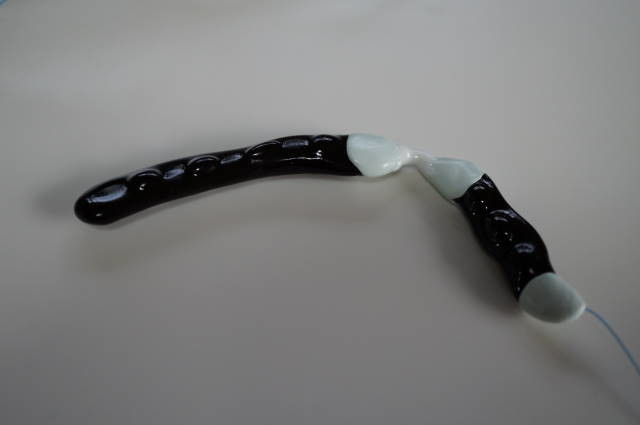
In an entry published in November 2020, a customer proposed an angled connection to target three possible sources of sensation. The customer anticipated that sharper angles could make removal difficult and cause bleeding. These were concerns about the proposed design, rather than a report of an injury.
Mr. Okada questioned the customer's explanation involving bladder-wall pressure but agreed to explore the concept. His proposal was to choose an existing leading chip and define the new design through the second chip and connection.
(Source: ok-lab's diary, published November 2020)
https://ok-lab.hatenablog.com/entry/2020/11/14/131426
The two-chip connection reached mold production after customer approval
In an entry published in November 2020, the customer accepted the prototype proposal and asked Mr. Okada to continue toward completion. Mr. Okada reported that mold production had begun. He considered the second chip potentially useful for other combinations, so he planned a larger firing batch.
Unlike earlier ceramic pieces, this second chip needed openings at both ends. The diary records the production plan, but does not record the customer's experience with the finished ceramic version.
(Source: ok-lab's diary, published November 2020)
https://ok-lab.hatenablog.com/entry/2020/11/28/121505
Standard bumps defined the two-chip connection at its planned launch
In an entry published in December 2020, Mr. Okada reported that the ceramic pieces had returned from firing. Surface bumps (raised features on the chips) were standard for this design, and he stated that no version without bumps existed. Sales were planned to begin the following week.
The leading piece carried the medium-length ceramic chip's price, while the second carried the short chip's price. The set required those chip purchases, 2 surface-bump options, and an angled-connection charge of ¥1,000 (about $6 at ¥156 = $1, rate as of 2026-09-04) tax excluded, as published in December 2020. Mr. Okada directed customers to account for each component and the additional custom work when ordering.
(Source: ok-lab's diary, published December 2020)
https://ok-lab.hatenablog.com/entry/2020/12/19/132929
A two-chip connection lost usable elasticity after seven reported uses
In an entry published in June 2022, the original proposer requested repair of a version with a screw-shaped second chip. The customer recalled only 7 uses, but reported that the rubber had lost so much elasticity that the device was unusable. The maker acknowledged that durability had not been considered during development.
If the connector had reached its lifespan, the maker said that lifespan was 2 years or less. Mr. Okada warned that rough use could shorten it further, with failure after a few uses when seeking stronger stimulation. The maker said future customers would need to accept the stated durability limit before ordering.
(Source: ok-lab's diary, published June 2022)
https://ok-lab.hatenablog.com/entry/2022/06/18/123201
A ceramic impact broke the two-chip connection customer's earlier set
In an entry published in March 2023, a customer requested another combined ceramic set, described as version 4+5. The customer reported that the previous chip broke after striking a ceramic toilet during removal. The report concerns a collision involving the ceramic piece.
Mr. Okada itemized the replacement's custom charges, including connection work and additional ceramic firing. The diary does not record how the replacement performed in use.
(Source: ok-lab's diary, published March 2023)
https://ok-lab.hatenablog.com/entry/2023/03/18/122146
The two-chip connection required an additional charge in April 2025
In an entry published in April 2025, a customer requested the angled set using short and medium-length ceramic chip order items. The order also included the surface-bump option. Mr. Okada explained that ¥1,100 (about $7 at ¥156 = $1, rate as of 2026-09-04) for connecting the chips was additional to the listed items.
The entry states that the customer paid that additional amount. The diary does not record how this particular finished set felt in use.
(Source: ok-lab's diary, published April 2025)
https://ok-lab.hatenablog.com/entry/2025/04/12/122910
Bulky attachments prompted another rethink of the two-chip connection
In an entry published in January 2026, Mr. Okada described why the older connector was relatively thick. Its internal cord passed through holes in the ceramic, with resin covering the attachment area. That description concerned the existing construction, rather than a newly announced size.
He thought newly introduced flexible-joint technology might make the angled set easier to use. The entry presents that possibility as his development idea, without recording customer results for a completed redesign.
(Source: ok-lab's diary, published January 2026)
https://ok-lab.hatenablog.com/entry/2026/01/10/122922
The redesigned two-chip connection carried new additional charges in January 2026
In an entry published in January 2026, Mr. Okada priced the redesigned connector separately from both ceramic chips. The standard additions were ¥2,000 (about $13 at ¥156 = $1, rate as of 2026-09-04) for ceramic reinforcement (wire along the chips) and ¥2,000 (about $13 at ¥156 = $1, rate as of 2026-09-04) for connection work, all tax excluded. The diary stated the combined additional charge as ¥4,000 (about $26 at ¥156 = $1, rate as of 2026-09-04) tax excluded.
Without full reinforcement, it quoted ¥3,000 (about $19 at ¥156 = $1, rate as of 2026-09-04) tax excluded, with wire attached over only short sections of each chip. The cheaper option still included a wire connection. Mr. Okada made full reinforcement the standard while allowing customers to request the shorter attachment.
(Source: ok-lab's diary, published January 2026)
https://ok-lab.hatenablog.com/entry/2026/01/31/122917
The maker's answer to two-chip connection problems
Mr. Okada changed the connector's construction and angle after reports of deterioration and breakage.
Cable reinforcement addressed two-chip connection failures in a separate repair
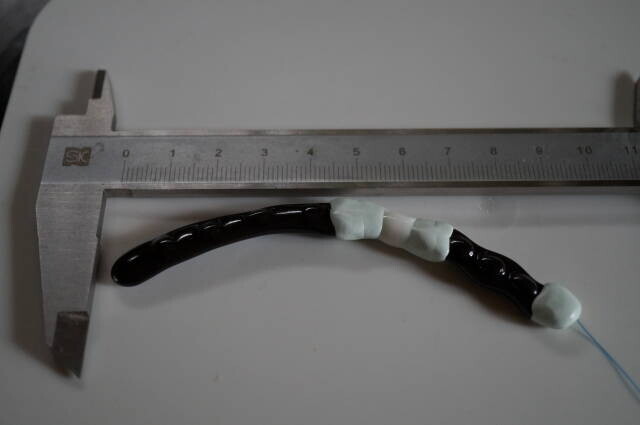
In an entry published in June 2022, Mr. Okada described a separate repair request from a customer outside Japan. He said international shipping cost more than the repair, while translated exchanges made the circumstances harder to establish. The trial connector had 4 cable reinforcements intended to limit extreme bending.
He expected improved durability, but had not established whether that approach suited glass chips or screw-assisted combinations. His planned response to orders for the standard angled set was to supply the reinforced version.
(Source: ok-lab's diary, published June 2022)
https://ok-lab.hatenablog.com/entry/2022/06/18/123201
Gentler two-chip connection angles followed reports of torn rubber
In an entry published in December 2023, Mr. Okada said extreme connection angles had led to reports of rubber tearing. He was therefore making recent sets with a gentler bend. He also proposed curved auxiliary chips on silicone tubing for customers dissatisfied with the reduced angle.
The diary warned that customers could not easily adjust those curved parts' positions. Mr. Okada expected their spacing to be settled with OK Lab before shipment.
(Source: ok-lab's diary, published December 2023)
https://ok-lab.hatenablog.com/entry/2023/12/30/122243
The two-chip connection gained a wire core in January 2026
In an entry published in January 2026, Mr. Okada described an older limit of about 60 degrees, later reduced to about 45 degrees. He reported that connection trouble reports stopped at the gentler angle. The redesign replaced the inner cord with nitinol wire (the flexible wire inside the new connector) and made ceramic reinforcement standard.
Mr. Okada claimed that the wire could maintain the connection's safety even if the rubber broke. The diary does not record long-term customer results for this redesign. Mr. Okada specified full reinforcement along the ceramic pieces as the standard arrangement.
(Source: ok-lab's diary, published January 2026)
https://ok-lab.hatenablog.com/entry/2026/01/31/122917
If you see blood in your urine, even a small amount or for the first time, do not wait and see. See a urologist right away.
If you suddenly cannot urinate, or the device cannot be removed, do not try to fix it yourself. Go to a medical facility, including emergency care, immediately.
How two-chip connection problems changed over time
| Published | What the diary said then |
|---|---|
| Nov 2020 | The original proposal anticipated difficult removal and bleeding with sharper angles. |
| Nov 2020 | Mold development began for a second chip with openings at both ends. |
| Dec 2020 | Bumps became standard; the custom set required separate component and connection charges. |
| Jan 2021 | Mr. Okada favored purpose-designed second chips over unrestricted combinations. |
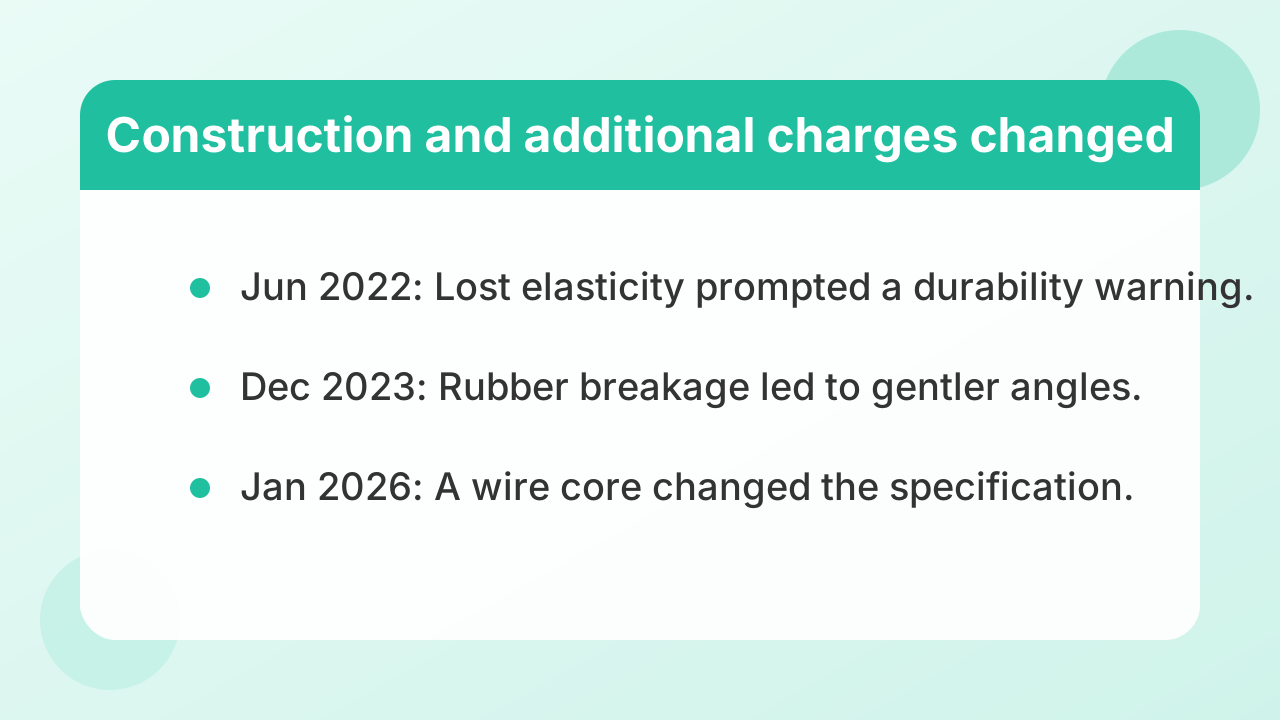
| Jun 2022 | Lost elasticity prompted a durability warning and discussion of reinforcement. |
| Mar 2023 | A customer reported ceramic breakage after impact with a toilet. |
| Dec 2023 | Rubber breakage reports had led to gentler connection angles. |
| Apr 2025 | A separate connection charge was added to a customer's component order. |
| Jan 2026 | A wire core and standard ceramic reinforcement changed the specification and additional price. |
The diary does not say what the current state is.
OK Prostate Chip products related to two-chip connection problems
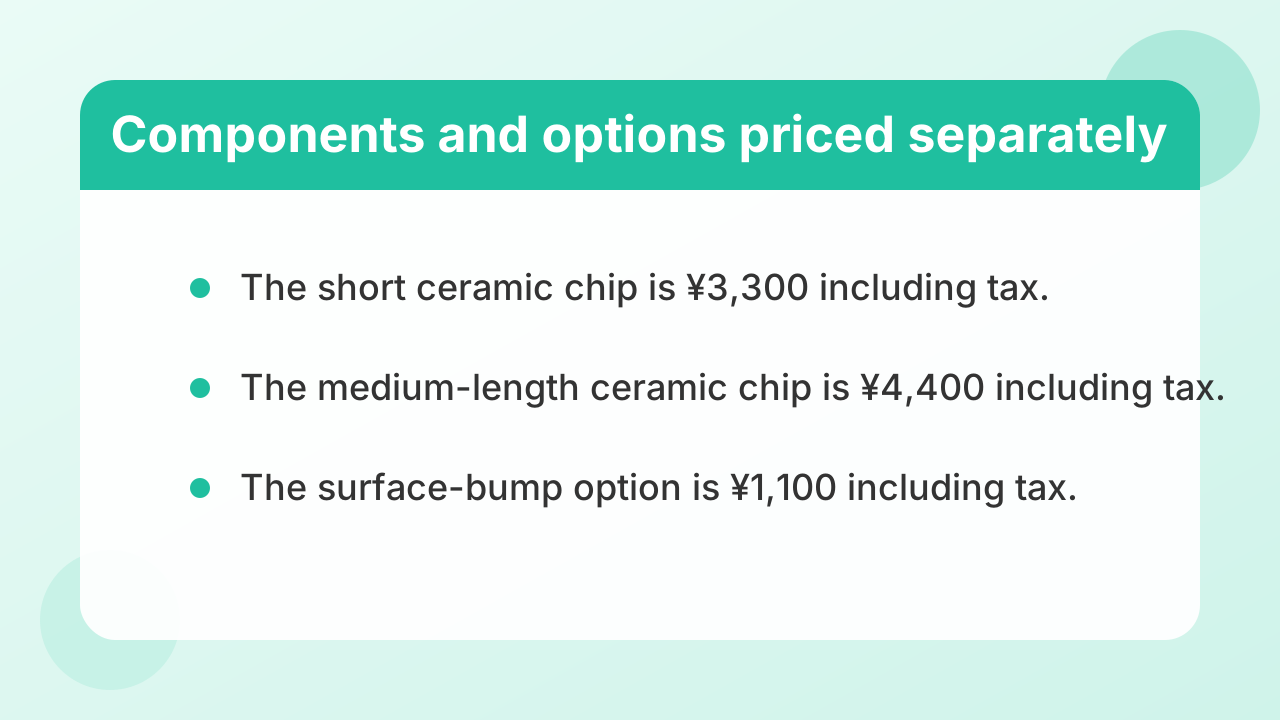
The current list prices the ceramic components and options separately.
Products that appear in these entries
| Product (official name) | Price incl. tax | Relation to this topic |
|---|---|---|
| Short ceramic chip (OKプロステートチップ 陶器素材ショートタイプ) | ¥3,300 (about $21 at ¥156 = $1, rate as of 2026-09-04) | An April 2025 angled-set order included this item before the separate connection charge was added. |
| Medium-length ceramic chip (OKプロステートチップ 陶器素材セミロングタイプ) | ¥4,400 (about $28 at ¥156 = $1, rate as of 2026-09-04) | The same April 2025 order included this item alongside the short ceramic chip. |
| Surface-bump option (イボ付きチップに変更オプション) | ¥1,100 (about $7 at ¥156 = $1, rate as of 2026-09-04) | The April 2025 angled-set order included this option for its ceramic components. |
(Source: ok-lab's diary, published April 2025)
https://ok-lab.hatenablog.com/entry/2025/04/12/122910
Products the diary mentioned as alternatives
| Product (official name) | Price incl. tax | Relation to this topic |
|---|---|---|
| Screw-shaped auxiliary chip (スクリュー型補助チップ追加オプション) | ¥3,300 (about $21 at ¥156 = $1, rate as of 2026-09-04) | In January 2021, Mr. Okada considered a screw-shaped second chip a safer design choice than an arbitrary pairing. |
(Source: ok-lab's diary, published January 2021)
https://ok-lab.hatenablog.com/entry/2021/01/09/130022
Custom angled sets (Umiushi Ver.5 and Ver.4+5): No matching product can be confirmed on the current list.
Curved auxiliary chips described in December 2023: No matching product can be confirmed on the current list.
Common worries about two-chip connection problems
The questions concerned spacing, compatible chip combinations, and a replacement for the rubber connector.
"How far apart could a two-chip connection be?"
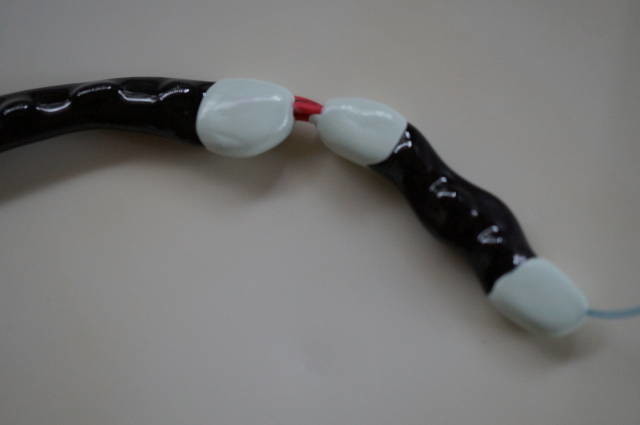
In an entry published in November 2020, the customer suggested a gap of 3mm–5mm, around 4mm, while asking for Mr. Okada's judgment. The customer acknowledged that a suitable gap depended on the connection material and flexibility. These figures were proposed dimensions, not a confirmed universal specification.
Mr. Okada's reply did not establish a tested spacing range. His proposal focused on the second chip's shape and the connection's position and angle.
(Source: ok-lab's diary, published November 2020)
https://ok-lab.hatenablog.com/entry/2020/11/14/131426
"Can a two-chip connection combine different chip sizes?"
In an entry published in January 2021, a customer asked about joining different ceramic sizes and shapes. Mr. Okada said he would accept arbitrary combinations if the customer understood the construction differences. He considered the purpose-designed connection stronger than an earlier broad-bodied ceramic pairing.
The diary does not record a completed order arising from that question. Mr. Okada favored the dedicated second chip or a screw-shaped auxiliary chip, which he considered safer by design.
(Source: ok-lab's diary, published January 2021)
https://ok-lab.hatenablog.com/entry/2021/01/09/130022
"Could six wires replace the rubber two-chip connection?"
In an entry published in June 2022, the original proposer suggested a six-wire structure as an alternative after the deterioration report. Mr. Okada thought it would weaken the pressure produced by the rubber's spring force. He explained that the proposed structure would follow a bend differently from the elastic connector.
The diary does not record a completed six-wire replacement or how it performed. Mr. Okada nevertheless thought the stronger six-wire version might provide some effect.
(Source: ok-lab's diary, published June 2022)
https://ok-lab.hatenablog.com/entry/2022/06/18/123201
Buying from outside Japan
OK Lab ships internationally to countries covered by Japan Post's EMS courier service. Overseas orders are paid in advance by PayPal. Each order carries a ¥400 (about $3 at ¥156 = $1, rate as of 2026-09-04) handling fee, and EMS shipping is charged on top. These terms come from OK Lab's official sales-terms page (written here as plain text, not a link: ok-lab.net/docs/law), checked on September 7, 2026; confirm them on the official store before you order, because they can change.
Summary of this article
| What you wanted to know | The answer |
|---|---|
| What is the immediate concern? | The diary records connector deterioration and breakage, with urgent warning signs addressed above. |
| What is the base product? | A urethral device made and sold by OK Lab in Japan. |
| What do the connection terms mean? | Rubber, wire, and reinforcement describe different parts of the connection's development. |
| What happened in the reported cases? | Problems included lost elasticity and a ceramic piece breaking after impact. |
| How did the maker respond? | Mr. Okada described reinforcement, gentler angles, and a wire-based redesign. |
| What changed over time? | The connection's construction, specification, and additional charges changed between the dated entries. |
| What is listed today? | Individual components and options appear on the supplied current list. |
| What remained uncertain in customer questions? | Proposed spacing and alternative construction were not accompanied by confirmed results. |
| How do overseas purchases work? | Advance PayPal payment, a ¥400 (about $3 at ¥156 = $1, rate as of 2026-09-04) handling fee, and additional EMS shipping apply under the stated terms. |
| What is the overall answer? | The diary documents redesigns after problems; it does not establish a trouble-free lifespan. |
Source: ok-lab's diary (Okada Comfortable Life Laboratory). The original entries are in Japanese; quotations on this page are translated. Photos and videos are on the original entries.
This article is a summary of the maker's development diary. The product is not a medical device and no result is guaranteed. If anything feels wrong or worries you, see a doctor. Prices, specifications and cautions change, so confirm the latest information on the official blog and the official site. Questions about ordering and shipping go to the seller.