![Can I send a used chip back for repair? | The rules depend on the repair [OK Prostate Chip]](/img/a/T0908/eyecatch.svg)
This page is based on entries from "ok-lab's diary" (https://ok-lab.hatenablog.com/), the Japanese development diary written by Mr. Okada, founder of OK Lab, a small company in Japan (Okada Comfortable Life Laboratory). Only the entries about "disinfection rules for repair returns" are summarized here, in order of publication. Past prices and sizes are as written at the time. Current prices come from the official product list (retrieved September 4, 2026). Quotations are translated from Japanese.
Note: This page is a personal reading log by someone with no connection to the maker or the seller. It reflects the source entries as of their publication dates and makes no guarantee of accuracy or safety. The product is not a medical device; talk to a doctor about any health decision. Check the official site for current information. This page contains advertising.
In short
Returned chips faced different disinfection rules depending on the material and repair.
Mr. Okada described sterilization, chlorine disinfection, and limits on repairs.
The latest relevant entry, published in August 2024, describes motorized chip repairs as exceptional.
If you see blood in your urine, even a small amount or for the first time, do not wait and see. See a urologist right away.
If you suddenly cannot urinate, or the device cannot be removed, do not try to fix it yourself. Go to a medical facility, including emergency care, immediately.
About this product
The OK Prostate Chip is a small device that is placed in the urethra (the urine passage) so that it acts on the prostate; the maker sells it in several shapes, sizes and materials. It is made and sold by OK Lab (Okada Comfortable Life Laboratory), a small company in Japan, through its own online store, and prices are in Japanese yen (JPY). The maker's development diary, "ok-lab's diary", is written in Japanese. This page is an English summary of it, and every quotation is translated. OK Lab ships internationally, so readers outside Japan can order (see "Buying from outside Japan" below). Product names on this page are plain-English descriptions. The official Japanese product name is shown once in the product table so you can find the same item in the store.
Before you read: key terms
| Term | Plain-English meaning |
|---|---|
| Urethra | The urine passage, where the chip is placed to act on the prostate. |
| Nylon thread | Thread attached to a chip for retrieval; several entries discuss replacing it. |
| High-pressure steam sterilizer | Workshop equipment used to sterilize returned products before repair work. |
| Resin | Material used to form chips or coat parts, including thread joints. |
| Controller | The electrical unit that controls a motorized chip's operation. |
What happens: prostate chip repair
The OK Prostate Chip is a small device placed in the urethra (urine passage) to act on the prostate. Repair returns are used chips sent back to the maker for work on their threads, coatings, or electrical parts. The diary describes disinfection requirements for these items before workshop handling, with different rules for different materials and jobs. Those rules concern returned equipment, including parts previously inside the body.
A short thread prompted a paid chip repair offer in April 2018
An entry published in April 2018 records a customer asking for thread replacement because the single glass chip's thread felt too short. Mr. Okada offered replacement after also suggesting an extension as an interim option. The quoted charges were ¥1,080 (about $7 at ¥156 = $1, rate as of 2026-09-04) for replacement and ¥400 (about $3 at ¥156 = $1, rate as of 2026-09-04) for shipping, packing, and handling, totaling ¥1,480 (about $9 at ¥156 = $1, rate as of 2026-09-04) as stated.
He said the returned chip would undergo high-pressure sterilization before work; the diary does not record whether this customer completed the replacement. Mr. Okada's return requirements included customer cleaning and boiling disinfection before shipment.
(Source: ok-lab's diary, published April 2018)
https://ok-lab.hatenablog.com/entry/20180414/1523697398
Steam treatment made complete thread replacement necessary even for small chip repairs
An entry published in April 2018 describes a customer requesting replacement after cutting the chip's thread. Mr. Okada reported treating incoming repairs in a high-pressure steam sterilizer (equipment used to sterilize returned products) for about 40 minutes. He said the treatment shrank the nylon thread (the attached retrieval thread), making complete thread replacement necessary even for simple repairs.
The diary does not record completion of that customer's repair. Mr. Okada required immediate sterilization of incoming repairs because the same workshop also made products for customers.
(Source: ok-lab's diary, published April 2018)
https://ok-lab.hatenablog.com/entry/20180421/1524299808
Used chip repairs excluded reshaping in the March 2019 reply
An entry published in March 2019 records a customer asking whether an oversized motorized chip could be reshaped. Mr. Okada refused reworking or reshaping after urethral use, limiting accepted work to glass-chip nylon thread and motor unit replacement. For those returns, he described whole-product steam sterilization, retaining only the glass and discarding the other parts.
Prices published then were ¥1,000 (about $6 at ¥156 = $1, rate as of 2026-09-04) excluding tax for thread replacement and ¥3,000 (about $19 at ¥156 = $1, rate as of 2026-09-04) excluding tax for motor unit replacement. The diary does not record whether this customer's chip was changed. Mr. Okada offered an 8 mm motor unit replacement as the available response to this request.
(Source: ok-lab's diary, published March 2019)
https://ok-lab.hatenablog.com/entry/2019/03/09/150813
Chlorine disinfection replaced steam for ceramic chip repairs involving shrinking threads
In an entry published in June 2019, a customer reported sharp thread joints on two ceramic chips and pain during use. Mr. Okada initially proposed rounding the joints, then favored a soft rubber covering because hardened resin (material coating the joints) might remain sharp. For this repair, he chose chlorine-based bleach disinfection because steam sterilization would shrink the threads.
The items arrived, but the diary does not record how the customer found them after repair. Mr. Okada also offered the rubber treatment to customers concerned about the joints.
(Source: ok-lab's diary, published June 2019)
https://ok-lab.hatenablog.com/entry/2019/06/29/143536
Used items carried a higher thread extension charge in April 2020
An entry published in April 2020 announced a thread extension service following requests to change thread length after ordering. The published charge was ¥500 (about $3 at ¥156 = $1, rate as of 2026-09-04) excluding tax for items not yet shipped or not yet used. Used items cost ¥1,000 (about $6 at ¥156 = $1, rate as of 2026-09-04) excluding tax, with high-pressure sterilization before the work. Mr. Okada offered extension because full thread replacement could require rebuilding attached parts.
(Source: ok-lab's diary, published April 2020)
https://ok-lab.hatenablog.com/entry/2020/04/04/152310
Failed chip repairs preceded a broken cable and trapped device
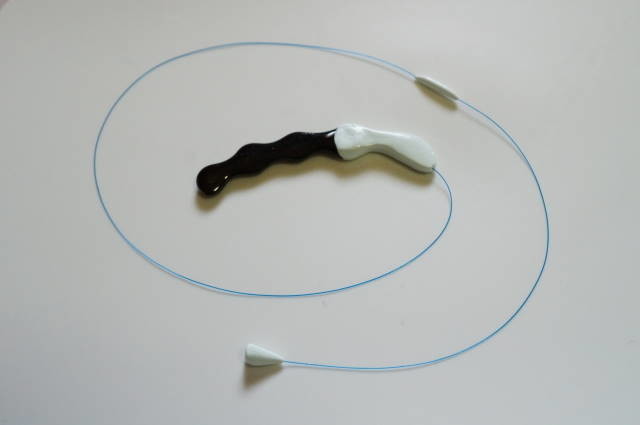
An entry published in November 2020 describes repeated failure of reinforcement over a customer's damaged cable covering. Mr. Okada said he could not clean the customer's product, and rubber applied over remaining dirt kept peeling; he judged repair impossible. The customer later used it with exposed wiring; the cable broke, leaving the chip trapped in the bladder.
Medical removal was attempted unsuccessfully, and a further procedure was planned. An update added the day after publication reported that the customer retrieved the chip independently. Mr. Okada warned against exposed wiring because he said the metal would inevitably weaken or corrode and break.
(Source: ok-lab's diary, published November 2020)
https://ok-lab.hatenablog.com/entry/2020/11/14/131426
The maker's answer to prostate chip repair
The diary ties repair decisions to the material, cleaning workload, and difficulties sterilizing returned equipment.
Thread replacement charges changed to reflect each connected chip's workload
An entry published in September 2021 changed thread replacement pricing for chips whose threads were not glued into resin. Mr. Okada had previously announced ¥500 (about $3 at ¥156 = $1, rate as of 2026-09-04) excluding tax for that service, but changed it to ¥500 (about $3 at ¥156 = $1, rate as of 2026-09-04) excluding tax per connected chip. He explained that a linked assembly required work on each individual chip.
For a five-chip assembly, he described separate one-hour cleaning periods with and without threads, plus 30 minutes of sterilization. He distinguished those waiting periods from the hands-on labor needed for the thread work. Mr. Okada suggested requesting paid replacement for the leading chip alone to limit the service charge.
(Source: ok-lab's diary, published September 2021)
https://ok-lab.hatenablog.com/entry/2021/09/25/125720
Blue chip repairs stopped including sterilization under the October 2021 policy
In an entry published in October 2021, Mr. Okada changed thread replacement rules for the resin models nicknamed blue chips. He described working in gloves and an apron, with the customer's chip returned without sterilization. Equipment used for the work would receive cleaning and sterilization afterward, while disposable protective items would be discarded.
He said handling each return as one uninterrupted job would help prevent customers' chips from being mixed up. No matching product can be confirmed on the current list. Mr. Okada asked customers to complete as much cleaning as possible before sending these chips.
(Source: ok-lab's diary, published October 2021)
https://ok-lab.hatenablog.com/entry/2021/10/02/125825
Difficult sterilization kept motorized chip repairs exceptional in August 2024
An entry published in August 2024 describes an exceptional repair offer for a motorized chip with a break away from its motor. Staff said repairs or replacements normally covered only initial defects; their interest in examining this fault prompted the exception. Mr. Okada reported repairing it, but the diary does not record its later performance.
He described breaks near the motor as almost impossible to repair, while breaks farther away might be repairable. He also said sterilization before repair was difficult for motorized chips. Mr. Okada therefore cautioned that he was reluctant to accept these repairs even when the wire fault might be repairable.
(Source: ok-lab's diary, published August 2024)
https://ok-lab.hatenablog.com/entry/2024/08/31/122909
If you see blood in your urine, even a small amount or for the first time, do not wait and see. See a urologist right away.
If you suddenly cannot urinate, or the device cannot be removed, do not try to fix it yourself. Go to a medical facility, including emergency care, immediately.
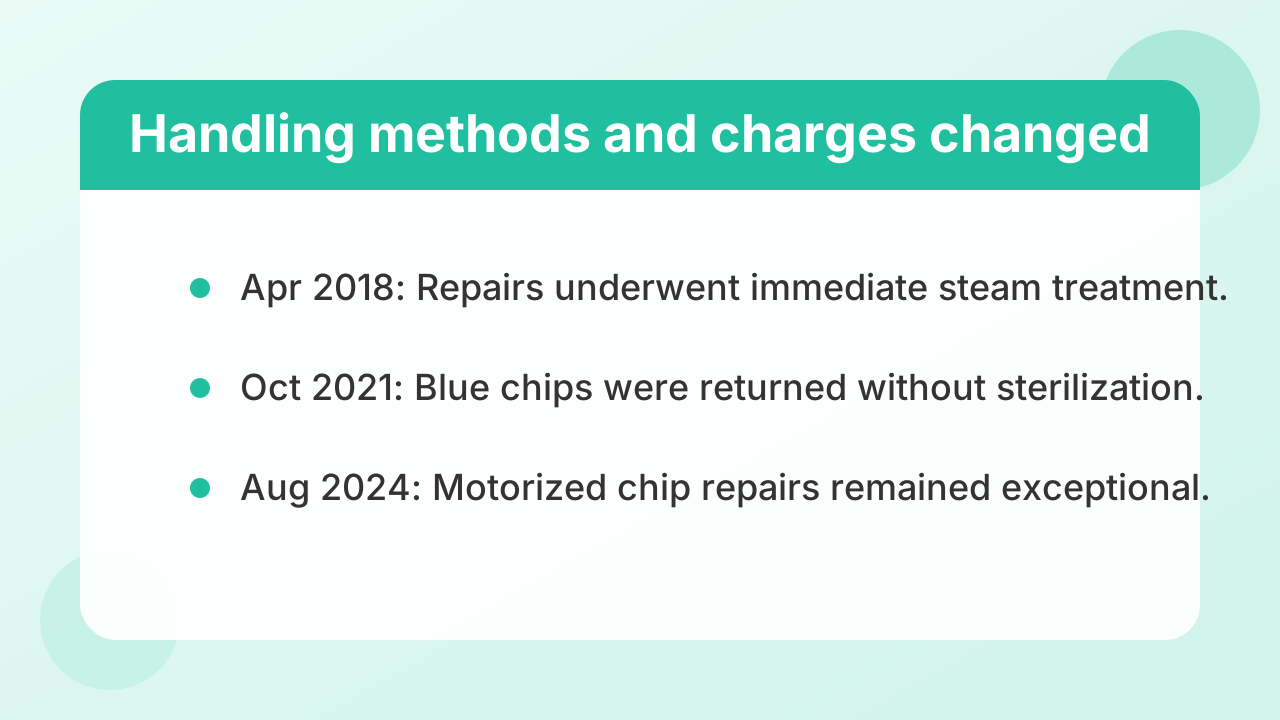
How prostate chip repair changed over time
| Published | What the diary said then |
|---|---|
| Apr 2018 | Returned repairs underwent immediate steam treatment, with complete thread replacement after shrinkage. |
| Mar 2019 | Used-chip reshaping was refused; glass-chip thread and motor unit replacements remained possible. |
| Jun 2019 | Chlorine disinfection was chosen for a repair where steam would shrink the threads. |
| Apr 2020 | Thread extension gained separate prices for unused and used items. |
| Nov 2020 | Repeated reinforcement failed; exposed wiring later broke, leaving a chip in the bladder. |
| Sep 2021 | Mr. Okada described bleach cleaning followed by steam sterilization for thread replacement orders. |
| Sep 2021 | Thread replacement for chips without glued thread joints became priced per chip. |
| Oct 2021 | Blue chip thread replacement changed to handling without sterilizing the customer's chip. |
| Aug 2024 | Motorized chip repairs remained exceptional; difficult sterilization before repairs was still a barrier. |
The diary does not say what the current state is.
OK Prostate Chip products related to prostate chip repair
No current product is directly tied to this topic.
Common worries about prostate chip repair
Reader questions show that a return could lead to replacement, restricted testing, or work confined to the electrical controls.
"Can chip repairs focus on the controller alone?"
In an entry published in March 2019, a customer asked about a motor that sometimes failed to run. The fault involved the controller (the unit controlling the motor), whose lights still worked. Mr. Okada initially suspected the motor, but the customer's follow-up pointed to the controller connection.
He offered a controller replacement that would leave the body-contacting end untouched. The diary records a completed repair and stronger internal resin fixing in newer shipments. Mr. Okada's return guidance called for the end 30 cm to remain wrapped because that area did not need handling.
(Source: ok-lab's diary, published March 2019)
https://ok-lab.hatenablog.com/entry/2019/03/02/151104
"Can chip repairs fail because a return remains dirty?"
An entry published in March 2019 describes a second repair request after a resin chip's thread came loose again. Mr. Okada said only about 30% of the surface dirt had come off after sterilization and soaking. He also expected another coating to make the chip thicker, so he proposed a new replacement for the repair fee alone.
The customer accepted and requested a first chip about 5 mm longer; the diary does not confirm that specification or final delivery. Mr. Okada asked the customer to accept a different shape from the original.
(Source: ok-lab's diary, published March 2019)
https://ok-lab.hatenablog.com/entry/2019/03/16/165528
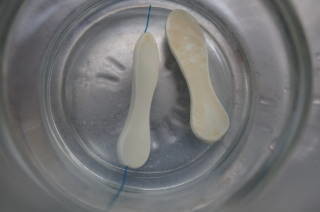
"Could chip repair disinfection limit how a fault is checked?"
In an entry published in July 2019, a customer requested rubber treatment for a mildly prickling thread joint on a curved ceramic chip. Mr. Okada said returned repairs always received chlorine disinfection, and he wore disposable rubber gloves during the work. He explained that the gloves prevented him from checking the prickling sensation directly with his fingers.
The diary does not record whether this customer's treatment was completed. Mr. Okada left any decision to apply the treatment to all products on hold. For this complaint, he offered free rubber treatment for unused items or those used only once.
(Source: ok-lab's diary, published July 2019)
https://ok-lab.hatenablog.com/entry/2019/07/06/152113
Buying from outside Japan
OK Lab ships internationally to countries covered by Japan Post's EMS courier service. Overseas orders are paid in advance by PayPal. Each order carries a ¥400 (about $3 at ¥156 = $1, rate as of 2026-09-04) handling fee, and EMS shipping is charged on top. These terms come from OK Lab's official sales-terms page (written here as plain text, not a link: ok-lab.net/docs/law), checked on September 7, 2026; confirm them on the official store before you order, because they can change.
Summary of this article
| What you wanted to know | The answer |
|---|---|
| What is the short answer? | Return handling depended on the material and repair; the diary does not establish today's complete policy. |
| What is the product? | A urethral device made by OK Lab in Japan, with prices in Japanese yen. |
| What parts and equipment matter here? | Retrieval threads, resin joints, electrical controls, and workshop sterilization equipment appear in the repair accounts. |
| What could happen after a return? | The entries describe thread replacement, limited repairs, replacement offers, and repairs judged impossible. |
| What did the maker change? | Mr. Okada changed charges and handling methods, including stopping sterilization for blue chip thread replacements. |
| How did the rules develop? | Entries from April 2018 through August 2024 describe changing treatment methods and repair limits. |
| Is there a current product specifically for this topic? | No current product is directly tied to this topic. |
| What did customers ask? | Questions concerned faulty controllers, repeated thread failures, and uncomfortable thread joints. |
| How do overseas purchases work? | Advance PayPal payment, a ¥400 (about $3 at ¥156 = $1, rate as of 2026-09-04) handling fee, and additional EMS shipping charges apply under the stated terms. |
Source: ok-lab's diary (Okada Comfortable Life Laboratory). The original entries are in Japanese; quotations on this page are translated. Photos and videos are on the original entries.
This article is a summary of the maker's development diary. The product is not a medical device and no result is guaranteed. If anything feels wrong or worries you, see a doctor. Prices, specifications and cautions change, so confirm the latest information on the official blog and the official site. Questions about ordering and shipping go to the seller.