![Do I need to clean and check it every time? | The maker says yes [OK Prostate Chip]](/img/a/T0902/eyecatch.svg)
This page is based on entries from "ok-lab's diary" (https://ok-lab.hatenablog.com/), the Japanese development diary written by Mr. Okada, founder of OK Lab, a small company in Japan (Okada Comfortable Life Laboratory). Only the entries about "cleaning before each use and checking for damage" are summarized here, in order of publication. Past prices and sizes are as written at the time. Current prices come from the official product list (retrieved September 4, 2026). Quotations are translated from Japanese.
Note: This page is a personal reading log by someone with no connection to the maker or the seller. It reflects the source entries as of their publication dates and makes no guarantee of accuracy or safety. The product is not a medical device; talk to a doctor about any health decision. Check the official site for current information. This page contains advertising.
In short
- Cleaning lapses and cracks appear in the diary, but their suspected causes are not always established.
- The maker calls for disinfection every time, damage checks, and attention to thread condition.
- Current listings include relevant models, while these cleaning and inspection records end in February 2022.
If you see blood in your urine, even a small amount or for the first time, do not wait and see. See a urologist right away. If you suddenly cannot urinate, or the device cannot be removed, do not try to fix it yourself. Go to a medical facility, including emergency care, immediately.
About this product

The OK Prostate Chip is a small device that is placed in the urethra (the urine passage) so that it acts on the prostate; the maker sells it in several shapes, sizes and materials. It is made and sold by OK Lab (Okada Comfortable Life Laboratory), a small company in Japan, through its own online store, and prices are in Japanese yen (JPY). The maker's development diary, "ok-lab's diary", is written in Japanese. This page is an English summary of it, and every quotation is translated. OK Lab ships internationally, so readers outside Japan can order (see "Buying from outside Japan" below). Product names on this page are plain-English descriptions. The official Japanese product name is shown once in the product table so you can find the same item in the store.
Before you read: key terms
| Term | Plain-English meaning |
|---|---|
| Urethra | The urine passage, where the chip is placed to act on the prostate. |
| Disinfection | Treatment discussed for the chip to address the maker's concerns about contamination. |
| Retrieval thread | Thread attached to the chip, discussed in connection with getting the device back out. |
| Stopper chip | An additional chip intended to limit movement toward the bladder. |
| Autoclave treatment | A treatment mentioned for sterilization. The diary does not explain this. |
| Nitrile gloves | Gloves named as an alternative to bare hands in the manual's hygiene precautions. |
| Lubricant | Gel or lotion discussed for dryness and difficulty moving the chip. |
| Syringe | A tool the February 2022 customer considered for supplying lubricant. |
| Vibration controller | The control unit connected to a vibrating chip to operate it. |
| USB connector | A cable connection discussed so the vibrating chip and controller could be separated. |
What happens: chip cleaning and inspection

The OK Prostate Chip is a small urethral device that the maker describes as acting on the prostate. Here, cleaning concerns contamination, while inspection concerns cracks, surface damage, dirt, and thread condition. Those checks involve the chip, its retrieval thread (the attached thread for retrieving it), and electrical connections on vibrating models. The diary relates these concerns to a device worn inside the urine passage, including cases where problems became apparent only afterward.
Missed chip cleaning was one suspected cause during stopper testing
In an entry published in June 2018, Mr. Okada suspected missed disinfection after developing inflammation of the urine passage during testing. The test involved a three-hole stopper chip (an additional chip intended to limit movement), measuring 17mm long and 9mm wide. According to his account, a doctor suggested excessive stopper size as another possible cause.
Mr. Okada noted that the stopper could lie across its thread and announced a shorter design, about 10mm long. The entry does not establish which suspected cause was responsible or describe the shorter design's subsequent results. Mr. Okada emphasized disinfection every time because this stopper had holes.
(Source: ok-lab's diary, published June 2018)
https://ok-lab.hatenablog.com/entry/20180630/1530342059
Chip inspection revealed an uneven crack after prolonged wear
In an entry published in September 2018, a customer reported a central crack after roughly one week of continuous wear. The glass awakening chip had an offset of about 0.2mm at the crack. The customer described repeated shallow scratches inside the urine passage without bleeding and suspected a previously hidden crack had become exposed.
After changing chips, the customer reported that stinging had stopped about 2 days later. The account does not establish when the crack first formed. Mr. Okada cautioned that he had no certain way to prevent delayed cracking.
(Source: ok-lab's diary, published September 2018)
https://ok-lab.hatenablog.com/entry/20180922/1537592180
Chip inspection also exposed delayed cracking in Mr. Okada's glass prototype
The same September 2018 entry described Mr. Okada's separate experiment with a glass prototype for anal use. He reported finding a crack about one week after it had seemed trouble-free during use. His prototype had not undergone the slow cooling used for the company's glass urethral chips.
Mr. Okada explained that this manufacturing step was intended to reduce strain inside the glass. He said he would abandon glass for that project for anal use. He advised inspection before every use of glass chips and no use of any chip with a crack.
(Source: ok-lab's diary, published September 2018)
https://ok-lab.hatenablog.com/entry/20180922/1537592180
Missed chip cleaning preceded chills, but Mr. Okada could not confirm why
In an entry published in February 2022, Mr. Okada described chills after a chip had touched a toilet. He wrote that he had used it again after only a water rinse, without repeating disinfection. He recorded 36.8°C, which he considered a slight fever compared with his usual 36.0°C.
He suspected inflammation of the urine passage, but reported no discomfort there and acknowledged that the fever might have another cause. His trial paused for 3 days; he reported no further problem 2 days after it resumed. Mr. Okada described the missed disinfection as an avoidable mistake.
(Source: ok-lab's diary, published February 2022)
https://ok-lab.hatenablog.com/entry/2022/02/19/123621
The maker's answer to chip cleaning and inspection

The maker's guidance broadened to cover the chip's surface, thread condition, contact hygiene, and possible damage from heat.
Chip inspection in the manual covered surface damage and thread strength
In an entry published in July 2021, Mr. Okada shared a manual covering the chip's surface and its retrieval thread. Its checklist included scratches, dirt, and whether the thread remained strong enough. The manual attributed thread failure to excessive use or unnoticed damage from something sharp.
For the longer wear it discussed, the manual included checks of both parts at least once a week. It also mentioned earlier thread replacement as a precaution against breakage. The manual's advice treated the thread's condition as part of inspection alongside the chip itself.
(Source: ok-lab's diary, published July 2021)
https://ok-lab.hatenablog.com/entry/2021/07/24/125923
Chip cleaning guidance warned that heat could also affect the thread
Another part of the July 2021 manual discussed disinfection (treatment addressing contamination concerns) using heat or chemicals. It named hot water and disinfectants, without giving a detailed comparison between them. It also warned about thread shrinkage during autoclave treatment (a sterilization method the diary does not explain).
The diary does not explain how much shrinkage might occur or identify a thread specification affected by it. Mr. Okada's published manual therefore paired its disinfection advice with a warning about possible damage to the thread.
(Source: ok-lab's diary, published July 2021)
https://ok-lab.hatenablog.com/entry/2021/07/24/125923
Chip cleaning concerns extended to hands, gloves, and lubricant packaging
A further passage in the July 2021 manual focused on contact hygiene around the device. It mentioned thoroughly washed hands or new nitrile gloves (gloves presented as an alternative to bare hands). The text also discussed lubricant (gel or lotion for dryness) as a possible source of infection.
Mr. Okada favored disposable products or packaging that avoided finger contact with the contents. The manual's hygiene advice therefore extended beyond the chip to other materials coming into contact with it.
(Source: ok-lab's diary, published July 2021)
https://ok-lab.hatenablog.com/entry/2021/07/24/125923
If you see blood in your urine, even a small amount or for the first time, do not wait and see. See a urologist right away. If you suddenly cannot urinate, or the device cannot be removed, do not try to fix it yourself. Go to a medical facility, including emergency care, immediately.
How chip cleaning and inspection changed over time

| Published | What the diary said then |
|---|---|
| Jun 2018 | A doctor questioned stopper size; Mr. Okada announced a shorter design. |
| Sep 2018 | A customer reported an uneven glass crack and shallow injuries. |
| Sep 2018 | Mr. Okada abandoned glass for his anal-device project after separate prototype cracking. |
| Jun 2020 | Staff acknowledged limits on hygiene controls for handmade production. |
| Jul 2021 | A manual covered chip surfaces, retrieval threads, contact hygiene, and heat-related thread shrinkage. |
| Feb 2022 | Mr. Okada described chills after toilet contact and missed disinfection. |
| Feb 2022 | A connector announcement addressed heat-sensitive controllers and ordinary USB covers. |
The diary does not say what the current state is.
OK Prostate Chip products related to chip cleaning and inspection

Current listings include models involved in these reports, including a glass model associated with a crack report.
Products that appear in these entries
| Product (official name) | Price incl. tax | Relation to this topic |
|---|---|---|
| Glass awakening chip (OKプロステート覚醒チップ) | ¥5,500 (about $35 at ¥156 = $1, rate as of 2026-09-04) | The September 2018 customer reported a crack in this glass model. |
| Curved resin chip with a flat face (OKプロステートチップ フラット面カーブ型 セミロングタイプ(生体適合樹脂)) | ¥6,050 (about $39 at ¥156 = $1, rate as of 2026-09-04) | A February 2022 customer using this model raised a concern about whether a vinyl syringe could tolerate heat. |
| Long ceramic vibrating chip (OKプロステート核振チップ 陶器素材ロングタイプ) | ¥8,800 (about $56 at ¥156 = $1, rate as of 2026-09-04) | A different February 2022 customer asked how the attached controller affected disinfection. |
(Source: ok-lab's diary, published September 2018)
https://ok-lab.hatenablog.com/entry/20180922/1537592180
(Source: ok-lab's diary, published February 2022)
https://ok-lab.hatenablog.com/entry/2022/02/26/123231
Products the diary mentioned as alternatives
The diary names no alternative.
The specific June 2018 test stopper and September 2018 glass prototype for anal use: No matching product can be confirmed on the current list.
The heat-resistant connector announced in February 2022: No matching product can be confirmed on the current list.
Common worries about chip cleaning and inspection
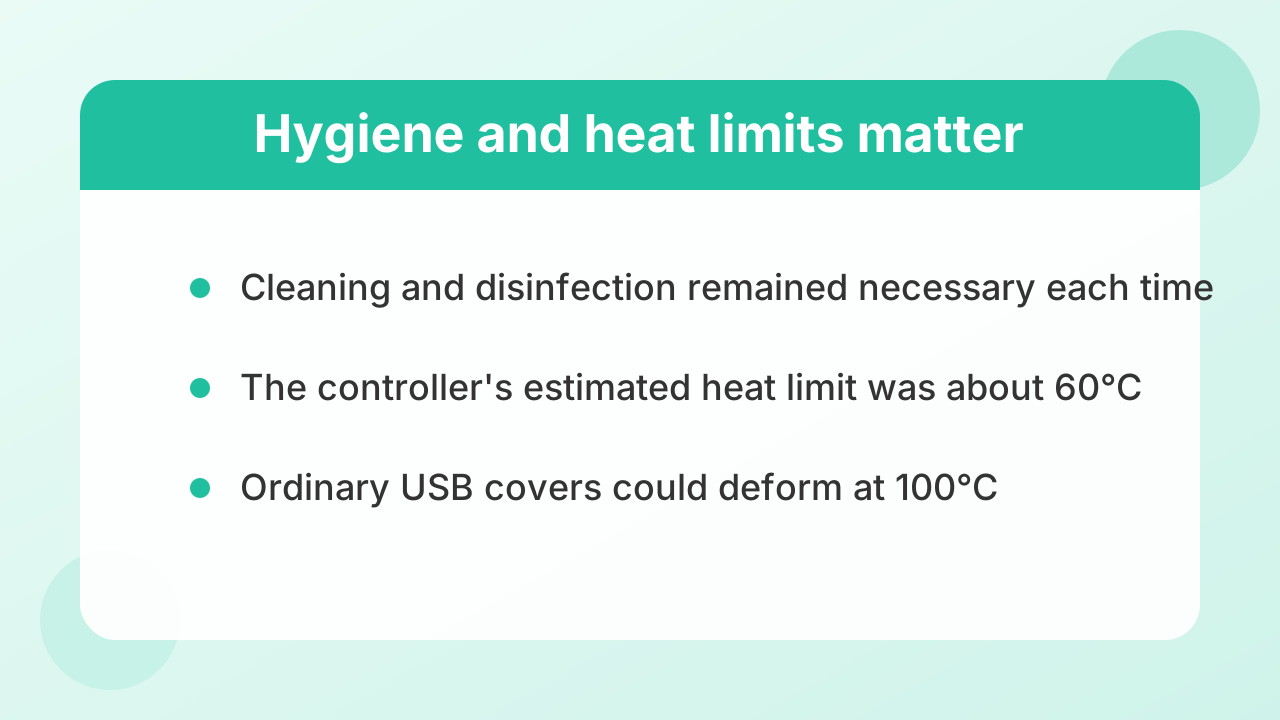
The reader questions concerned a new chip's hygiene, equipment that could deform, and the heat limits of connected electrical parts.
"Does chip cleaning matter before first use?"
In an entry published in June 2020, a customer in South Korea asked about manufacturing hygiene and breakage inside the body. Staff said handmade production could not provide the strict hygiene and precision controls associated with factory manufacturing. They acknowledged a few breakage cases, described the risk as low, and said those incidents had not caused major injuries.
Staff favored ceramic or resin over glass, claiming these materials would not become sharp if broken. The diary does not record whether this customer bought a chip or how it felt in use. The staff's hygiene advice applied from the first use: cleaning and disinfection remained necessary each time.
(Source: ok-lab's diary, published June 2020)
https://ok-lab.hatenablog.com/entry/2020/06/27/120614
"What if chip cleaning equipment cannot tolerate boiling?"
In an entry published in February 2022, a customer using a curved resin chip with a flat face asked about lubrication equipment. The customer reported that a vinyl syringe (a tool considered for supplying lubricant) would deform during boiling.
The diary does not record whether the customer's equipment concern was resolved. Mr. Okada's advice addressed lubrication, but did not establish a suitable disinfection method for that syringe.
(Source: ok-lab's diary, published February 2022)
https://ok-lab.hatenablog.com/entry/2022/02/26/123231
"Can chip cleaning damage a vibrating model's controller?"
A different customer in the February 2022 entry asked whether the long ceramic vibrating chip's controller (the electrical control unit) was separate. Mr. Okada said standard assemblies were connected and estimated the controller's heat limit at about 60°C. He also warned that ordinary USB connector covers could deform at 100°C.
His reply announced a boiling-resistant USB connector (a cable connection) intended to separate the chip from its controller. The diary does not record whether the customer bought that option. Mr. Okada recommended the newly released connector to address the ordinary plug's heat limitation.
(Source: ok-lab's diary, published February 2022)
https://ok-lab.hatenablog.com/entry/2022/02/26/123231
Buying from outside Japan

OK Lab ships internationally to countries covered by Japan Post's EMS courier service. Overseas orders are paid in advance by PayPal. Each order carries a ¥400 (about $3 at ¥156 = $1, rate as of 2026-09-04) handling fee, and EMS shipping is charged on top. These terms come from OK Lab's official sales-terms page (written here as plain text, not a link: ok-lab.net/docs/law), checked on September 7, 2026; confirm them on the official store before you order, because they can change.
Summary of this article
| What you wanted to know | The answer |
|---|---|
| In short: does care matter every time? | The maker repeatedly calls for disinfection and checks for damage. |
| About this product: what is it? | A device from Japan placed in the urine passage to act on the prostate. |
| Key terms: which parts matter here? | The chip, its retrieval thread, and the controller and connections of vibrating models. |
| What happens: what went wrong? | The diary records suspected contamination problems and cracks discovered after use. |
| The maker's answer: what did guidance cover? | Surface condition, thread strength, disinfection, contact hygiene, and possible heat damage. |
| Changes over time: how did the discussion develop? | Individual problems were followed by broader manual guidance and a connector announcement. |
| Related products: what is currently listed? | The glass awakening, curved resin, and long ceramic vibrating models appear in the current list. |
| Common worries: what did customers ask? | Questions concerned manufacturing hygiene, heat-sensitive equipment, and the vibrating chip's controller. |
| Buying abroad: what are the stated terms? | Advance PayPal payment, EMS shipping, and a ¥400 (about $3 at ¥156 = $1, rate as of 2026-09-04) handling fee, with shipping charged separately. |
| Overall summary: what remains uncertain? | The suspected illness causes and several customer outcomes were not confirmed. |
Source: ok-lab's diary (Okada Comfortable Life Laboratory). The original entries are in Japanese; quotations on this page are translated. Photos and videos are on the original entries.
This article is a summary of the maker's development diary. The product is not a medical device and no result is guaranteed. If anything feels wrong or worries you, see a doctor. Prices, specifications and cautions change, so confirm the latest information on the official blog and the official site. Questions about ordering and shipping go to the seller.