![Will an autoclave shrink the chip's thread? | The maker reports nylon shrinkage [OK Prostate Chip]](/img/a/T0887/eyecatch.svg)
This page is based on entries from "ok-lab's diary" (https://ok-lab.hatenablog.com/), the Japanese development diary written by Mr. Okada, founder of OK Lab, a small company in Japan (Okada Comfortable Life Laboratory). Only the entries about "thread shrinkage during high-pressure sterilization" are summarized here, in order of publication. Past prices and sizes are as written at the time. Current prices come from the official product list (retrieved September 4, 2026). Quotations are translated from Japanese.
Note: This page is a personal reading log by someone with no connection to the maker or the seller. It reflects the source entries as of their publication dates and makes no guarantee of accuracy or safety. The product is not a medical device; talk to a doctor about any health decision. Check the official site for current information. This page contains advertising.
In short
- Nylon thread (the retrieval cord) shrank in Mr. Okada's autoclave (high-pressure steam sterilizer) tests.
- The maker advised against high-pressure treatment and discussed longer thread for customers worried about shortening.
- The latest supplied reply, published in January 2023, still rejected autoclaving with nylon attached.
About this product
The OK Prostate Chip is a small device that is placed in the urethra (the urine passage) so that it acts on the prostate; the maker sells it in several shapes, sizes and materials. It is made and sold by OK Lab (Okada Comfortable Life Laboratory), a small company in Japan, through its own online store, and prices are in Japanese yen (JPY). The maker's development diary, "ok-lab's diary", is written in Japanese. This page is an English summary of it, and every quotation is translated. OK Lab ships internationally, so readers outside Japan can order (see "Buying from outside Japan" below). Product names on this page are plain-English descriptions. The official Japanese product name is shown once in the product table so you can find the same item in the store.
Before you read: key terms
| Term | Plain-English meaning |
|---|---|
| Urethra | The urine passage; the maker describes placing the chip there to act on the prostate. |
| Nylon thread | The cord attached to the chip, serving as a retrieval cord. |
| Autoclave | The high-pressure steam sterilizer discussed in the diary, used for treatment before shipping or workshop repairs. |
| Resin | Material used for chip bodies and thread joints; the repair replies also discuss it as a covering for damaged areas. |
| Siliconairo | Another cord discussed as a possible thread material; Mr. Okada says it contains nylon. |
What happens: nylon thread shrinkage
The OK Prostate Chip is a small device placed in the urethra so that it acts on the prostate. The nylon thread attached to the chip serves as a retrieval cord, with a connection at the chip's end. This article concerns that thread becoming shorter during heat treatment intended to disinfect the product. The diary describes the issue during preparation for shipping, workshop repairs, and a customer's questions about treatment at home.
Thread shrinkage forced remakes before shipping in November 2017
In an entry published in November 2017, Mr. Okada described discovering shortened thread just before products were shipped to customers. He says nylon thread intended for stitching had shrunk during high-pressure treatment, forcing numerous products to be remade. The glass had already been processed above 500°C, but further manufacturing steps followed, so he had added a final treatment before shipping.
Mr. Okada writes that his earlier personal tests had not alerted him to the change in thread length. The entry says outgoing products were then receiving boiling-water treatment only. He advised against high-pressure treatment and wrote that ordinary boiling water appeared not to shorten the thread.
(Source: ok-lab's diary, published November 2017)
https://ok-lab.hatenablog.com/entry/20171129/1511963864
Thread shrinkage meant complete replacement during an April 2018 repair
In an entry published in April 2018, Mr. Okada described a repair request after a customer had cut the thread. He says returned devices underwent approximately 40 minutes of high-pressure steam treatment immediately upon arrival at the workshop. He explained that the same premises were used to make products for other customers.
According to Mr. Okada, that treatment shortened the thread, making complete replacement necessary even for a small repair. The diary does not record how this customer's chip felt after the work. Mr. Okada says customers requesting minor repairs still needed full thread replacement under that process.
(Source: ok-lab's diary, published April 2018)
https://ok-lab.hatenablog.com/entry/20180421/1524299808
Avoiding thread shrinkage changed a June 2019 ceramic repair plan
In an entry published in June 2019, a customer reported painful, sharp thread joints on two ceramic models, both in M size. These were the ceramic stimulation chip and the short comma-shaped ceramic chip. Mr. Okada proposed workshop repairs, with chlorine bleach used for disinfection because the sterilizer would shrink the thread.
After receiving the chips, he considered their joints typical of his production and thought more resin (material covering the joints) would be insufficient. He planned softer rubber at the connections; the diary does not record the customer's experience after their return. Mr. Okada invited customers troubled by that joint shape to request the rubber treatment.
(Source: ok-lab's diary, published June 2019)
https://ok-lab.hatenablog.com/entry/2019/06/29/143536
Thread shrinkage added a separate charge to an October 2019 repair
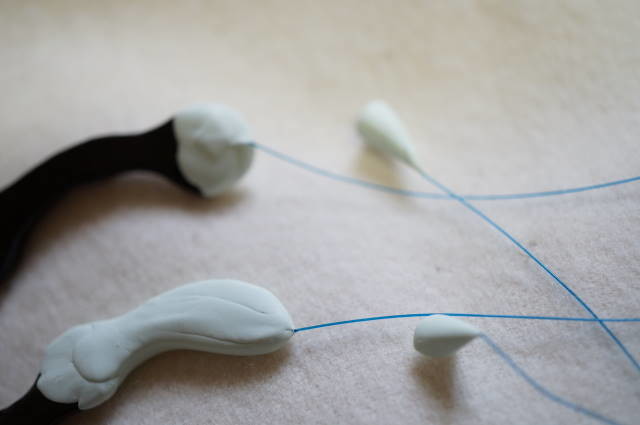
In an entry published in October 2019, a customer sought repairs for a semi-long glass chip with a rough, damaged surface. The customer had bought it with an added stopper; Mr. Okada said repair might be possible for small, localized damage. He said the proposed repair required a thread replacement fee because the workshop's high-pressure treatment would shorten the thread.
Filling the damaged area with resin would be free, but the entry gives no amount for the thread replacement charge. The diary does not record whether this repair was completed. Mr. Okada advised against continued use if the glass showed more widespread cracking.
(Source: ok-lab's diary, published October 2019)
https://ok-lab.hatenablog.com/entry/2019/10/12/125944
The maker's answer to nylon thread shrinkage
Mr. Okada's responses covered longer thread, other disinfection methods, and the limits of changing the cord.
Longer cords were suggested after a February 2019 thread shrinkage report
In an entry published in February 2019, a customer clarified that the thread had become visibly shorter after a hot-water soak. This was the follow-up to the earlier question about thread length, rather than a report of an autoclave being used. Mr. Okada acknowledged that hot water might have shortened this customer's thread.
His own dedicated-pot tests involved repeated boiling, yet he reported no noticeable shortening in that setup. The entry does not give a measured change for the customer's thread or establish why the accounts differed. Mr. Okada suggested ordering slightly longer thread for customers concerned about shortening.
(Source: ok-lab's diary, published February 2019)
https://ok-lab.hatenablog.com/entry/2019/02/09/152257
The July 2021 instructions retained a warning about autoclave thread shrinkage
In an entry published in July 2021, Mr. Okada published handling instructions with a specific warning about thread shrinkage in an autoclave. He presented the instructions as guidance for a novelty product, without a guarantee of effects.
The same text also cautioned against customers repairing or modifying the product themselves. For disinfection, the published instructions named hot water or disinfectants.
(Source: ok-lab's diary, published July 2021)
https://ok-lab.hatenablog.com/entry/2021/07/24/125923
Mr. Okada ruled out another cord because of autoclave thread shrinkage
In an entry published in January 2023, Mr. Okada discussed another nylon-containing cord (Siliconairo). He wrote that it also contained nylon, so it shared the material behind the shrinkage concern.
He asked for suggestions for a better cord material, but the entry names no successful replacement. Mr. Okada's conclusion was that this alternative cord was also unsuitable for autoclaving.
(Source: ok-lab's diary, published January 2023)
https://ok-lab.hatenablog.com/entry/2023/01/14/122952
How nylon thread shrinkage changed over time
| Published | What the diary said then |
|---|---|
| Nov 2017 | Pre-shipment shrinkage prompted remakes and a switch to boiling-water treatment. |
| Apr 2018 | Returned chips underwent pressure treatment, making complete thread replacement necessary. |
| Feb 2019 | Mr. Okada reported a measured shrinkage result from an autoclave test. |
| Feb 2019 | A customer's hot-water account prompted acknowledgment of uncertainty and a longer-thread suggestion. |
| Jun 2019 | A ceramic repair plan used chlorine bleach to avoid heat-related shortening. |
| Oct 2019 | A glass repair quote separated paid thread replacement from free surface filling. |
| Jul 2021 | Published instructions included an autoclave shrinkage warning. |
| Jan 2023 | Nylon still prevented support for autoclaving; the alternative cord also contained nylon. |
The diary does not say what the current state is.
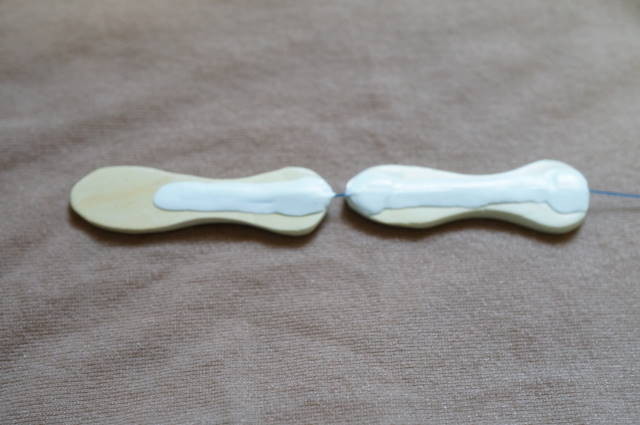
OK Prostate Chip products related to nylon thread shrinkage
The current list includes models from these cases, but the January 2023 reply did not support autoclaving with nylon thread.
Products that appear in these entries
| Product (official name) | Price incl. tax | Relation to this topic |
|---|---|---|
| Ceramic stimulation chip (OKプロステートチップ 陶器素材覚醒タイプ) | ¥5,500 (about $35 at ¥156 = $1, rate as of 2026-09-04) | June 2019: an M-size example was returned over sharp thread joints, prompting repairs intended to avoid thread shrinkage. |
| Short comma-shaped ceramic chip (OKプロステートチップ 陶器素材ショート勾玉タイプ) | ¥4,400 (about $28 at ¥156 = $1, rate as of 2026-09-04) | June 2019: this was the other M-size model in the same complaint and proposed repair using chlorine bleach. |
| Semi-long glass chip (OKプロステートチップ ガラス素材セミロングタイプ) | ¥4,400 (about $28 at ¥156 = $1, rate as of 2026-09-04) | October 2019: a buyer of this model with an added stopper received a repair reply that included a thread replacement charge. |
| Semi-long resin chip (OKプロステートチップ セミロングタイプ(生体適合樹脂)) | ¥5,500 (about $35 at ¥156 = $1, rate as of 2026-09-04) | January 2023: its buyer asked about autoclaving, and staff rejected it because the nylon thread could shrink. |
The semi-long resin chip is listed in OK Lab's own online store.

(Source: ok-lab's diary, published June 2019)
https://ok-lab.hatenablog.com/entry/2019/06/29/143536
(Source: ok-lab's diary, published October 2019)
https://ok-lab.hatenablog.com/entry/2019/10/12/125944
(Source: ok-lab's diary, published January 2023)
https://ok-lab.hatenablog.com/entry/2023/01/14/122952
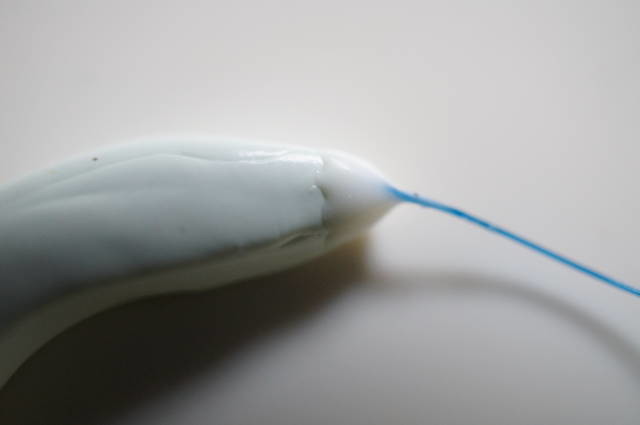
Products the diary mentioned as alternatives
The diary names no alternative.
February 2019 custom resin chip and January 2023 cord (Siliconairo):
No matching product can be confirmed on the current list.
Common worries about nylon thread shrinkage
The diary separates a customer's hot-water report from the maker's pressure test and the complete product's heat limits.
"Did boiling water cause the reported nylon thread shrinkage?"
In an entry published in February 2019, a customer asked whether hot-water disinfection could explain a shorter thread on a custom resin chip. Mr. Okada replied that his autoclave test at 120°C produced 15% shrinkage, while he had experienced none with ordinary 100°C boiling. He suggested contact with a pot wall outside the water could expose thread to temperatures above 100°C.
The customer's later account described a hot-water soak; the diary does not establish why the thread shortened. Mr. Okada also recalled visibly thicker thread during the earlier high-pressure shrinkage test. His suggestion for customers concerned about shortening was to order slightly longer thread.
(Source: ok-lab's diary, published February 2019)
https://ok-lab.hatenablog.com/entry/2019/02/02/153358
(Source: ok-lab's diary, published February 2019)
https://ok-lab.hatenablog.com/entry/2019/02/09/152257
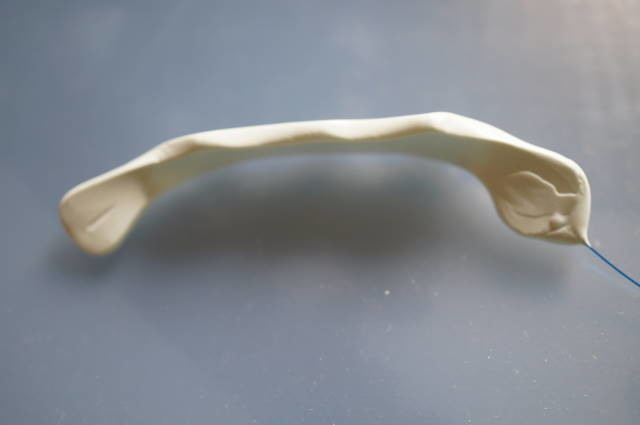
"Can thread shrinkage add costs to glass chip repairs?"
In an entry published in October 2019, a customer asked about repairing damaged glass on a semi-long chip. Mr. Okada attached the thread charge to shrinkage during workshop treatment, rather than to filling the small damaged area. That reply did not provide a general price for all thread work.
The June 2019 ceramic repair reply described a different treatment plan, so it cannot establish the charge for this glass repair. For glass showing more widespread cracking, Mr. Okada advised against further use.
(Source: ok-lab's diary, published June 2019)
https://ok-lab.hatenablog.com/entry/2019/06/29/143536
(Source: ok-lab's diary, published October 2019)
https://ok-lab.hatenablog.com/entry/2019/10/12/125944
"Is autoclave sterilization possible at 121°C or 134°C?"
In an entry published in January 2023, a first-time buyer of the semi-long resin chip asked about those two machine settings. The customer wanted to reduce uncertainty before trying a product they had not used before. Staff replied that the chip body was not the obstacle, but heating shortened the nylon thread, so the assembled product was not supported.
Mr. Okada added that prolonged tests of the body had appeared unproblematic. The diary does not record whether the customer attempted autoclaving or what happened when the product was used. The published reply ruled out autoclaving the product with that thread.
(Source: ok-lab's diary, published January 2023)
https://ok-lab.hatenablog.com/entry/2023/01/14/122952
Buying from outside Japan
OK Lab ships internationally to countries covered by Japan Post's EMS courier service. Overseas orders are paid in advance by PayPal. Each order carries a ¥400 (about $3 at ¥156 = $1, rate as of 2026-09-04) handling fee, and EMS shipping is charged on top. These terms come from OK Lab's official sales-terms page (written here as plain text, not a link: ok-lab.net/docs/law), checked on September 7, 2026; confirm them on the official store before you order, because they can change.
Summary of this article
| What you wanted to know | The answer |
|---|---|
| What is the short answer? | The maker reports nylon thread shrinkage under high-pressure heat. |
| What is the product? | A urethral device made and sold by OK Lab in Japan. |
| Which terms matter? | The attached nylon cord and the autoclave are central to this issue. |
| What happened in the cases? | Shrinkage affected production and repair work; treatment plans differed between entries. |
| What answers did the maker offer? | Longer thread, other disinfection methods, and a warning that another nylon-containing cord remained unsuitable. |
| What changed over time? | Workshop reports developed into written warnings and a January 2023 compatibility refusal. |
| Which products appear today? | The related models above cost ¥4,400 (about $28 at ¥156 = $1, rate as of 2026-09-04) or ¥5,500 (about $35 at ¥156 = $1, rate as of 2026-09-04) incl. tax on the supplied list. |
| What remains uncertain? | The customer's hot-water shrinkage was unresolved; a tolerant chip body did not establish whole-product compatibility. |
| How do overseas orders work? | Advance PayPal payment, a ¥400 (about $3 at ¥156 = $1, rate as of 2026-09-04) handling fee, and additional EMS shipping charges apply under the stated terms. |
Source: ok-lab's diary (Okada Comfortable Life Laboratory). The original entries are in Japanese; quotations on this page are translated. Photos and videos are on the original entries.
This article is a summary of the maker's development diary. The product is not a medical device and no result is guaranteed. If anything feels wrong or worries you, see a doctor. Prices, specifications and cautions change, so confirm the latest information on the official blog and the official site. Questions about ordering and shipping go to the seller.