![How do I wash tucking devices and underwear? | Care depends on the design [OK Prostate Chip]](/img/a/T0906/eyecatch.svg)
This page is based on entries from "ok-lab's diary" (https://ok-lab.hatenablog.com/), the Japanese development diary written by Mr. Okada, founder of OK Lab, a small company in Japan (Okada Comfortable Life Laboratory). Only the entries about cleaning tucking devices and underwear are summarized here, in order of publication. Past prices and sizes are as written at the time. Current prices come from the official product list (retrieved September 4, 2026). Quotations are translated from Japanese.
Note: This page is a personal reading log by someone with no connection to the maker or the seller. It reflects the source entries as of their publication dates and makes no guarantee of accuracy or safety. The product is not a medical device; talk to a doctor about any health decision. Check the official site for current information. This page contains advertising.
In short
- Washing limitations changed as fabric covers, belts, and ceramic plates were redesigned.
- Mr. Okada’s main answer was separating fabric from components needing different care.
- The current list does not confirm the historical frame and tucking underwear versions discussed here.
If you see blood in your urine, even a small amount or for the first time, do not wait and see. See a urologist right away. If you suddenly cannot urinate, or the device cannot be removed, do not try to fix it yourself. Go to a medical facility, including emergency care, immediately.
About this product

The OK Prostate Chip is a small device that is placed in the urethra (the urine passage) so that it acts on the prostate; the maker sells it in several shapes, sizes and materials. It is made and sold by OK Lab (Okada Comfortable Life Laboratory), a small company in Japan, through its own online store, and prices are in Japanese yen (JPY).
The maker's development diary, "ok-lab's diary", is written in Japanese. This page is an English summary of it, and every quotation is translated. OK Lab ships internationally, so readers outside Japan can order (see "Buying from outside Japan" below).
Product names on this page are plain-English descriptions. The official Japanese product name is shown once in the product table so you can find the same item in the store.
Before you read: key terms
| Term | Plain-English meaning |
|---|---|
| Urethra | The urine passage; the base chip occupies this passage to act on the prostate. |
| Tucking device | An external device intended to hold the penis inward and reduce its visible projection. |
| Stocking fabric | Thin fabric used for covers; its role varies from cushioning a frame to enclosing wearable components. |
| USB connector | An electrical plug connecting a powered component to its supply; the diary discusses its washing compatibility. |
| Ceramic plate | A hard external component that presses against the penis as part of a tucking device. |
| Glans | The head of the penis; its relationship to the plate opening affects concealment and urine routing in these entries. |
| Bidet spray | A washing spray discussed as a way to clean exposed surfaces after urination. |
| Tent | A stretch-fabric panel over a ceramic plate, intended to keep the penis from projecting through the plate opening. |
What happens: washing tucking devices and underwear
The OK Prostate Chip is a small device placed in the urethra (the urine passage) to act on the prostate. These cleaning entries also cover external tucking devices (devices that hold the penis inward) and underwear worn around the groin. The designs include fabric-covered frames, ceramic plates against the penis, and stretch fabric over those plates. Their covers and supports serve different purposes, so the diary describes different washing limits for different versions.
Washing wearable frames shaped the original electrical connection choice
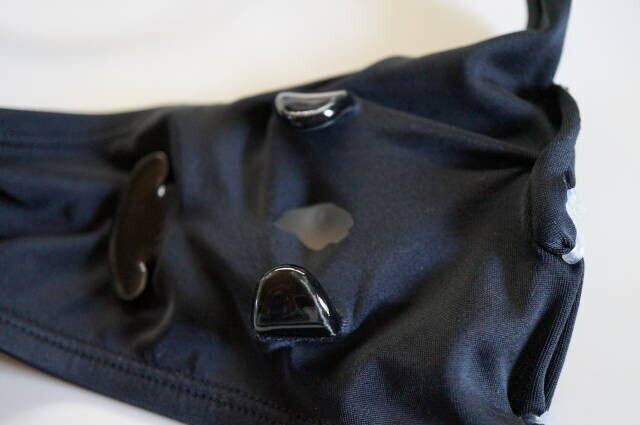
In an entry published in April 2020, Mr. Okada introduced an external wire frame intended to press around the prostate from the pubic side. Stocking fabric covered the frame because, he wrote, bare wire could stick to skin and tug. The frame needed whole-unit washing, so its electrical connection was limited to USB.
The published price was ¥7,000 (about $45 at ¥156 = $1, rate as of 2026-09-04) excluding tax, including a USB-equipped 3V battery box. No matching product can be confirmed on the current list. Mr. Okada’s washing guidance explicitly included the USB connector (the electrical plug), which he said could be washed with the frame.
(Source: ok-lab's diary, published April 2020)
https://ok-lab.hatenablog.com/entry/2020/04/11/151453
Washing wearable frames became easier without the stocking cover
In a separate entry published in April 2020, Mr. Okada identified the first frame’s stocking cover as a weakness for washing and handling. The revised frame omitted that cover, with easier handling among its stated aims. Its appearance also changed to silver stainless steel with white resin accents.
The published price was ¥5,000 (about $32 at ¥156 = $1, rate as of 2026-09-04) excluding tax, including a tip motor and a USB plug connection about 5cm long; controllers and pulling straps were separate. No matching product can be confirmed on the current list. Mr. Okada presented the uncovered frame as his answer to the earlier version’s handling difficulties.
(Source: ok-lab's diary, published April 2020)
https://ok-lab.hatenablog.com/entry/2020/04/18/133904
Cleaning tucking plates changed when urine exited at the front
In an entry published in April 2023, Mr. Okada described enlarging the plate’s central opening from about 7mm to about 20mm. Previously, urine reached the back of the plate, where he said a bidet spray (a washing spray) could not clean directly. He reported that the wider opening routed urine through the front, leaving the back unsoiled and allowing spray cleaning of the exposed surface.
He also stopped development of the earlier condom-and-tube urine-routing arrangement. No matching product can be confirmed on the current list. Mr. Okada offered earlier buyers who had achieved flattening a free exchange, while warning that replacements would take time.
(Source: ok-lab's diary, published April 2023)
https://ok-lab.hatenablog.com/entry/2023/04/22/123057
Tucking plate cleaning remained possible during a reported removal problem
In an entry published in May 2023, Mr. Okada reported difficulty removing a plate with an opening about 2cm across. The plate remained around the glans (the head of the penis), although he described being able to wash the surrounding penis. His account does not establish that the plate was subsequently removed.
He believed removal might still be possible with more effort, but that was his expectation rather than a recorded result. No matching product can be confirmed on the current list. Mr. Okada cautioned against complete passage through the opening for wearers whose erections might prevent removal.
(Source: ok-lab's diary, published May 2023)
https://ok-lab.hatenablog.com/entry/2023/05/06/123024
Repeated tucking device washing exposed a failure in imitation leather
In an entry published in January 2024, Mr. Okada explained why development of a ceramic plate with directly attached imitation leather had stalled. Repeated washing caused the material’s surface layer to peel away from its fabric backing. Although intended for shoes exposed to water, it had not tolerated daily wetting in his tests.
He changed the belt assembly from an earlier 8mm tubing approach to construction entirely from 4mm tubing. No matching product can be confirmed on the current list. Mr. Okada presented the simpler tube assembly as a lower-cost answer that was easier to clean.
(Source: ok-lab's diary, published January 2024)
https://ok-lab.hatenablog.com/entry/2024/01/06/123004
Washing ceramic underwear by machine was ruled out for sewn fabric
In an entry published in July 2024, Mr. Okada described ceramic underwear with an added stretch-fabric crotch section. The ceramic plate pressed against the penis, while the fabric also covered the testicles. In that construction, the cloth was sewn to the tubing belt and could not be separated for washing.
Earlier plate-and-tube arrangements had separable components, but the added sewn fabric changed that feature. No matching product can be confirmed on the current list. Mr. Okada specified handwashing only for this version because the attached cloth prevented machine washing.
(Source: ok-lab's diary, published July 2024)
https://ok-lab.hatenablog.com/entry/2024/07/06/122927
Washing tucking underwear influenced the move to separately sold pieces
In an entry published in July 2024, Mr. Okada discontinued the tube-belt version in favor of string underwear made entirely from swimwear fabric. The front panel, ties, and sewing thread all used that material. The sales arrangement became one underwear piece and one ceramic plate.
The historical prices were ¥6,000 (about $38 at ¥156 = $1, rate as of 2026-09-04) excluding tax for the plate and ¥6,000 (about $38 at ¥156 = $1, rate as of 2026-09-04) excluding tax for the free-size underwear. No matching product can be confirmed on the current list. Mr. Okada suggested buying 2 underwear pieces to provide a change while one was being washed.
(Source: ok-lab's diary, published July 2024)
https://ok-lab.hatenablog.com/entry/2024/07/20/123059
The maker's answer to washing tucking devices and underwear
The diary’s answers depend on whether the item contains fabric, ceramic, electrical parts, or permanently joined materials.
Drying stocking fabric relied on moisture absorption in the maker’s account
In an entry published in January 2022, Mr. Okada described his experience with a wearable vibrating device that partly used stocking fabric. He reported bathing while wearing it, but said the vibration felt much weaker underwater. He attributed that reduction to the water absorbing vibration.
His account also referred to earlier tests involving stocking garments. No matching product can be confirmed on the current list. Mr. Okada’s drying advice centered on towel absorption; he said body warmth then dried the stocking fabric quickly.
(Source: ok-lab's diary, published January 2022)
https://ok-lab.hatenablog.com/entry/2022/01/01/124134
Cleaning ceramic plates offered advantages alongside weight and breakage concerns
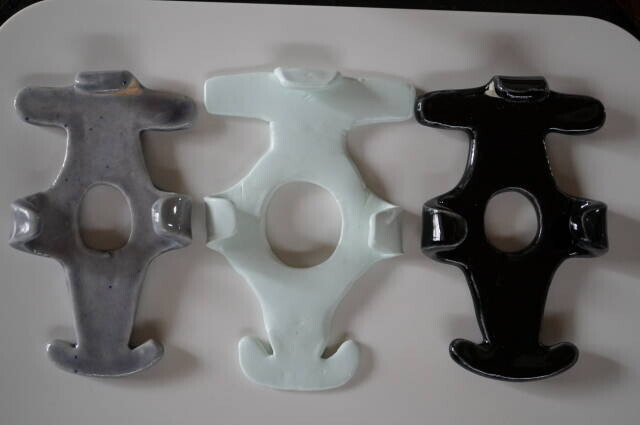
In an entry published in May 2023, Mr. Okada explained his choice of ceramic for the external pressing plate. He described ceramic as resistant to dirt, easy to clean, and gentle on skin. The historical weights were about 20g for the earlier resin plate and about 40g for the ceramic plate.
His test also involved a small fabric cover, which he said dried quickly after paper or cloth absorbed moisture. He said moisture behind the plate dried at a similar rate to moisture on the penis. Mr. Okada also cautioned that dropping the ceramic plate could break it.
(Source: ok-lab's diary, published May 2023)
https://ok-lab.hatenablog.com/entry/2023/05/20/123034
Washing tent-style underwear was compared with ordinary underwear care
In an entry published in July 2024, Mr. Okada discussed a tucking design that did not use the urethra. Its tent (a stretch-fabric panel over the plate) was intended to prevent the penis from projecting through the opening. He set aside the earlier slit idea because an opening could undermine that intended containment.
He also temporarily set aside discussion of combining this design with the OK Prostate Chip. No matching product can be confirmed on the current list. Mr. Okada’s advice for this external design was ordinary underwear hygiene; he considered special hygiene management and disinfection unnecessary.
(Source: ok-lab's diary, published July 2024)
https://ok-lab.hatenablog.com/entry/2024/07/13/123018
Washing detachable underwear allowed separate care for fabric and ceramic
In an entry published in July 2024, Mr. Okada described a construction in which the underwear and ceramic plate could separate for washing. His stated aim was to give the fabric part the washing convenience of ordinary underwear. Reinforcement around the fabric openings was intended to limit widening and help keep the plate from slipping free.
The washing distinction concerned the separate materials in this particular design. Mr. Okada’s care description assigned dishwashing detergent to the ceramic plate and machine laundering with laundry detergent to the fabric underwear.
(Source: ok-lab's diary, published July 2024)
https://ok-lab.hatenablog.com/entry/2024/07/20/123059
If you see blood in your urine, even a small amount or for the first time, do not wait and see. See a urologist right away. If you suddenly cannot urinate, or the device cannot be removed, do not try to fix it yourself. Go to a medical facility, including emergency care, immediately.
How washing tucking devices and underwear changed over time
| Published | What the diary said then |
|---|---|
| Apr 2020 | Whole-unit washing prompted USB-only connections for the covered external frame. |
| Apr 2020 | The revised frame omitted its stocking cover to simplify handling. |
| Dec 2021 | A separate sleeve, rings, and motors were proposed to simplify washing. |
| Apr 2023 | A wider plate opening moved urine discharge to the front surface. |
| May 2023 | Washing remained possible in the maker’s account despite difficulty removing the plate. |
| May 2023 | Ceramic brought claimed cleaning advantages, additional weight, and a breakage concern. |
| Jan 2024 | Repeated wetting damaged imitation leather; a simpler tubing belt followed. |
| Jul 2024 | Permanently attached crotch fabric restricted ceramic underwear to handwashing. |
| Jul 2024 | The maker compared external tent-style underwear hygiene with ordinary underwear care. |
| Jul 2024 | Detachable fabric became machine-washable, and the tube-belt version was discontinued. |
The diary does not say what the current state is.
OK Prostate Chip products related to washing tucking devices and underwear
No current product is directly tied to this topic.
Common worries about washing tucking devices and underwear
The customer request in this material concerned a fabric sleeve containing vibrating motors.
"Can a washable vibrating sleeve contain eight built-in motors?"
In an entry published in December 2021, a customer requested a stocking-fabric sleeve enclosing 8 motors and their cables. Mr. Okada replied that enclosing the components would make both handling and washing difficult. He instead proposed a separate set comprising 8 motors, 4 holding rings, and 1 cover sleeve.
The diary does not record whether the customer accepted the proposed set. No matching product can be confirmed on the current list. Mr. Okada’s advice distinguished laundering the sleeve and rings from separate boiling or cleaning of the 8 motor units.
(Source: ok-lab's diary, published December 2021)
https://ok-lab.hatenablog.com/entry/2021/12/04/124140
Buying from outside Japan

OK Lab ships internationally to countries covered by Japan Post's EMS courier service. Overseas orders are paid in advance by PayPal. Each order carries a ¥400 (about $3 at ¥156 = $1, rate as of 2026-09-04) handling fee, and EMS shipping is charged on top. These terms come from OK Lab's official sales-terms page (written here as plain text, not a link: ok-lab.net/docs/law), checked on September 7, 2026; confirm them on the official store before you order, because they can change.
Summary of this article
| What you wanted to know | The answer |
|---|---|
| What is the short answer? | Washing limits depend on the construction; the diary describes several different designs. |
| What is the base product? | The OK Prostate Chip is a urethral device made by OK Lab in Japan. |
| What do the cleaning terms mean? | Fabric covers, external plates, electrical connectors, and stretch-fabric tents serve different roles. |
| What problems occurred? | Covers complicated washing, imitation leather peeled, and sewn fabric prevented machine laundering. |
| What did the maker propose? | Simpler materials and separable components, with care described for each particular design. |
| What changed over time? | The July 2024 detachable underwear allowed separate fabric and ceramic cleaning. |
| Which current product is confirmed here? | No current product is directly tied to this topic. |
| What did a customer ask? | Whether a sleeve could contain eight motors; Mr. Okada proposed separate components. |
| How are overseas orders handled? | Advance PayPal payment, a ¥400 (about $3 at ¥156 = $1, rate as of 2026-09-04) handling fee, and additional EMS shipping charges. |
Source: ok-lab's diary (Okada Comfortable Life Laboratory). The original entries are in Japanese; quotations on this page are translated. Photos and videos are on the original entries.
This article is a summary of the maker's development diary. The product is not a medical device and no result is guaranteed. If anything feels wrong or worries you, see a doctor. Prices, specifications and cautions change, so confirm the latest information on the official blog and the official site. Questions about ordering and shipping go to the seller.