![Can boiling damage my chip or thread? | The maker warns about hot cookware [OK Prostate Chip]](/img/a/T0904/eyecatch.svg)
This page is based on entries from "ok-lab's diary" (https://ok-lab.hatenablog.com/), the Japanese development diary written by Mr. Okada, founder of OK Lab, a small company in Japan (Okada Comfortable Life Laboratory). Only the entries about "damage and deformation during boiling" are summarized here, in order of publication. Past prices and sizes are as written at the time. Current prices come from the official product list (retrieved September 4, 2026). Quotations are translated from Japanese.
Note: This page is a personal reading log by someone with no connection to the maker or the seller. It reflects the source entries as of their publication dates and makes no guarantee of accuracy or safety. The product is not a medical device; talk to a doctor about any health decision. Check the official site for current information. This page contains advertising.
In short
- The diary records shortened nylon, heat-damaged thread, changes in loop shape, and a resin chip breaking after boiling.
- Mr. Okada emphasizes avoiding concentrated heat from cookware; protective cord designs still have limits.
- The current list includes the second-generation resin model involved in the breakage report, without confirming individual size availability.
About this product
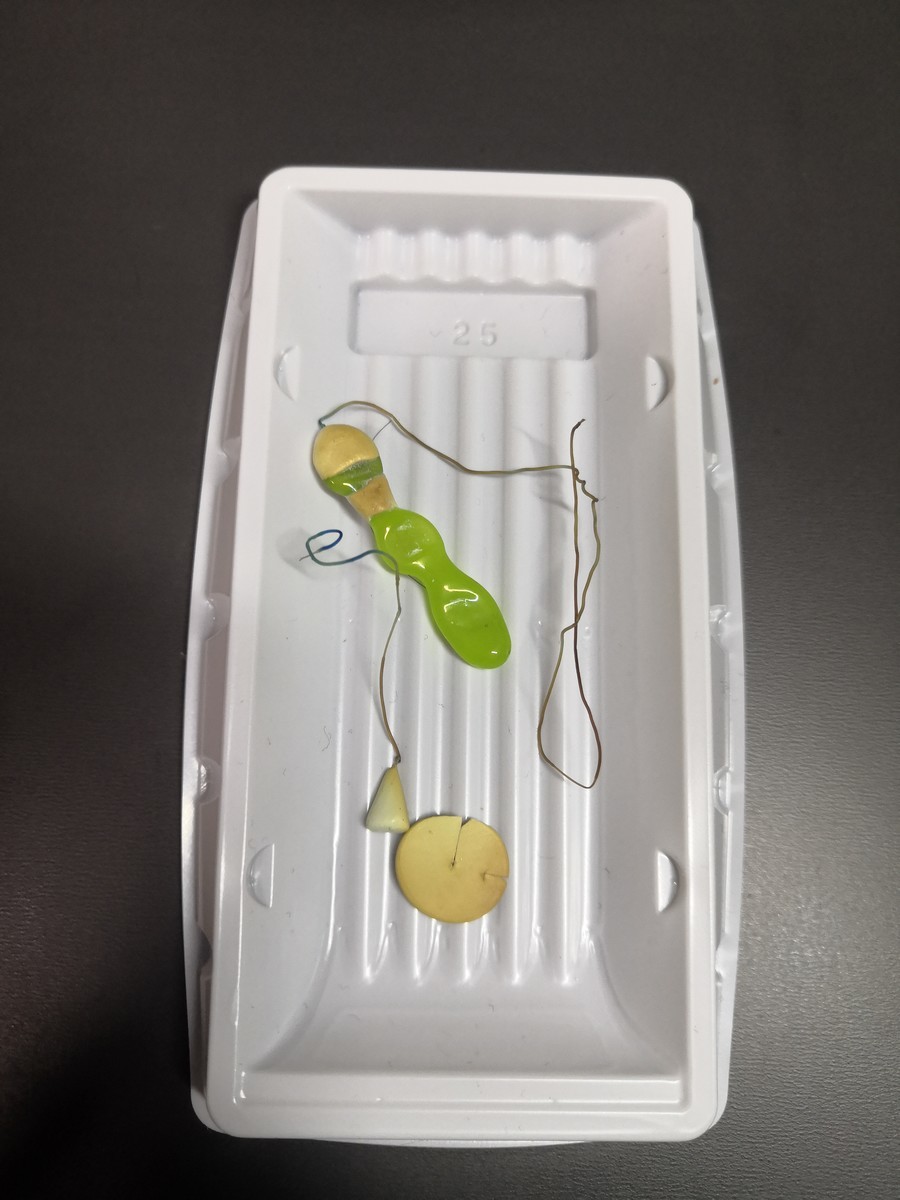
The OK Prostate Chip is a small device that is placed in the urethra (the urine passage) so that it acts on the prostate; the maker sells it in several shapes, sizes and materials. It is made and sold by OK Lab (Okada Comfortable Life Laboratory), a small company in Japan, through its own online store, and prices are in Japanese yen (JPY).
The maker's development diary, "ok-lab's diary", is written in Japanese. This page is an English summary of it, and every quotation is translated. OK Lab ships internationally, so readers outside Japan can order (see "Buying from outside Japan" below).
Product names on this page are plain-English descriptions. The official Japanese product name is shown once in the product table so you can find the same item in the store.
Before you read: key terms
| Term | Plain-English meaning |
|---|---|
| Urethra | The urine passage, where the maker says the chip is placed to act on the prostate. |
| Nylon thread | A cord attached to the chip, used to connect parts of the device. |
| Silicone-covered cord | Nylon inside a soft silicone tube, developed to protect the nylon while limiting the tube's stretch. |
| Integrated nylon loop | A loop attached directly to the chip, designed to retain its shape. |
| Thermal stress | Stress associated with uneven heating; the production specialist proposed it as an explanation for chip breakage. |
| Autoclave | A high-pressure sterilizer, mentioned when comparing uniform heating with uneven contact heating. |
| 3D printing | The manufacturing process that forms the chip's layers; the diary does not explain the process further. |
What happens: chip damage during boiling
The OK Prostate Chip is a device placed in the urethra (the urine passage) to act on the prostate. Its attached nylon thread (a cord connecting device parts) can form a loop in some designs. Customers discuss boiling as a way to clean the device, and Mr. Okada focuses on contact with hot cookware. Reported problems include shortened thread, changes in loop shape, and damage to the chip itself during heating.
Nylon thread shrinkage prompted comparisons with temperatures above ordinary boiling
In an entry published in February 2019, a customer asked whether hot-water cleaning could explain a noticeably shorter nylon thread. Mr. Okada replied that his testing had produced 15% shrinkage at 120°C in a high-pressure sterilizer. He said he had not experienced shrinkage during ordinary boiling at 100°C.
The diary does not record whether contact with cookware caused this customer's shortening. Mr. Okada suggested considering contact with an exposed pan wall as a possible explanation.
(Source: ok-lab's diary, published February 2019)
https://ok-lab.hatenablog.com/entry/2019/02/02/153358
A pan boiling dry damaged more than the glass chip's thread
In an entry published in September 2021, a customer asked whether thread replacement could make an overheated glass chip usable again. The customer reported that the pan had apparently boiled dry for at least 10 minutes, leaving the thread badly deteriorated. The resin portion had also changed color, although the customer had avoided rapid cooling.
Staff initially quoted ¥1,100 (about $7 at ¥156 = $1, rate as of 2026-09-04) for thread replacement plus a ¥400 (about $3 at ¥156 = $1, rate as of 2026-09-04) handling fee, with possible differences for attached options. A follow-up established that the glass was cracked too, so thread replacement could not proceed. Staff advised against using thread whose material had changed through overheating.
(Source: ok-lab's diary, published September 2021)
https://ok-lab.hatenablog.com/entry/2021/09/18/130132
Heat-resistant cord first appeared with prototype prices and purchase restrictions
In an entry published in September 2022, Mr. Okada introduced a silicone-covered cord (nylon enclosed within a soft silicone tube). His prototype pricing was ¥1,000 (about $6 at ¥156 = $1, rate as of 2026-09-04) excluding tax for each 10cm section, with a maximum of 4 sections. He wrote that regular sales were expected to begin soon.
The announcement did not offer conversion of an existing chip through the ordinary thread-replacement service. For products originally purchased with this cord, he offered replacement to the same specification. Mr. Okada directed interested buyers toward the new cord-equipped products, rather than offering the cord as a retrofit for their existing chips.
(Source: ok-lab's diary, published September 2022)
https://ok-lab.hatenablog.com/entry/2022/09/24/122837
A nylon loop changed shape during boiling but retained its outline
In an entry published in October 2025, Mr. Okada described an integrated nylon loop (a loop attached directly to the chip). The design followed a customer's request, and he reported that a small pan could leave the overall loop slightly shaped like the pan. He nevertheless said the basic loop shape remained.
He described loops around 10cm as nearly straight and feather-shaped, while longer loops could retain some deformation. Published surcharges, excluding tax, were ¥1,000 (about $6 at ¥156 = $1, rate as of 2026-09-04) for loops up to 10cm, ¥1,500 (about $10 at ¥156 = $1, rate as of 2026-09-04) up to 20cm, and ¥3,000 (about $19 at ¥156 = $1, rate as of 2026-09-04) up to 30cm. Mr. Okada described hanging storage as allowing the loop to return to its original shape.
(Source: ok-lab's diary, published October 2025)
https://ok-lab.hatenablog.com/entry/2025/10/25/122907
A resin chip broke during boiling inside its glass container
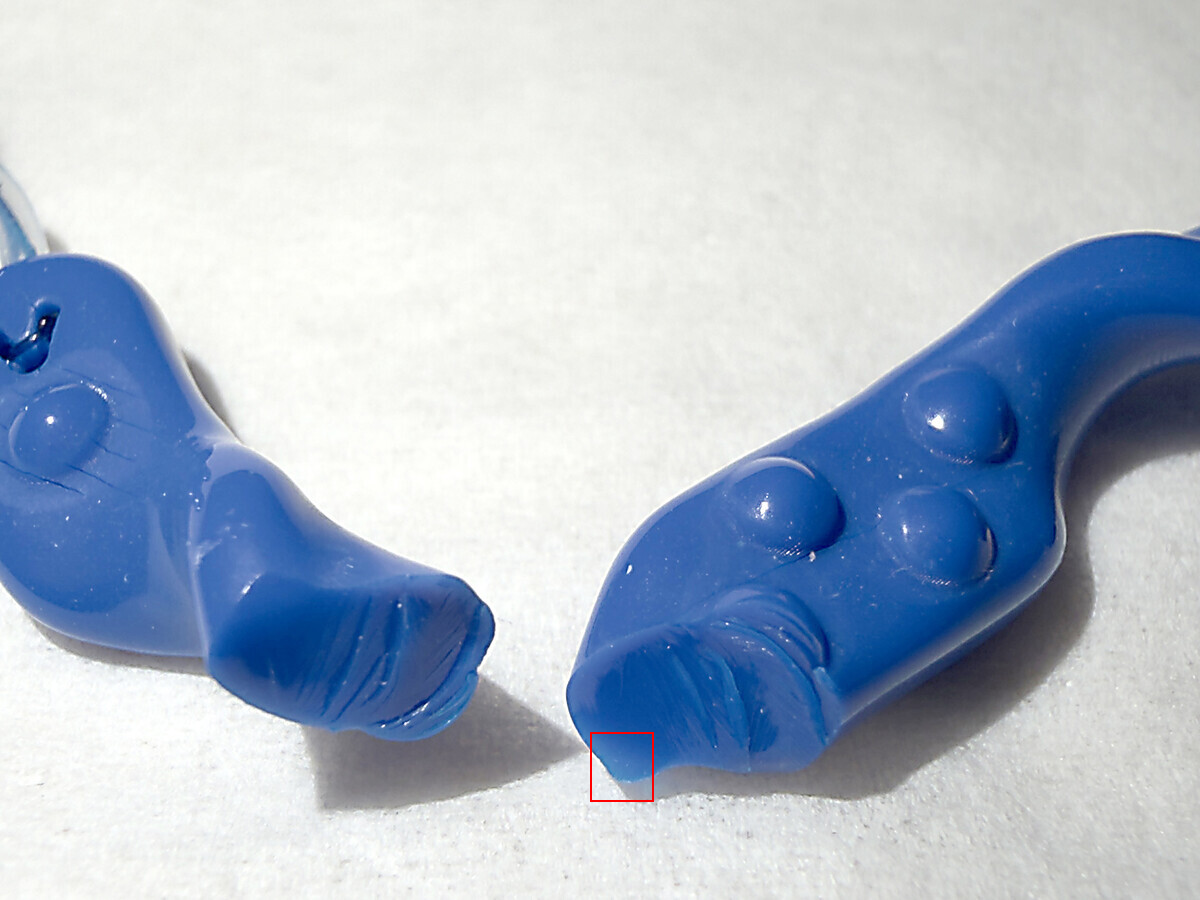
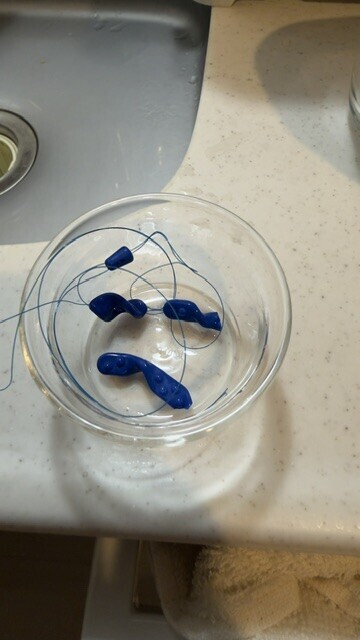
In an entry published in June 2026, a customer sought an explanation after a second-generation resin chip split during boiling. After about 10 minutes, it lay in two pieces inside a small glass container chosen to avoid scratches and thread damage from the frying pan. The customer reported no visible damage during earlier washing and no unusually forceful handling.
Staff initially saw no obvious problem with the described cleaning arrangement and said this was their first comparable report involving an unmodified second-generation chip. Mr. Okada suspected heat transfer through the small container, but acknowledged that he lacked the knowledge to establish the cause. He asked for explanations from anyone familiar with the phenomenon; later entries continued the investigation.
(Source: ok-lab's diary, published June 2026)
https://ok-lab.hatenablog.com/entry/2026/06/13/122909
The maker's answer to chip damage during boiling
The maker's replies focus on limiting direct heat exposure, while acknowledging the limits of protective materials and the uncertainty of individual failures.
Heat-resistant cord was designed to shield nylon from hot cookware
In September 2022, Mr. Okada described the protective purpose of the silicone-covered cord introduced that month. He said its silicone covering resisted temperatures above 200°C and would protect the nylon during contact with a pan's rim. He also explained that the nylon inside limited stretching of the soft outer tube.
According to Mr. Okada, enclosing the nylon kept water away from it and prevented the deterioration he associated with prolonged water exposure. The diary does not record long-term customer results for these prototypes. Mr. Okada proposed the covered cord as protection against the heat vulnerability of exposed nylon.
(Source: ok-lab's diary, published September 2022)
https://ok-lab.hatenablog.com/entry/2022/09/24/122837
Heat-resistant cord received custom pricing, but overheating remained a concern
In an entry published in February 2026, a customer wanted a more heat-resistant cord because contact with the pan's bottom had caused shrinkage. They requested a 30cm silicone-covered cord for an assembly that included a separate stopper. Staff quoted ¥2,200 (about $14 at ¥156 = $1, rate as of 2026-09-04) for that cord, and Mr. Okada recorded making the requested combination.
The diary does not record how the finished assembly performed after heating. Mr. Okada thought the covering would probably withstand light contact with cookware. He cautioned that a pan boiling dry could still cause the nylon alone to shrink inside its covering.
(Source: ok-lab's diary, published February 2026)
https://ok-lab.hatenablog.com/entry/2026/02/21/122935
Uneven heating emerged as one proposed explanation for the cracked chip
In a follow-up published in July 2026, the production specialist proposed thermal stress (stress caused by uneven heating) after examining the broken resin chip. The specialist stated that glass resting directly against a heated frying pan could exceed 100°C internally at its bottom, with an upper limit of 115°C. They considered excessive customer force very unlikely and attributed the break to heat concentrated through contact with the glass.
The specialist said the resin could withstand an autoclave (a high-pressure sterilizer) under uniform heating, but could break under uneven heating. Mr. Okada emphasized that this explanation was not certain. His suggested measure centered on sufficient water for the chip to move freely, reducing sustained contact with the heated bottom.
(Source: ok-lab's diary, published July 2026)
https://ok-lab.hatenablog.com/entry/2026/07/04/122918
How chip damage during boiling changed over time
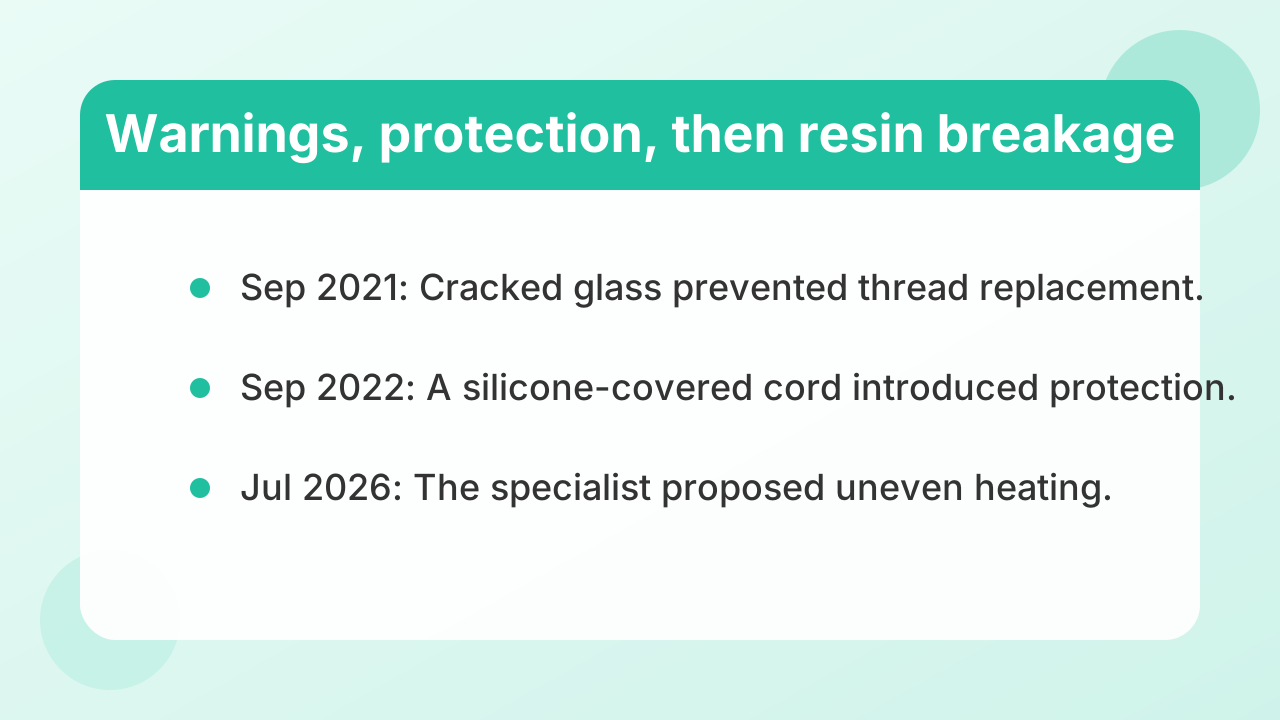
| Published | What the diary said then |
|---|---|
| Jan 2019 | Experience with boiling glass and resin came with a warning about exposed nylon. |
| Feb 2019 | A shortening report prompted comparison with shrinkage in hotter sterilizer testing. |
| Sep 2021 | Cracked glass prevented thread replacement after a pan boiled dry. |
| Sep 2022 | A silicone-covered cord introduced protection against contact with hot cookware. |
| Oct 2025 | Integrated loops retained their basic outline despite some deformation in small pans. |
| Feb 2026 | A custom covered-cord response included a warning that internal nylon could still shrink. |
| Jun 2026 | First comparable unmodified second-generation break reported about a year after launch. |
| Jun 2026 | Staff offered a refund because replacement stock was unavailable. |
| Jul 2026 | The production specialist proposed uneven heating as the fracture mechanism. |
OK Prostate Chip products related to chip damage during boiling
The current list includes the second-generation resin model involved in the June 2026 breakage report.
Products that appear in these entries
| Product (official name) | Price incl. tax | Relation to this topic |
|---|---|---|
| Second-generation resin chip (OKプロステートチップ 凶悪ゾロ(第二世代生体適合樹脂)) | ¥6,600 (about $42 at ¥156 = $1, rate as of 2026-09-04) | The June 2026 customer reported this model breaking during boiling inside a glass container. |
This second-generation resin chip is listed in OK Lab's own online store.

(Source: ok-lab's diary, published June 2026)
https://ok-lab.hatenablog.com/entry/2026/06/13/122909
Products the diary mentioned as alternatives
The diary names no alternative.
Silicone-covered cord and integrated nylon-loop options:
No matching product can be confirmed on the current list.
Common worries about chip damage during boiling
The reader questions concern heat tolerance, electrical parts, and what happens when a chip breaks.
"Can boiling damage both a glass chip and its thread?"
In an entry published in January 2019, a customer asked whether boiling would harm their glass product. Mr. Okada replied that, in his experience, boiling at 100°C had caused no problems with either glass or resin. His qualification concerned the attached nylon, rather than only the chip's main material.
He wrote that thread outside the water could touch cookware directly and reach temperatures above 100°C. The diary does not record a later heat-damage outcome for this customer's glass chip. Mr. Okada cautioned about exposed nylon touching the pan even when the chip itself appeared compatible with boiling.
(Source: ok-lab's diary, published January 2019)
https://ok-lab.hatenablog.com/entry/20190112/1547275441
"Does boiling damage the motorized chip's electrical parts?"
In an entry published in March 2019, a customer asked whether the motorized chip needed different treatment because it contained electronics. Mr. Okada wrote that its controller was unsuitable for washing or boiling and also cautioned against steam exposure. For the cord and chip, his reply distinguished residual hot water from an actively heated pan.
The reply included a limit of about 30 seconds, explicitly presented as advice based on experience. The diary does not record how the customer's electrical parts fared after cleaning. Mr. Okada warned that contact with actively heated cookware had a high likelihood of damaging the cord.
(Source: ok-lab's diary, published March 2019)
https://ok-lab.hatenablog.com/entry/2019/03/02/151104
"Did the cracked chip qualify for a refund?"
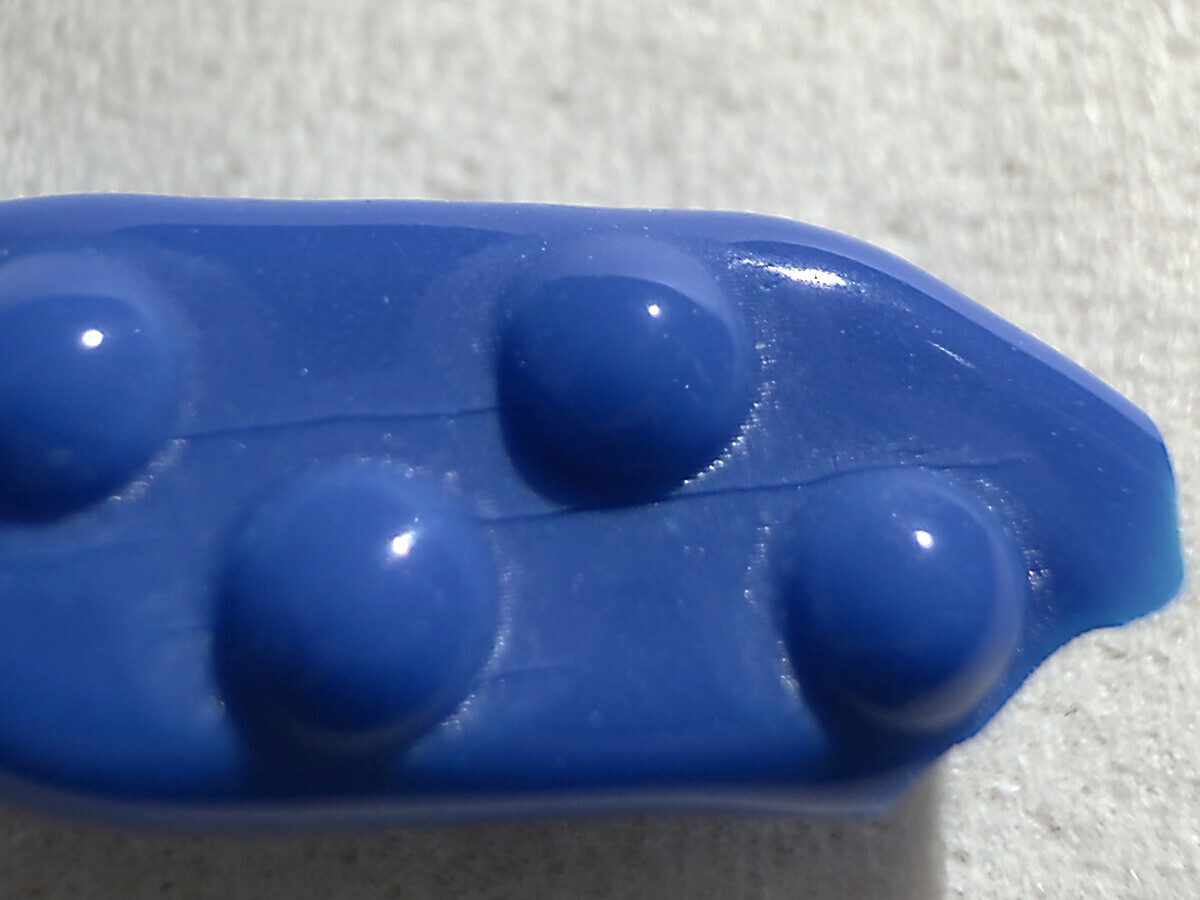
In a follow-up published in June 2026, the customer from the resin-breakage case asked whether the problem could be treated as an initial defect. Close-up photographs showed cracks along 3D-printed layers (layers formed during manufacture), including around the thread attachment hole. The customer also reported that a semi-long chip purchased around the same time had remained unaffected.
Staff could not identify the cause but agreed to handle the case as an initial defect. The affected model's M size was out of stock, with no restocking date, so staff offered a refund; the diary does not record its completion. Staff requested the broken item for examination by the manufacturer, and Mr. Okada asked other customers to report similar experiences.
(Source: ok-lab's diary, published June 2026)
https://ok-lab.hatenablog.com/entry/2026/06/27/122906
Buying from outside Japan
OK Lab ships internationally to countries covered by Japan Post's EMS courier service. Overseas orders are paid in advance by PayPal. Each order carries a ¥400 (about $3 at ¥156 = $1, rate as of 2026-09-04) handling fee, and EMS shipping is charged on top. These terms come from OK Lab's official sales-terms page (written here as plain text, not a link: ok-lab.net/docs/law), checked on September 7, 2026; confirm them on the official store before you order, because they can change.
Summary of this article
| What you wanted to know | The answer |
|---|---|
| What is the short answer? | The diary records damage associated with heating and warns about contact with cookware. |
| What is this product? | A urethral device made by OK Lab in Japan, with prices stated in JPY. |
| Which terms matter? | Nylon and silicone describe cord materials; thermal stress is the proposed uneven-heating explanation. |
| What happened during boiling? | Reports included shortened thread, damaged glass assemblies, loop deformation, and a broken resin chip. |
| What did the maker propose? | Protection for vulnerable parts and less concentrated contact heat, with limits acknowledged. |
| What changed over time? | Early thread warnings expanded into protective cord designs and a later investigation of resin breakage. |
| Which current product is connected? | The second-generation resin model in the breakage report is listed at ¥6,600 (about $42 at ¥156 = $1, rate as of 2026-09-04) including tax. |
| What did customers ask? | Whether glass and electrical parts tolerated heating, and whether a broken chip qualified for a refund. |
| How do overseas purchases work? | Japan Post EMS, advance PayPal payment, and a ¥400 (about $3 at ¥156 = $1, rate as of 2026-09-04) handling fee plus shipping. |
Source: ok-lab's diary (Okada Comfortable Life Laboratory). The original entries are in Japanese; quotations on this page are translated. Photos and videos are on the original entries.
This article is a summary of the maker's development diary. The product is not a medical device and no result is guaranteed. If anything feels wrong or worries you, see a doctor. Prices, specifications and cautions change, so confirm the latest information on the official blog and the official site. Questions about ordering and shipping go to the seller.