![Will discoloration come off my prostate chip? | No single fix is recorded [OK Prostate Chip]](/img/a/T0901/eyecatch.svg)
This page is based on entries from "ok-lab's diary" (https://ok-lab.hatenablog.com/), the Japanese development diary written by Mr. Okada, founder of OK Lab, a small company in Japan (Okada Comfortable Life Laboratory). Only the entries about whether discoloration and stains come off are summarized here, in order of publication. Past prices and sizes are as written at the time. Current prices come from the official product list (retrieved September 4, 2026). Quotations are translated from Japanese.
Note: This page is a personal reading log by someone with no connection to the maker or the seller. It reflects the source entries as of their publication dates and makes no guarantee of accuracy or safety. The product is not a medical device; talk to a doctor about any health decision. Check the official site for current information. This page contains advertising.
In short
Some marks resisted removal; one yellow patch came from liquid inside a poorly sealed tube.
The maker advised replacing severely faded thread and offered a refund for unresolved black residue.
Rubber staining remained a design concern in March 2026, when a beaded alternative was still experimental.
If you see blood in your urine, even a small amount or for the first time, do not wait and see. See a urologist right away. If you suddenly cannot urinate, or the device cannot be removed, do not try to fix it yourself. Go to a medical facility, including emergency care, immediately.
About this product
The OK Prostate Chip is a small device that is placed in the urethra (the urine passage) so that it acts on the prostate; the maker sells it in several shapes, sizes and materials. It is made and sold by OK Lab (Okada Comfortable Life Laboratory), a small company in Japan, through its own online store, and prices are in Japanese yen (JPY). The maker's development diary, "ok-lab's diary", is written in Japanese. This page is an English summary of it, and every quotation is translated. OK Lab ships internationally, so readers outside Japan can order (see "Buying from outside Japan" below). Product names on this page are plain-English descriptions. The official Japanese product name is shown once in the product table so you can find the same item in the store.
Before you read: key terms
| Term | Plain-English meaning |
|---|---|
| Urethra | The urine passage; it carries urine and is where the base device is placed. |
| Retrieval thread | A cord attached to a chip to provide a means of removal. |
| Chipless device | A design built from tubing and wire, with connected joints, intended to act on the prostate. |
| Silicone | A covering material used around parts of devices discussed here; the tubing separates wire from direct contact with the urethral lining. |
| Resin / epoxy resin | Materials used for joins or coverings; epoxy resin formed prototype beads intended to reduce contact with tubing and rubber. |
| Guide loop | A loop intended to help guide the device; the March 2025 discussion concerns discoloration on its resin. |
| Oxide film | A reader's proposed explanation for black ring residue. The diary does not explain this. |
| Citric acid and baking soda | Substances mentioned as possible cleaners for black ring marks. The diary does not explain their use on this device. |
What happens: prostate chip discoloration
The OK Prostate Chip is a device placed in the urethra (the urine passage) to act on the prostate. Discoloration affects threads and coverings, including chipless devices (designs built from tubing and wire). A separate anal device in the back passage had aluminum covered with silicone (a material used for coverings). A retrieval thread (a cord for removal) serves a different purpose from coverings that separate wire from tissue or seal joints.
Black deposits remained on a recovered chip in May 2018
In an entry published in May 2018, a customer reported testing a custom semi-long chip that later needed hospital removal. Its retrieval thread had detached, and the chip had reached the bladder. After removal, the customer found a black deposit on the side without thread; it had resisted a fingernail scratch.
Mr. Okada declined to comment, so this entry gives no maker explanation for the deposit. The customer reported feeling well again, but the diary does not record whether the black deposit was eventually removed. No matching product can be confirmed on the current list.
(Source: ok-lab's diary, published May 2018)
https://ok-lab.hatenablog.com/entry/20180511/1526036007
Yellow discoloration came from liquid inside an imperfectly sealed test device
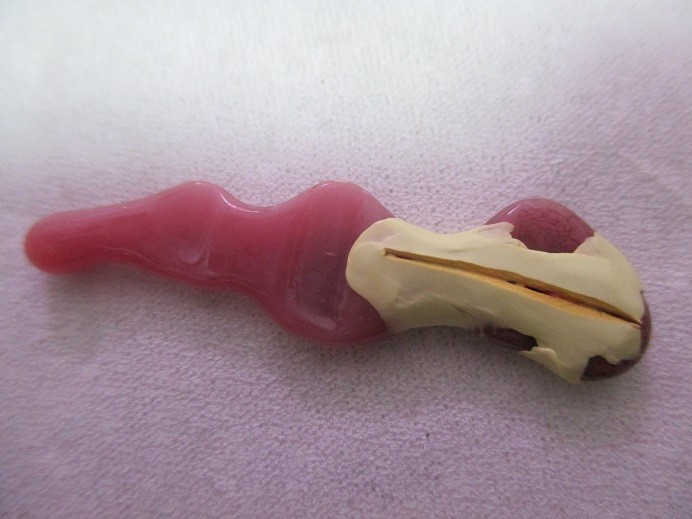
In the entry published on September 17, 2022, Mr. Okada reported yellowing on a silicone-covered aluminum anal test device. He said boiling alone had not readily removed the yellow mark. In the entry published on September 24, 2022, he explained that liquid had entered the tube through an inadequately sealed end.
He described an early test item with a poor seal, which he had used without checking closely. His corrected account placed the yellow material inside the covering and withdrew his initial interpretation of an outside stain. No matching product can be confirmed on the current list.
(Source: ok-lab's diary, published September 2022)
https://ok-lab.hatenablog.com/entry/2022/09/17/123057
(Source: ok-lab's diary, published September 2022)
https://ok-lab.hatenablog.com/entry/2022/09/24/122837
Brown chip discoloration was attributed to urine coloring in February 2025
In an entry published in February 2025, a customer described a chipless device whose joining resin (material binding parts) changed from cream to brown. The customer described the color change as causing no apparent problem, while separately reporting a broken wire. OK Lab's staff attributed the discoloration to coloring substances in urine and said the amount varied greatly between individuals.
Staff added that rubber parts were especially easy to stain, although the customer's report described the changed area as resin. The diary does not record whether the brown color was removed or whether any cleaning method restored the original cream color. No matching product can be confirmed on the current list.
(Source: ok-lab's diary, published February 2025)
https://ok-lab.hatenablog.com/entry/2025/02/08/122932
Brown stains marked resin Mr. Okada believed had been inside his bladder
In an entry published in March 2025, Mr. Okada described brown discoloration covering half the resin on a chipless prototype's guide loop. The guide loop (a loop intended to help guide the device) had a colored area he associated with placement inside his bladder. He wrote that urine was always present in the bladder's area nearest the prostate, causing strong staining there.
His comparison concerned different areas of his own device, with less color on parts he described as sitting outside the bladder. That was his explanation of the pattern; the diary does not record whether the brown discoloration came off. No matching product can be confirmed on the current list.
(Source: ok-lab's diary, published March 2025)
https://ok-lab.hatenablog.com/entry/2025/03/08/123016
The maker's answer to prostate chip discoloration
The recorded responses concern thread replacement, manufacturing changes, tentative cleaning suggestions, and an experimental change of surface material.
Fading nylon thread prompted a replacement warning after repeated boiling
In an entry published in January 2020, Mr. Okada described daily boiling as part of his own durability testing. He said the nylon thread's dye gradually faded, becoming almost transparent after about six months. Although his checks showed no sign of snapping, he believed the thread's strength had fallen considerably.
This account concerned the fading of color already present in the nylon. His stated principle was boiling only before use; he did not recommend daily boiling of unused items. Mr. Okada recommended replacing nylon thread once its color became extremely faint.
(Source: ok-lab's diary, published January 2020)
https://ok-lab.hatenablog.com/entry/2020/01/11/151714
Yellow discoloration led Mr. Okada toward changes in manufacturing
In an entry published in September 2022, Mr. Okada described a manufacturing response to liquid entering the silicone-covered aluminum test device. The proposed change targeted the section inside the body, where he wanted no gap between the tube and aluminum.
He said eliminating that space had become technically possible, but manufacturing would require substantially more work. The additional work remained a concern for him in that report. The diary does not record whether this manufacturing change was introduced into products offered for sale.
(Source: ok-lab's diary, published September 2022)
https://ok-lab.hatenablog.com/entry/2022/09/24/122837
Black ring residue prompted cleaning suggestions without a recorded successful result
In an entry published in June 2025, a reader suggested an oxide film (an unexplained term for the suspected black layer). The reader suspected high-temperature boiling and compared the marks with something seen on stainless steel cookware. Citric acid and baking soda were mentioned as possible cleaners, without a reported result for the affected ring.
This reader said their own ring, made in March 2025, had shown no such problem; it was a separate customer's account. Mr. Okada repeated the citric-acid suggestion, but the diary does not record confirmation of the cause or successful cleaning of the original ring.
(Source: ok-lab's diary, published June 2025)
https://ok-lab.hatenablog.com/entry/2025/06/07/122954
Rubber staining prompted an experimental beaded design that still needed improvement
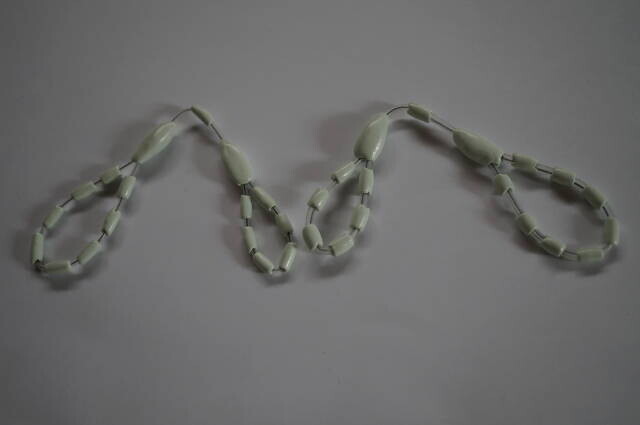
In an entry published in March 2026, Mr. Okada again identified urine-related staining as a weakness of rubber at chipless device joints. He explained that tubing separated the wire from the urethral lining, while rubber was needed for waterproofing at the connections. A beaded prototype used epoxy resin (the material forming the beads) over most surfaces to reduce contact with the tubing and rubber.
Mr. Okada reported more friction than expected during his test and said improvements were needed before he could offer the design. The diary does not record whether the prototype resisted discoloration or made stains easier to remove. No matching product can be confirmed on the current list.
(Source: ok-lab's diary, published March 2026)
https://ok-lab.hatenablog.com/entry/2026/03/07/122907
If you see blood in your urine, even a small amount or for the first time, do not wait and see. See a urologist right away. If you suddenly cannot urinate, or the device cannot be removed, do not try to fix it yourself. Go to a medical facility, including emergency care, immediately.
How prostate chip discoloration changed over time
| Published | What the diary said then |
|---|---|
| May 2018 | A recovered custom chip had a black deposit that resisted scratching. |
| Jan 2020 | Daily boiling faded nylon dye; Mr. Okada suspected substantial strength loss. |
| Sep 2022 | Mr. Okada reported yellowing that boiling alone had not readily removed. |
| Sep 2022 | The yellowing was reidentified as liquid entering through a faulty seal. |
| Feb 2025 | Staff attributed brown discoloration to urine coloring and noted individual differences. |
| Mar 2025 | Mr. Okada associated a brown resin area with time inside his bladder. |
| May 2025 | Staff offered a return and refund for unexplained black ring residue. |
| Jun 2025 | A reader proposed an oxide film; successful cleaning remained unrecorded. |
| Mar 2026 | Rubber staining remained a weakness during development of a beaded prototype. |
OK Prostate Chip products related to prostate chip discoloration
No current product is directly tied to this topic.
Common worries about prostate chip discoloration
The customer exchanges cover storage, replacement after wire failure, and uncertainty about black residue.
"What storage advice accompanied warnings about fading nylon thread?"
In an entry published in January 2020, a customer asked about storing a growing collection of chips and managing their attached threads. The customer described using a plastic container and having trouble with tangled thread that retained kinks afterward. Mr. Okada acknowledged that he had not developed a storage solution.
His reply also described silicone-covered connecting cable that showed no apparent deterioration after about six months of daily boiling. He thought that cable might be more durable than nylon, but the diary does not record how the customer's storage arrangement changed. Mr. Okada advised storage in a dry environment away from sunlight and other sources of ultraviolet light.
(Source: ok-lab's diary, published January 2020)
https://ok-lab.hatenablog.com/entry/2020/01/11/151714
"Can chip discoloration and broken wire lead to replacement?"
In an entry published in February 2025, the customer who reported brown resin also asked for stronger wire after a break. The failure had occurred after two weeks, and staff initially offered a refund because they could not identify its cause. Staff said thicker wire would complicate production and needed testing, so that change could not be supplied immediately.
The customer then requested the same product, but staff preferred a refund while awaiting wire manufactured with its bend already set. The customer agreed to the refund; the diary does not record whether the payment was completed. Staff advised against an immediate identical replacement because they believed the unexplained break could happen again under the same conditions.
(Source: ok-lab's diary, published February 2025)
https://ok-lab.hatenablog.com/entry/2025/02/08/122932
"Is black residue on a stainless steel ring harmless?"
In an entry published in May 2025, a customer asked whether black, oily material coming from a stainless steel ring was worrying. The material appeared during alcohol cleaning and worsened with further washing; staff knew neither its cause nor its composition. Staff explained that the coil was commercially sourced and that they had no earlier reports on which to base an explanation.
The customer chose to keep the ring after finding a possible explanation online; the diary does not record whether the residue disappeared. No matching product can be confirmed on the current list. Staff advised returning the ring for a refund if cleaning or boiling left residue, or if the customer remained uneasy.
(Source: ok-lab's diary, published May 2025)
https://ok-lab.hatenablog.com/entry/2025/05/31/122940
Buying from outside Japan
OK Lab ships internationally to countries covered by Japan Post's EMS courier service. Overseas orders are paid in advance by PayPal. Each order carries a ¥400 (about $3 at ¥156 = $1, rate as of 2026-09-04) handling fee, and EMS shipping is charged on top. These terms come from OK Lab's official sales-terms page (written here as plain text, not a link: ok-lab.net/docs/law), checked on September 7, 2026; confirm them on the official store before you order, because they can change.
Summary of this article
| What you wanted to know | The answer |
|---|---|
| What is the short answer about discoloration? | Some marks resisted removal, and the entries provide no single fix for every material. |
| What is the OK Prostate Chip? | A device made by OK Lab in Japan, placed in the urethra to act on the prostate. |
| Which parts are discussed? | Retrieval threads, coverings, resin joins, guide loops, rubber connections, and a stainless steel ring. |
| What happened in the reported cases? | Reports included black deposits, internal yellowing, brown resin, and fading nylon dye. |
| What measures did the maker describe? | Thread replacement, changes to sealing, tentative cleaning suggestions, and an experimental beaded surface. |
| What changed over time? | Explanations became more specific, but rubber staining remained a concern in March 2026. |
| Which current product is directly linked to these cases? | No current product is directly tied to this topic. |
| What did customer questions establish? | Storage advice and refund offers were recorded; successful stain removal was not established in those exchanges. |
| Can someone outside Japan order? | The stated terms use PayPal, EMS shipping, and a ¥400 (about $3 at ¥156 = $1, rate as of 2026-09-04) handling fee. |
| Is a complete stain-removal result recorded? | The supplied entries do not record a method that resolved every kind of discoloration discussed here. |
Source: ok-lab's diary (Okada Comfortable Life Laboratory). The original entries are in Japanese; quotations on this page are translated. Photos and videos are on the original entries.
This article is a summary of the maker's development diary. The product is not a medical device and no result is guaranteed. If anything feels wrong or worries you, see a doctor. Prices, specifications and cautions change, so confirm the latest information on the official blog and the official site. Questions about ordering and shipping go to the seller.