![Can't clean inside a prostate chip? | The maker's answer depends on its construction [OK Prostate Chip]](/img/a/T0899/eyecatch.svg)
This page is based on entries from "ok-lab's diary" (https://ok-lab.hatenablog.com/), the Japanese development diary written by Mr. Okada, founder of OK Lab, a small company in Japan (Okada Comfortable Life Laboratory). Only the entries about "disinfecting parts that cannot be cleaned inside" are summarized here, in order of publication. Past prices and sizes are as written at the time. Current prices come from the official product list (retrieved September 4, 2026). Quotations are translated from Japanese.
Note: This page is a personal reading log by someone with no connection to the maker or the seller. It reflects the source entries as of their publication dates and makes no guarantee of accuracy or safety. The product is not a medical device; talk to a doctor about any health decision. Check the official site for current information. This page contains advertising.
In short
- Some cavities and tubing admit water while leaving inner surfaces hard to reach.
- The maker repeatedly calls for boiling and rejects some designs when that is unavailable.
- A 2025 design exposed wire for cleaning; a May 2026 sheath still admitted water.
If you see blood in your urine, even a small amount or for the first time, do not wait and see. See a urologist right away. If you suddenly cannot urinate, or the device cannot be removed, do not try to fix it yourself. Go to a medical facility, including emergency care, immediately.
About this product
The OK Prostate Chip is a small device that is placed in the urethra (the urine passage) so that it acts on the prostate; the maker sells it in several shapes, sizes and materials. It is made and sold by OK Lab (Okada Comfortable Life Laboratory), a small company in Japan, through its own online store, and prices are in Japanese yen (JPY). The maker's development diary, "ok-lab's diary", is written in Japanese. This page is an English summary of it, and every quotation is translated. OK Lab ships internationally, so readers outside Japan can order (see "Buying from outside Japan" below). Product names on this page are plain-English descriptions. The official Japanese product name is shown once in the product table so you can find the same item in the store.
Before you read: key terms
| Term | Plain-English meaning |
|---|---|
| Hollow chip | A chip with an internal passage intended to let urine flow through it. |
| Tube cover | A flexible covering around a thread or wire, used in support and loop designs. |
| Sheath | A casing around moving wire, forming part of a custom assembly. |
| Ultrasonic cleaner | An eyeglass-cleaning device that Mr. Okada considered for difficult chip cavities. |
| Gatekeeper | An attachment requested to limit chip movement; the entries discuss fixed and detachable versions. |
| Controller | The unit controlling a vibrating chip; its connection affected the maker's boiling claims. |
| Nitinol | The wire material used for adjustable loops and connections; the diary discusses its ability to recover its shape. |
What happens: cleaning inside a prostate chip
The OK Prostate Chip is a small device placed in the urethra to act on the prostate. This topic concerns hollow chips and tube covers (flexible coverings around threads or wires) used in versions described by the diary. Some passages carry urine, while other spaces surround wires in attachments that extend into the urethra or bladder. The entries describe water reaching spaces that the maker or customers said were difficult to clean, including gaps inside covers.
Hollow chip cleaning was one obstacle to selling the prototypes
In an entry published in February 2018, Mr. Okada described hollow prototypes that became difficult to remove during his testing. He suspected their outer surfaces dried and stuck to the urethral wall, although a medical examination had not established that cause.
He also identified difficult internal cleaning and considered an ultrasonic cleaner (an eyeglass-cleaning device). His report of a normal examination did not establish safety: the doctor expressly rejected that interpretation. Mr. Okada said he would not consider selling these hollow prototypes until the surface-drying problem was overcome.
(Source: ok-lab's diary, published February 2018)
https://ok-lab.hatenablog.com/entry/20180228/1519809422
Chip disinfection and stopper size both concerned the maker
In an entry published in June 2018, Mr. Okada suspected missed disinfection of a perforated stopper had contributed to his urethral inflammation. The diary also records a doctor's different concern: the stopper might have been too large.
Its recorded dimensions were 17mm long and 9mm wide, and Mr. Okada changed the planned length to about 10mm. Mr. Okada stated that disinfection on every occasion was essential for the perforated design.
(Source: ok-lab's diary, published June 2018)
https://ok-lab.hatenablog.com/entry/20180630/1530342059
A condom covering raised chip cleaning concerns about knots
An entry published in January 2019 carried an adviser's warning about covering a chip with a condom. The adviser argued that knots could harbor bacteria and that reuse increased infection and detachment risks.
The adviser also said the covering could catch internally and would not solve the material concerns behind the proposal. Mr. Okada accepted the objection about bacterial buildup during reuse, while continuing to defend the idea for single use.
(Source: ok-lab's diary, published January 2019)
https://ok-lab.hatenablog.com/entry/2019/01/26/152042
Water inside a foil prototype complicated hollow chip cleaning
In an entry published in March 2019, Mr. Okada described testing a chip made from aluminum foil. He reported no problem during his brief test, but said water penetrated its interior.
He suspected bacteria could grow inside during extended use. His suggestion remained conditional: he thought short-term use and hot-water disinfection might make it usable.
(Source: ok-lab's diary, published March 2019)
https://ok-lab.hatenablog.com/entry/2019/03/09/150813
Replaceable wires left tube cleaning unresolved, with breakage also reported
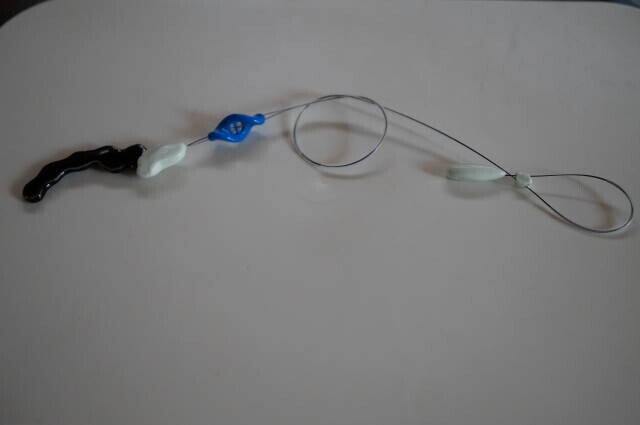
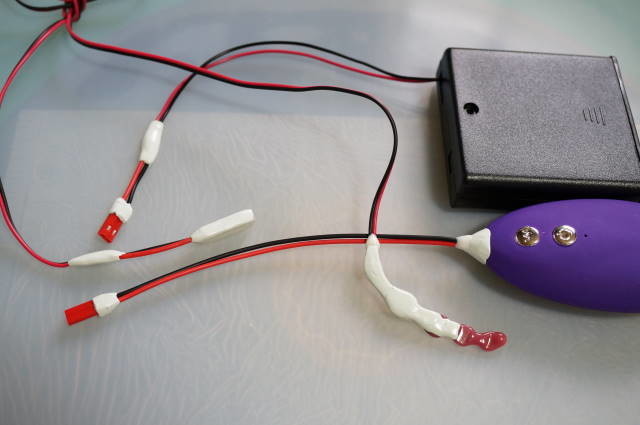
In an entry published in January 2023, Mr. Okada discussed a custom support with three parallel lines and replaceable wire. He said its tubing could neither be cleaned internally nor sealed while retaining wire replacement.
The same passage separately mentions a report that a blue chip broke during boiling with wire attached. The passage does not identify that chip as part of the three-line assembly. Mr. Okada advised against that tube design where boiling was unavailable, while warning that breakage during boiling was also possible.
(Source: ok-lab's diary, published January 2023)
https://ok-lab.hatenablog.com/entry/2023/01/14/122952
Interrupted covers made tube cleaning a concern around screw chips
In an entry published in October 2024, Mr. Okada described a loop assembly with optional blue or stainless-steel screw chips. The tube could not pass through those screw chips, so it stopped on either side.
He explained that these breaks in the cover allowed water into the tubing. These screw chips also became fixed in position once incorporated. For this construction, Mr. Okada described boiling disinfection as the only cleaning method.
(Source: ok-lab's diary, published October 2024)
https://ok-lab.hatenablog.com/entry/2024/10/26/122649
A bladder loop leak exposed another problem for tube cleaning
In an entry published in June 2025, a customer reported water inside a bladder-loop device after about 2 months of use. A small hole had appeared on the inside of a permanently bent section, prompting a request for a larger replacement loop.
Staff requested a photograph, and the customer supplied one while suggesting cleaning damage or remaining soap as possible explanations. Mr. Okada considered premature tube deterioration the likely issue; neither explanation was confirmed. The diary does not record whether the replacement order was completed.
(Source: ok-lab's diary, published June 2025)
https://ok-lab.hatenablog.com/entry/2025/06/14/122936
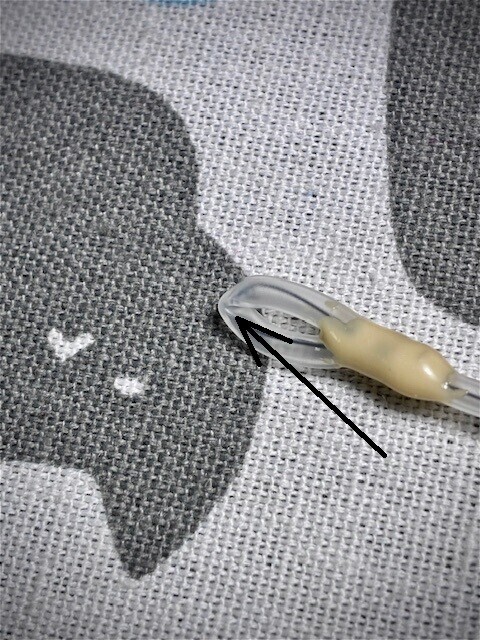
Sealed screw chips still left sheath cleaning unresolved in May 2026
In an entry published in May 2026, a customer requested a custom assembly incorporating adjoining blue screw chips. Mr. Okada made the connection and believed the screw chips' thread holes were sealed, unlike their usual construction.
He distinguished those holes from the sheath (a casing around moving wire), whose sliding wire prevented sealing. Water could therefore pass through the sheath, despite the sealing within the screw chips. Mr. Okada maintained that boiling disinfection was essential for this assembly.
(Source: ok-lab's diary, published May 2026)
https://ok-lab.hatenablog.com/entry/2026/05/09/122904
The maker's answer to cleaning inside a prostate chip
The maker's responses focused on boiling compatibility, access to enclosed surfaces, and construction changes.
Hollow connector cleaning limited the maker's support for urethral plugs
In an entry published in September 2019, a customer wanted detachable plugs on a glass vibrating chip and its controllers. Mr. Okada offered a custom option while standard sales were still being considered.
He said cavities in both connector halves made internal cleaning difficult and generally advised against placing those plugs in the urethra. He described the terminal-equipped chip as boilable, while the controller (the unit controlling vibration) could not accompany the earlier connected version. His conditional discussion mentioned boiling or alcohol immersion; it did not withdraw his general objection to urethral plug use.
(Source: ok-lab's diary, published September 2019)
https://ok-lab.hatenablog.com/entry/2019/09/07/135854
A fixed gatekeeper made chip disinfection an assembly design issue
In an entry published in June 2022, a customer ordered a ceramic vibrating chip with a non-detachable gatekeeper. A gatekeeper is an attachment requested in these entries to limit chip movement.
Mr. Okada explained that this fixed assembly had to remain together for boiling. He specified a connection modification costing ¥550 (about $4 at ¥156 = $1, rate as of 2026-09-04) as published in June 2022. His reply made compatibility with boiling a requirement of that particular assembly.
(Source: ok-lab's diary, published June 2022)
https://ok-lab.hatenablog.com/entry/2022/06/04/123036
Detachable joints shaped the maker's answer about internal tube cleaning
In an entry published in March 2024, a reader questioned the hygiene and maintenance burden of a long liquid-delivery tube. Mr. Okada described a prototype intended to carry liquid deeper into the urethra.
He considered internal rinsing and boiling sufficient for that design, and thought access at disconnected joints would improve cleaning. He also acknowledged that more convenient devices might exist and did not strongly recommend his prototype. His hygiene answer favored access to the tube's interior and joints.
(Source: ok-lab's diary, published March 2024)
https://ok-lab.hatenablog.com/entry/2024/03/09/122635
Short movable covers changed wire cleaning access in August 2025
In an entry published in August 2025, Mr. Okada announced changes to nitinol (the wire material used for adjustable loops) connections. Several short, movable tube covers replaced continuous coverage over the doubled wire.
He explained that this arrangement allowed access to the wire itself for cleaning. The adjustable loop also gained a dedicated part costing ¥1,000 (about $6 at ¥156 = $1, rate as of 2026-09-04) excluding tax and a protective cover about 40mm long. Mr. Okada retained that loop cover as a required safeguard against excessively small bends.
(Source: ok-lab's diary, published August 2025)
https://ok-lab.hatenablog.com/entry/2025/08/16/122934
If you see blood in your urine, even a small amount or for the first time, do not wait and see. See a urologist right away. If you suddenly cannot urinate, or the device cannot be removed, do not try to fix it yourself. Go to a medical facility, including emergency care, immediately.
How cleaning inside a prostate chip changed over time
| Published | What the diary said then |
|---|---|
| Feb 2018 | Hollow prototypes remained withheld from sale pending a solution to surface drying. |
| Jun 2018 | Perforated stopper prompted stronger disinfection warnings and a shorter planned size. |
| Sep 2019 | Connector cavities prompted a general objection to urethral plug use. |
| Aug 2022 | Staff called boiling essential; a customer's friction problem persisted afterward. |
| Jan 2023 | Replaceable wire prevented sealing, and a separate boiling-related chip breakage was reported. |
| Oct 2023 | Gap filling became a quoted custom option rather than standard construction. |
| Oct 2024 | Screw-chip variants interrupted the tube cover and admitted water. |
| Jun 2025 | A customer reported a hole in a persistently bent loop tube. |
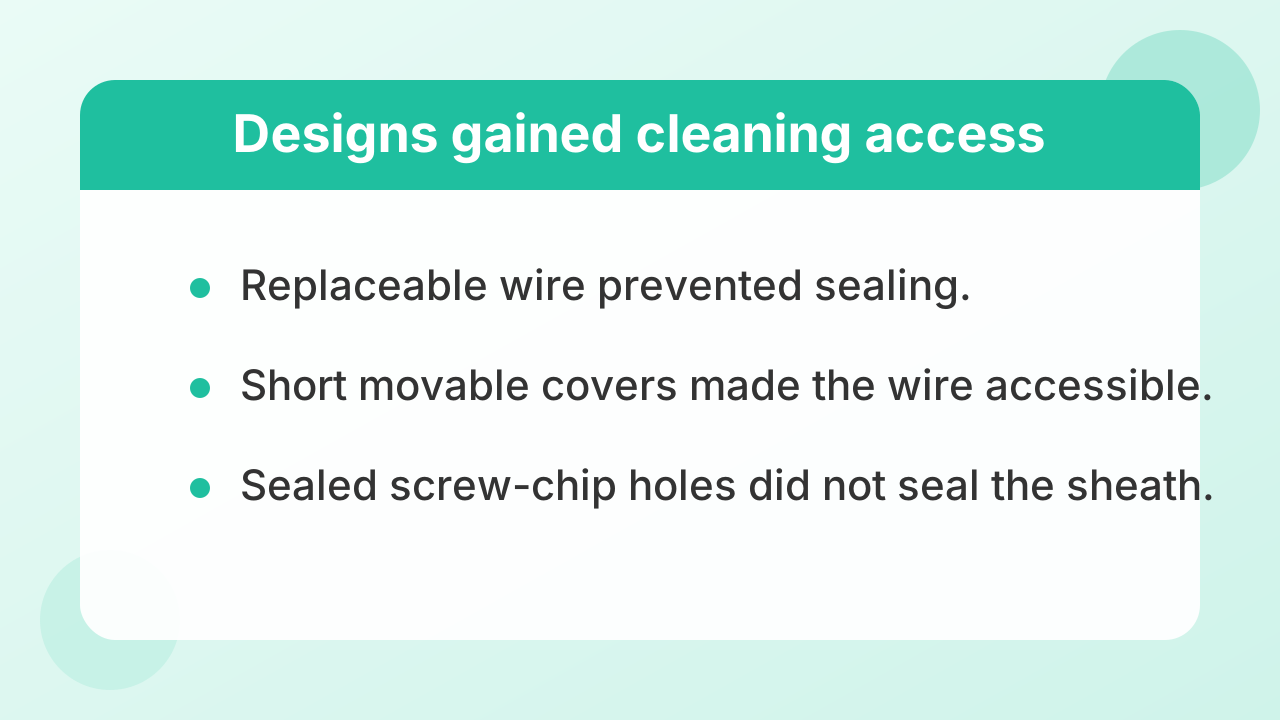
| Aug 2025 | Short movable covers made the wire accessible for cleaning. |
| May 2026 | Sealed screw-chip holes did not seal the surrounding sliding-wire sheath. |
OK Prostate Chip products related to cleaning inside a prostate chip
The current list includes base models named in the custom connector cases.
Products that appear in these entries
| Product (official name) | Price incl. tax | Relation to this topic |
|---|---|---|
| Glass vibrating semi-long chip (OKプロステート核振チップ ガラス素材セミロングタイプ) | ¥6,600 (about $42 at ¥156 = $1, rate as of 2026-09-04) | September 2019: this base model appeared in a custom plug order whose connector cavities raised cleaning concerns. |
| Ceramic vibrating semi-long chip (OKプロステート核振チップ 陶器素材セミロングタイプ) | ¥6,600 (about $42 at ¥156 = $1, rate as of 2026-09-04) | June 2022: this base model appeared in a fixed gatekeeper assembly requiring a connection modification for boiling. |
(Source: ok-lab's diary, published September 2019)
https://ok-lab.hatenablog.com/entry/2019/09/07/135854
(Source: ok-lab's diary, published June 2022)
https://ok-lab.hatenablog.com/entry/2022/06/04/123036
Products the diary mentioned as alternatives
The diary names no alternative.
Prototypes and custom assemblies described above
No matching product can be confirmed on the current list.
Common worries about cleaning inside a prostate chip
Readers questioned friction, inaccessible wires, and gaps between joined chips.
"Would boiling make tube cleaning easier and reduce friction?"
In an entry published in August 2022, a customer asked whether boiling would reduce tube friction after an unsuccessful, severely painful trial. Staff said they could not identify the cause, but considered boiling essential because they knew no other way to clean inside that product's tubing.
The customer's subsequent test produced almost no change in friction. Mr. Okada separately described a newer design with 2mm tubing as sealed in principle, while recognizing possible contamination before manufacture. He still favored occasional boiling for that sealed design.
(Source: ok-lab's diary, published August 2022)
https://ok-lab.hatenablog.com/entry/2022/08/20/122920
"Could a custom design solve urethral bead cleaning problems?"
In an entry published in June 2023, a customer explained why they wanted a custom assembly after using another company's metal urethral beads. They reported inaccessible internal wire, rapid rusting, and bleeding where the beads or wire pinched tissue.
The customer declined an earlier alternative because they feared tangling inside the body, then requested a quotation for a different assembly. Staff quoted the requested construction, and the diary showed the finished item. The diary does not record how that assembly felt in use.
(Source: ok-lab's diary, published June 2023)
https://ok-lab.hatenablog.com/entry/2023/06/10/123053
"Would filling twin-chip gaps make chip cleaning easier?"
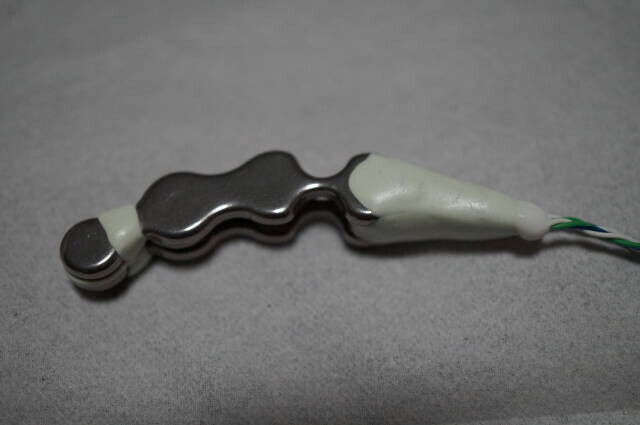
In an entry published in October 2023, a reader asked whether resin filling between twin stainless-steel chips would simplify cleaning. Mr. Okada explained that he had deliberately kept resin coverage limited to preserve exposed metal surfaces.
He nevertheless offered gap filling for an additional ¥2,000 (about $13 at ¥156 = $1, rate as of 2026-09-04) excluding tax, reflecting the extra finishing work. The pictured revision still had an unfilled gap; a completed filled version was not documented. His offer treated filling as an optional custom preference, rather than changing the standard construction.
(Source: ok-lab's diary, published October 2023)
https://ok-lab.hatenablog.com/entry/2023/10/21/123054
Buying from outside Japan
OK Lab ships internationally to countries covered by Japan Post's EMS courier service. Overseas orders are paid in advance by PayPal. Each order carries a ¥400 (about $3 at ¥156 = $1, rate as of 2026-09-04) handling fee, and EMS shipping is charged on top. These terms come from OK Lab's official sales-terms page (written here as plain text, not a link: ok-lab.net/docs/law), checked on September 7, 2026; confirm them on the official store before you order, because they can change.
Summary of this article
| What you wanted to know | The answer |
|---|---|
| What is the short answer? | The maker's cleaning claims depend on whether water enters and whether internal surfaces are accessible. |
| What is this product? | A device made by OK Lab in Japan and placed in the urethra. |
| What do the terms mean? | Cavities, covers, and sheaths describe different spaces within chips or their attachments. |
| What problems occurred? | The entries describe difficult cleaning, leaking tubes, and breakage during boiling. |
| What did the maker propose? | Boiling-compatible assemblies, accessible joints, and movable covers. |
| What changed over time? | Some designs gained cleaning access; the May 2026 sheath still admitted water. |
| Which current products appear? | Glass and ceramic vibrating base models are each listed at ¥6,600 (about $42 at ¥156 = $1, rate as of 2026-09-04) including tax. |
| What worried customers? | Friction after cleaning, inaccessible wire, and gaps between chips. |
| How do overseas orders work? | Advance PayPal payment, a ¥400 (about $3 at ¥156 = $1, rate as of 2026-09-04) handling fee, and additional EMS shipping charges. |
Source: ok-lab's diary (Okada Comfortable Life Laboratory). The original entries are in Japanese; quotations on this page are translated. Photos and videos are on the original entries.
This article is a summary of the maker's development diary. The product is not a medical device and no result is guaranteed. If anything feels wrong or worries you, see a doctor. Prices, specifications and cautions change, so confirm the latest information on the official blog and the official site. Questions about ordering and shipping go to the seller.