![How do you store a prostate chip? | The maker favors dry storage away from sunlight [OK Prostate Chip]](/img/a/T0896/eyecatch.svg)
This page is based on entries from "ok-lab's diary" (https://ok-lab.hatenablog.com/), the Japanese development diary written by Mr. Okada, founder of OK Lab, a small company in Japan (Okada Comfortable Life Laboratory). Only the entries about "chip storage and cases" are summarized here, in order of publication. Past prices and sizes are as written at the time. Current prices come from the official product list (retrieved September 4, 2026). Quotations are translated from Japanese.
Note: This page is a personal reading log by someone with no connection to the maker or the seller. It reflects the source entries as of their publication dates and makes no guarantee of accuracy or safety. The product is not a medical device; talk to a doctor about any health decision. Check the official site for current information. This page contains advertising.
In short
Storage reports include tangled thread, broken resin, and a hole in repeatedly folded tubing.
Mr. Okada favors dry storage away from ultraviolet light and cautions about pressure on attached parts.
The current list includes a resin chip from a breakage case and a mask suggested as a pouch.
About this product
The OK Prostate Chip is a small device that is placed in the urethra (the urine passage) so that it acts on the prostate; the maker sells it in several shapes, sizes and materials. It is made and sold by OK Lab (Okada Comfortable Life Laboratory), a small company in Japan, through its own online store, and prices are in Japanese yen (JPY). The maker's development diary, "ok-lab's diary", is written in Japanese. This page is an English summary of it, and every quotation is translated. OK Lab ships internationally, so readers outside Japan can order (see "Buying from outside Japan" below). Product names on this page are plain-English descriptions. The official Japanese product name is shown once in the product table so you can find the same item in the store.
Before you read: key terms
| Term | Plain-English meaning |
|---|---|
| Urethra | The urine passage, where the chip is placed to act on the prostate. |
| Retrieval thread | Thread attached to the chip so that it can be retrieved. |
| Integrated nylon loop | Nylon thread forming a loop directly from the chip body; the maker explored it for better shape retention. |
| Ultraviolet light | Light associated with sunlight in the diary; avoiding exposure forms part of Mr. Okada's storage advice. |
| Silica gel | Something Mr. Okada proposed including in a zipped storage container. Its purpose is unspecified: The diary does not explain this. |
| Nitinol | Nickel-titanium shape-memory wire, explored as a flexible replacement for the chip's thread. |
| Ethanol | The alcohol a customer used as a storage liquid, hoping to keep the chip clean. |
| PP bag | The plastic zip bag named in the breakage report, used to contain the chip during storage and boiling. |
What happens: chip storage
The OK Prostate Chip is a small device placed in the urethra (the urine passage) to act on the prostate. Storage cases hold the chip and its attached thread outside the body between uses. The diary describes household containers, hanging storage, and a pouch suggestion, alongside problems involving tangled thread, pressure on a chip, and damaged tubing. The accounts concern the chip's attached parts as well as the container around them.
Small size made chip storage discreet in Mr. Okada's account
In an entry published in January 2018, Mr. Okada said discreet storage was an unexpectedly frequent reason customers liked the device. He described reports that its small size helped keep it unnoticed by other household members. One reported comparison was with fishing tackle.
He weighed a single glass chip at 1 gram and a coated two-chip assembly, including thread and packaging, at 3 grams. Mr. Okada regarded that compactness as a practical storage advantage.
(Source: ok-lab's diary, published January 2018)
https://ok-lab.hatenablog.com/entry/20180127/1517054930
A lined chip storage case worked for one customer's thread
In an entry published in February 2020, a customer described a case from a Japanese discount shop's nail, screw, and hook set. It contained a cloth lining, with the retrieval thread (the thread attached for retrieving the chip) arranged in loops. The customer reported slight bends in the thread, but no tangling once it was released.
The customer's cautions concerned thread trapped in the lid and tangles during unpacking. Mr. Okada thanked them for the example; the diary records no additional advice about that particular case.
(Source: ok-lab's diary, published February 2020)
https://ok-lab.hatenablog.com/entry/2020/02/01/151232
A customer reported a hole in a tube that stayed folded during storage
In an entry published in June 2025, a customer reported a hole in a chipless bladder-loop device after about 2 months. The hole was inside a bend that stayed folded during storage, and the customer suspected water had entered the tube.
After staff requested a photograph, the customer supplied one and suggested cleaning damage or soap residue as possible explanations. Mr. Okada instead suspected the silicone tube's own durability, saying it appeared to have weakened before the wire. The customer wanted a larger replacement loop; the diary does not record whether that order was completed.
(Source: ok-lab's diary, published June 2025)
https://ok-lab.hatenablog.com/entry/2025/06/14/122936
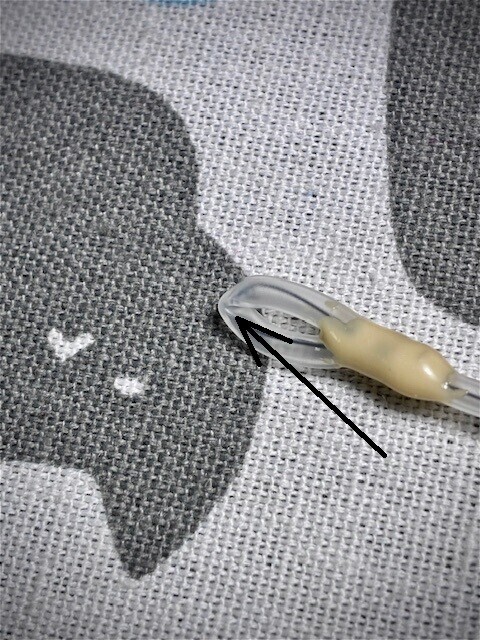
Hanging chip storage restored the maker's integrated nylon loop
In an entry published in October 2025, a customer requested an integrated nylon loop (thread forming a loop directly from the chip body). Mr. Okada reported better shape retention than ordinary nylon thread, with small rubber joins keeping paired loops together. He observed slight distortion after boiling in a small pan, followed by recovery during hanging storage.
The published conversion charges, excluding tax, were ¥1,000 (about $6 at ¥156 = $1, rate as of 2026-09-04) for lengths up to 10cm, ¥1,500 (about $10 at ¥156 = $1, rate as of 2026-09-04) up to 20cm, and ¥3,000 (about $19 at ¥156 = $1, rate as of 2026-09-04) up to 30cm. The maximum was 30cm, because the work reached 60cm during manufacture. Mr. Okada presented hanging storage as the way this particular loop regained its shape.
(Source: ok-lab's diary, published October 2025)
https://ok-lab.hatenablog.com/entry/2025/10/25/122907
Duplicate ceramic devices prompted a longer-term chip storage suggestion
In an entry published in January 2026, Mr. Okada discussed storing duplicates of a preferred movable ceramic chip. He considered its ceramic, resin, silicone rubber, and embedded wire capable of lasting a long time.
Nylon thread was his exception: he estimated only a few years when wet. He thought protection from ultraviolet light (including light from sunlight) could give stored nylon much greater durability. On that basis, he suggested buying and storing identical examples after settling on a preferred size.
(Source: ok-lab's diary, published January 2026)
https://ok-lab.hatenablog.com/entry/2026/01/17/122907
The maker's answer to chip storage
Mr. Okada's storage suggestions addressed moisture, light, thread shape, and the different behavior of attached materials.
Dry chip storage was the maker's preference for unused stock
In an entry published in January 2020, Mr. Okada described repeated boiling as a durability test involving chips he was not using. After about half a year of daily boiling, their nylon thread was almost transparent. It showed no immediate tendency to snap when pulled, but he believed its strength had fallen considerably.
He discouraged that repeated treatment of unused stock, favoring preparation before use instead. His advice also called for replacement of severely faded nylon thread. For storage itself, Mr. Okada favored a dry environment protected from sunlight and other ultraviolet light.
(Source: ok-lab's diary, published January 2020)
https://ok-lab.hatenablog.com/entry/2020/01/11/151714
A zipped container was an additional chip storage suggestion
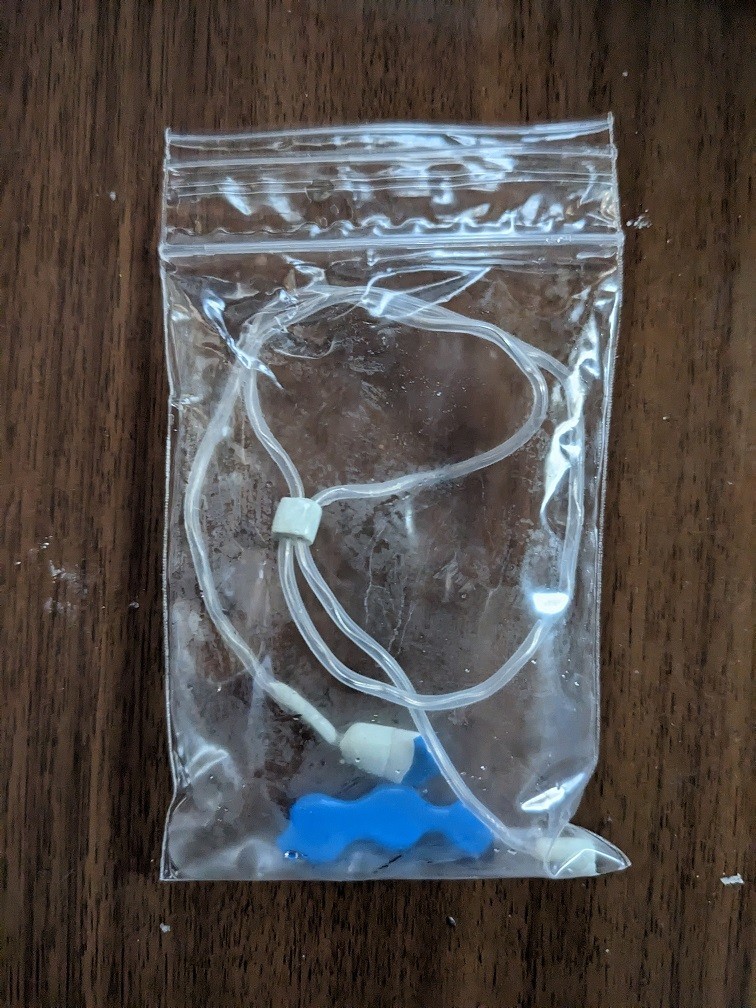
A separate customer account in the entry published in February 2020 described hanging a chip by a loop at the thread's end. The customer said the device touched nothing else and its weight kept the thread straight. They also suggested a necklace case.
Mr. Okada thought hanging storage might suit people already using that kind of jewelry storage. His additional suggestion was a zipped plastic container together with silica gel (an item whose function the diary does not explain).
(Source: ok-lab's diary, published February 2020)
https://ok-lab.hatenablog.com/entry/2020/02/01/151232
Coiled wire offered another chip storage possibility in development
In an entry published in October 2024, Mr. Okada described silicone-covered nitinol (nickel-titanium shape-memory wire) as a possible replacement for thread. His example contained two 0.3mm wires inside a silicone tube with an outside diameter of 1mm and an inside diameter of 0.5mm.
He said the assembly could remain coiled during storage or boiling. He also said it tolerated high temperatures and contact with a pan's rim during boiling. Mr. Okada's stated caution was that direct flame was unacceptable.
(Source: ok-lab's diary, published October 2024)
https://ok-lab.hatenablog.com/entry/2024/10/12/122911
How chip storage changed over time
| Published | What the diary said then |
|---|---|
| Jan 2018 | Mr. Okada identified discreet storage as an unexpectedly frequent source of customer satisfaction. |
| Feb 2019 | Alcohol storage remained untested; Mr. Okada offered tentative reassurance. |
| Jan 2020 | Tangled thread prompted discussion of storage conditions and nylon deterioration. |
| Feb 2020 | Reader case designs and a zipped-container suggestion expanded the storage discussion. |
| Jan 2023 | A broken resin chip raised concerns about pressure from attachments. |
| Oct 2024 | Mr. Okada described silicone-covered nitinol wire that could remain coiled. |
| Jun 2025 | A hole appeared inside a persistent bend in a chipless device's tube. |
| Oct 2025 | Integrated nylon loops brought shape-recovery observations and conversion charges based on length. |
| Jan 2026 | Mr. Okada suggested storing duplicate movable ceramic chips, citing his expectations of material durability. |
OK Prostate Chip products related to chip storage
The current list includes the resin chip named in the breakage report and a mask previously suggested as a pouch.
Products that appear in these entries
| Product (official name) | Price incl. tax | Relation to this topic |
|---|---|---|
| Semi-long resin chip (OKプロステートチップ セミロングタイプ(生体適合樹脂)) | ¥5,500 (about $35 at ¥156 = $1, rate as of 2026-09-04) | The January 2023 report concerned this chip in size M with custom attachments; the current list does not specify that configuration. |
(Source: ok-lab's diary, published January 2023)
https://ok-lab.hatenablog.com/entry/2023/01/14/122952
Products the diary mentioned as alternatives
| Product (official name) | Price incl. tax | Relation to this topic |
|---|---|---|
| Hosiery-fabric mask with flannel insert (パンスト素材マスク+ネル生地保護布) | ¥550 (about $4 at ¥156 = $1, rate as of 2026-09-04) | In February 2020, Mr. Okada introduced this at ¥500 (about $3 at ¥156 = $1, rate as of 2026-09-04) excluding tax and suggested it could also serve as a chip pouch. |
(Source: ok-lab's diary, published February 2020)
https://ok-lab.hatenablog.com/entry/2020/02/29/155031
For the June 2025 chipless loop, October 2025 integrated loop-thread build, and January 2026 movable ceramic design:
No matching product can be confirmed on the current list.
Common worries about chip storage
The replies leave alcohol compatibility, a customer's eventual case choice, and the precise cause of one chip's breakage unresolved.
"Is alcohol suitable for chip storage?"
In an entry published in February 2019, a customer asked whether alcohol would damage a chip and whether another storage liquid was better. The customer used ethanol (an alcohol) inside a small, sealed, dish-shaped bottle, hoping for clean storage and easy carrying.
Mr. Okada said he had never tested alcohol storage because he had an alcohol allergy. The diary does not record the customer's longer-term storage result or name a better liquid. Mr. Okada offered tentative reassurance: he had received no reports of alcohol-related breakage and thought it was probably acceptable.
(Source: ok-lab's diary, published February 2019)
https://ok-lab.hatenablog.com/entry/2019/02/02/153358
"Can a chip storage case stop the thread tangling?"
In an entry published in January 2020, a customer wanted a better storage arrangement as their collection grew. While using a plastic case from a Japanese discount shop, they had struggled to undo a tangle in the thread. The knot left bends behind even after it was undone.
Mr. Okada admitted he had not developed a storage solution; the diary does not record a successful replacement case for that customer. His reply offered general storage advice about dryness and protection from light, rather than a particular case.
(Source: ok-lab's diary, published January 2020)
https://ok-lab.hatenablog.com/entry/2020/01/11/151714
"Could chip storage explain a broken resin chip?"
In an entry published in January 2023, a customer reported a size M semi-long resin chip broken at its first groove beside the thread. Their follow-up clarified that they discovered the break while taking it from a PP bag (the named plastic storage bag) after boiling. Staff identified that groove as the weakest point, described previous pressure-related breaks, and said no spontaneous breakage had been reported.
The manufacturing reply favored more space in a larger bag, suspecting the springy wire had pressed the chip against the plastic. Mr. Okada suspected a stainless-steel attachment increased stress through leverage during collisions, without confirming the cause. His proposed precaution centered on reducing heat-driven movement during prolonged boiling.
(Source: ok-lab's diary, published January 2023)
https://ok-lab.hatenablog.com/entry/2023/01/14/122952
Buying from outside Japan
OK Lab ships internationally to countries covered by Japan Post's EMS courier service. Overseas orders are paid in advance by PayPal. Each order carries a ¥400 (about $3 at ¥156 = $1, rate as of 2026-09-04) handling fee, and EMS shipping is charged on top. These terms come from OK Lab's official sales-terms page (written here as plain text, not a link: ok-lab.net/docs/law), checked on September 7, 2026; confirm them on the official store before you order, because they can change.
Summary of this article
| What you wanted to know | The answer |
|---|---|
| What is the short answer? | Mr. Okada favors dry storage away from sunlight; the diary also records tangles and damaged components. |
| What is the product? | A small urethral device made and sold by OK Lab in Japan, with prices in Japanese yen. |
| Which storage terms matter? | The entries distinguish retrieval thread, integrated loops, wire, storage liquids, and containers. |
| What happened in storage? | Customers described discreet cases, tangled thread, a broken resin chip, and a hole in folded tubing. |
| What did the maker suggest? | Dryness, protection from ultraviolet light, and storage arrangements suited to the attached thread or wire. |
| What changed over time? | Discussion expanded from compactness and household cases to attachment stress, tubing durability, and loop designs. |
| Which current products are connected? | The listed semi-long resin chip costs ¥5,500 (about $35 at ¥156 = $1, rate as of 2026-09-04); the mask suggested as a pouch costs ¥550, (about $4 at ¥156 = $1, rate as of 2026-09-04) both including tax. |
| What remains uncertain? | Alcohol compatibility was untested, and the precise cause of the reported resin break was not established. |
| How do overseas orders work? | Advance PayPal payment, a ¥400 (about $3 at ¥156 = $1, rate as of 2026-09-04) handling fee, and additional Japan Post EMS shipping charges apply under the stated terms. |
Source: ok-lab's diary (Okada Comfortable Life Laboratory). The original entries are in Japanese; quotations on this page are translated. Photos and videos are on the original entries.
This article is a summary of the maker's development diary. The product is not a medical device and no result is guaranteed. If anything feels wrong or worries you, see a doctor. Prices, specifications and cautions change, so confirm the latest information on the official blog and the official site. Questions about ordering and shipping go to the seller.