![Can I boil the whole device? | Some parts cannot withstand the heat [OK Prostate Chip]](/img/a/T0884/eyecatch.svg)
This page is based on entries from "ok-lab's diary" (https://ok-lab.hatenablog.com/), the Japanese development diary written by Mr. Okada, founder of OK Lab, a small company in Japan (Okada Comfortable Life Laboratory). Only the entries about "parts that cannot be boiled and heat limits" are summarized here, in order of publication. Past prices and sizes are as written at the time. Current prices come from the official product list (retrieved September 4, 2026). Quotations are translated from Japanese.
This article is about boiling the OK Prostate Chip, and summarizes heat limits, testing, and designs over time. It includes customer questions, current products, and buying from outside Japan.
Note: This page is a personal reading log by someone with no connection to the maker or the seller. It reflects the source entries as of their publication dates and makes no guarantee of accuracy or safety. The product is not a medical device; talk to a doctor about any health decision. Check the official site for current information. This page contains advertising.
In short
Boiling can damage the controllers, ordinary USB connectors, adhesive bonds, and nylon parts described in these entries.
Mr. Okada's later designs separated heat-sensitive controllers from the chip using detachable connections.
Later USB redesigns improved heat resistance, but nylon and plug limitations remained in entries published through 2026.
About this product
The OK Prostate Chip is a small device that is placed in the urethra (the urine passage) so that it acts on the prostate; the maker sells it in several shapes, sizes and materials. It is made and sold by OK Lab (Okada Comfortable Life Laboratory), a small company in Japan, through its own online store, and prices are in Japanese yen (JPY).
The maker's development diary, "ok-lab's diary", is written in Japanese. This page is an English summary of it, and every quotation is translated.
OK Lab ships internationally, so readers outside Japan can order (see "Buying from outside Japan" below). Product names on this page are plain-English descriptions. The official Japanese product name is shown once in the product table so you can find the same item in the store.
Before you read: key terms
| Term | Plain-English meaning |
|---|---|
| Vibrating chip | A chip containing a small motor, intended to provide vibration inside the urethra. |
| Controller | The electronic unit connected to a vibrating chip to operate its motor. |
| USB connector | A detachable electrical connection used to separate the chip from its controller. |
| Miniature connector | A small electrical fitting used to join detachable chip and controller sections. |
| Epoxy resin | A material used to coat or bond chip parts and electrical connections. |
| Electrode chip | A chip with electrical contacts, intended to provide electrical stimulation through connected equipment. |
| Autoclave | A pressurized steam sterilizer used for the heat tests and proposed sterilization discussed here. |
| 6-wire support cable | A cable assembly intended to support the chip's position. |
| Sleeved nylon thread | Nylon inside a tube, requested for a chip-and-stopper connection to resist heat damage. |
What happens: boiling the OK Prostate Chip
The OK Prostate Chip is a small device placed in the urethra, the urine passage, to act on the prostate. These entries concern the heat resistance of its body, attached threads, cables, and electrical connections. Vibrating models include a motor and an external controller, while detachable connectors allow those sections to separate. The diary distinguishes components inside the urethra from control equipment outside the body, and records different heat limits for different parts.
An adhesive bond failed during boiling despite initially holding firmly
In an entry published in June 2018, Mr. Okada reported epoxy resin (a coating and bonding material) separating from glass. Roughened glass performed worse, while Aron adhesive initially bonded firmly. That bond failed at 100°C, against an 80°C limit he found on the adhesive maker's website.
For future production, he favored a mechanical tie over reliance on adhesion. His proposed remedy involved adhesive repair and alcohol-based disinfection, with boiling excluded from his suggestion for continued use.
(Source: ok-lab's diary, published June 2018)
https://ok-lab.hatenablog.com/entry/20180602/1527922643
The attached battery box complicated boiling an early vibrating prototype
In an entry published in December 2018, Mr. Okada described a vibrating chip (a chip containing a small motor) with an attached battery box. He reported that the portion intended for the urethra briefly tolerated 100°C, while the battery box made hot-water treatment difficult.
No matching product can be confirmed on the current list. Mr. Okada said longer durability testing was needed before release.
(Source: ok-lab's diary, published December 2018)
https://ok-lab.hatenablog.com/entry/20181215/1544857573
A switch-free battery box did not share the controller's boiling restrictions
In an entry published in September 2019, Mr. Okada reported that a switch-free 1.5V battery box operated underwater for one hour. He also reported successful bath and shower trials.
His boiling claim for this battery-box design explicitly excluded the battery itself. He warned that the electronic controller and ordinary vibrator controller would fail if wet.
(Source: ok-lab's diary, published September 2019)
https://ok-lab.hatenablog.com/entry/2019/09/07/135854
A chip body showed heat resistance during prolonged steam testing
In an entry published in August 2021, Mr. Okada reported testing a semilong chip in an autoclave (a pressurized steam sterilizer). It received continuous steam heating at 120°C for more than 10 hours.
He observed no change, despite noting that epoxy resin can soften at that temperature. No matching product can be confirmed on the current list. He described this as a durability test.
(Source: ok-lab's diary, published August 2021)
https://ok-lab.hatenablog.com/entry/2021/08/28/125823
Heat resistance varied with size among the tested chip motors
In an entry published in September 2021, Mr. Okada answered a question about boiling vibrating chips with contrasting motor observations. He reported that the 10 mm motor kept running during boiling at 100°C. The 8 mm motor stopped at about 80°C and restarted as it cooled.
(Source: ok-lab's diary, published September 2021)
https://ok-lab.hatenablog.com/entry/2021/09/25/125720
Rated and observed heat resistance of a 6-wire chip support cable
In an entry published in June 2022, Mr. Okada discussed a 6-wire support cable (an assembly supporting the chip's position). Its thin auxiliary cable had an official heat rating of 105°C, according to its supplier. Mr. Okada reported no problem in his own 120°C autoclave test.
He considered a thicker silicone-based design heat-resistant. No matching product can be confirmed on the current list. He favored that design despite its greater width.
(Source: ok-lab's diary, published June 2022)
https://ok-lab.hatenablog.com/entry/2022/06/18/123201
A tube around the chip's nylon thread did not eliminate the risk of shrinkage
In an entry published in February 2026, a customer requested more heat-resistant thread after reporting shrinkage associated with contact with a pan. Staff quoted ¥2,200 (about $14 at ¥156 = $1, rate as of 2026-09-04) for 30 cm of sleeved nylon thread (nylon inside a tube). Mr. Okada confirmed making the requested thread-and-stopper assembly.
No matching product can be confirmed on the current list. Mr. Okada thought light pan contact might be tolerated, but warned that a pan boiling dry could still shrink the nylon inside.
(Source: ok-lab's diary, published February 2026)
https://ok-lab.hatenablog.com/entry/2026/02/21/122935
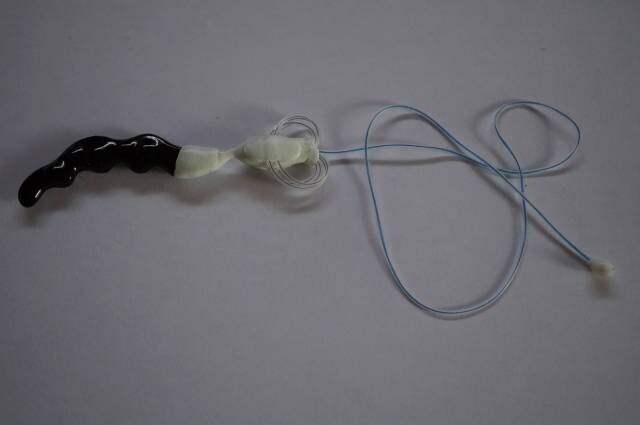
The maker's answer to boiling the OK Prostate Chip
The maker developed detachable connections, while continuing to exclude heat-sensitive parts from his boiling claims.
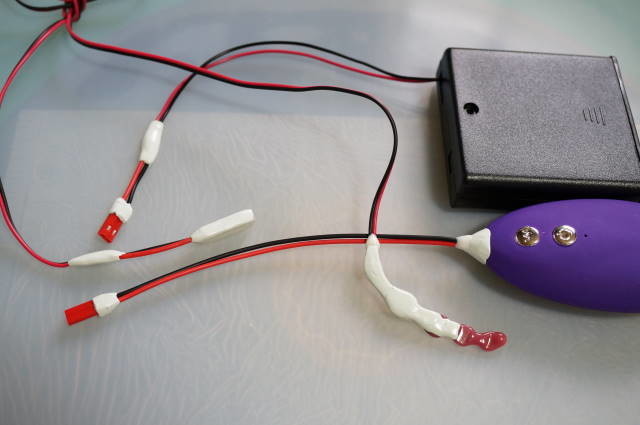
Detachable miniature connectors separated parts with different boiling limits
In an entry published in April 2019, Mr. Okada introduced a miniature connector (a small detachable electrical fitting) for vibrating chips. He described its chip-side half as fully waterproof, while the controller-side half was not designed to that standard. The connector's silicone, epoxy resin, and metal construction tolerated 100°C, and he reported no apparent problem after about 10 minutes of chip-side boiling.
Proposed prices were ¥2,000 (about $13 at ¥156 = $1, rate as of 2026-09-04) per half and ¥4,000 (about $26 at ¥156 = $1, rate as of 2026-09-04) per set, tax excluded. No matching product can be confirmed on the current list. Mr. Okada offered these as custom work because production was too labor-intensive for regular sales.
(Source: ok-lab's diary, published April 2019)
https://ok-lab.hatenablog.com/entry/2019/04/06/151323
The redesigned USB connector for the chip offered better heat resistance without any safety guarantee
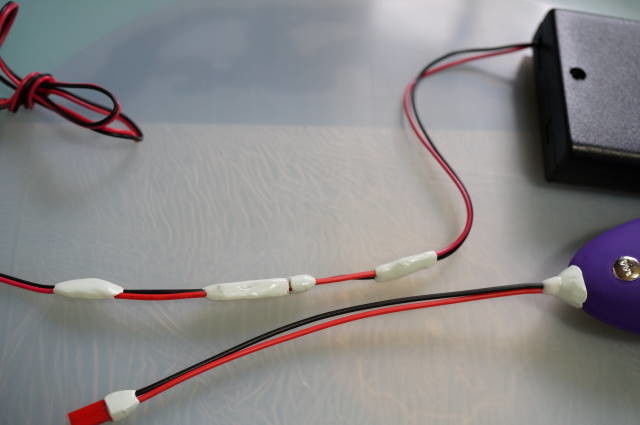
In an entry published in January 2022, Mr. Okada presented a USB connector (a detachable electrical connection) designed for 100°C. He said its epoxy-covered cable joint tolerated that temperature. The metal portion and internal resin showed no deformation in separate 120°C tests.
Published January 2022 prices were ¥1,000 (about $6 at ¥156 = $1, rate as of 2026-09-04) tax excluded for the redesigned male connector and ¥500 (about $3 at ¥156 = $1, rate as of 2026-09-04) tax excluded for the ordinary version. No matching product can be confirmed on the current list. Mr. Okada explicitly gave no guarantee of durability or safety.
(Source: ok-lab's diary, published January 2022)
https://ok-lab.hatenablog.com/entry/2022/01/15/124252
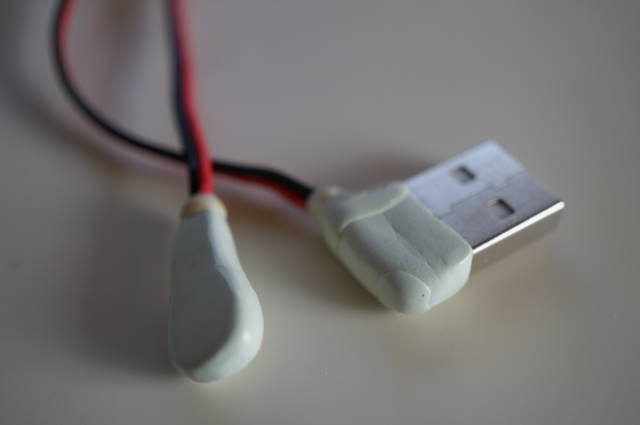
An electrode connector request addressed a plug's boiling limitation
An entry published in April 2022 discussed an electrode chip (a chip with electrical contacts for stimulation). A customer wanted a heat-resistant USB connection between that chip and its external plug. The quoted additions were ¥1,100 (about $7 at ¥156 = $1, rate as of 2026-09-04) for the chip-side USB work and ¥550 (about $4 at ¥156 = $1, rate as of 2026-09-04) for the plug-side work.
The diary does not record how that assembly performed afterward. Mr. Okada said the plug itself was unsuitable for boiling, but considered the proposed intermediate USB connection promising.
(Source: ok-lab's diary, published April 2022)
https://ok-lab.hatenablog.com/entry/2022/04/02/123050
The later electrode build still needed a separate boiling-compatible connection
In an entry published in May 2026, a customer wanted a locking electrode assembly because the existing parallel cables were prone to breaking. Staff initially advised against the requested arrangement, saying it would place excessive strain on those cables. They proposed a different locking design previously developed as a prototype.
Mr. Okada reported making an electrode version of that alternative. Staff said OK Lab had no plug suitable for boiling, so the build included a heat-resistant USB connection before the plug. No matching product can be confirmed on the current list.
(Source: ok-lab's diary, published May 2026)
https://ok-lab.hatenablog.com/entry/2026/05/16/122906
How boiling the OK Prostate Chip changed over time
| Published | What the diary said then |
|---|---|
| Jun 2018 | Adhesive failure prompted plans for mechanical attachment. |
| Mar 2019 | A cleaning reply distinguished the controller from chip and cable components. |
| Apr 2019 | Custom detachable connectors made separate chip-side heat treatment possible. |
| May 2020 | Ordinary USB plastic was identified as a heat-sensitive component. |
| Aug 2021 | Prolonged steam testing produced no observed change in a semilong chip body. |
| Jan 2022 | A redesigned USB terminal addressed the earlier connector problem. |
| Jan 2023 | Nylon shrinkage ruled out autoclave treatment of an assembled resin chip. |
| Sep 2025 | Mr. Okada considered heat-resistant replacement thread near the external portion. |
| Feb 2026 | A protective tube still left its nylon core vulnerable to overheating. |
| May 2026 | An electrode build retained separate USB and plug connections because plugs remained unsuitable. |
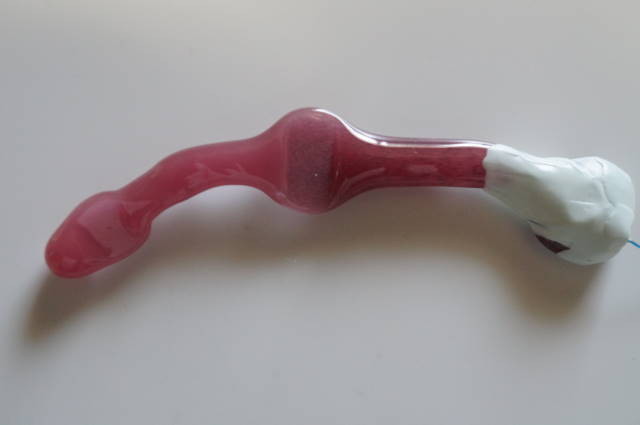
OK Prostate Chip products related to boiling the OK Prostate Chip
The current list includes devices discussed here, but does not confirm the historical heat-resistant USB build.
Products featured in these entries about boiling
| Product (official name) | Price incl. tax | Relation to this topic |
|---|---|---|
| Glass semilong vibrating chip (OKプロステート核振チップ ガラス素材セミロングタイプ) | ¥6,600 (about $42 at ¥156 = $1, rate as of 2026-09-04) | September 2019: a request for custom detachable connections named this base model. |
| Electronic controller option (ICコントローラに変更(核振チップオプション)) | ¥2,200 (about $14 at ¥156 = $1, rate as of 2026-09-04) | September 2019: this controller featured in the custom detachable assembly request. |
| Long ceramic vibrating chip (OKプロステート核振チップ 陶器素材ロングタイプ) | ¥8,800 (about $56 at ¥156 = $1, rate as of 2026-09-04) | February 2022: a prospective buyer asked whether its controller remained attached during boiling. |
| Semilong resin chip (OKプロステートチップ セミロングタイプ(生体適合樹脂)) | ¥5,500 (about $35 at ¥156 = $1, rate as of 2026-09-04) | January 2023: a first-time buyer asked about autoclave treatment, which staff rejected because of the nylon thread. |
(Source: ok-lab's diary, published September 2019)
https://ok-lab.hatenablog.com/entry/2019/09/07/135854
(Source: ok-lab's diary, published February 2022)
https://ok-lab.hatenablog.com/entry/2022/02/26/123231
(Source: ok-lab's diary, published January 2023)
https://ok-lab.hatenablog.com/entry/2023/01/14/122952
Alternative products mentioned in the diary's entries on boiling
The diary names no alternative.
Common worries about boiling the OK Prostate Chip
The diary gives different answers for controllers, plugs, ordinary USB connectors, and nylon-thread assemblies.
"Does boiling a vibrating chip damage its controller?"
In an entry published in March 2019, a reader asked how the electronic parts affected cleaning. Mr. Okada ruled out washing or boiling the controller (the unit that operates the vibrating chip's motor). His proposed alternative for that component was alcohol-based surface cleaning.
The chip-and-cable discussion set an approximately 30-second heat-exposure limit, concerning water after heating had stopped. The diary does not record how the reader's equipment performed afterward. Mr. Okada cautioned against heated-pan contact, steam reaching the controller, and switching on the motor during heating.
(Source: ok-lab's diary, published March 2019)
https://ok-lab.hatenablog.com/entry/2019/03/02/151104
"Does a detachable plug make boiling vibrating chips straightforward?"
In an entry published in September 2019, a customer asked to buy a glass semilong vibrating chip with detachable connections. Mr. Okada offered custom work for an additional ¥2,160 (about $14 at ¥156 = $1, rate as of 2026-09-04); the customer then requested both electronic and simpler controller versions. The diary does not record how the finished arrangement performed in use.
Mr. Okada considered the detachable chip section boilable and the separation safer, while excluding the attached controller from that claim. Both plug halves had cavities that he considered difficult to clean. His advice generally opposed plugs inside the urethra, despite mentioning boiling or alcohol soaking as possible cleaning approaches.
(Source: ok-lab's diary, published September 2019)
https://ok-lab.hatenablog.com/entry/2019/09/07/135854
"Can ordinary USB connectors withstand boiling?"
In an entry published in May 2020, a reader asked whether a USB connector could tolerate the chip's boiling treatment. Mr. Okada said water exposure was acceptable, but the connector's plastic started deforming around 80°C.
The diary does not record whether the reader ordered that configuration. His answer explicitly excluded that USB connector from boiling.
(Source: ok-lab's diary, published May 2020)
https://ok-lab.hatenablog.com/entry/2020/05/16/131332
"How heat-resistant was the chip's controller?"
In an entry published in February 2022, a prospective long ceramic vibrating chip buyer asked whether the controller and chip were directly connected. Mr. Okada confirmed that the standard model had a continuous connection. He thought about 60°C was the controller's safe heat limit, and warned about both heat and steam.
The diary does not record whether the order was completed. Mr. Okada recommended the recently released heat-resistant USB connection to separate the controller.
(Source: ok-lab's diary, published February 2022)
https://ok-lab.hatenablog.com/entry/2022/02/26/123231
"Does a heat-resistant resin chip body permit autoclave sterilization?"
In an entry published in January 2023, a first-time buyer asked about autoclave sterilization of a semilong resin chip. They were considering equipment offering 121°C and 134°C cycles. Staff said the body had tolerated testing, but its nylon thread shrank under heat.
Mr. Okada added that sleeved nylon thread shared this limitation because it also contained nylon. The diary does not record whether the buyer pursued autoclave sterilization. OK Lab's answer was that the product, including its thread, was unsuitable for that treatment.
(Source: ok-lab's diary, published January 2023)
https://ok-lab.hatenablog.com/entry/2023/01/14/122952
Buying from outside Japan
OK Lab ships internationally to countries covered by Japan Post's EMS courier service. Overseas orders are paid in advance by PayPal. Each order carries a ¥400 (about $3 at ¥156 = $1, rate as of 2026-09-04) handling fee, and EMS shipping is charged on top. These terms come from OK Lab's official sales-terms page (written here as plain text, not a link: ok-lab.net/docs/law), checked on September 7, 2026; confirm them on the official store before you order, because they can change.
Summary of this article
| What you wanted to know | The answer |
|---|---|
| In short: can every part withstand boiling? | The diary identifies separate limits for bonds, electrical parts, and nylon. |
| About the product: what is it? | A urethral device made by OK Lab in Japan, priced in JPY. |
| Key terms: which components matter? | The body, motor, controller, connectors, support cable, and thread have different roles. |
| What happens with heat? | Reported outcomes range from unchanged chip bodies to adhesive failure and thread shrinkage. |
| What was the maker's answer? | Detachable connections addressed some electrical-component limitations. |
| What changed over time? | Connector designs evolved, while later entries still described nylon and plug limitations. |
| Which current products appear? | The table identifies named chip models and an electronic controller option. |
| What did customers ask? | Questions concerned controllers, plugs, USB plastic, and complete assemblies in autoclaves. |
| How do overseas orders work? | Advance PayPal payment, a handling fee, and additional EMS shipping charges apply. |
Source: ok-lab's diary (Okada Comfortable Life Laboratory). The original entries are in Japanese; quotations on this page are translated. Photos and videos are on the original entries.
This article is a summary of the maker's development diary. The product is not a medical device and no result is guaranteed. If anything feels wrong or worries you, see a doctor. Prices, specifications and cautions change, so confirm the latest information on the official blog and the official site. Questions about ordering and shipping go to the seller.