![Can I fix a broken chip with glue? | Repairs were reported, but breakage remained a concern [OK Prostate Chip]](/img/a/T0877/eyecatch.svg)
This page is based on entries from "ok-lab's diary" (https://ok-lab.hatenablog.com/), the Japanese development diary written by Mr. Okada, founder of OK Lab, a small company in Japan (Okada Comfortable Life Laboratory). Only the entries about "repairing a cracked chip with glue" are summarized here, in order of publication. Past prices and sizes are as written at the time. Current prices come from the official product list (retrieved September 4, 2026). Quotations are translated from Japanese.
Note: This page is a personal reading log by someone with no connection to the maker or the seller. It reflects the source entries as of their publication dates and makes no guarantee of accuracy or safety. The product is not a medical device; talk to a doctor about any health decision. Check the official site for current information. This page contains advertising.
In short
- Customers reported glue repairs, but the diary also records broken ceramic leaving a fragment inside the body.
- Mr. Okada's responses progressed from adhesive repairs to reinforcement intended to keep broken ceramic pieces connected.
- The current list includes ceramic models from these cases; the reinforcement surcharge belongs to June 2025.
If you see blood in your urine, even a small amount or for the first time, do not wait and see. See a urologist right away.
If you suddenly cannot urinate, or the device cannot be removed, do not try to fix it yourself. Go to a medical facility, including emergency care, immediately.
About this product

The OK Prostate Chip is a small device that is placed in the urethra (the urine passage) so that it acts on the prostate; the maker sells it in several shapes, sizes and materials. It is made and sold by OK Lab (Okada Comfortable Life Laboratory), a small company in Japan, through its own online store, and prices are in Japanese yen (JPY). The maker's development diary, "ok-lab's diary", is written in Japanese. This page is an English summary of it, and every quotation is translated. OK Lab ships internationally, so readers outside Japan can order (see "Buying from outside Japan" below). Product names on this page are plain-English descriptions. The official Japanese product name is shown once in the product table so you can find the same item in the store.
Before you read: key terms
| Term | Plain-English meaning |
|---|---|
| Urethra | The urine passage, where the chip is placed to act on the prostate. |
| Resin | Material used to form chips, coat parts, or hold their threads in place. |
| Epoxy | A resin used in these entries as an adhesive or reinforcing coating. |
| Superglue | An instant adhesive used in the reported attempts to bond or reinforce damaged parts. |
| Aron Alpha | The named superglue used for the customer's ceramic repair reported in October 2019. |
| Shape-memory wire | Flexible wire used in the June 2025 prototypes to reinforce ceramic and try to keep broken sections connected. |
| Pressure sterilizer | Equipment used for Mr. Okada's heat-disinfection test on thread in February 2019. |
What happens: broken chip repair
The OK Prostate Chip is a small device placed in the urethra (urine passage) to act on the prostate. Glue repairs described here concern cracks in the chip or resin (material used to form or coat parts) around its thread. They concern the device itself, including parts intended to sit inside the body. The entries describe customer repairs, Mr. Okada's tests, and later attempts to prevent broken ceramic sections from separating.
Glue repair addressed a crack where the long chip's thread emerged
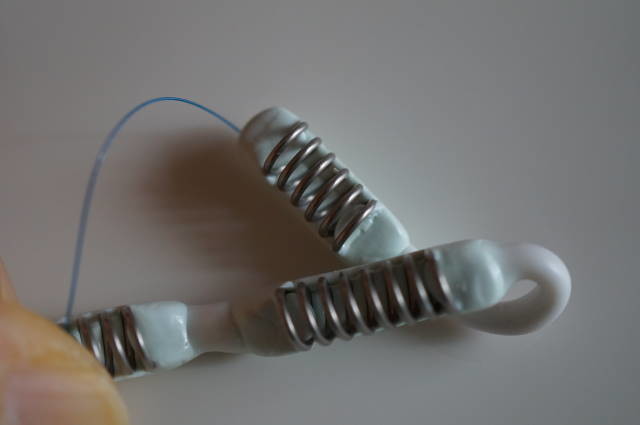
In an entry published in May 2018, a customer reported a small crack where the thread emerged from a long chip. The customer had reinforced that area with superglue (an instant adhesive) and reported no trouble during subsequent use. The diary does not record how long that repair lasted.
Mr. Okada said the message inspired a proposal combining superglue with epoxy (a resin used here for bonding and reinforcement). He believed each material could offset the other's weakness, including superglue's poor resistance to impact. His proposed reinforcement had superglue between epoxy layers, intended to reduce brittleness.
(Source: ok-lab's diary, published May 2018)
https://ok-lab.hatenablog.com/entry/20180513/1526181573
Broken ceramic chip repair followed an impact against a toilet bowl
In an entry published in October 2019, a customer described a short ceramic chip shooting out during urination and striking the toilet bowl. It split in two, and the customer reported continued use without an apparent problem after a repair with Aron Alpha superglue. The diary does not record longer-term results for that repair.
Mr. Okada said the ceramic revision introduced that week was considerably stronger. He also said impact resistance depended on where the chip was struck, and acknowledged limited comparative testing. Mr. Okada suggested epoxy might bond ceramic more effectively than superglue, presenting it as a possibility.
(Source: ok-lab's diary, published October 2019)
https://ok-lab.hatenablog.com/entry/2019/10/05/141806
Broken chip repair held during Mr. Okada's limited ceramic test
In an entry published in April 2021, Mr. Okada discussed his modified ceramic chip (Sea Slug 3, modification 2). He had accidentally broken it against a hard object during production and reported a strong bond after an epoxy repair.
After about 2 days of continuous use, he said the repaired joint resisted a subsequent strength check. The diary does not record a longer follow-up for that repaired piece. Mr. Okada treated the result as support for epoxy bonding broken ceramic, drawing a comparison with repaired bowls.
(Source: ok-lab's diary, published April 2021)
https://ok-lab.hatenablog.com/entry/2021/04/10/125809
An earlier broken chip left a fragment inside the body
In an entry published in June 2025, Mr. Okada recalled an earlier case of a ceramic chip breaking inside the body. A complex-shaped tip from that chip (Sea Slug 2) remained in the bladder and proved difficult to retrieve. According to his account, a doctor eventually removed it successfully.
He suspected an unnoticed crack had been present, but did not establish that as the cause. The diary does not give the date of the original incident. Mr. Okada identified preventing detached fragments as the reason for pursuing a new reinforcement design.
(Source: ok-lab's diary, published June 2025)
https://ok-lab.hatenablog.com/entry/2025/06/07/122954
Broken chip prevention tests still produced fragments from the long ceramic model
In an entry published in June 2025, Mr. Okada described drop tests of short, semi-long twisted, and long ceramic prototypes. The test pieces had wire reinforcement but lacked the additional epoxy covering planned for the finished reinforcement. All 3 survived a drop of 1 meter onto a wooden floor.
At 1.5 meters, the short and semi-long pieces remained intact, while small fragments broke away from the long one. He wrote that the damaged long chip still appeared largely connected and felt almost unbroken. Mr. Okada suggested possible adhesive repair, but phrased continued use as a possibility.
(Source: ok-lab's diary, published June 2025)
https://ok-lab.hatenablog.com/entry/2025/06/07/122954
The maker's answer to broken chip repair
Mr. Okada proposed adhesive repairs, then explored reinforcement intended to prevent broken pieces from separating.
Glue repair lost its apparent strength during the maker's boiling test
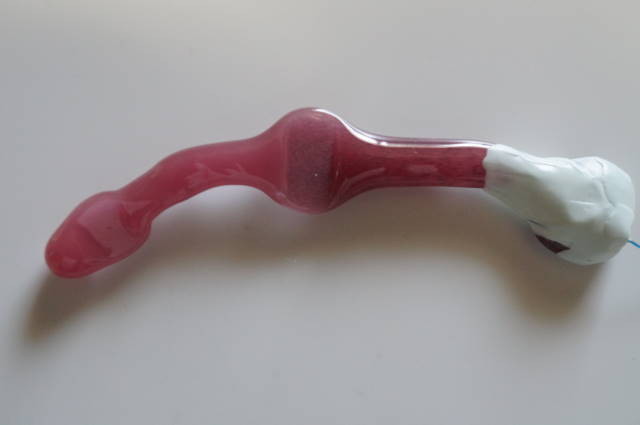
In an entry published in June 2018, Mr. Okada reported a strong bond between detached resin and glass using Aron superglue. That bond failed during boiling at 100 degrees, and he said the adhesive maker's website gave a limit of 80 degrees. He also found that roughened glass shed its resin more readily than smooth glass.
He therefore planned to move away from reliance on adhesive bonding toward a physical tie made from resin. The diary does not record longer-term results for either approach. Mr. Okada nevertheless proposed continued use after adhesive repair, with a change in disinfection approach.
(Source: ok-lab's diary, published June 2018)
https://ok-lab.hatenablog.com/entry/20180602/1527922643
Resin chip repair led to reinforcement requiring additional manufacturing time
In an entry published in February 2019, Mr. Okada said several customers had reported continued use after epoxy repairs. He believed the matching resin families would bond, and said OK Lab's own repair option was also limited to additional epoxy. After reconsidering his first reply, he developed a layered reinforcement using a less brittle resin alongside epoxy.
The diary does not record how long that reinforcement lasted. The extra work added about 5 days, so he said the charge for a reinforced thread attachment would rise slightly. Mr. Okada asked for feedback on the reinforcement's durability before committing to its sale.
(Source: ok-lab's diary, published February 2019)
https://ok-lab.hatenablog.com/entry/2019/02/02/153358
Broken chip prevention shifted toward wire reinforcement with a separate surcharge
In an entry published in June 2025, Mr. Okada abandoned a rubber-coating idea after a day because he thought it missed the underlying problem. He adopted reinforcement with shape-memory wire (flexible wire used here to support ceramic), reporting a strong bond with the ceramic. He found the 0.2 mm wire flexible enough to make manufacturing easier than expected.
Mr. Okada believed reinforced pieces would remain connected after cracking, while acknowledging that ceramic could still break. The reinforcement surcharge was ¥2,000 (about $13 at ¥156 = $1, rate as of 2026-09-04), tax excluded, above the regular ceramic-chip price, regardless of shape, as published in June 2025. Mr. Okada proposed the reinforcement to address the risk of a broken tip remaining inside the body.
(Source: ok-lab's diary, published June 2025)
https://ok-lab.hatenablog.com/entry/2025/06/07/122954
If you see blood in your urine, even a small amount or for the first time, do not wait and see. See a urologist right away.
If you suddenly cannot urinate, or the device cannot be removed, do not try to fix it yourself. Go to a medical facility, including emergency care, immediately.
How broken chip repair changed over time

| Published | What the diary said then |
|---|---|
| May 2018 | A thread-area crack prompted a proposal combining superglue and epoxy. |
| Jun 2018 | An apparently strong glass-resin bond failed during boiling. |
| Feb 2019 | Reinforcement added about 5 days of work, with a higher charge planned. |
| Oct 2019 | Improved ceramic was reported stronger, though impact comparisons remained limited. |
| Apr 2021 | A repaired ceramic chip reportedly withstood a strength check after about 2 days' use. |
| Jun 2025 | Wire reinforcement targeted separation after breakage; a surcharge of ¥2,000, (about $13 at ¥156 = $1, rate as of 2026-09-04) tax excluded, was announced. |
The diary does not say what the current state is.
OK Prostate Chip products related to broken chip repair
The short ceramic chip and long curved ceramic chip appear in the current list and the October 2019 cases.
Products that appear in these entries

| Product (official name) | Price incl. tax | Relation to this topic |
|---|---|---|
| Short ceramic chip (OKプロステートチップ 陶器素材ショートタイプ) | ¥3,300 (about $21 at ¥156 = $1, rate as of 2026-09-04) | In October 2019, a customer reported repairing this model after it broke against a toilet bowl. |
| Long curved ceramic chip (OKプロステートチップ 陶器素材ロング勾玉タイプ) | ¥7,700 (about $49 at ¥156 = $1, rate as of 2026-09-04) | In October 2019, a customer reported that this model's ceramic core broke during an attempted repair. |
(Source: ok-lab's diary, published October 2019)
https://ok-lab.hatenablog.com/entry/2019/10/05/141806
Products the diary mentioned as alternatives
The diary names no alternative.
Historical names include the May 2018 long chip and the February 2019 custom resin chip. No matching product can be confirmed on the current list.
The April 2021 modified ceramic chip, earlier chip recalled in June 2025, and June 2025 reinforced prototypes are also historical builds. No matching product can be confirmed on the current list.
Common worries about broken chip repair
The diary's repair replies depended on the material, thread attachment, and reported damage.
"Can broken chip repair include replacing the whole thread?"
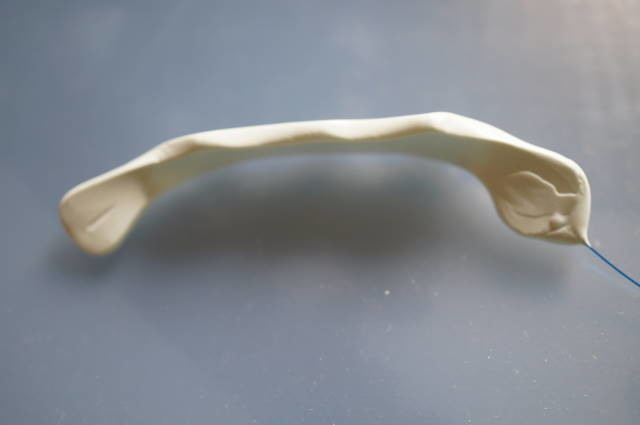
In an entry published in February 2019, a customer asked about repair or replacement after the thread began separating. The customer particularly valued this difficult custom build and reported similar trouble with earlier connected parts. Mr. Okada suspected an inherent weakness in his resin products.
He said glass models allowed complete thread replacement, while threads set into resin during manufacture generally could not be replaced. He initially thought a remake might suffer the same failure; the diary does not record this customer's eventual result. His initial recommendation was adhesive repair, before he returned to the problem with a new reinforcement proposal.
(Source: ok-lab's diary, published February 2019)
https://ok-lab.hatenablog.com/entry/2019/02/02/153358
"Could heat shrink the thread on a broken chip?"
In an entry published in February 2019, a customer asked whether hot-water disinfection had shortened the thread. The customer thought repeated exposure had made it noticeably shorter.
Mr. Okada reported 15% shrinkage at 120 degrees in a pressure sterilizer (equipment used in his heat-disinfection test). He said his tests had not produced shrinkage during ordinary boiling at 100 degrees. Mr. Okada offered contact with a hotter pan surface as a possible explanation, but the diary does not confirm the cause.
(Source: ok-lab's diary, published February 2019)
https://ok-lab.hatenablog.com/entry/2019/02/02/153358
"Can a broken ceramic chip be replaced after repair fails?"
In an entry published in October 2019, a customer requested a replacement long curved ceramic chip after problems with its resin coating. The customer reported bleeding during use, then said the ceramic core broke while they were attempting an epoxy repair.
Mr. Okada doubted that the raised resin explained the bleeding, but could not judge the claimed ceramic defect himself. He said he would consult the ceramic maker, while acknowledging that he could not currently supply the requested replacement. His proposed resolution was a refund, whose completion the diary does not record.
(Source: ok-lab's diary, published October 2019)
https://ok-lab.hatenablog.com/entry/2019/10/05/141806
Buying from outside Japan

OK Lab ships internationally to countries covered by Japan Post's EMS courier service. Overseas orders are paid in advance by PayPal. Each order carries a ¥400 (about $3 at ¥156 = $1, rate as of 2026-09-04) handling fee, and EMS shipping is charged on top. These terms come from OK Lab's official sales-terms page (written here as plain text, not a link: ok-lab.net/docs/law), checked on September 7, 2026; confirm them on the official store before you order, because they can change.
Summary of this article
| What you wanted to know | The answer |
|---|---|
| In short: can glue fix a broken chip? | Repairs were reported, but breakage and retained fragments also appear in the diary. |
| About this product: what is it? | A device placed in the urethra, made and sold by OK Lab in Japan. |
| Key terms: what are the repair materials? | The entries discuss resin, epoxy, superglue, and shape-memory wire. |
| What happens after damage? | Customer repairs and Mr. Okada's tests appear alongside a retained fragment and prototypes that still broke. |
| What was the maker's answer? | Mr. Okada proposed adhesive repair, then explored reinforcement intended to prevent separation. |
| How did the approach change? | The selected entries progress from adhesive experiments in May 2018 to wire reinforcement in June 2025. |
| Which related products are listed today? | The short ceramic chip costs ¥3,300 (about $21 at ¥156 = $1, rate as of 2026-09-04); the long curved ceramic chip costs ¥7,700, (about $49 at ¥156 = $1, rate as of 2026-09-04) both including tax. |
| What did customers ask? | Questions concerned repair or replacement, thread shrinkage, and replacement after a ceramic failure. |
| How do overseas orders work? | The stated terms are advance PayPal payment, a ¥400 (about $3 at ¥156 = $1, rate as of 2026-09-04) handling fee, and additional EMS shipping. |
Source: ok-lab's diary (Okada Comfortable Life Laboratory). The original entries are in Japanese; quotations on this page are translated. Photos and videos are on the original entries.
This article is a summary of the maker's development diary. The product is not a medical device and no result is guaranteed. If anything feels wrong or worries you, see a doctor. Prices, specifications and cautions change, so confirm the latest information on the official blog and the official site. Questions about ordering and shipping go to the seller.