![Can I make my own prostate chip cable? | Earlier improvements also brought failures [OK Prostate Chip]](/img/a/T0876/eyecatch.svg)
This page is based on entries from "ok-lab's diary" (https://ok-lab.hatenablog.com/), the Japanese development diary written by Mr. Okada, founder of OK Lab, a small company in Japan (Okada Comfortable Life Laboratory). Only the entries about "DIY prostate chip cables" are summarized here, in order of publication. Past prices and sizes are as written at the time. Current prices come from the official product list (retrieved September 4, 2026). Quotations are translated from Japanese.
Note: This page is a personal reading log by someone with no connection to the maker or the seller. It reflects the source entries as of their publication dates and makes no guarantee of accuracy or safety. The product is not a medical device; talk to a doctor about any health decision. Check the official site for current information. This page contains advertising.
In short
- Cable modifications improved flexibility in the maker's tests, but some designs caused discomfort or suffered wire failures.
- Mr. Okada later changed the construction because he expected supporting wires to break.
- No matching product can be confirmed on the current list.
About this product
The OK Prostate Chip is a small device that is placed in the urethra (the urine passage) so that it acts on the prostate; the maker sells it in several shapes, sizes and materials. It is made and sold by OK Lab (Okada Comfortable Life Laboratory), a small company in Japan, through its own online store, and prices are in Japanese yen (JPY). The maker's development diary, "ok-lab's diary", is written in Japanese. This page is an English summary of it, and every quotation is translated. OK Lab ships internationally, so readers outside Japan can order (see "Buying from outside Japan" below). Product names on this page are plain-English descriptions. The official Japanese product name is shown once in the product table so you can find the same item in the store.
Before you read: key terms
| Term | Plain-English meaning |
|---|---|
| Parallel cable | Two electrical leads joined side by side, used to carry power to a motor or electrode chip. |
| Auxiliary screw | A support attachment mentioned as a way to help a vibrating chip stay in place. |
| USB connection | The power connection offered for a portable battery in the March 2020 entry. |
| Sphincter | The diary does not explain this. |
| Electrode chip | A chip connected to an electrical stimulation device, used to deliver electrical stimulation. |
| 4-line cable | A parallel cable with supporting wires along both sides, intended to hold a bend while remaining flexible. |
| Floating 3-line cable | A parallel cable with a tube along one side, intended to accommodate a separate supporting wire. |
What happens: DIY prostate chip cables
The OK Prostate Chip is a small device placed in the urethra (the urine passage) to act on the prostate. The cables connect to vibrating or electrical chips, with part of the cable lying inside the urethra. These entries explore changes intended to hold the chip in place or help the cable keep its shape. Mr. Okada reports improvements, discomfort, and failures that prompted later changes.
A twisted cable offered cheaper support, with discomfort concerns
In an entry published in March 2020, Mr. Okada introduced a custom twisted-cable version of a ¥3,000 (about $19 at ¥156 = $1, rate as of 2026-09-04) vibrating chip. He said the twist provided the holding function of an auxiliary screw (a support attachment), while keeping costs down. A March 14 update changed the standard distance between chip and twist from 2.5cm to 3.5cm.
A USB connection (power from a portable battery) cost an additional ¥500 (about $3 at ¥156 = $1, rate as of 2026-09-04), as published in March 2020. No matching product can be confirmed on the current list. Mr. Okada cautioned that prolonged contact between the twist and the prostate or sphincter could cause discomfort.
(Source: ok-lab's diary, published March 2020)
https://ok-lab.hatenablog.com/entry/2020/03/07/152901
A flexible cable prototype held bends better than the stiff version
In an entry published in March 2022, Mr. Okada compared a stiff custom cable with a prototype containing a thin supporting wire. He described the stiff version as difficult to bend and unable to retain a bent shape. The prototype remained flexible, held its shape, and advanced more easily than the ordinary parallel cable (two joined electrical leads), according to his report.
These were Mr. Okada's own observations during development. No matching product can be confirmed on the current list. Mr. Okada planned further testing of wire materials and how securely the wire stayed against the cable.
(Source: ok-lab's diary, published March 2022)
https://ok-lab.hatenablog.com/entry/2022/03/12/122940
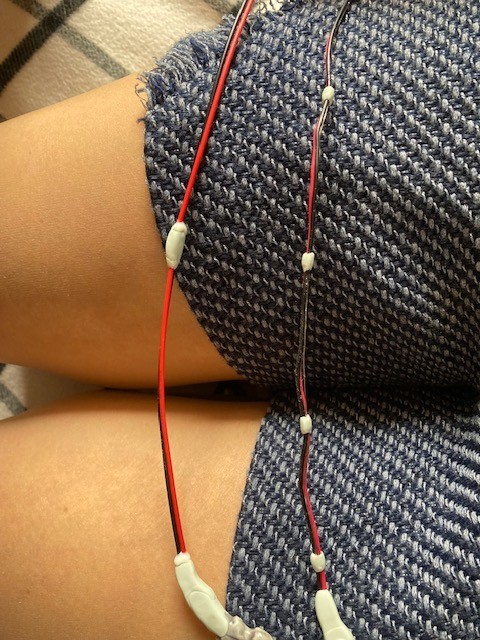
Decorative cable changes did not deliver the same supporting strength
In another entry published in March 2022, Mr. Okada described a striped cable prototype with a slightly less flexible surface. He said it resisted folding somewhat, but still lacked enough stiffness to advance by pushing alone. He distinguished that result from the shape retention of a cable containing supporting wire.
He also rejected nylon-coated wire because, in his assessment, the coating undermined the wire's useful properties. No matching product can be confirmed on the current list. Mr. Okada said wire material and thickness still needed careful evaluation.
(Source: ok-lab's diary, published March 2022)
https://ok-lab.hatenablog.com/entry/2022/03/19/123203
An electrode cable modification produced stimulation the maker considered dangerous
In an entry published in April 2022, a customer reported connecting an electrode chip (a chip delivering electrical stimulation) to a modified external device. The customer described power 1 and a maximum of 3 minutes as their limits, with 2 or above producing overwhelming stimulation. The report also described unpredictable changes in sensation when the chip moved.
The customer said ordinary sensation returned the following day, with no abnormality noticed. Mr. Okada nevertheless suspected urethral injury and warned that an internal burn might go unnoticed. He asked the customer to stop using that electrical device.
(Source: ok-lab's diary, published April 2022)
https://ok-lab.hatenablog.com/entry/2022/04/02/123050
A shorter supported cable was proposed after a pain report
In an entry published in May 2022, a customer reported pain from a 4-line cable (a parallel cable supported by wires on both sides). Mr. Okada attributed pain in his own experience to the cable folding sharply at one point when the urethra shortened. He did not record whether his proposed change resolved this customer's discomfort.
His proposed accordion-shaped version was about 20% shorter: a 15cm cable became approximately 12cm long, with a width around 7mm. Mr. Okada presented that shape as a response to concentrated bending, based on his experience with the cable.
(Source: ok-lab's diary, published May 2022)
https://ok-lab.hatenablog.com/entry/2022/05/28/123218
Wire failures ended sales of several earlier supported cable designs
In an entry published in January 2023, Mr. Okada said sales of the old 4-line, 6-line, and wire-supported loop designs had stopped. Reports of broken wires, or wires appearing close to breaking, prompted those decisions. His revised approach assumed that supporting wires would eventually break.
He therefore stopped connecting the wire directly to the cable or chip and described separate tube-based constructions instead. Mr. Okada cautioned that repeated extreme bending would break the wire and called for replacement before deterioration.
(Source: ok-lab's diary, published January 2023)
https://ok-lab.hatenablog.com/entry/2023/01/07/123115
The maker's answer to DIY prostate chip cables
Mr. Okada's later answers emphasized hidden damage, wire support, and the limits of making a cable thinner.
A damaged cable did not necessarily produce an obvious warning sensation
In an entry published in April 2022, Mr. Okada described his own tests involving a broken supporting wire in a 4-line cable. He reported finding a protruding wire afterward, although the internal sensation had been stretching rather than a sharp prick. This observation formed part of his concern that sensation could give an incomplete picture of damage.
Mr. Okada cautioned against trusting sensation alone as evidence that nothing was wrong.
(Source: ok-lab's diary, published April 2022)
https://ok-lab.hatenablog.com/entry/2022/04/02/123050
Cable repair advice changed after the customer clarified the fault
In an entry published in July 2022, a customer sought further help with a bend close to the chip. The customer explained that earlier advice about shortening the supported section did not fit the construction or the fault's location. Mr. Okada acknowledged the misunderstanding.
His revised answer focused on support within the red and black cable's grooves, with existing wire bends left in place. The diary does not record how the cable behaved after that revised advice. Mr. Okada cautioned that unsupported 0.3mm wire bent easily and could bend again when it lifted away from the cable.
(Source: ok-lab's diary, published July 2022)
https://ok-lab.hatenablog.com/entry/2022/07/16/123031
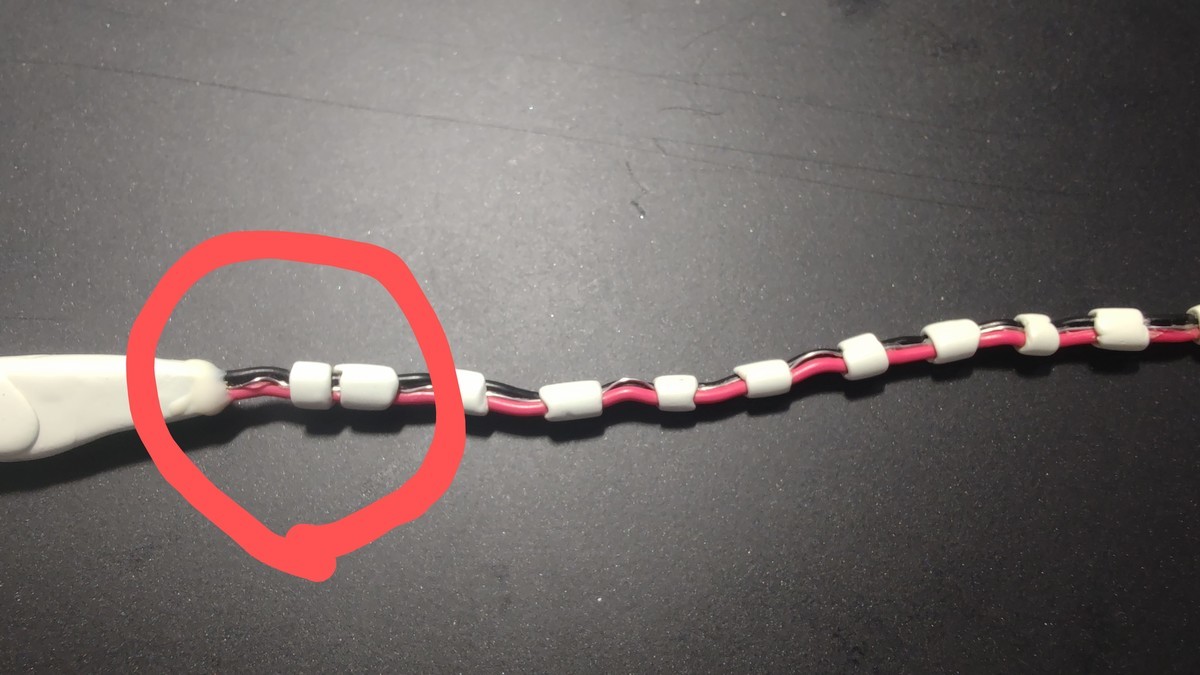
A thinner electrode cable conflicted with the maker's strength requirements
In an entry published in August 2024, a customer asked whether fewer cable leads could make a linked electrode assembly thinner. Mr. Okada replied that separating the joined leads made them extremely weak in his experience. His policy was to use a single separated lead only when it was completely enclosed in resin.
He said the doubled parallel cable measured approximately 2.5mm × 2.5mm, close in size to tubing with a 2.5mm outside diameter. The diary does not record a completed thinner version for this customer. Mr. Okada favored intact parallel cable for an uncovered connection between chips.
(Source: ok-lab's diary, published August 2024)
https://ok-lab.hatenablog.com/entry/2024/08/17/122842
How DIY prostate chip cables changed over time
| Published | What the diary said then |
|---|---|
| Mar 2020 | A switched 3V battery box replaced the plain model's unswitched 1.5v box. |
| Mar 2022 | A rigid return-shaped stopper remained experimental because of urethral loading and chip displacement concerns. |
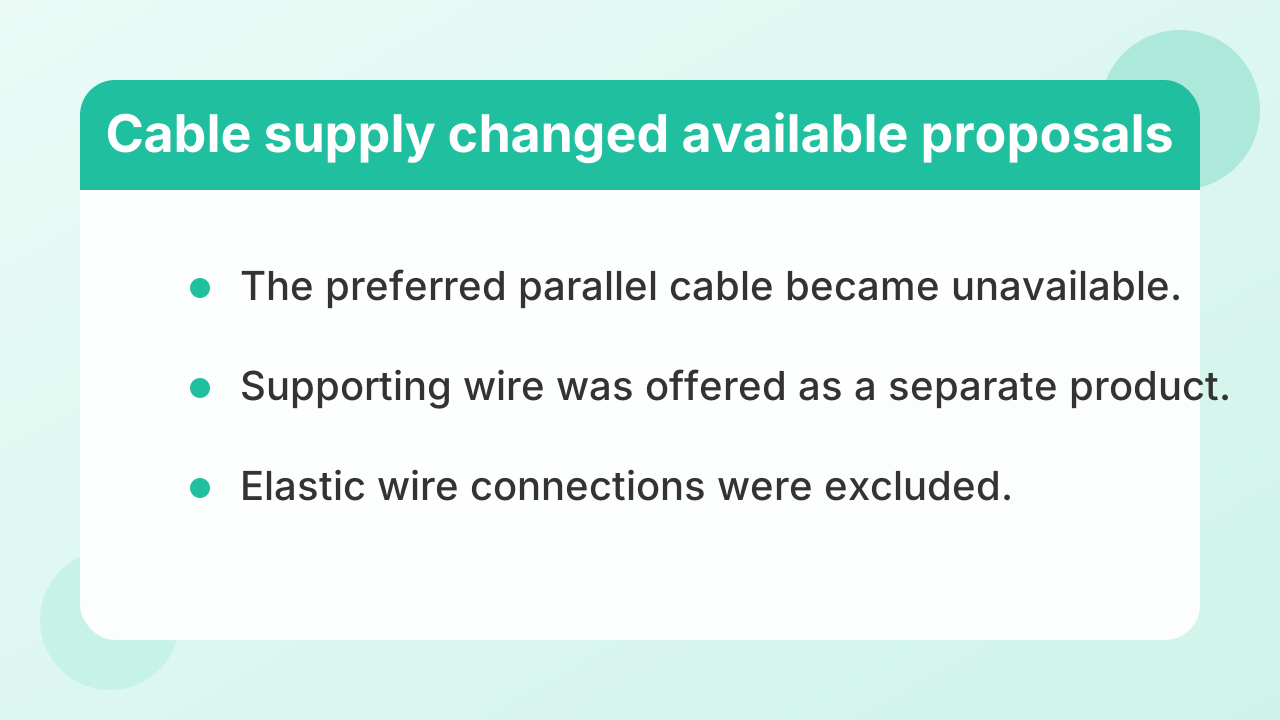
| Nov 2022 | The preferred parallel cable became unavailable, prompting consideration of twisted cable as a substitute. |
| Jan 2023 | The proposed 3-line cable and its supporting wire were offered as separate products. |
| Aug 2024 | Elastic wire connections were excluded from the inexpensive electrode proposal to preserve its low price. |
The diary does not say what the current state is.
OK Prostate Chip products related to DIY prostate chip cables
No current product is directly tied to this topic.
Common worries about DIY prostate chip cables
The reader questions led to conditional offers and reservations, rather than blanket acceptance of homemade cable ideas.
"Can OK Lab connect a homemade cable to my chip?"
In an entry published in November 2022, a reader proposed a homemade twisted cable and asked about sending it to OK Lab. Mr. Okada was willing to consider connecting a supplied cable to a vibrating motor. He said there had been previous cases of customer-supplied cables becoming completed vibrating devices.
The diary does not record whether this reader's proposed build was completed. Mr. Okada generally ruled out attaching supplied cables to chips without motors because the connection could not be soldered. He also reiterated that requests to attach his stock stiff cable to an ordinary chip were refused.
(Source: ok-lab's diary, published November 2022)
https://ok-lab.hatenablog.com/entry/2022/11/26/122622
"Can a replacement cable hold a very sharp bend?"
In an entry published in January 2023, a customer wanted a cable suitable for a 180-degree bend alongside a support garment. Mr. Okada said newer designs using coated, twisted wire were poorly suited to such an extreme bend. He proposed the floating 3-line cable (a parallel cable with a tube for a separate supporting wire).
The diary does not record whether that customer's proposed replacement was completed or how it felt in use. No matching product can be confirmed on the current list. Mr. Okada made wire deterioration and timely replacement explicit cautions in his offer.
(Source: ok-lab's diary, published January 2023)
https://ok-lab.hatenablog.com/entry/2023/01/07/123115
"Can my electrode cable have a 2.5mm plug?"
In an entry published in August 2024, a reader relayed a question about a 2.5mm plug for an external electrical device. Mr. Okada said this connection was not standard because he had not found suitable standalone parts. He offered paid work if a customer supplied a commercially available plug assembly.
The diary does not record a completed connection arising from that question. Mr. Okada also invited information about suitable standalone plug parts.
(Source: ok-lab's diary, published August 2024)
https://ok-lab.hatenablog.com/entry/2024/08/17/122842
"Will stronger wire make a DIY cable more reliable?"
In an entry published in March 2026, a customer suggested a cable-and-wire construction recalling an earlier supported design. Mr. Okada expressed concern that the proposed wire was much stronger than the cable beside it. His reservation concerned the difference between the materials' strengths.
He said OK Lab used that cable-and-wire combination only in a separate design where a cable loop enclosed the wire. The diary does not record a completed prototype of the customer's proposed arrangement. Mr. Okada agreed to consider the suggestion while retaining his concern about the side-by-side construction.
(Source: ok-lab's diary, published March 2026)
https://ok-lab.hatenablog.com/entry/2026/03/14/122910
Buying from outside Japan
OK Lab ships internationally to countries covered by Japan Post's EMS courier service. Overseas orders are paid in advance by PayPal. Each order carries a ¥400 (about $3 at ¥156 = $1, rate as of 2026-09-04) handling fee, and EMS shipping is charged on top. These terms come from OK Lab's official sales-terms page (written here as plain text, not a link: ok-lab.net/docs/law), checked on September 7, 2026; confirm them on the official store before you order, because they can change.
Summary of this article
| What you wanted to know | The answer |
|---|---|
| What is the short answer about DIY cables? | The diary records useful prototype behavior alongside discomfort and wire failures. |
| What is the base product? | A small urethral device made by OK Lab in Japan, with prices in Japanese yen. |
| What do the cable terms mean? | They distinguish joined power leads, supporting wires, and tube-based support arrangements. |
| What happened during development? | Twisted and supported cables were tried; some earlier wire designs were subsequently withdrawn. |
| What did the maker emphasize? | Sensation could miss damage, unsupported wire could bend, and separated leads could lose strength. |
| How did the proposals change over time? | Power arrangements, cable supply, support construction, and cost constraints changed the available proposals. |
| Which current product matches these custom designs? | No current product is directly tied to this topic. |
| Would OK Lab accept a customer's cable idea? | Some proposals received conditional consideration; others were refused or remained unresolved. |
| How do overseas purchases work? | The stated terms require advance PayPal payment, EMS shipping, and a ¥400 (about $3 at ¥156 = $1, rate as of 2026-09-04) handling fee. |
Source: ok-lab's diary (Okada Comfortable Life Laboratory). The original entries are in Japanese; quotations on this page are translated. Photos and videos are on the original entries.
This article is a summary of the maker's development diary. The product is not a medical device and no result is guaranteed. If anything feels wrong or worries you, see a doctor. Prices, specifications and cautions change, so confirm the latest information on the official blog and the official site. Questions about ordering and shipping go to the seller.