![Is a DIY wire prostate chip safe? | The diary records breakage and abandoned designs [OK Prostate Chip]](/img/a/T0868/eyecatch.svg)
This page is based on entries from "ok-lab's diary" (https://ok-lab.hatenablog.com/), the Japanese development diary written by Mr. Okada, founder of OK Lab, a small company in Japan (Okada Comfortable Life Laboratory). Only the entries about "DIY wire prostate chips" are summarized here, in order of publication. Past prices and sizes are as written at the time. Current prices come from the official product list (retrieved September 4, 2026). Quotations are translated from Japanese.
Note: This page is a personal reading log by someone with no connection to the maker or the seller. It reflects the source entries as of their publication dates and makes no guarantee of accuracy or safety. The product is not a medical device; talk to a doctor about any health decision. Check the official site for current information. This page contains advertising.
In short
- DIY wire chip experiments involved breakage risks, a dangerous prototype, and unexplained bleeding.
- Mr. Okada later abandoned direct wire attachment in favor of designs using tubes.
- No matching current product is confirmed for these historical custom builds.
If you see blood in your urine, even a small amount or for the first time, do not wait and see. See a urologist right away. If you suddenly cannot urinate, or the device cannot be removed, do not try to fix it yourself. Go to a medical facility, including emergency care, immediately.
About this product

The OK Prostate Chip is a small device that is placed in the urethra (the urine passage) so that it acts on the prostate; the maker sells it in several shapes, sizes and materials. It is made and sold by OK Lab (Okada Comfortable Life Laboratory), a small company in Japan, through its own online store, and prices are in Japanese yen (JPY). The maker's development diary, "ok-lab's diary", is written in Japanese. This page is an English summary of it, and every quotation is translated. OK Lab ships internationally, so readers outside Japan can order (see "Buying from outside Japan" below). Product names on this page are plain-English descriptions. The official Japanese product name is shown once in the product table so you can find the same item in the store.
Before you read: key terms
| Term | Plain-English meaning |
|---|---|
| Urethra | The urine passage; the location of the chip assemblies described here. |
| DIY wire chip | A homemade assembly using wire to connect chip parts or transmit vibration. |
| Wire stopper | A part matched to wire diameter, intended to limit the prototype's travel. |
| Nylon thread | Thread connecting chip parts; discussed as an additional connection alongside wire. |
| Silicone tube | A flexible hollow sleeve used as a placement aid or to contain wire. |
| Hot-melt glue | Heat-softened adhesive proposed by a customer as a coating for a wire core. |
| Nylon-coated stranded wire | Several wire strands covered with nylon, proposed for connecting ceramic chips. |
What happens: DIY wire prostate chips
The OK Prostate Chip is a device placed in the urethra (the urine passage) to act on the prostate. In these entries, homemade wire assemblies connect chips or carry vibration from an external motor to an internal chip. Other versions use wire inside a silicone tube (a flexible hollow sleeve), with the tube forming part of the urethral assembly. The diary records these experiments and Mr. Okada's responses to breakage.
DIY wire chip coatings raised an unanswered question about nylon thread
In an entry published in October 2019, a customer proposed hot-melt glue (heat-softened adhesive) as a coating over a wire core. The customer reported a smooth surface, but the entry gives no independent assessment of that claim. Mr. Okada was interested, while worrying about compatibility with nylon thread because the resin melted above 100 degrees. He wanted specialist input because resin quality depended on the source material.
(Source: ok-lab's diary, published October 2019)
https://ok-lab.hatenablog.com/entry/2019/10/19/125859
A DIY wire chip prototype traveled dangerously deep without any stopper
In an entry published in October 2021, Mr. Okada described an experimental rotating chip assembly connected to an external motor. He called this custom build a prostate drill. Without a wire stopper (a part intended to limit travel), his first prototype moved past the prostate and deep into the bladder.
Mr. Okada described the result as extremely dangerous. No matching product can be confirmed on the current list. His later proposal included a stopper, but his assessment was only that it might be somewhat safer.
(Source: ok-lab's diary, published October 2021)
https://ok-lab.hatenablog.com/entry/2021/10/09/125823
Unexplained bleeding halted development of the rotating DIY wire chip
In an entry published in October 2021, Mr. Okada reported unexplained bleeding and suspended development of the rotating prototype. He turned instead to a motorless internal chip assembly. No matching product can be confirmed on the current list.
His trial paired this with a German-made ring-shaped vibrator worn at the base of the penis. At that time, he had no plans to sell the featured vibrator. His proposed direction was to let an external device generate vibration while the internal assembly transmitted it.
(Source: ok-lab's diary, published October 2021)
https://ok-lab.hatenablog.com/entry/2021/10/16/125843
A longer DIY wire chip assembly still carried breakage concerns
In an entry published in October 2021, Mr. Okada described a linked chip unit about 8–9 cm long. The design had a rear wire loop of 2–3 cm, intended as a contact point for an external vibrator. He hoped separate, parallel wires between chips would avoid both breaking together; nylon thread provided another connection.
No matching product can be confirmed on the current list. He still acknowledged that wire breakage could not be eliminated.
(Source: ok-lab's diary, published October 2021)
https://ok-lab.hatenablog.com/entry/2021/10/30/125607
Reports of failing metal ended sales of earlier DIY wire designs
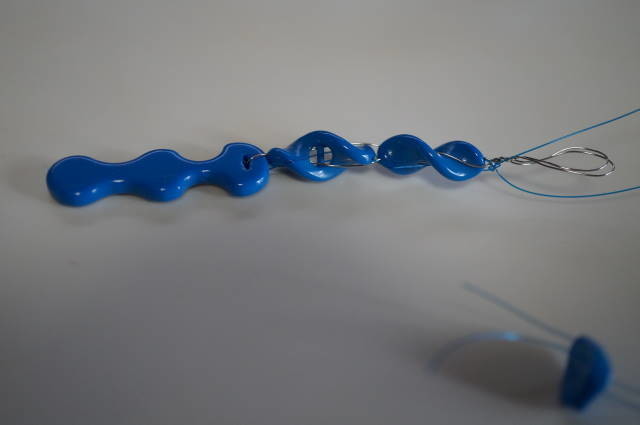
An entry published in January 2023 reported discontinued sales of the old 4-line and 6-line cable designs. The older wire-and-tube chip assembly had also been discontinued. Mr. Okada attributed these decisions to reports of broken wire or wire that appeared close to breaking, despite earlier favorable feedback. His stated starting point for any renewed work was that wire would eventually break.
(Source: ok-lab's diary, published January 2023)
https://ok-lab.hatenablog.com/entry/2023/01/07/123115
The maker's answer to DIY wire prostate chips
Mr. Okada's responses focused on wire failure, additional connections, and eventually separating wire from the chip and cable.
DIY wire chip advice favored smaller diameters than the hole allowed
In an entry published in October 2021, Mr. Okada discussed the blue resin chip's central thread opening. He described it as about 1 mm, able to accommodate wire around 0.7 mm. Because that wire seemed stiff, his preference was 0.5 mm or less, reflecting concern about pressure on the urethra.
The custom wire stopper cost ¥1,000 (about $6 at ¥156 = $1, rate as of 2026-09-04) excluding tax, as published in October 2021, and required the requested wire diameter. No matching product can be confirmed on the current list. His advice then was replacement after every use, because he regarded eventual wire breakage as unavoidable.
(Source: ok-lab's diary, published October 2021)
https://ok-lab.hatenablog.com/entry/2021/10/09/125823
DIY wire chip servicing costs included separate charges for thread
An entry published in October 2021 described servicing for an assembly combining two nylon threads and two wires. The published thread-replacement charge was ¥500 (about $3 at ¥156 = $1, rate as of 2026-09-04) × 3 chips; the wire-replacement charge was also ¥500 (about $3 at ¥156 = $1, rate as of 2026-09-04) × 3 chips. The diary stated a total of ¥3,000 (about $19 at ¥156 = $1, rate as of 2026-09-04) excluding tax.
Mr. Okada explained that extensive twisting could make separating the thread from the wire almost impossible. At publication, testing of the combined assembly's strength was still planned. He proposed replacing both thread and wire after extensive twisting, but only the wire when twisting was limited.
(Source: ok-lab's diary, published October 2021)
https://ok-lab.hatenablog.com/entry/2021/10/16/125843
Twisted DIY wire chip connections resisted breakage without eliminating it
An entry published in October 2021 compared three 0.3 mm wire arrangements: parallel wires, twisted wires, and wires twisted with nylon. Mr. Okada found twisting more resistant to bending and breakage; adding nylon made little apparent difference. His preferred layout kept the connected chips and screw-shaped helper inside the urethra, with only nylon thread outside.
He proposed a replacement interval of 10 uses or roughly 100 hours of accumulated use. He still expected eventual failure, even where twisting made breakage harder. He also called for earlier replacement wherever an extreme bend had developed.
(Source: ok-lab's diary, published October 2021)
https://ok-lab.hatenablog.com/entry/2021/10/23/125707
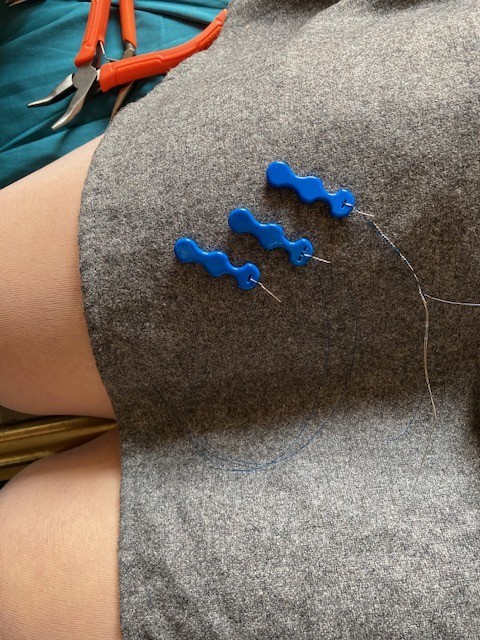
DIY wire chip tubing was damaged by unfinished cut ends
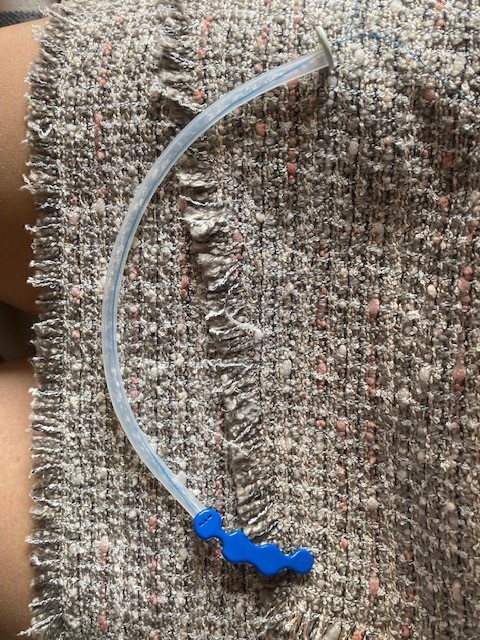
In an entry published in February 2022, Mr. Okada found that cut wire ends punctured or scratched silicone tubing. He offered a prepared set for ¥1,000 (about $6 at ¥156 = $1, rate as of 2026-09-04) excluding tax, as published in February 2022. It contained 25 cm of tubing with a 5 mm outside diameter.
The accompanying wire measured 30 cm long and 0.5 mm in diameter, with ends prepared by the maker. No matching product can be confirmed on the current list. He identified rounded wire ends as necessary after the damage seen in his trial.
(Source: ok-lab's diary, published February 2022)
https://ok-lab.hatenablog.com/entry/2022/02/19/123621
DIY wire chip supply shifted toward tubes without directly attached metal
In an entry published in January 2023, Mr. Okada changed what his company would supply. Wire would no longer be directly attached to the chip or electrical cable. Instead, the offered designs used a hollow tube alone or a tube alongside a cable, leaving wire selection to the customer.
The revised cable used a tube on only one side, because tubes on both sides would make the assembly too large. No matching product can be confirmed on the current list. His accompanying warning remained that repeated extreme bending would eventually break the wire.
(Source: ok-lab's diary, published January 2023)
https://ok-lab.hatenablog.com/entry/2023/01/07/123115
If you see blood in your urine, even a small amount or for the first time, do not wait and see. See a urologist right away. If you suddenly cannot urinate, or the device cannot be removed, do not try to fix it yourself. Go to a medical facility, including emergency care, immediately.
How DIY wire prostate chips changed over time
| Published | What the diary said then |
|---|---|
| Oct 2019 | Resin quality prompted Mr. Okada to consider consulting specialists. |
| Oct 2021 | A stopper-free rotating prototype traveled dangerously deep. |
| Oct 2021 | Hand-held vibration was reported to disperse into the body. |
| Oct 2021 | Twisting resisted breakage better, but failure remained possible. |
| Oct 2021 | A linked assembly added a rear contact loop for external vibration. |
| Feb 2022 | A prepared tubing-and-wire set followed damage from untreated wire ends. |
| Jan 2023 | Sales of older wire designs had stopped after failure reports. |
The diary does not say what the current state is.
OK Prostate Chip products related to DIY wire prostate chips
No current product is directly tied to this topic.
Common worries about DIY wire prostate chips
The reader requests concern motor size, coated wire, and difficulty placing a chip.
"Can DIY wire chips replace a motor that won't fit?"
In an entry published in October 2021, a customer could not accommodate an 8 mm motor. The motor stopped working after a modification exposed much of its metal, and Mr. Okada suspected lost waterproofing. He proposed transmitting vibration from an external motor through wire to a chip.
The diary does not record how this arrangement worked for that customer. Mr. Okada's reply cautioned that stiff wire could put strain on the urethra.
(Source: ok-lab's diary, published October 2021)
https://ok-lab.hatenablog.com/entry/2021/10/09/125823
"Does nylon coating make DIY wire chips more dependable?"
In an entry published in October 2021, a customer wanted ceramic chips without their usual thread. The customer planned a trial with 0.6 mm nylon-coated stranded wire (several wire strands covered with nylon). Mr. Okada said an earlier trial of thinner coated wire had produced no favorable report.
He feared the nylon coating could also fail when the wire broke. The diary does not record how the customer's planned trial turned out. His reply favored a separate nylon thread as an additional connection, because he did not trust the coating alone.
(Source: ok-lab's diary, published October 2021)
https://ok-lab.hatenablog.com/entry/2021/10/23/125707
"Can a DIY wire chip make placement easier?"
In an entry published in February 2022, customers asked for tools that would make chip placement easier. Mr. Okada initially attributed difficulties with manual handling to inexperience and was reluctant to offer such tools. He then reconsidered whether differences between individuals mattered more than practice.
The diary does not record whether those customers found his proposal easier to use. He continued to warn that tools could apply unintended force.
(Source: ok-lab's diary, published February 2022)
https://ok-lab.hatenablog.com/entry/2022/02/19/123621
Buying from outside Japan

OK Lab ships internationally to countries covered by Japan Post's EMS courier service. Overseas orders are paid in advance by PayPal. Each order carries a ¥400 (about $3 at ¥156 = $1, rate as of 2026-09-04) handling fee, and EMS shipping is charged on top. These terms come from OK Lab's official sales-terms page (written here as plain text, not a link: ok-lab.net/docs/law), checked on September 7, 2026; confirm them on the official store before you order, because they can change.
Summary of this article
| What you wanted to know | The answer |
|---|---|
| What is the short answer? | These experiments included breakage risks, bleeding, and abandoned designs. |
| What is the base product? | A device made by OK Lab in Japan for placement in the urethra. |
| What do the key terms mean? | Wire connects parts or carries vibration; thread and tubing serve distinct supporting roles. |
| What happened in the experiments? | The diary records a dangerously deep-moving prototype and later discontinued wire designs. |
| What did the maker propose? | Thinner wire, additional thread connections, maintenance limits, and eventually tubes without directly attached wire. |
| What changed over time? | Entries progressed from material experiments to failures and a changed supply approach by January 2023. |
| Which current product matches? | No current product is directly tied to this topic. |
| What worried customers? | Motor fit, coated-wire durability, and difficulty placing chips. |
| How can someone order from outside Japan? | Advance PayPal payment, a ¥400 (about $3 at ¥156 = $1, rate as of 2026-09-04) handling fee, and additional EMS shipping charges apply. |
Source: ok-lab's diary (Okada Comfortable Life Laboratory). The original entries are in Japanese; quotations on this page are translated. Photos and videos are on the original entries.
This article is a summary of the maker's development diary. The product is not a medical device and no result is guaranteed. If anything feels wrong or worries you, see a doctor. Prices, specifications and cautions change, so confirm the latest information on the official blog and the official site. Questions about ordering and shipping go to the seller.