![Can I glue or repair a prostate chip? | The diary records failures, including surgery [OK Prostate Chip]](/img/a/T0873/eyecatch.svg)
This page is based on entries from "ok-lab's diary" (https://ok-lab.hatenablog.com/), the Japanese development diary
written by Mr. Okada, founder of OK Lab (Okada Comfortable Life Laboratory). Only the entries about "gluing or repairing a prostate chip"
are summarized here, in order of publication. Past prices and sizes are as written at the time. Current prices come from
the official product list (retrieved September 4, 2026). Quotations are translated from Japanese.
Note: This page is a personal reading log by someone with no connection to the maker or the seller. It reflects the source entries as of their publication dates and makes no guarantee of accuracy or safety. The product is not a medical device; talk to a doctor about any health decision. Check the official site for current information. This page contains advertising.
In short
Customers told OK Lab, a small company in Japan, about glue failures that left parts inside the bladder.
Mr. Okada proposed refunds, connection changes and case-specific repairs, while acknowledging unresolved bonding problems.
Related products remain listed, but the diary does not confirm whether the proposed pin redesign reached production.
If you see blood in your urine, even a small amount or for the first time, do not wait and see. See a urologist right away. If you suddenly cannot urinate, or the device cannot be removed, do not try to fix it yourself. Go to a medical facility, including emergency care, immediately.
About this product

The OK Prostate Chip is a small device that is placed in the urethra (the urine passage) so that it acts on the prostate; the maker sells it in several shapes, sizes and materials. It is made and sold by OK Lab (Okada Comfortable Life Laboratory), a small company in Japan, through its own online store, and prices are in Japanese yen (JPY). The maker's development diary, "ok-lab's diary", is written in Japanese. This page is an English summary of it, and every quotation is translated. OK Lab ships internationally, so readers outside Japan can order (see "Buying from outside Japan" below). Product names on this page are plain-English descriptions. The official Japanese product name is shown once in the product table so you can find the same item in the store.
Before you read: key terms
| Term | Plain-English meaning |
|---|---|
| Urethra | The urine passage, where the chip is placed to act on the prostate. |
| Retrieval thread | Thread attached to a chip so it can be pulled out. |
| Epoxy adhesive | A resin-based glue used in the reported joints and proposed coatings. |
| Loop attachment | A loop-based thread connection intended to prevent complete thread detachment. |
| Stopper chip | An accessory intended to prevent retrieval thread being drawn inward. |
| Spring core | A thin spring inside a bendable connection, intended to provide restoring force. |
| Glaze | A ceramic surface coating. Its purpose: The diary does not explain this. |
| Hot-melt adhesive | Glue shaped while hot, proposed as a material for homemade devices. |
| Balloon catheter | A urine-draining tube with a balloon; the customer proposed it as a support for an attachment. |
| Sliding-lock holder (Gatekeeper) | An accessory with a lock and fastening pins. Its full purpose: The diary does not explain this. |
What happens: glue repairs
The OK Prostate Chip is a small device placed in the urethra to act on the prostate. A retrieval thread (a thread used to pull the chip out) is part of the designs discussed here. In these entries, glue appears at thread attachments, connections between parts, and accessory fasteners. Customers also proposed homemade glued devices, while Mr. Okada discussed repairs, manufacturing changes, and unresolved problems with joints coming apart.
Homemade glue failure left one long chip inside the bladder
In an entry published in April 2018, a customer wanted stronger stimulation from a long chip joined to a standard chip. An epoxy adhesive (a resin-based glue) joint failed, leaving the long chip inside the bladder without usable retrieval thread. It emerged a week later, the customer reported, with dark deposits at the glass–resin boundary.
Mr. Okada acknowledged the danger but kept his production resin confidential as manufacturing knowledge. He cautioned that long-chip buyers needed to be prepared for possible hospital treatment.
(Source: ok-lab's diary, published April 2018)
https://ok-lab.hatenablog.com/entry/20180407/1523090115
Peeling glue joints prompted Mr. Okada's offer of a refund
In an entry published in May 2018, a customer asked whether a semi-long glass chip remained usable after its thread attachment changed. The customer reported a gap between resin and glass after 5 minutes of hot-water treatment and cleaning with ethanol. The customer feared that the thread might detach.
Mr. Okada said other customers had also reported thread failures; he had no finished answer to resin peeling. The diary does not record whether this customer returned the chip. Mr. Okada proposed a refund and suggested considering a later product after the detachment concern had been addressed.
(Source: ok-lab's diary, published May 2018)
https://ok-lab.hatenablog.com/entry/20180524/1527153380
A failed homemade glue joint led to surgery
In an entry published in May 2019, a customer described surgery after plastic aquarium tubing separated from a homemade metal urethral device. Seeking something safer, the customer bought a glass stimulation chip (Awakening) but found it too thin for the sensation they wanted. They reported that it broke during cleaning about a week after purchase.
The customer asked Mr. Okada for a thicker product. He apologized for the breakage, but the diary records no later purchase or result. Mr. Okada suggested waiting for ceramic products with fewer size restrictions.
(Source: ok-lab's diary, published May 2019)
https://ok-lab.hatenablog.com/entry/2019/05/04/162111
Prototype glue repairs were followed by separation at another joint
In an entry published in April 2021, a customer reported on a sample with a spring core (a thin spring inside a bendable connection). Although its restoring force suited the customer, the rubber separated from the chip on its first use. After a strong instant-glue repair, the rubber separated from the screw-shaped section on the next use.
Another repair was still under observation when the customer wrote. Mr. Okada said he had not adopted spring cores for further work because the rubber coating was difficult to make evenly. He favored other rubber-coated connections, with the choice depending on where the connection would reach.
(Source: ok-lab's diary, published April 2021)
https://ok-lab.hatenablog.com/entry/2021/04/03/130518
Glue repairs failed again on a loose holder pin
In an entry published in December 2024, a customer reported a loose pin on a sliding-lock holder (Gatekeeper) after 8 or 9 uses. An attempted repair with Konishi Bond Ultra Multi-Purpose SU also separated during boiling. The customer asked which adhesive would hold and proposed a U-shaped pin.
Mr. Okada explained that glue alone held the existing pins, so strong force could dislodge them. He said his metal-use Aron adhesive might also be unreliable. Mr. Okada accepted the suggestion of U-shaped pins for future builds, but the entry does not report a completed redesign.
(Source: ok-lab's diary, published December 2024)
https://ok-lab.hatenablog.com/entry/2024/12/07/122832
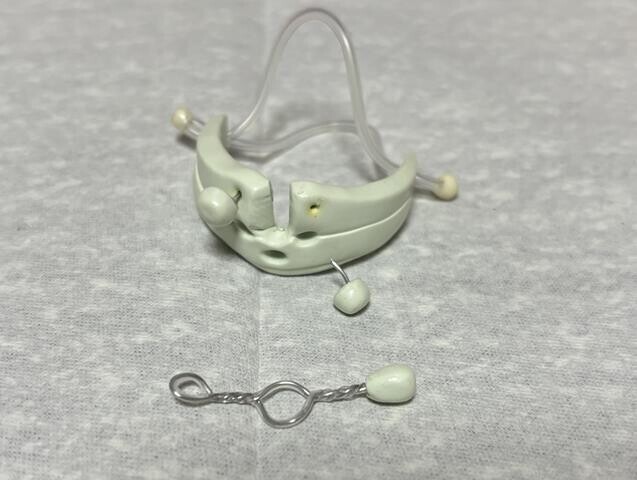
The maker's answer to glue repairs
The maker's responses included refunds and design changes, while proposed adhesive fixes remained tied to individual problems.
Loop attachments addressed thread loss while glue problems remained unresolved
In an entry published in May 2018, Mr. Okada announced loop attachments (loop-based thread connections) for shipments starting May 24. New packaging distinguished these from the earlier connection. He also offered conversion of older attachments, while warning that demand could delay the work.
Some sales had been suspended on May 10, and unmodified products shipped May 10–23 qualified for a requested refund. He believed the loop design resolved complete thread detachment, while resin peeling remained unresolved. Mr. Okada asked customers to wait while he tested further bonding measures.
(Source: ok-lab's diary, published May 2018)
https://ok-lab.hatenablog.com/entry/20180524/1527153380
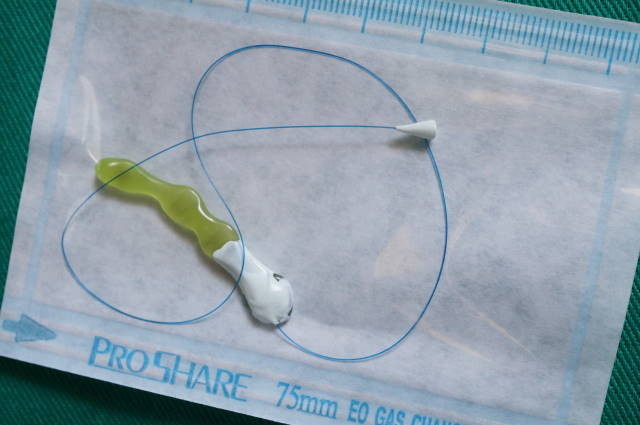
Stopper glue repairs were proposed without a fundamental material fix
In an entry published in June 2018, a customer reported a broken stopper chip (a thread-retaining accessory) despite its increased thickness. The break occurred during work in thick jeans; Mr. Okada described the resin as brittle, with no fundamental fix.
He discussed adhesive reinforcement for a dedicated stopper and tape reinforcement for one shared between chips. Mr. Okada offered pre-bonded stoppers on request with a chip purchase.
(Source: ok-lab's diary, published June 2018)
https://ok-lab.hatenablog.com/entry/20180602/1527922643
Painful resin edges prompted glue repair proposals without a confirmed outcome
In an entry published in June 2018, a customer reported a painful resin edge once a custom chip reached the prostate. They said bleeding sometimes followed, preventing repeated use. Mr. Okada suspected thicker resin, added to address thread loss and peeling, might explain the catching.
He said thinner coatings were no longer an option for those safety measures. He said replacing the thread would require reworking the whole attachment, and might still leave another raised edge. Mr. Okada proposed surface correction or additional epoxy coating, but reported no confirmed solution.
(Source: ok-lab's diary, published June 2018)
https://ok-lab.hatenablog.com/entry/20180630/1530342059
Hot-melt glue proposals raised questions about compatibility with nylon thread
In an entry published in October 2019, a reader described DIY devices made with hot-melt adhesive (glue shaped while hot). Mr. Okada discussed the material as a possible construction option, while noting that it melted above 100 degrees.
His reply did not report a completed chip made from that material. Mr. Okada cautioned about compatibility with nylon thread and proposed consulting specialists about resin quality.
(Source: ok-lab's diary, published October 2019)
https://ok-lab.hatenablog.com/entry/2019/10/19/125859
A catheter attachment proposal left its glue joint unproven
In an entry published in April 2023, a customer proposed an add-on for a balloon catheter (a urine-draining tube with a balloon). Mr. Okada initially saw problems with selling the arrangement, and the customer repeated the request to sell only the attachment. He remained unsure about reliable attachment to silicone tubing.
He thought glue might work, but worried that tied attachments could slip or come off. The diary does not record a completed prototype. Mr. Okada asked for further ideas for a firmly attached part.
(Source: ok-lab's diary, published April 2023)
https://ok-lab.hatenablog.com/entry/2023/04/29/123107
If you see blood in your urine, even a small amount or for the first time, do not wait and see. See a urologist right away. If you suddenly cannot urinate, or the device cannot be removed, do not try to fix it yourself. Go to a medical facility, including emergency care, immediately.
How glue repairs changed over time
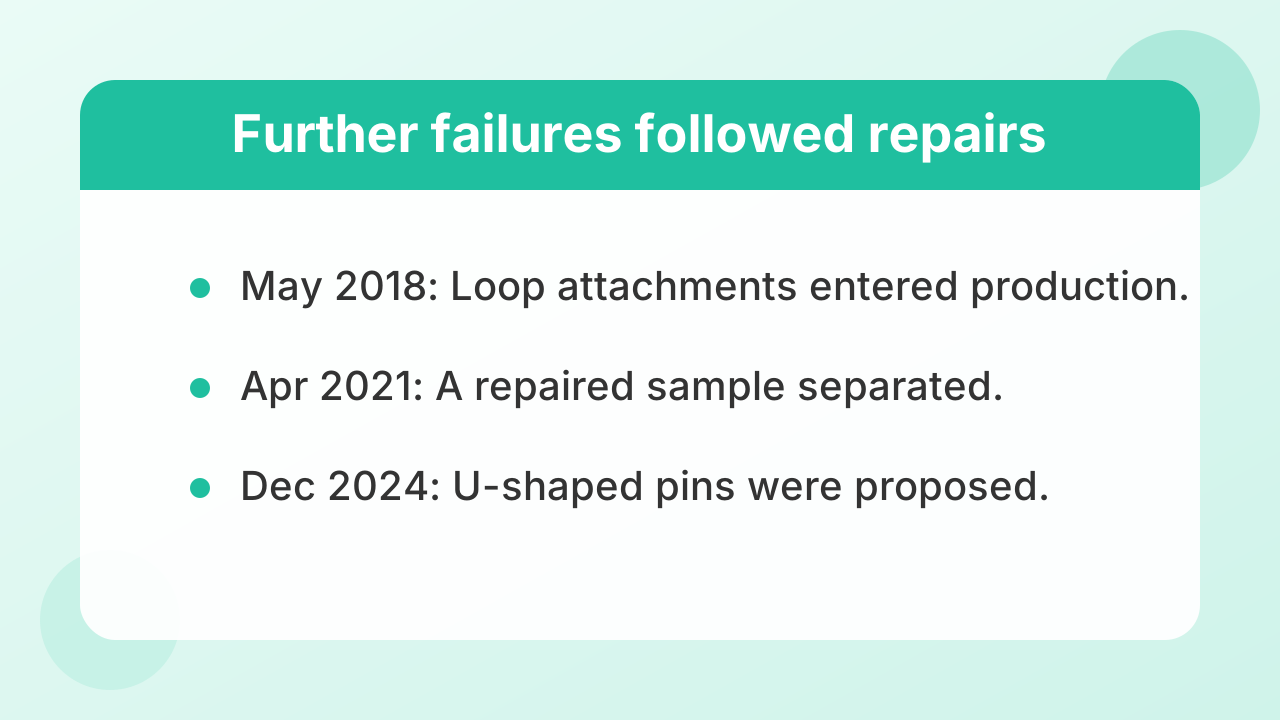
| Published | What the diary said then |
|---|---|
| Apr 2018 | A homemade epoxy joint failed, leaving a long chip inside the bladder. |
| May 2018 | Loop attachments entered production; resin peeling remained unresolved. |
| Jun 2018 | Increased stopper thickness did not prevent another fracture. |
| Jun 2018 | Thicker protective resin was suspected of causing painful catching. |
| May 2019 | Detached aquarium tubing in a homemade device led to surgery. |
| Jun 2019 | A threadless custom resin screw chip was quoted at ¥3,000 (about $19 at ¥156 = $1, rate as of 2026-09-04) excluding tax. |
| Apr 2021 | A repaired spring-core sample separated at another joint. |
| Aug 2022 | Staff favored direct connections over accessory-based modifications for new orders. |
| Dec 2023 | Staff suggested adhesive for a detached sliding lock. |
| Dec 2024 | Mr. Okada proposed U-shaped pins after another fastening failure. |
The diary does not say what the current state is.
OK Prostate Chip products related to glue repairs
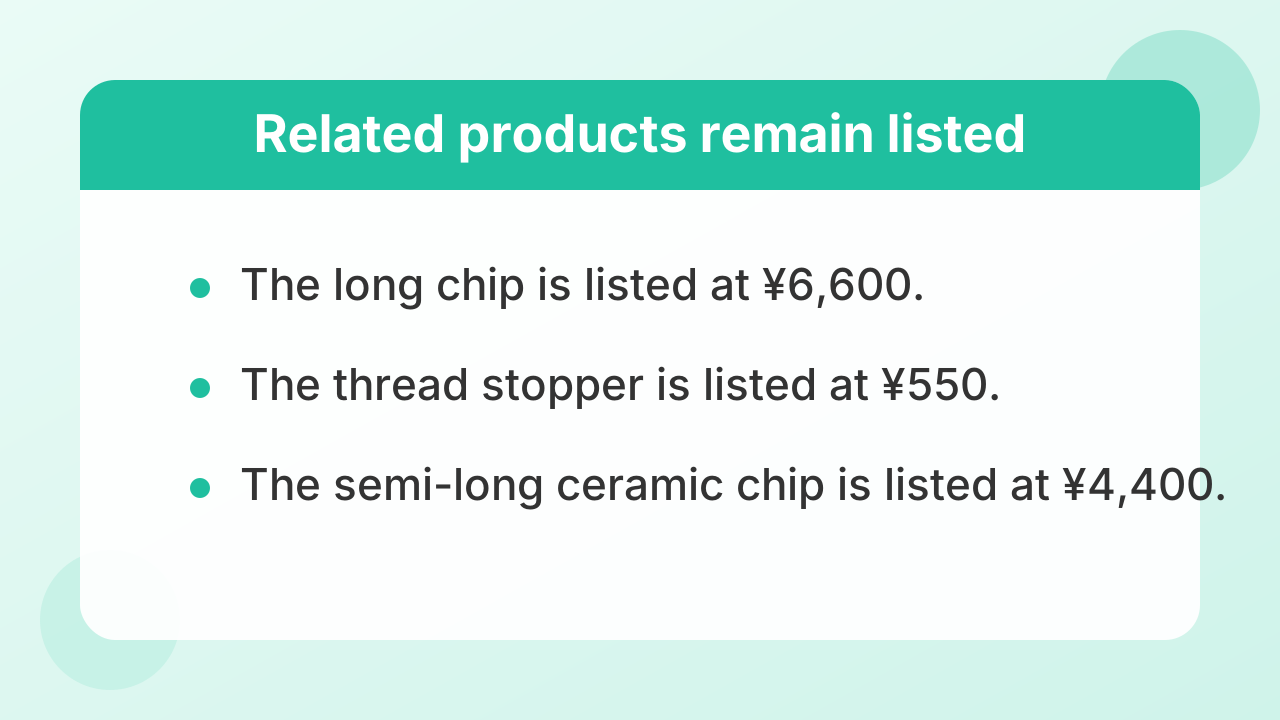
The current list includes products involved in these reports and a ceramic model Mr. Okada suggested waiting for.
Products that appear in these entries
| Product (official name) | Price incl. tax | Relation to this topic |
|---|---|---|
| Long chip (OKプロステートチップ ロングタイプ) | ¥6,600 (about $42 at ¥156 = $1, rate as of 2026-09-04) | April 2018: a customer modified a standard long chip and reported a failed glue joint. |
| Semi-long glass chip (OKプロステートチップ ガラス素材セミロングタイプ) | ¥4,400 (about $28 at ¥156 = $1, rate as of 2026-09-04) | May 2018: a customer reported a gap at its resin-and-glass thread attachment. |
| Thread stopper (OKプロステートチップ用糸飲み込み防止ストッパーチップ) | ¥550 (about $4 at ¥156 = $1, rate as of 2026-09-04) | June 2018: a fracture report prompted reinforcement proposals and a pre-bonded supply option. |
| Glass stimulation chip (OKプロステート覚醒チップ) | ¥5,500 (about $35 at ¥156 = $1, rate as of 2026-09-04) | May 2019: bought after a homemade-device accident, this chip later broke during cleaning. |
| Sliding-lock holder (スライドロック式尿道ゲートキーパー) | ¥6,600 (about $42 at ¥156 = $1, rate as of 2026-09-04) | December 2023: its detached locking part prompted a question about adhesive repair. |
(Source: ok-lab's diary, published April 2018)
https://ok-lab.hatenablog.com/entry/20180407/1523090115
(Source: ok-lab's diary, published May 2018)
https://ok-lab.hatenablog.com/entry/20180524/1527153380
(Source: ok-lab's diary, published June 2018)
https://ok-lab.hatenablog.com/entry/20180602/1527922643
(Source: ok-lab's diary, published May 2019)
https://ok-lab.hatenablog.com/entry/2019/05/04/162111
(Source: ok-lab's diary, published December 2023)
https://ok-lab.hatenablog.com/entry/2023/12/30/122243
Products the diary mentioned as alternatives
| Product (official name) | Price incl. tax | Relation to this topic |
|---|---|---|
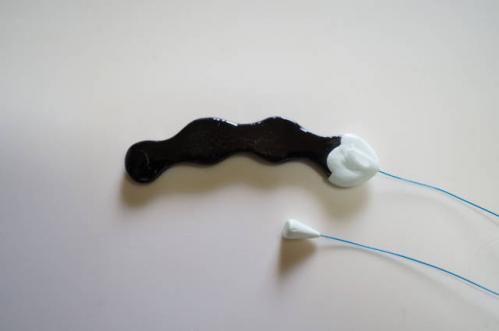
| Semi-long ceramic chip (OKプロステートチップ 陶器素材セミロングタイプ) | ¥4,400 (about $28 at ¥156 = $1, rate as of 2026-09-04) | June 2019: Mr. Okada advised waiting for this instead of commissioning a resin semi-long chip. |
The semi-long ceramic chip is listed in OK Lab's own online store.
(Source: ok-lab's diary, published June 2019)
https://ok-lab.hatenablog.com/entry/2019/06/01/155432
Custom threadless chips, the spring-core sample, the custom resin chip, and the proposed catheter attachment: No matching product can be confirmed on the current list.
Common worries about glue repairs
"Can I order threadless prostate chips for DIY repairs?"
In an entry published in June 2019, a customer asked about ceramic chips without embedded retrieval thread. Mr. Okada first said the unglazed hole needed resin coating, then agreed to supply it bare if its rough finish was acceptable. Glaze (the ceramic's glossy surface coating) was absent there because that area supported the chip during firing.
The customer's threadless resin screw chip was quoted at ¥3,000 (about $19 at ¥156 = $1, rate as of 2026-09-04) excluding tax, without the ¥1,000 (about $6 at ¥156 = $1, rate as of 2026-09-04) excluding tax thread-embedding fee. The diary does not record whether these custom orders were completed. Mr. Okada advised waiting for the semi-long ceramic model and warned that custom ceramic shapes would take longer.
(Source: ok-lab's diary, published June 2019)
https://ok-lab.hatenablog.com/entry/2019/06/01/155432
"Can glue repairs connect my existing chip to tubing?"
In an entry published in August 2022, a customer proposed connecting an existing chip to tubing through a separate safety accessory. Staff said an earlier attempt using that accessory had failed. After a revised adhesive proposal, staff thought the idea might work.
They noted that nylon thread stretched, which could leave the parts loose. They had no plan to modify customers' existing chips; no successful version was recorded. For new orders, staff favored direct connections because they expected lower costs.
(Source: ok-lab's diary, published August 2022)
https://ok-lab.hatenablog.com/entry/2022/08/20/122920
"Will glue repairs fix a detached sliding lock?"
In an entry published in December 2023, a customer asked whether adhesive could repair the sliding-lock holder's detached locking part. Staff suggested Aron Alpha adhesive and said they thought it would secure the part.
The diary does not record whether the repair held in later use. Staff invited the customer to ask again if anything remained unclear.
(Source: ok-lab's diary, published December 2023)
https://ok-lab.hatenablog.com/entry/2023/12/30/122243
Buying from outside Japan

OK Lab ships internationally to countries covered by Japan Post's EMS courier service. Overseas orders are paid in advance by PayPal. Each order carries a ¥400 (about $3 at ¥156 = $1, rate as of 2026-09-04) handling fee, and EMS shipping is charged on top. These terms come from OK Lab's official sales-terms page (written here as plain text, not a link: ok-lab.net/docs/law), checked on September 7, 2026; confirm them on the official store before you order, because they can change.
Summary of this article
| What you wanted to know | The answer |
|---|---|
| The short answer | Glue failures included loose attachments and parts retained inside the bladder. |
| What the product is | A urethral device made and sold by OK Lab in Japan. |
| Which terms matter | Thread attachments, resin joints and accessory fasteners have different roles. |
| What happened | Reports include surgery and further failures after repairs. |
| How the maker responded | Refunds, revised connections and proposed repairs addressed different problems. |
| What changed over time | Loop attachments arrived in May 2018; U-shaped pins were proposed in December 2024. |
| Which products are listed today | The September 2026 list includes relevant chips and accessories. |
| What customer questions reveal | Some custom requests and repair suggestions lack recorded outcomes. |
| How overseas buying works | Advance PayPal payment, a ¥400 (about $3 at ¥156 = $1, rate as of 2026-09-04) handling fee, and additional EMS shipping charges apply. |
Source: ok-lab's diary (Okada Comfortable Life Laboratory). The original entries are in Japanese; quotations on this page are translated. Photos and videos are on the original entries.
This article is a summary of the maker's development diary. The product is not a medical device and no result is guaranteed. If anything feels wrong or worries you, see a doctor. Prices, specifications and cautions change, so confirm the latest information on the official blog and the official site. Questions about ordering and shipping go to the seller.