![An object is stuck in my rectum—what now? | Get medical help immediately [OK Prostate Chip]](/img/a/T0777/eyecatch.svg)
This page is based on entries from "ok-lab's diary" (https://ok-lab.hatenablog.com/), the Japanese development diary written by Mr. Okada, founder of OK Lab, a small company in Japan (Okada Comfortable Life Laboratory). Only the entries about "rectal and anal foreign body cases" are summarized here, in order of publication. Past prices and sizes are as written at the time. Current prices come from the official product list (retrieved September 4, 2026). Quotations are translated from Japanese.
Note: This page is a personal reading log by someone with no connection to the maker or the seller. It reflects the source entries as of their publication dates and makes no guarantee of accuracy or safety. The product is not a medical device; talk to a doctor about any health decision. Check the official site for current information. This page contains advertising.
In short
- The diary describes objects that became stuck during anal masturbation and required hospital treatment.
- Mr. Okada paused an anal-device project after unexplained bleeding during his own testing.
- These entries do not identify a current product for dealing with a retained rectal object.
If you see blood in your urine, even a small amount or for the first time, do not wait and see. See a urologist right away. If you suddenly cannot urinate, or the device cannot be removed, do not try to fix it yourself. Go to a medical facility, including emergency care, immediately.
About this product
The OK Prostate Chip is a small device that is placed in the urethra (the urine passage) so that it acts on the prostate; the maker sells it in several shapes, sizes and materials. It is made and sold by OK Lab (Okada Comfortable Life Laboratory), a small company in Japan, through its own online store, and prices are in Japanese yen (JPY).
The maker's development diary, "ok-lab's diary", is written in Japanese. This page is an English summary of it, and every quotation is translated.
OK Lab ships internationally, so readers outside Japan can order (see "Buying from outside Japan" below). Product names on this page are plain-English descriptions. The official Japanese product name is shown once in the product table so you can find the same item in the store.
Before you read: key terms
| Term | Plain-English meaning |
|---|---|
| Prostate | The chip targets this body part for stimulation; the diary does not explain its normal function. |
| Urethra | The urine passage; the base chip is placed here to act on the prostate. |
| Rectal foreign body | An object lodged in the rectum; the cases here involve objects used for sexual stimulation. |
| U-shaped anal prototype | An experimental device with a bend, intended by the maker to press on the prostate through the bowel wall. |
| Forceps | Medical grasping instruments; clinicians tried them unsuccessfully to retrieve the silicone toy in the September 2018 report. |
| Myoma borer | A surgical instrument used to retrieve that toy; the diary does not explain its usual purpose. |
| General anesthesia | Named in the hospital report as part of treatment. The diary does not explain this. |
| Anoscopy | The examination used to look for an abnormality or bleeding after Mr. Okada's prototype test. |
| Endoscopy | The further internal examination mentioned by his doctor; the diary does not specify which examination was meant. |
| Bowel perforation | A hole in the bowel; this describes an injury, not a device or its purpose. |
What happens: rectal foreign body cases
The OK Prostate Chip is a small device placed in the urethra to act on the prostate. The cases here concern a rectal foreign body (an object lodged in the rectum), following anal masturbation. They involve objects used for sexual stimulation, including a silicone toy that required hospital treatment. The diary also connects one hospital report with Mr. Okada's development of an anal device intended to press on the prostate through the bowel wall.
Rectal foreign body reports described accidents involving several household objects
In an entry published in October 2017, Mr. Okada reproduced a news account describing objects that had become lodged through the anus. Its examples included a bat, a beer bottle, an electric toothbrush, a cucumber, and corn. The account attributed such incidents frequently to accidents during masturbation, although the diary gives no frequency estimate.
The same account described patients giving accidental explanations rather than disclosing the sexual context. It does not give an individual treatment result for each listed object. Mr. Okada discusses embarrassment around the subject, but this passage contains no specific advice for managing a retained object.
(Source: ok-lab's diary, published October 2017)
https://ok-lab.hatenablog.com/entry/20171026/1508989298
A customer described reduced sensation after emergency rectal foreign body treatment
In an entry published in January 2018, a customer described an earlier anal-masturbation accident involving an object that could not be retrieved. The customer reported receiving treatment through the anus at a nighttime emergency service. The diary does not identify that object or date the accident itself.
According to the customer, prostate sensation was largely absent after that treatment, although a doctor had found no abnormality in prostate function. This establishes the sequence the customer reported; the account supplies no medical finding that the treatment caused the change. The customer subsequently tried a urethral chip to explore which sensations remained, and Mr. Okada advised treating the report as an individual experience.
(Source: ok-lab's diary, published January 2018)
https://ok-lab.hatenablog.com/entry/20180118/1516263011
A stuck silicone anal toy required treatment under general anesthesia
In an entry published in September 2018, Mr. Okada summarized a medical case involving a 34-year-old man who sought help. The man could not retrieve a silicone toy used during masturbation; the cone-shaped object measured 30×10cm. An initial outpatient attempt without anesthesia failed, and treatment proceeded under general anesthesia.
Several forceps (medical grasping instruments) could not secure the object for removal. The report described successful removal with a myoma borer (a surgical instrument used for retrieval in this case), without an incision. The supplied passage does not record the patient's later recovery.
(Source: ok-lab's diary, published September 2018)
https://ok-lab.hatenablog.com/entry/20180901/1535779541
A rectal foreign body report influenced an experimental anal-device design
In an entry published in October 2018, Mr. Okada explained how the earlier hospital case had influenced his design thinking. His U-shaped anal prototype (an experimental device with a bend) was intended to press on the prostate through the bowel wall. He thought the gap between its outgoing and returning sections might reach 7-8cm.
He also reported that his own testing had reached about 6cm, describing the bowel wall as stretching readily at that spacing. These were his design estimates and personal observations; the entry does not establish a medically safe size range. No matching product can be confirmed on the current list.
(Source: ok-lab's diary, published October 2018)
https://ok-lab.hatenablog.com/entry/20181005/1538740535
The maker's answer to rectal foreign body cases
The maker emphasized individual experiences, sought assessment for his own bleeding, and paused commercialization while its cause remained unexplained.
Experiences after a stuck anal toy were presented as individual accounts
In an entry published in January 2018, Mr. Okada introduced the customer's feedback as a report shaped by personal circumstances. The customer had obtained a custom short chip about 1cm longer than the usual version. In the account, the larger chip did not produce the hoped-for prostate sensation, and the customer reported little difference from the ordinary short version.
Mr. Okada welcomed the detailed feedback but did not describe the chip as treatment for the customer's reported loss of sensation. No matching product can be confirmed on the current list. Mr. Okada advised reading the report as one person's experience because bodies and sexual sensations differ considerably.
(Source: ok-lab's diary, published January 2018)
https://ok-lab.hatenablog.com/entry/20180118/1516263011

Rectal bleeding prompted a clinic visit without confirming its cause
In an entry published in October 2018, Mr. Okada reports blood on his anal prototype. He also describes dark blood in several spots on his stool the next morning, which prompted a visit to an anal clinic. An anoscopy (an examination of the anal canal) showed neither an abnormality nor active bleeding, according to his account.
He reports that further investigation would require endoscopy (an internal examination), which the doctor did not specifically recommend at that visit. The doctor suspected medicine preventing blood clots, prescribed for his heart disease, might explain the bleeding; the diary does not confirm that cause. According to Mr. Okada, the doctor described bowel perforation (a hole in the bowel) from masturbation with instruments as common and urged caution.
(Source: ok-lab's diary, published October 2018)
https://ok-lab.hatenablog.com/entry/20181013/1539409481
Unexplained rectal bleeding halted the maker's planned anal-prototype release
In the entry published in October 2018, Mr. Okada says the patent application for his anal-device project had just been completed. He nevertheless announced a temporary pause in commercialization. The reason he gave was that his own bleeding remained unexplained.
The supplied entries do not record a later diagnosis or the lifting of that pause. This announcement does not establish that any item on today's product list was permanently discontinued. Mr. Okada's stated condition for offering the prototype for sale was first establishing what had caused his bleeding.
(Source: ok-lab's diary, published October 2018)
https://ok-lab.hatenablog.com/entry/20181013/1539409481
If you see blood in your urine, even a small amount or for the first time, do not wait and see. See a urologist right away. If you suddenly cannot urinate, or the device cannot be removed, do not try to fix it yourself. Go to a medical facility, including emergency care, immediately.
How rectal foreign body cases changed over time
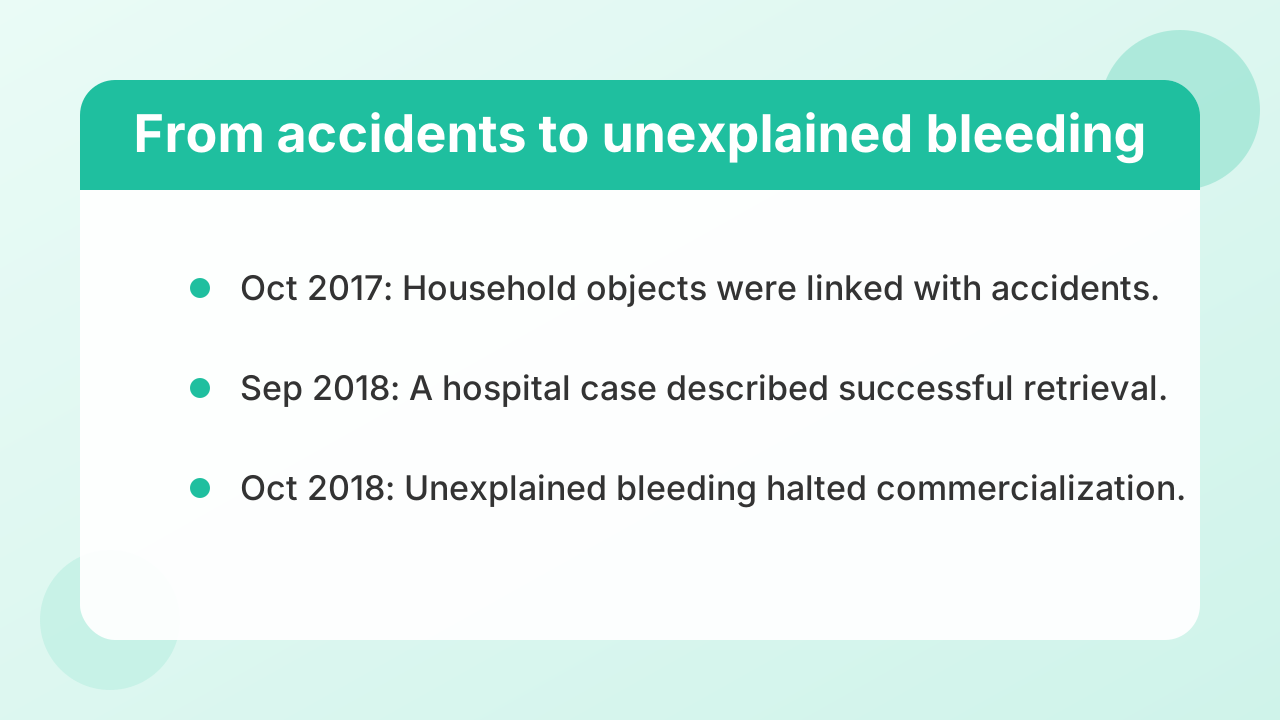
| Published | What the diary said then |
|---|---|
| Oct 2017 | A news account linked retained household objects with masturbation accidents. |
| Jan 2018 | A customer reported reduced sensation after emergency treatment, despite normal prostate function on examination. |
| Sep 2018 | A hospital case described successful retrieval after an initial outpatient attempt failed. |
| Oct 2018 | Mr. Okada applied the earlier case to spacing estimates for an anal prototype. |
| Oct 2018 | Unexplained bleeding led Mr. Okada to pause commercialization after a patent application. |
OK Prostate Chip products related to rectal foreign body cases
No current product is directly tied to this topic.
Common worries about rectal foreign body cases

(The material contains no questions from readers.)
Buying from outside Japan
OK Lab ships internationally to countries covered by Japan Post's EMS courier service. Overseas orders are paid in advance by PayPal. Each order carries a ¥400 (about $3 at ¥156 = $1, rate as of 2026-09-04) handling fee, and EMS shipping is charged on top. These terms come from OK Lab's official sales-terms page (written here as plain text, not a link: ok-lab.net/docs/law), checked on September 7, 2026; confirm them on the official store before you order, because they can change.
Summary of this article
| What you wanted to know | The answer |
|---|---|
| What is the immediate concern? | These accounts include retained objects requiring hospital treatment. |
| What is the base product? | A device made by OK Lab in Japan and placed in the urethra; prices are in JPY. |
| What do the medical terms describe? | Retained objects, hospital retrieval tools, examinations, and possible bowel injury. |
| What happened in the cases? | Reports covered emergency retrieval, a customer's altered sensation, and the maker's experimental design reasoning. |
| How did the maker respond? | He emphasized individual experiences, sought medical assessment, and paused the anal prototype's commercialization. |
| What changed over time? | The supplied entries move from accident reports to development, then an unresolved bleeding concern. |
| Is there a current product for this problem? | No current product is directly tied to this topic. |
| Were reader questions recorded? | The supplied passages contain no reader questions about managing a retained rectal object. |
| How do overseas orders work? | Advance PayPal payment, a ¥400 (about $3 at ¥156 = $1, rate as of 2026-09-04) handling fee, and additional EMS shipping charges apply. |
Source: ok-lab's diary (Okada Comfortable Life Laboratory). The original entries are in Japanese; quotations on this page are translated. Photos and videos are on the original entries.
This article is a summary of the maker's development diary. The product is not a medical device and no result is guaranteed. If anything feels wrong or worries you, see a doctor. Prices, specifications and cautions change, so confirm the latest information on the official blog and the official site. Questions about ordering and shipping go to the seller.