![Where are the seminal vesicles, and can a chip stimulate them? | The maker proposes indirect pressure [OK Prostate Chip]](/img/a/T0776/eyecatch.svg)
This page is based on entries from "ok-lab's diary" (https://ok-lab.hatenablog.com/), the Japanese development diary written by Mr. Okada, founder of OK Lab, a small company in Japan (Okada Comfortable Life Laboratory). Only the entries about "seminal vesicle location and stimulation" are summarized here, in order of publication. Past prices and sizes are as written at the time. Current prices come from the official product list (retrieved September 4, 2026). Quotations are translated from Japanese.
Note: This page is a personal reading log by someone with no connection to the maker or the seller. It reflects the source entries as of their publication dates and makes no guarantee of accuracy or safety. The product is not a medical device; talk to a doctor about any health decision. Check the official site for current information. This page contains advertising.
In short
- Mr. Okada describes paired seminal vesicles behind the bladder and proposes reaching them indirectly through pressure.
- His diary warns that strong pressure and prolonged bladder vibration may carry health risks.
- The supplied current list includes the short ceramic chip used as a component in a paired-chip example.
If you see blood in your urine, even a small amount or for the first time, do not wait and see. See a urologist right away. If you suddenly cannot urinate, or the device cannot be removed, do not try to fix it yourself. Go to a medical facility, including emergency care, immediately.
About this product
The OK Prostate Chip is a small device that is placed in the urethra (the urine passage) so that it acts on the prostate; the maker sells it in several shapes, sizes and materials. It is made and sold by OK Lab (Okada Comfortable Life Laboratory), a small company in Japan, through its own online store, and prices are in Japanese yen (JPY).
The maker's development diary, "ok-lab's diary", is written in Japanese. This page is an English summary of it, and every quotation is translated.
OK Lab ships internationally, so readers outside Japan can order (see "Buying from outside Japan" below). Product names on this page are plain-English descriptions. The official Japanese product name is shown once in the product table so you can find the same item in the store.
Before you read: key terms
| Term | Plain-English meaning |
|---|---|
| Urethra | The urine passage, where the maker describes the chip being placed to act on the prostate. |
| Prostate | The body structure the chip targets. Its normal function: The diary does not explain this. |
| Seminal vesicles | Paired structures Mr. Okada describes as holding semen and lying behind the bladder. |
| Bladder | The organ beside the seminal vesicles in Mr. Okada's account. Its normal function: The diary does not explain this. |
| Internal urethral sphincter | The boundary Mr. Okada discusses between the prostate region and bladder. Its normal function: The diary does not explain this. |
| Paired-chip connection | A wire joining two chips, intended to provide support and transmit spring pressure between them. |
| Nitinol | The shape-memory wire used in the movable prototype; it provides a flexible connection and carries vibration. |
What happens: seminal vesicle stimulation
The OK Prostate Chip is a small device placed in the urethra (urine passage) to act on the prostate. Mr. Okada places the seminal vesicles (paired structures he describes as holding semen) behind the bladder, near the prostate. His proposed designs aim to stimulate them indirectly from inside the bladder, with pressure or vibration passing through its wall. The accounts include his personal theories and customer reports of devices moving completely into the bladder.
Seminal vesicle location inspired a wider chip proposal in July 2018
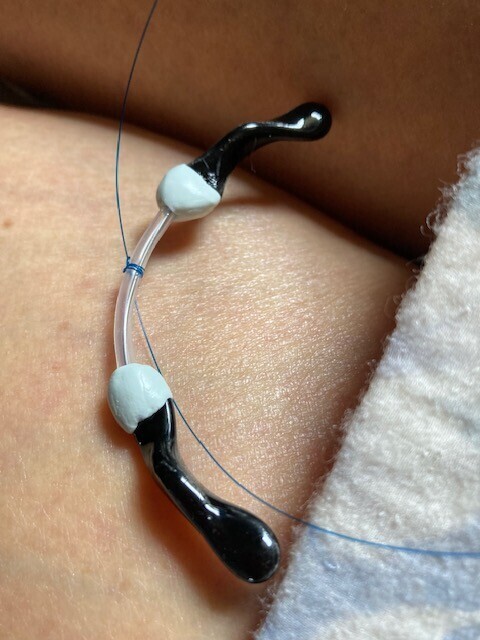
In an entry published in July 2018, Mr. Okada explained that a side-view drawing can make the two seminal vesicles look like one. He proposed that a chip's wider, horizontal head might affect areas near both structures. His idea concerned the ends of a wide-headed chip (Cobra), rather than a reported result from a customer.
He also expected that its shape would contact different areas from an earlier flat chip. He did not know which shape would work better. The diary does not record whether the proposed effect near both vesicles was confirmed.
(Source: ok-lab's diary, published July 2018)
https://ok-lab.hatenablog.com/entry/20180721/1532152353
Seminal vesicle stimulation became a bladder-side proposal in April 2024
In an entry published in April 2024, Mr. Okada described a new idea after examining a rotating anatomical illustration. He thought pressure from the bladder side might affect the seminal vesicles, rather than pressure coming only from the bowel side. He suggested this might make ejaculation easier to trigger, while questioning whether it could exert enough pressure to expel semen.
The proposed device used long chips joined by a paired-chip connection (a wire linking two chips). The diary does not record a completed test of that proposal in this April passage.
(Source: ok-lab's diary, published April 2024)
https://ok-lab.hatenablog.com/entry/2024/04/27/122924
Seminal vesicle stimulation weakened when Mr. Okada's test device moved deeper
In an entry published in May 2024, Mr. Okada reported testing a paired-chip device more than 10 cm long. He said deeper placement produced almost no sensation, while a less-deep position restored a strong sensation that he attributed to the vesicles.
He associated that sensation with an area 1-2 cm from the internal urethral sphincter (the boundary he describes beside the bladder). He thought deeper placement took the tip away from the relevant structures. His account also describes the device moving farther into the bladder without him noticing. Mr. Okada warned that forceful pressure on the vesicles could involve unknown health problems.
(Source: ok-lab's diary, published May 2024)
https://ok-lab.hatenablog.com/entry/2024/05/04/122911
Seminal vesicle stimulation remained limited with earlier bladder loop designs
In an entry published in May 2025, Mr. Okada distinguished bladder stimulation from the effect he wanted near the seminal vesicles. He reported that the loop-only design (Chipless) affected the bladder but apparently did not reach the vesicles.
He also described a pressure chip (Alien) intended to act from the bladder side. In his view, even successful contact would affect only one vesicle, rather than both together. He therefore proposed a design with separate side loops to address that limitation.
(Source: ok-lab's diary, published May 2025)
https://ok-lab.hatenablog.com/entry/2025/05/10/122936
A retained cord report left the presumed seminal vesicle stimulation unconfirmed
An entry published in May 2025 records a customer's call about a vibrating chip's cord that could not be removed. The customer said roughly 30 cm was inside the bladder. Mr. Okada suspected tangling, but no removal or treatment outcome was recorded.
Subsequent orders were handled by other staff, who did not establish how the incident ended. His suggestion that the cord might have pressed near the vesicles was his speculation about this incident. Mr. Okada advised the customer to see a doctor.
(Source: ok-lab's diary, published May 2025)
https://ok-lab.hatenablog.com/entry/2025/05/10/122936
Another bladder entry incident did not establish successful seminal vesicle stimulation
The entry published in May 2025 also describes a separate customer whose entire loop-only device, about 20 cm long, entered the bladder. Mr. Okada speculated that the object might have exerted pressure near the vesicles.
The supplied passage gives no reply addressed specifically to this customer and no account of removal. Mr. Okada warned against a whole device disappearing beyond reach inside the bladder.
(Source: ok-lab's diary, published May 2025)
https://ok-lab.hatenablog.com/entry/2025/05/10/122936
Seminal vesicle stimulation prompted a flexible vibrating prototype in February 2026
In an entry published in February 2026, Mr. Okada described a movable connection between a ceramic chip and a motor. The connection used nitinol (shape-memory wire), which he said carried vibration to the chip. He proposed that vibration through the bladder wall could affect nearby vesicles even without pressure aimed directly at them.
He reported stronger apparent vibration at the ceramic tip than at the motor. The prototype supported 8 mm and 10 mm motors. Mr. Okada excluded the 6 mm motor because he doubted the reliability of its wire connection.
(Source: ok-lab's diary, published February 2026)
https://ok-lab.hatenablog.com/entry/2026/02/14/121602
The maker's answer to seminal vesicle stimulation
Mr. Okada proposed different shapes and connections while acknowledging unresolved design questions and possible health risks.
Seminal vesicle location remained his explanation for differences in sensation
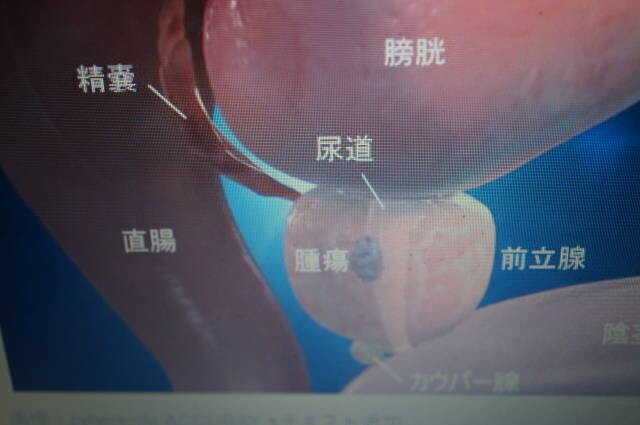
In a separate passage published in May 2024, Mr. Okada explained how a three-dimensional illustration changed his understanding of the anatomy. He described the vesicles as almost meeting beside the internal urethral sphincter, then separating farther away. That was his explanation for a concentrated area of sensation.
He also thought the vesicles responded more strongly to new pressure than to continued contact. He attributed stimulation to poking or compression, rather than a chip merely passing alongside them. Mr. Okada encouraged learning from anatomical views that could be examined from different angles.
(Source: ok-lab's diary, published May 2024)
https://ok-lab.hatenablog.com/entry/2024/05/04/122911
Stronger seminal vesicle stimulation made one spring-loaded design unsuitable for prolonged placement
In an entry published in May 2024, Mr. Okada compared different arrangements of the paired-chip design. He described a stronger spring-loaded arrangement as producing pressure too intense for leaving in place for long periods.
By contrast, he described an arrangement using two flat, curved chips as more stable and less intense. That comparison concerned his experience with those particular arrangements. Mr. Okada limited his claim about stronger pressure to theoretical feasibility because he considered the possible health consequences unknown.
(Source: ok-lab's diary, published May 2024)
https://ok-lab.hatenablog.com/entry/2024/05/04/122911
Seminal vesicle stimulation proposals carried separate connection charges in May 2024
The entry published in May 2024 priced the paired-chip connection separately from the chips themselves. A bare-wire connection cost ¥3,000 (about $19 at ¥156 = $1, rate as of 2026-09-04) tax excluded, in addition to the prices of both chips.
A connection with a tube cover cost ¥4,000 (about $26 at ¥156 = $1, rate as of 2026-09-04) tax excluded, again in addition to both chips. The cover made the connection more than 1 mm thicker than the bare-wire version. Mr. Okada favored bare wire when a thinner connection was wanted.
(Source: ok-lab's diary, published May 2024)
https://ok-lab.hatenablog.com/entry/2024/05/04/122911
Paired side loops became his proposed answer for seminal vesicle stimulation
In an entry published in May 2025, Mr. Okada proposed a bladder loop with paired side loops, nicknamed the bladder mouse. His intended contact area was just beyond the internal urethral sphincter; the side loops were intended to face the bladder's rear.
His prototype had a bladder loop of about 3 cm and side loops of about 2.5 cm. Prices were ¥4,000 (about $26 at ¥156 = $1, rate as of 2026-09-04) for the ordinary loop, ¥2,000 (about $13 at ¥156 = $1, rate as of 2026-09-04) for both side loops, and ¥6,000 (about $38 at ¥156 = $1, rate as of 2026-09-04) for the combined design, all tax excluded. Mr. Okada said further investigation was needed into suitable loop sizes, bending angles and opening directions.
(Source: ok-lab's diary, published May 2025)
https://ok-lab.hatenablog.com/entry/2025/05/10/122936
Seminal vesicle stimulation prototypes gained another processing charge in February 2026
In an entry published in February 2026, the movable connection was available only with ceramic chips. Its added processing fee was ¥4,000 (about $26 at ¥156 = $1, rate as of 2026-09-04) tax excluded for short and semi-long ceramic versions. The ceramic chip (Awakening) and long version carried a ¥5,000 (about $32 at ¥156 = $1, rate as of 2026-09-04) tax-excluded processing fee.
These charges were additional to the existing vibrating chip price. The standard ceramic chip was 10 mm shorter than the usual vibrating version, although Mr. Okada also described longer options. Mr. Okada cautioned that strong bladder vibration, or continuing it for a long time, might harm health.
(Source: ok-lab's diary, published February 2026)
https://ok-lab.hatenablog.com/entry/2026/02/14/121602
If you see blood in your urine, even a small amount or for the first time, do not wait and see. See a urologist right away. If you suddenly cannot urinate, or the device cannot be removed, do not try to fix it yourself. Go to a medical facility, including emergency care, immediately.
How seminal vesicle stimulation changed over time
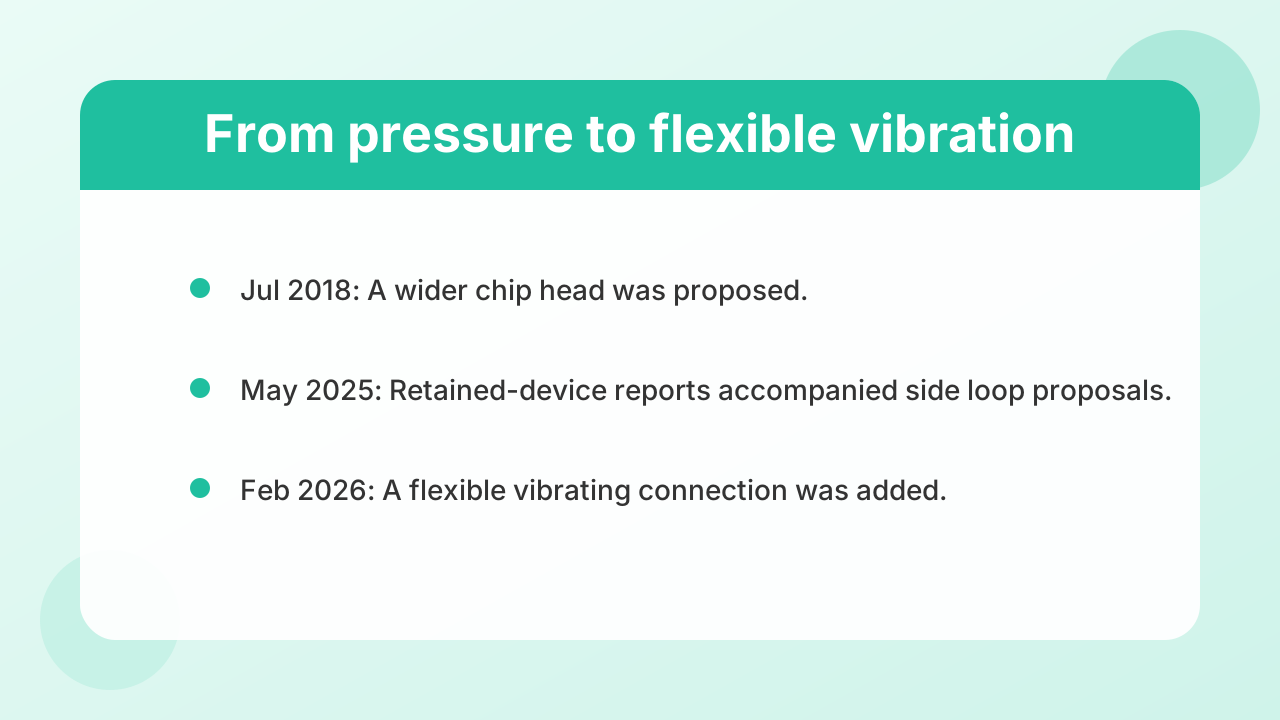
| Published | What the diary said then |
|---|---|
| Jul 2018 | A wider chip head was proposed to affect areas near both vesicles. |
| Apr 2024 | Rotating anatomical views prompted a proposal for pressure from the bladder side. |
| May 2024 | Personal tests linked deeper placement with fading sensation, according to Mr. Okada. |
| May 2024 | Connection choices carried separate charges beyond the prices of both chips. |
| May 2025 | Retained-device reports accompanied proposals for paired side loops. |
| Feb 2026 | A flexible vibrating connection added another approach, with cautions about intensity and duration. |
The diary does not say what the current state is.
OK Prostate Chip products related to seminal vesicle stimulation
The short ceramic chip appears in a May 2024 paired-device example and is on the supplied current list.
Products that appear in these entries

| Product (official name) | Price incl. tax | Relation to this topic |
|---|---|---|
| Short ceramic chip (OKプロステートチップ 陶器素材ショートタイプ) | ¥3,300 (about $21 at ¥156 = $1, rate as of 2026-09-04) | In May 2024, Mr. Okada described this component in a paired-chip arrangement that he found stable. |
(Source: ok-lab's diary, published May 2024)
https://ok-lab.hatenablog.com/entry/2024/05/04/122911
Products the diary mentioned as alternatives
The diary names no alternative.
For the complete historical designs and custom assemblies described above: No matching product can be confirmed on the current list.
Common worries about seminal vesicle stimulation
(The material contains no questions from readers.)
Buying from outside Japan
OK Lab ships internationally to countries covered by Japan Post's EMS courier service. Overseas orders are paid in advance by PayPal. Each order carries a ¥400 (about $3 at ¥156 = $1, rate as of 2026-09-04) handling fee, and EMS shipping is charged on top. These terms come from OK Lab's official sales-terms page (written here as plain text, not a link: ok-lab.net/docs/law), checked on September 7, 2026; confirm them on the official store before you order, because they can change.
Summary of this article
| What you wanted to know | The answer |
|---|---|
| In short: what is the claim? | Mr. Okada proposes indirect pressure near the vesicles and acknowledges possible health risks. |
| About this product: what is it? | A device made in Japan, placed in the urethra to act on the prostate. |
| Key terms: what are seminal vesicles? | Mr. Okada describes paired structures behind the bladder that hold semen. |
| What happens: what do the accounts establish? | They record personal sensations, proposed explanations and separate customer incidents with missing outcomes. |
| The maker's answer: what changed in his designs? | He explored spring pressure, paired loops and flexible vibration while retaining cautions. |
| Changed over time: what period is covered? | July 2018 through February 2026; present status is not established for the custom designs. |
| Products: what is on the current list? | The short ceramic component is ¥3,300 (about $21 at ¥156 = $1, rate as of 2026-09-04) including tax; that does not price a complete custom assembly. |
| Common worries: were reader questions supplied? | No reader questions appear in the supplied passages. |
| Buying abroad: what terms are stated? | Japan Post's EMS courier service, advance PayPal payment, a ¥400 (about $3 at ¥156 = $1, rate as of 2026-09-04) handling fee and additional shipping. |
Source: ok-lab's diary (Okada Comfortable Life Laboratory). The original entries are in Japanese; quotations on this page are translated. Photos and videos are on the original entries.
This article is a summary of the maker's development diary. The product is not a medical device and no result is guaranteed. If anything feels wrong or worries you, see a doctor. Prices, specifications and cautions change, so confirm the latest information on the official blog and the official site. Questions about ordering and shipping go to the seller.