![Why won't the chip go around the bend? | The maker links fit to shape and individual differences [OK Prostate Chip]](/img/a/T0772/eyecatch.svg)
This page is based on entries from "ok-lab's diary" (https://ok-lab.hatenablog.com/), the Japanese development diary written by Mr. Okada, founder of OK Lab, a small company in Japan (Okada Comfortable Life Laboratory). Only the entries about "internal urethral length and the perineal curve" are summarized here, in order of publication. Past prices and sizes are as written at the time. Current prices come from the official product list (retrieved September 4, 2026). Quotations are translated from Japanese.
Note: This page is a personal reading log by someone with no connection to the maker or the seller. It reflects the source entries as of their publication dates and makes no guarantee of accuracy or safety. The product is not a medical device; talk to a doctor about any health decision. Check the official site for current information. This page contains advertising.
In short
Mr. Okada links difficult passage to the urethral curve and differences between bodies.
His proposed designs address support, rigid length, and pressure around the bend.
The latest supplied entry describes short tests of a cushioning tube, without establishing a universal fit.
If you see blood in your urine, even a small amount or for the first time, do not wait and see. See a urologist right away. If you suddenly cannot urinate, or the device cannot be removed, do not try to fix it yourself. Go to a medical facility, including emergency care, immediately.
About this product

The OK Prostate Chip is a small device that is placed in the urethra (the urine passage) so that it acts on the prostate; the maker sells it in several shapes, sizes and materials. It is made and sold by OK Lab (Okada Comfortable Life Laboratory), a small company in Japan, through its own online store, and prices are in Japanese yen (JPY).
The maker's development diary, "ok-lab's diary", is written in Japanese. This page is an English summary of it, and every quotation is translated.
OK Lab ships internationally, so readers outside Japan can order (see "Buying from outside Japan" below). Product names on this page are plain-English descriptions. The official Japanese product name is shown once in the product table so you can find the same item in the store.
Before you read: key terms
| Term | Plain-English meaning |
|---|---|
| Urethra | The urine passage; the chip and rods discussed here occupy parts of it. |
| Prostate | The organ the chip is intended to act on through pressure from within, according to the maker. |
| Perineum | The body region used to locate the bend and support. The diary does not explain this. |
| Sphincter | A structure before the prostate, used as a reference for reach and pressure. The diary does not explain this. |
| Pubic bone | The anatomical landmark used as the starting reference for Mr. Okada's length estimate. The diary does not explain this. |
| Urologist | A doctor named as a source of care for urethral problems. The diary does not explain this. |
| Urethral sound | A rod-shaped urethral device, also called a bougie, intended here to guide or support a chip. |
| Perineal support bar | An external curved component intended to support the arrangement and indicate the internal rod's position, according to Mr. Okada. |
| Baseplate | The external support plate; the diary describes it as holding the assembly against the body. |
| Silicone-metal rod | The maker's relatively stiff rod construction, intended to retain its shape and support predictable positioning. |
| Six-hole connector | A small joining part proposed to connect the chip's tube tail and rod. |
| Stopper | A component intended to limit movement, discussed here as part of the tube-tail design. |
| Tube tail | Tubing around a chip's thread, proposed to cushion the thread near the bend and sphincter. |
What happens: chip fit around the urethral curve
The OK Prostate Chip is a small urethral device intended to act on the prostate through pressure from within, according to its maker. Mr. Okada describes an internal route with a bend near the perineum (the body region he uses as a reference). He uses its length and shape to explain chip fit and the purpose of internal rods and external supports.
A swan-shaped prototype failed to follow the urethral curve in resin

An entry published in February 2023 described Mr. Okada's swan-shaped hook prototype, intended to act as an anchor inside the body. He reported that the resin version did not reach its intended position at the prostate. He suspected that compression made the urethral route less slippery than usual.
He reported successful placement with glass, but breakage remained a concern because of the forces on this connected design. Ceramic was under consideration; the diary does not record a completed ceramic hook in this paragraph. Mr. Okada advised against the glass hook for customers despite his own test result.
(Source: ok-lab's diary, published February 2023)
https://ok-lab.hatenablog.com/entry/2023/02/04/122938
Mr. Okada linked pain to movement around the urethral curve
In an entry published in April 2023, Mr. Okada reported pain during prolonged tests of a rigid urethral sound (a rod-shaped urethral device). These tests lacked a perineal support bar (the external curved support). He blamed large sideways movements when the baseplate (the external support plate) shifted.
He described substantial movement up and down as well, although the rod itself retained its shape. He believed the support bar established a fixed relationship between the external component and internal rod. Mr. Okada favored this support arrangement as a way to judge the rod's position from outside the body.
(Source: ok-lab's diary, published April 2023)
https://ok-lab.hatenablog.com/entry/2023/04/08/122508
Mr. Okada found longer tips beyond the urethral curve harder to place
In an entry published in May 2023, Mr. Okada discussed an S-shaped rod intended to stabilize a chip. He estimated 10 cm ± 2 cm from below the pubic bone (the starting landmark) to near the sphincter (his reference before the prostate). That estimate concerned the internal route, while he described much larger differences in external penis length.
Mr. Okada wrote that a longer rigid tip could reach the prostate but became increasingly difficult to place. He reported that the rod's role had shifted from holding the penis centrally in the plate to supporting stable chip placement. His preferred design combined a relatively short S-shaped rod with a flexible connection to the chip.
(Source: ok-lab's diary, published May 2023)
https://ok-lab.hatenablog.com/entry/2023/05/27/122912
A urethral curve prototype had separate rigid and soft section prices
An entry published in June 2023 introduced prices for a combined rigid-and-soft urethral sound. The rigid section could be specified up to 10 cm and cost ¥2,500 (about $16 at ¥156 = $1, rate as of 2026-09-04), tax excluded. The twist version was ¥3,000, (about $19 at ¥156 = $1, rate as of 2026-09-04) while soft sections cost ¥500 (about $3 at ¥156 = $1, rate as of 2026-09-04), tax excluded, per 1.5 cm.
Soft lengths came in 1.5 cm increments, and the combined length limit was 22 cm. No matching product can be confirmed on the current list. Mr. Okada limited orders to that total length because he considered longer builds difficult to make.
(Source: ok-lab's diary, published June 2023)
https://ok-lab.hatenablog.com/entry/2023/06/03/121955
The maker's answer to chip fit around the urethral curve
Mr. Okada's proposals changed from external support to shorter rigid sections and cushioning around the thread.
The early urethral curve explanation focused on direction and support
In an entry published in July 2021, Mr. Okada reproduced a draft instruction sheet explaining resistance before the prostate. It described an upward bend of approximately 90 degrees, a few centimeters before the sphincter. Its proposed response focused on support from the perineum to guide direction.
The draft also stated that its claimed effects were not guaranteed. It included warnings about bleeding and people who could not seek care for urethral problems. Mr. Okada's draft advised medical consultation for people already receiving treatment or feeling physically unwell.
(Source: ok-lab's diary, published July 2021)
https://ok-lab.hatenablog.com/entry/2021/07/24/125923
A shorter urethral sound was Mr. Okada's more cautious proposal
In an entry published in April 2023, Mr. Okada described a silicone-metal rod of about 10 cm overall, ending around the perineum. He called this his safest proposal, but qualified it as based on his body and acknowledged that others might need more length. The diary does not record safety testing in other people.
The same entry offered custom lengths up to about 12 cm at the 10 cm price, with longer ones at the 20 cm price. It listed standard lengths of 10 cm, 20 cm, and 25 cm, without stating yen amounts in this paragraph. Mr. Okada preferred the shape-holding silicone-metal construction over flexible tubing because he believed its position was more predictable.
(Source: ok-lab's diary, published April 2023)
https://ok-lab.hatenablog.com/entry/2023/04/08/122508
A urethral curve design combined stiffness inside with flexibility farther out
In an entry published in June 2023, Mr. Okada proposed giving different parts of the rod different properties. He argued that keeping a straight, soft rod bent through 90 degrees could burden the urethra during prolonged placement. His proposed internal section instead held an S-shaped curve.
For the section within the externally hanging penis, he favored softness because that part of the body changes direction. He contrasted this with the previous design, whose rigid section extended about 2 cm beyond the plate. Mr. Okada therefore proposed a combined rod with a rigid internal section and a flexible outer section.
(Source: ok-lab's diary, published June 2023)
https://ok-lab.hatenablog.com/entry/2023/06/03/121955
A tube tail addressed pressure near the urethral curve in short tests
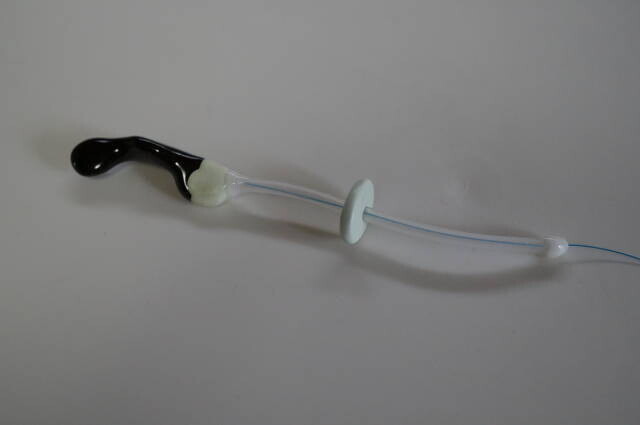
In an entry published in November 2023, Mr. Okada reported sphincter strain after about a day with a directly connected gourd-shaped rod and chip. He then described a tube tail (tubing around the chip's thread), initially about 15 mm long, with a smaller dedicated six-hole connector (a joining part). His later idea used a longer tail and stopper without depending on the rod.
He claimed that 2.5 mm tubing around the thread at the sphincter and 90-degree bend almost eliminated the surrounding urethral burden. In his short tests, 4 mm tubing felt pressuring, while the narrower tube was barely noticeable; longer-term stability remained under discussion. Mr. Okada favored the gentler tail design at that point while acknowledging that further testing was needed.
(Source: ok-lab's diary, published November 2023)
https://ok-lab.hatenablog.com/entry/2023/11/18/122841
If you see blood in your urine, even a small amount or for the first time, do not wait and see. See a urologist right away. If you suddenly cannot urinate, or the device cannot be removed, do not try to fix it yourself. Go to a medical facility, including emergency care, immediately.
How chip fit around the urethral curve changed over time

| Published | What the diary said then |
|---|---|
| Jul 2021 | Draft instructions attributed difficult passage to an upward bend before the sphincter. |
| Feb 2023 | Resin hook placement failed; glass raised breakage concerns. |
| Apr 2023 | Staff declined to promise customer fit or sell the hook with a pulling-effect claim. |
| May 2023 | Mr. Okada explained why the support plate extended below its central opening. |
| May 2023 | The rod's purpose shifted toward chip stability rather than fixing the penis centrally. |
| Jun 2023 | A combined rigid-and-soft rod introduced different properties along its length. |
| Nov 2023 | Short tube-tail tests addressed pressure from the thread around the bend. |
OK Prostate Chip products related to chip fit around the urethral curve

The current list confirms the ceramic chip a customer named, but not the custom rod configurations discussed here.
Products that appear in these entries
| Product (official name) | Price incl. tax | Relation to this topic |
|---|---|---|
| Ceramic stimulation chip (OKプロステートチップ 陶器素材覚醒タイプ) | ¥5,500 (about $35 at ¥156 = $1, rate as of 2026-09-04) | An April 2023 customer asked about combining this chip with a custom rod to reach the prostate; no completed fit is recorded. |
The ceramic stimulation chip is listed in OK Lab's own online store.

(Source: ok-lab's diary, published April 2023)
https://ok-lab.hatenablog.com/entry/2023/04/08/122508
Products the diary mentioned as alternatives
The diary names no alternative.
Swan-shaped hook, custom silicone-metal rods, and experimental tail assembly: No matching product can be confirmed on the current list.
Common worries about chip fit around the urethral curve

The customer questions concern buying a fitted hook, choosing a length, and understanding the body's route.
"Can I buy a hook fitted to my urethral curve?"
In an entry published in April 2023, a customer asked to buy the earlier hook intended to draw the prostate forward. OK Lab's staff replied that repeated prototypes had produced a shape fitting the developer's body. Staff said making an equivalent fit for customers was essentially impractical.
They considered customer shaping as a possible sales arrangement, but said any pulling effect would then depend on chance. The diary does not record whether this customer bought a different product. Staff's answer was that they could not sell the hook on the promise of that effect.
(Source: ok-lab's diary, published April 2023)
https://ok-lab.hatenablog.com/entry/2023/04/08/122508
"What urethral sound length would reach the prostate?"
In a follow-up question published in April 2023, the customer asked about a flat rod combined with the ceramic stimulation chip. They wanted a suitable length and asked how much adjustment the external support could provide. Mr. Okada's 12 cm curved configuration did not hook the prostate; he said a longer tip became extremely difficult to place.
He did not provide a measured adjustment range for the external support. The diary does not record how the proposed combination fitted or felt for this customer. Mr. Okada said depth from perineum to sphincter varied greatly and advised individual judgment based on past experience.
(Source: ok-lab's diary, published April 2023)
https://ok-lab.hatenablog.com/entry/2023/04/08/122508
"Does the urethral curve run straight inward from its start?"
In an entry published in May 2023, a customer said the external support system's diagrams had not made its arrangement clear. Mr. Okada replied with a video and described a route first traveling downward, then curving inward around the perineum. He said the plate extended about 4 cm below its central opening to support the portion near the body's surface.
He also credited the perineal bar and lower support tube with improving stability by giving the arrangement a clearer path. The diary does not record whether the explanation resolved this customer's difficulty. Mr. Okada preferred the plate version with a wider opening, which he said made positioning easier.
(Source: ok-lab's diary, published May 2023)
https://ok-lab.hatenablog.com/entry/2023/05/06/123024
Buying from outside Japan

OK Lab ships internationally to countries covered by Japan Post's EMS courier service. Overseas orders are paid in advance by PayPal. Each order carries a ¥400 (about $3 at ¥156 = $1, rate as of 2026-09-04) handling fee, and EMS shipping is charged on top. These terms come from OK Lab's official sales-terms page (written here as plain text, not a link: ok-lab.net/docs/law), checked on September 7, 2026; confirm them on the official store before you order, because they can change.
Summary of this article
| What you wanted to know | The answer |
|---|---|
| What is the short answer? | Mr. Okada reports a curved route and individual differences, without a universal fit. |
| What is this product? | A urethral device made by OK Lab in Japan, sold through its own online store in JPY. |
| What do the terms mean? | The internal rod, external support, and tube tail have different intended roles. |
| Why might the chip not follow the curve? | The diary describes bends, difficult rigid shapes, and movement during testing. |
| What did the maker propose? | External support, shorter rigid sections, combined materials, and cushioning around the thread. |
| What changed over time? | The entries moved from a bend explanation to prototypes addressing fit and pressure. |
| Which current product appears? | The customer's named ceramic chip is ¥5,500 (about $35 at ¥156 = $1, rate as of 2026-09-04) incl. tax. |
| What did customers ask? | Whether a fitted hook was sold, what length was needed, and how the support arrangement worked. |
| How does overseas buying work? | Advance PayPal payment, a ¥400 (about $3 at ¥156 = $1, rate as of 2026-09-04) handling fee, and additional Japan Post EMS shipping charges. |
Source: ok-lab's diary (Okada Comfortable Life Laboratory). The original entries are in Japanese; quotations on this page are translated. Photos and videos are on the original entries.
This article is a summary of the maker's development diary. The product is not a medical device and no result is guaranteed. If anything feels wrong or worries you, see a doctor. Prices, specifications and cautions change, so confirm the latest information on the official blog and the official site. Questions about ordering and shipping go to the seller.