![Does medical-grade mean this chip is safe? | The diary gives no scientific guarantee [OK Prostate Chip]](/img/a/T0760/eyecatch.svg)
This page is based on entries from "ok-lab's diary" (https://ok-lab.hatenablog.com/), the Japanese development diary written by Mr. Okada, founder of OK Lab, a small company in Japan (Okada Comfortable Life Laboratory). Only the entries about "using medical devices as evidence of safety" are summarized here, in order of publication. Past prices and sizes are as written at the time. Current prices come from the official product list (retrieved September 4, 2026). Quotations are translated from Japanese.
Note: This page is a personal reading log by someone with no connection to the maker or the seller. It reflects the source entries as of their publication dates and makes no guarantee of accuracy or safety. The product is not a medical device; talk to a doctor about any health decision. Check the official site for current information. This page contains advertising.
In short
The diary records safety concerns despite the maker's use of materials associated with medical devices.
Mr. Okada describes design changes but acknowledges that the complete device lacked a scientific safety guarantee.
The latest supplied entry announces coated wire and a policy against direct nitinol (nickel-titanium alloy) contact with skin.
If you see blood in your urine, even a small amount or for the first time, do not wait and see. See a urologist right away. If you suddenly cannot urinate, or the device cannot be removed, do not try to fix it yourself. Go to a medical facility, including emergency care, immediately.
About this product

The OK Prostate Chip is a small device that is placed in the urethra (the urine passage) so that it acts on the prostate; the maker sells it in several shapes, sizes and materials. It is made and sold by OK Lab (Okada Comfortable Life Laboratory), a small company in Japan, through its own online store, and prices are in Japanese yen (JPY). The maker's development diary, "ok-lab's diary", is written in Japanese. This page is an English summary of it, and every quotation is translated. OK Lab ships internationally, so readers outside Japan can order (see "Buying from outside Japan" below). Product names on this page are plain-English descriptions. The official Japanese product name is shown once in the product table so you can find the same item in the store.
Before you read: key terms
| Term | Plain-English meaning |
|---|---|
| Urethra | The urine passage; the chip occupies part of it to act on the prostate. |
| Suture thread | Surgical thread for stitching or tying tissue; the maker uses it to connect chip parts. |
| Epoxy resin | A resin used to secure chip connections; the diary questions its suitability for prolonged bodily contact. |
| Silicone | Material used for outer tubes and coatings intended to separate metal from the body's lining. |
| Catheter | A medical tube; the diary describes its use during hospital care and heart examinations. |
| Pessary | A support placed in the vagina to support a dropped uterus, cited as a silicone comparison. |
| Guidewire | A thin wire that guides a catheter during a medical examination. |
| Nitinol | A nickel-titanium alloy used for flexible connections and as a possible replacement for nylon thread. |
| Biocompatible | The maker's term for suitability to remain in the body; he uses it when discussing material selection. |
What happens: urethral device safety
The OK Prostate Chip is a small device placed inside the urethra to act on the prostate. In these entries, the safety discussion concerns connecting threads, joint materials, and coverings that can contact the lining of the urethra. Mr. Okada draws reassurance from materials used in surgery and medical devices, while correspondents question whether those comparisons apply to his product. The exchanges address both the materials themselves and problems with the finished assembly.
Surgical thread supported Mr. Okada's early urethral device safety claims
In an entry published in October 2017, Mr. Okada described nylon suture thread (surgical thread for stitching or tying tissue). The connecting thread measured about 0.2 mm, and he said one continuous length linked all the chip parts. He argued that suitability for stitches also meant comfortable contact with the urethral lining.
He described the connected structure as protection against parts separating, including after damage. Connecting lengths were planned in 1 cm increments, with production after an order. Mr. Okada asked customers to choose lengths according to their circumstances.
(Source: ok-lab's diary, published October 2017)
https://ok-lab.hatenablog.com/entry/20171009/1507521149
An adviser challenged medical-grade safety claims about the original materials
In an entry published in October 2018, Mr. Okada recalled an adviser questioning the materials used at launch. The adviser regarded only the surgical nylon thread as carrying guaranteed safety and wanted a surgical-stainless-steel version.
Mr. Okada said that version had not yet been produced. His proposed response was a condom barrier around the chip, drawing reassurance from the medical-device status of the covering and thread.
(Source: ok-lab's diary, published October 2018)
https://ok-lab.hatenablog.com/entry/20181027/1540618195
An adviser warned that condom coverings could undermine urethral device safety
In an entry published in January 2019, an adviser challenged the proposed condom covering for contact inside the urethra and bladder. The adviser distinguished suitability for external or vaginal contact from suitability inside the urinary system. They warned that knots could harbor bacteria and loose edges could catch inside the bladder, potentially requiring surgery.
They also warned that chemicals from the chip's materials could pass through the covering, which added infection and detachment risks. Mr. Okada still regarded single use as fairly safe, based on medical-device examples he had read about. His caution concerned reuse, which he agreed could allow bacteria to collect.
(Source: ok-lab's diary, published January 2019)
https://ok-lab.hatenablog.com/entry/2019/01/26/152042
Hospital examples supported Mr. Okada's silicone safety argument about prolonged contact
In an entry published in November 2023, Mr. Okada identified the covering as silicone (the material used for the flexible outer tube). He drew reassurance from the silicone catheter (a medical tube used during hospital care) used during his own hospitalization. He also cited a pessary (a vaginal support for a dropped uterus), another example of prolonged silicone contact.
These comparisons led him to expect few problems from prolonged contact with the body's lining. Mr. Okada's practical caution concerned friction, even while he expressed confidence in silicone.
(Source: ok-lab's diary, published November 2023)
https://ok-lab.hatenablog.com/entry/2023/11/11/122638
Unexpected movement raised urethral device safety concerns about a ceramic prototype
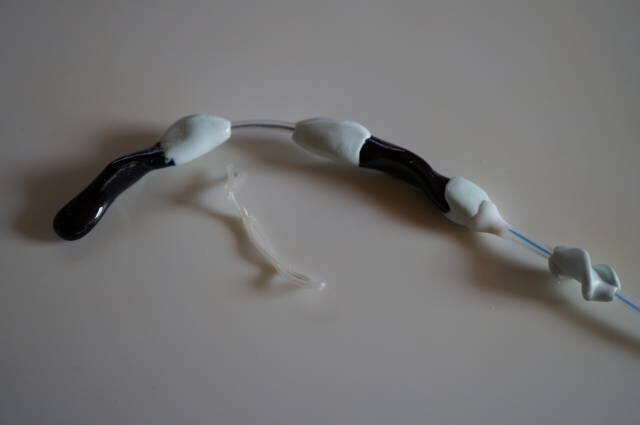
An entry published in March 2024 describes Mr. Okada testing a ceramic pair connected by elastic nickel-titanium wire. He reported that slight force moved the prototype more than 3 cm toward the bladder, beyond his intended position. He attributed the unexpected movement to its very low resistance and warned that it might not stay reliably in place.
The connection also depended on epoxy resin (a resin used to secure parts), which he said could become unstable if cracked. No matching product can be confirmed on the current list. Mr. Okada said sales would follow further use tests and tests for wire breakage or cracked connections.
(Source: ok-lab's diary, published March 2024)
https://ok-lab.hatenablog.com/entry/2024/03/16/123023
Medical guidewires inspired nitinol safety expectations during early connection tests
In an entry published in October 2024, Mr. Okada drew inspiration from guidewires (thin wires used to guide catheters during heart examinations). He chose 0.3 mm nitinol (a nickel-titanium alloy) wire after reading that some medical guidewires were about 0.25 mm thick. He described an encouraging connection test and hoped the wire could replace nylon thread.
He also wrote that his search found retained-wire accidents but no breakage examples. No matching product can be confirmed on the current list. Mr. Okada said he would proceed cautiously with development and testing.
(Source: ok-lab's diary, published October 2024)
https://ok-lab.hatenablog.com/entry/2024/10/12/122911
The maker's answer to urethral device safety
The maker changed connections and added barriers, while acknowledging that the complete device lacked a scientific safety guarantee.
An epoxy failure prompted changes to urethral device safety features
In an entry published in December 2018, a prospective buyer asked whether glass connections could pull apart and anal chips could break. Mr. Okada confirmed that an epoxy connection had pulled apart and said the glass attachment had been changed to a thread-secured design. He believed the revised connection would hold.
For the anal device, he described a wire core compensating for limited flexibility, while acknowledging that cracks remained possible. The diary does not record the buyer's later experience with either device. Mr. Okada favored surgical thread because he considered it gentler on the body's lining.
(Source: ok-lab's diary, published December 2018)
https://ok-lab.hatenablog.com/entry/20181222/1545459719
Allergy concerns led to a stronger nitinol safety policy
In an entry published in September 2025, Mr. Okada acknowledged that some people could develop allergies to nitinol despite its medical uses. He relayed a supplier's warning that nickel could escape from cut surfaces. His proposed solution was a silicone coating intended to keep metal from directly contacting the urethral lining.
Coated 0.1 mm and 0.15 mm wires could remain 0.3 mm or less thick, he reported. He described little change in flexibility and expected the coating to withstand ordinary friction. Mr. Okada stated a policy against offering products whose nitinol wire directly touched skin.
(Source: ok-lab's diary, published September 2025)
https://ok-lab.hatenablog.com/entry/2025/09/06/122911

Silicone safety options had different prices and fit limits
In that September 2025 entry, Mr. Okada listed thin silicone coating over the whole wire at no extra charge. Thicker coating cost ¥500 (about $3 at ¥156 = $1, rate as of 2026-09-04) excluding tax per 5 cm, as published that month. He described thicker sections as an option intended to reduce the wire's tendency to press into sensitive tissue.
He also warned that these sections would not pass through accessory-chip holes. No matching product can be confirmed on the current list. Mr. Okada advised choosing thicker coating according to the intended application.
(Source: ok-lab's diary, published September 2025)
https://ok-lab.hatenablog.com/entry/2025/09/06/122911
If you see blood in your urine, even a small amount or for the first time, do not wait and see. See a urologist right away. If you suddenly cannot urinate, or the device cannot be removed, do not try to fix it yourself. Go to a medical facility, including emergency care, immediately.
How urethral device safety changed over time
| Published | What the diary said then |
|---|---|
| Oct 2017 | Mr. Okada based reassurance on surgical thread and connected parts. |
| Oct 2018 | A condom barrier was proposed after an adviser questioned material safety. |
| Dec 2018 | A reported failed connection prompted a different glass attachment. |
| Jan 2019 | An adviser challenged the covering's infection, detachment, and material-protection assumptions. |
| May 2021 | Resin-free titanium connections were under development; a safe wearing duration remained unestablished. |
| Nov 2022 | Mr. Okada acknowledged he could not compare alternative cable coverings' safety. |
| Nov 2023 | Silicone tubes: 4 mm outside, 2 mm inside; or 2 mm outside, 1 mm inside. |
| Mar 2024 | A ceramic prototype moved unexpectedly toward the bladder. |
| Oct 2024 | Nitinol was proposed to address breakage in an earlier wire core. |
| Sep 2025 | A coating and direct-contact policy addressed remaining metal-allergy concerns. |
The diary does not say what the current state is.
OK Prostate Chip products related to urethral device safety
No current product is directly tied to this topic.
Common worries about urethral device safety
The questions concern contamination, prolonged wear, and the choice of a silicone covering.
"Does a condom covering improve urethral device safety?"
In an entry published in November 2018, a reader questioned contamination during preparation of a condom covering and the loss of glass's surface benefits. Mr. Okada accepted that preparation could introduce bacteria, despite his confidence in a barrier against contamination from fingers. He also favored the lubricant supplied inside a sealed condom, treating the package's medical-device status as reassurance.
The diary does not record whether that reader tried the proposal or what happened afterward. His recommendation favored sealed packaging and less direct handling.
(Source: ok-lab's diary, published November 2018)
https://ok-lab.hatenablog.com/entry/20181103/1541231588
"Do medical materials establish long-term safety without symptoms?"
In an entry published in May 2021, a customer asked whether one month of continuous wear was safe without pain, bleeding, or other symptoms. Mr. Okada described about one week as his own limit, based on personal experience. He considered the surgical thread biocompatible (suitable for remaining in the body), but said the connecting epoxy lacked that recognition despite relative stability.
His answer provided no scientific guarantee for the device at that time. The diary does not record whether the customer attempted a month or experienced problems. Mr. Okada left duration to personal judgment and responsibility; his experience did not establish a guaranteed safe wearing period.
(Source: ok-lab's diary, published May 2021)
https://ok-lab.hatenablog.com/entry/2021/05/01/130245
"Does catheter use settle silicone safety against cheaper coverings?"
In an entry published in November 2022, a reader asked why silicone was chosen over cheaper cable coverings and proposed a twisted-cable design. Mr. Okada cited medical catheters as his main reason, but said he could not compare the materials' safety.
He was willing to consider supplied cable for a motorized device, subject to construction concerns. The diary does not record whether this proposal became a completed order. Mr. Okada ruled out the proposed non-motorized connection and said he declined stiff-cable requests for those chips.
(Source: ok-lab's diary, published November 2022)
https://ok-lab.hatenablog.com/entry/2022/11/26/122622
Buying from outside Japan

OK Lab ships internationally to countries covered by Japan Post's EMS courier service. Overseas orders are paid in advance by PayPal. Each order carries a ¥400 (about $3 at ¥156 = $1, rate as of 2026-09-04) handling fee, and EMS shipping is charged on top. These terms come from OK Lab's official sales-terms page (written here as plain text, not a link: ok-lab.net/docs/law), checked on September 7, 2026; confirm them on the official store before you order, because they can change.
Summary of this article
| What you wanted to know | The answer |
|---|---|
| What is the short answer? | Medical-device comparisons did not resolve the safety concerns recorded in these entries. |
| What is the product? | A small urethral device made and sold by OK Lab in Japan. |
| What do the terms mean? | Threads connect parts; resin secures joints; silicone provides a covering. |
| What happened in the diary? | Reassuring material comparisons appeared alongside warnings and unexpected prototype behavior. |
| What did the maker change? | Connections, wire coverings, and the policy on direct metal contact. |
| How did the discussion develop? | It moved from surgical-thread reassurance to concerns about assemblies, duration, movement, and allergies. |
| Which current product answers this worry? | No current product is directly tied to this topic. |
| What did readers ask? | Whether coverings, symptom-free wear, or catheter comparisons justified confidence. |
| How does overseas buying work? | Advance PayPal payment, a ¥400 (about $3 at ¥156 = $1, rate as of 2026-09-04) handling fee, and additional EMS shipping. |
Source: ok-lab's diary (Okada Comfortable Life Laboratory). The original entries are in Japanese; quotations on this page are translated. Photos and videos are on the original entries.
This article is a summary of the maker's development diary. The product is not a medical device and no result is guaranteed. If anything feels wrong or worries you, see a doctor. Prices, specifications and cautions change, so confirm the latest information on the official blog and the official site. Questions about ordering and shipping go to the seller.