![Can a chip stay in like a urinary catheter? | The diary records discomfort and unresolved experiments [OK Prostate Chip]](/img/a/T0758/eyecatch.svg)
This page is based on entries from "ok-lab's diary" (https://ok-lab.hatenablog.com/), the Japanese development diary written by Mr. Okada, founder of OK Lab, a small company in Japan (Okada Comfortable Life Laboratory). Only the entries about "long-term catheter use" are summarized here, in order of publication. Past prices and sizes are as written at the time. Current prices come from the official product list (retrieved September 4, 2026). Quotations are translated from Japanese.
Note: This page is a personal reading log by someone with no connection to the maker or the seller. It reflects the source entries as of their publication dates and makes no guarantee of accuracy or safety. The product is not a medical device; talk to a doctor about any health decision. Check the official site for current information. This page contains advertising.
In short
- The diary records pain, temporary urine leakage, and difficulties with devices intended to stay in place.
- Mr. Okada favored reducing pressure on the muscles that hold a chip.
- The latest supplied entry describes a planned experiment, without a recorded result.
If you see blood in your urine, even a small amount or for the first time, do not wait and see. See a urologist right away. If you suddenly cannot urinate, or the device cannot be removed, do not try to fix it yourself. Go to a medical facility, including emergency care, immediately.
About this product

The OK Prostate Chip is a small device that is placed in the urethra (the urine passage) so that it acts on the prostate; the maker sells it in several shapes, sizes and materials. It is made and sold by OK Lab (Okada Comfortable Life Laboratory), a small company in Japan, through its own online store, and prices are in Japanese yen (JPY).
The maker's development diary, "ok-lab's diary", is written in Japanese. This page is an English summary of it, and every quotation is translated. OK Lab ships internationally, so readers outside Japan can order (see "Buying from outside Japan" below).
Product names on this page are plain-English descriptions. The official Japanese product name is shown once in the product table so you can find the same item in the store.
Before you read: key terms
| Term | Plain-English meaning |
|---|---|
| Urethra | The urine passage; the diary discusses both chips and catheter tubes inside it. |
| Urinary catheter | A tube used to carry urine from the bladder; several entries discuss one left in place. |
| Balloon catheter | A urine-drainage tube with a balloon inside the bladder, intended to keep the tube there. |
| Sphincter | A closing muscle; Mr. Okada discusses its role in urine control and holding a chip. |
| Inner and outer sphincters | The diary distinguishes a muscle near the bladder from another that can be tightened voluntarily to control urine. |
| Urinary retention | Being unable to pass urine despite wanting to; this names a problem, rather than a device or treatment. |
| Screw-shaped support chip | An additional chip discussed as a way to support the main device and keep it in place. |
| Narrowed section | A thinner part of a chip; Mr. Okada investigates it as a place where a sphincter can hold the device. |
What happens: long-term catheter use
The OK Prostate Chip is a small device placed in the urethra to act on the prostate. These entries compare keeping a chip there with a urinary catheter (a tube used to drain urine from the bladder). A balloon catheter (a drainage tube with a retaining balloon) has that balloon inside the bladder. Mr. Okada draws on hospital experiences and his own experiments when discussing pressure, discomfort, and how devices stay in place.
For long-term catheter use, the tube reaches into the bladder
In an entry published in September 2019, Mr. Okada pointed readers toward a doctor's illustrated account of urinary catheter placement. The discussion described a tube passing through the urethra into the bladder, rather than stopping where a chip might rest.
It also identified passage beyond a sphincter (a closing muscle) as a difficulty. Mr. Okada presented the account to readers who had trouble with chip placement. The supplied paragraph contains no follow-up showing whether it resolved anyone's difficulty.
(Source: ok-lab's diary, published September 2019)
https://ok-lab.hatenablog.com/entry/2019/09/28/140637
Mr. Okada reported temporary urine leakage after long-term catheter use
In an entry published in June 2021, Mr. Okada recalled a catheter remaining in place for one full day during earlier surgery. He reported urine leakage for about 2 days afterward and suspected that a sphincter had been injured.
He also wondered whether his own movement of the catheter had contributed; the paragraph does not record a medical diagnosis of the cause. Elsewhere in this reply, he described hospital balloon catheters remaining in place for about two weeks. He questioned whether continuing pressure on the muscle was desirable.
(Source: ok-lab's diary, published June 2021)
https://ok-lab.hatenablog.com/entry/2021/06/26/125926
In long-term catheter use discussions, one recessed prototype was declined
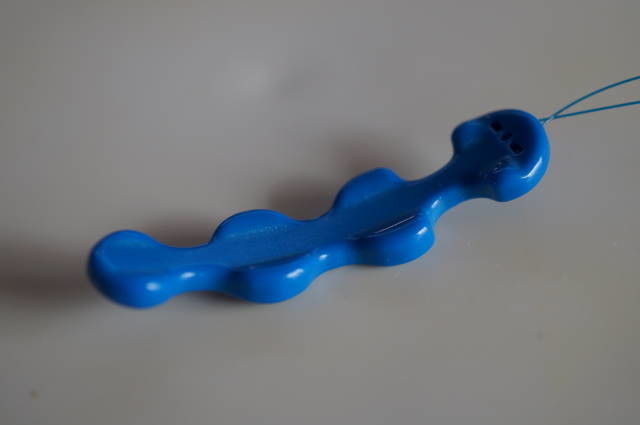
In an entry published in January 2022, Mr. Okada also described a separate curved prototype with a slightly recessed flat face. It lacked a through-hole, but he thought its recess might improve urine flow.
The prototype had arrived just after a similar flat-faced model went on sale. Mr. Okada said he might have chosen it if both designs had arrived before that launch. No matching product can be confirmed on the current list. He declined to adopt it for the time being because he did not want to sell two similar designs together.
(Source: ok-lab's diary, published January 2022)
https://ok-lab.hatenablog.com/entry/2022/01/08/123729
Long-term catheter use discussions included a case of missed urinary retention
In an entry published in May 2022, Mr. Okada recalled an older hospital incident involving a relative. He said the relative appeared confused and repeatedly called for nursing help.
According to his account, urinary retention (being unable to pass urine) went unrecognized for some time. He reported that catheter drainage eventually released more than 1000CC of urine. The diary does not record the relative's condition after drainage.
(Source: ok-lab's diary, published May 2022)
https://ok-lab.hatenablog.com/entry/2022/05/28/123218
Long-term catheter use inspired an arrowhead prototype that resisted removal
In an entry published in February 2024, Mr. Okada reconsidered relying on the outer sphincter (the muscle under voluntary control) to hold a chip. He contrasted it with the inner sphincter (the muscle near the bladder).
He described a balloon catheter as having a water-filled balloon inside the bladder, held there, in his account, by the inner sphincter. His own arrowhead-shaped test piece, about 11–12 mm wide, resisted removal; he eventually reported getting it out with pain. No matching product can be confirmed on the current list. He said further research should address shapes that caused less injury during removal.
(Source: ok-lab's diary, published February 2024)
https://ok-lab.hatenablog.com/entry/2024/02/10/123023
Long-term catheter use inspired plans for a large bladder-loop experiment
In an entry published in January 2025, Mr. Okada described hospital use of a silicone tube with a balloon measuring about 20 mm. He placed that balloon near the tube's end, inside the bladder, as the feature permitting continuous placement.
He used this comparison to introduce his interest in a large loop-shaped device inside the bladder. He proposed testing the idea on himself. The supplied entry does not record the test's outcome or a completed product.
(Source: ok-lab's diary, published January 2025)
https://ok-lab.hatenablog.com/entry/2025/01/04/122911
The maker's answer to long-term catheter use
Mr. Okada's proposed changes focused on muscle pressure and urine flow, with several ideas remaining experimental.
Long-term catheter use led Mr. Okada to favor thinner chip sections
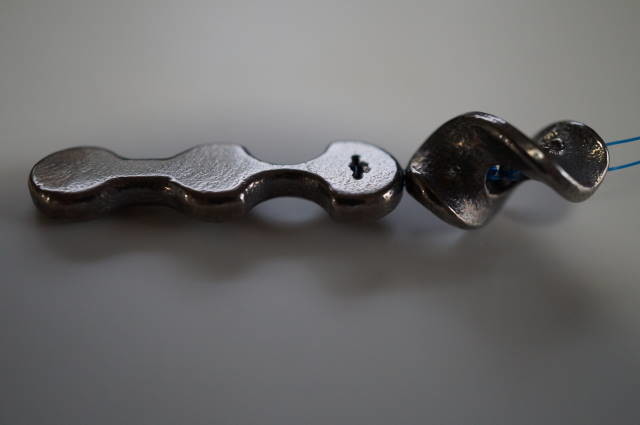
In an entry published in June 2021, Mr. Okada reported almost one week of continuous placement with little noticeable fatigue during a titanium-chip test. Its narrowed section (the thinner part held by the muscle) measured 2 mm; he considered about 5 mm necessary for ceramic or glass strength.
For the separate width across the groove's cutout, he preferred about 4 mm for sensation and 6–7 mm for stable placement. He argued that a thinner section reduced muscle strain and improved the device's ability to stay in place. No matching product can be confirmed on the current list. His advice was to consider comfort during extended wear separately from pleasure.
(Source: ok-lab's diary, published June 2021)
https://ok-lab.hatenablog.com/entry/2021/06/26/125926
Long-term catheter use comparisons highlighted strength limits in thin resin
In an entry published in June 2021, Mr. Okada described tests of a resin then being developed for contact with body tissue. He said a section of 3 mm or more was needed for strength, although he had also commissioned specimens around 2 mm thick.
He reported being unable to break the thinner specimen with his fingers. Its fabricator, however, reported breaking one by applying force deliberately. No matching product can be confirmed on the current list. Mr. Okada's comparison treated material strength as a constraint on making the muscle-contact area thinner.
(Source: ok-lab's diary, published June 2021)
https://ok-lab.hatenablog.com/entry/2021/06/26/125926
Long-term catheter use comparisons exposed problems with a proposed drainage hole
In an entry published in January 2022, a customer proposed a hole through a chip so urination would not dislodge it. Mr. Okada recalled a separate urine-collection design in which normal urination pushed out tubing with an internal diameter around 3 mm.
He explained that a medical catheter collects urine beyond the inner sphincter and drains without relying on normal urination pressure. He also warned that a hole through the proposed chip could bypass the outer sphincter's control, allowing leakage. The diary does not record completion or testing of the customer's requested chip. His reply cautioned that adding a passage for urine could undermine the ability to hold urine back.
(Source: ok-lab's diary, published January 2022)
https://ok-lab.hatenablog.com/entry/2022/01/08/123729
If you see blood in your urine, even a small amount or for the first time, do not wait and see. See a urologist right away. If you suddenly cannot urinate, or the device cannot be removed, do not try to fix it yourself. Go to a medical facility, including emergency care, immediately.
How long-term catheter use changed over time
| Published | What the diary said then |
|---|---|
| Oct 2017 | Mr. Okada acknowledged delayed pain and small injuries after contact with delicate tissue. |
| Sep 2019 | A catheter illustration brought difficulty passing a closing muscle into the discussion. |
| Jun 2021 | A comfort question prompted discussion of muscle pressure and narrower chip sections. |
| Jan 2022 | A drainage-hole proposal raised concerns about displacement and uncontrolled urine leakage. |
| May 2022 | Mr. Okada recalled delayed recognition of a relative's urinary retention. |
| Nov 2023 | A silicone question prompted reassurance drawn from Mr. Okada's hospital experience. |
| Feb 2024 | Attention shifted toward bladder anchoring, alongside a test involving difficult removal. |
| Jan 2025 | A bladder-loop experiment was proposed; its outcome was not recorded in the supplied entry. |
The diary does not say what the current state is.
OK Prostate Chip products related to long-term catheter use
No current product is directly tied to this topic.
Common worries about long-term catheter use
The reader questions concern tissue damage, discomfort during extended wear, and prolonged contact with silicone.
"Can long-term catheter use damage delicate tissue?"
In an entry published in October 2017, a reader raised concern about injury to the delicate lining of the urethra. Mr. Okada agreed that contact with a foreign object could cause pain noticed later or tiny injuries with minor bleeding.
He acknowledged that no device eliminates friction. Mr. Okada advised stopping use if discomfort developed.
(Source: ok-lab's diary, published October 2017)
https://ok-lab.hatenablog.com/entry/20171026/1508989298
"Does long-term catheter use mean chips can stay in comfortably?"
In an entry published in June 2021, a customer wanted several days of wear but reported muscle-like pain after about 3 hours. Their short ceramic twist chip had a screw-shaped support chip (an additional piece intended to hold the main chip) at 0 mm spacing.
Mr. Okada described a 5–6 mm sphincter being squeezed tightly between the main chip and its support. He also suspected the ceramic twist's relatively broad narrowed section could contribute to fatigue during extended wear. No matching product can be confirmed on the current list. Mr. Okada warned that comfortable wear might last only a few hours; the diary does not record whether the customer's discomfort resolved.
(Source: ok-lab's diary, published June 2021)
https://ok-lab.hatenablog.com/entry/2021/06/26/125926
"Does hospital experience establish silicone safety for long-term catheter use?"
In an entry published in November 2023, a reader asked about keeping silicone tubing in the urethra for extended periods. The larger tube had a 4 mm outside diameter and 2 mm inside diameter; the smaller measured 2 mm outside and 1 mm inside.
Mr. Okada drew reassurance from his hospital catheter, which he said remained unchanged throughout his stay. He did not state the length of that stay. His reply treated hospital use as a reason to expect few problems with prolonged silicone contact. The diary does not record the reader's longer-term experience with these tubes.
(Source: ok-lab's diary, published November 2023)
https://ok-lab.hatenablog.com/entry/2023/11/11/122638
Buying from outside Japan

OK Lab ships internationally to countries covered by Japan Post's EMS courier service. Overseas orders are paid in advance by PayPal. Each order carries a ¥400 (about $3 at ¥156 = $1, rate as of 2026-09-04) handling fee, and EMS shipping is charged on top. These terms come from OK Lab's official sales-terms page (written here as plain text, not a link: ok-lab.net/docs/law), checked on September 7, 2026; confirm them on the official store before you order, because they can change.
Summary of this article
| What you wanted to know | The answer |
|---|---|
| What is the short answer? | The diary records discomfort and experiments, without establishing a general comfortable wear time. |
| What is the product? | A urethral device made by OK Lab in Japan; its store prices are in JPY. |
| Which terms matter? | Catheters drain urine; the diary discusses closing muscles as supports for chips. |
| What actually happened? | Reports include temporary leakage, delayed recognition of blocked urination, and a prototype that resisted removal. |
| What did the maker propose? | Thinner chip sections and altered urine pathways, with limitations and uncompleted proposals. |
| How did the discussion change? | It moved from tissue concerns toward muscle pressure, urine flow, and experimental bladder anchoring. |
| Which current product fits this topic? | No current product is directly tied to this topic. |
| What concerned readers? | Delicate tissue, painful extended wear, and leaving silicone in place. |
| How does overseas buying work? | Advance PayPal payment, a ¥400 (about $3 at ¥156 = $1, rate as of 2026-09-04) handling fee, and additional EMS shipping under the stated terms. |
Source: ok-lab's diary (Okada Comfortable Life Laboratory). The original entries are in Japanese; quotations on this page are translated. Photos and videos are on the original entries.
This article is a summary of the maker's development diary. The product is not a medical device and no result is guaranteed. If anything feels wrong or worries you, see a doctor. Prices, specifications and cautions change, so confirm the latest information on the official blog and the official site. Questions about ordering and shipping go to the seller.