![Is the OK Prostate Chip a prostatic stent? | The diary describes key differences [OK Prostate Chip]](/img/a/T0757/eyecatch.svg)
This page is based on entries from "ok-lab's diary" (https://ok-lab.hatenablog.com/), the Japanese development diary written by Mr. Okada, founder of OK Lab, a small company in Japan (Okada Comfortable Life Laboratory). Only the entries about "OK Prostate Chip vs prostatic stent" are summarized here, in order of publication. Past prices and sizes are as written at the time. Current prices come from the official product list (retrieved September 4, 2026). Quotations are translated from Japanese.
Note: This page is a personal reading log by someone with no connection to the maker or the seller. It reflects the source entries as of their publication dates and makes no guarantee of accuracy or safety. The product is not a medical device; talk to a doctor about any health decision. Check the official site for current information. This page contains advertising.
In short
- The diary compares the chip with prostatic stents while describing differences in structure, handling and purpose.
- Mr. Okada's proposed improvements address anchoring, urine flow and flexible connections.
- The latest relevant entry reports a chip that could not be removed, without a recorded resolution.
If you see blood in your urine, even a small amount or for the first time, do not wait and see. See a urologist right away.
If you suddenly cannot urinate, or the device cannot be removed, do not try to fix it yourself. Go to a medical facility, including emergency care, immediately.
About this product

The OK Prostate Chip is a small device that is placed in the urethra (the urine passage) so that it acts on the prostate; the maker sells it in several shapes, sizes and materials. It is made and sold by OK Lab (Okada Comfortable Life Laboratory), a small company in Japan, through its own online store, and prices are in Japanese yen (JPY).
The maker's development diary, "ok-lab's diary", is written in Japanese. This page is an English summary of it, and every quotation is translated. OK Lab ships internationally, so readers outside Japan can order (see "Buying from outside Japan" below).
Product names on this page are plain-English descriptions. The official Japanese product name is shown once in the product table so you can find the same item in the store.
Before you read: key terms
| Term | Plain-English meaning |
|---|---|
| Urethra | The urine passage; it is also where the diary's chip designs sit. |
| Prostatic urethra | The passage through the prostate; medical stents are described as holding it open for urine. |
| Prostatic stent | A mesh or hollow support placed medically to keep a narrowed urine passage open. |
| Urinary catheter | A medical tube carrying urine internally; the diary uses it to explain different flow paths. |
| Urinary sphincters | Closing structures discussed on either side of the prostate; their grip features in the maker's anchoring explanation. |
| Bulbar urethra | The section on the outward side of the outer sphincter; some designs place an additional support there. |
| Shape-memory alloy | Metal that returns toward a preset shape; the diary discusses its use in stents and chip connections. |
| Retrieval thread | A thread intended to allow a chip to be withdrawn; its failure appears in the March 2026 report. |
| Milking | The maker's term for external handling intended to move a chip through the urethra. |
| Patent document | A published description of an invention; Mr. Okada consulted these documents when comparing stent designs. |
| Urologist | A doctor consulted about urinary problems; the diary refers to this specialist when discussing medical stents. |
What happens: OK Prostate Chip vs prostatic stent
The OK Prostate Chip is a small device placed in the urethra to act on the prostate. In the April 2018 account, a prostatic stent is a mesh or hollow tube placed surgically to maintain urine flow. It supports the prostatic urethra (the urine passage through the prostate) where that passage has narrowed. Mr. Okada compares such medical devices with his chip when discussing anchoring, sensation and the space available for urine.
Prostatic stent deposits limited permanent placement in the October 2017 account
In an entry published in October 2017, Mr. Okada described medical prostatic stents as commonly intended for lengthy placement. He nevertheless wrote that stones forming from urine made permanent placement difficult. His discussion also compared the chip with a urinary catheter (a medical tube carrying urine).
He said urine washed the catheter's interior, while its closely fitting outer surface received little such washing. He acknowledged that fluid flow could not remove every bacterium. Mr. Okada's proposed precaution was a chip design that allowed bodily fluids to flow around its outside.
(Source: ok-lab's diary, published October 2017)
https://ok-lab.hatenablog.com/entry/20171011/1507687119
Prostatic stent anchors addressed movement toward the bladder in earlier designs
An entry published in October 2017 examined patent document 2012-125562 (a published description of an earlier stent design). Mr. Okada described supports in both the prostate and the bulbar urethra (the section beyond the outer sphincter toward the exit). He interpreted the latter support as an anchor against movement into the bladder.
He attributed possible stent movement to changes in the prostate's shape. Another design he discussed, 2004-523280, included a bladder balloon as well as a prostate section. Mr. Okada regarded the 2008-543499 design, spanning the bladder, prostate and bulbar urethra, as the most stable-looking option.
(Source: ok-lab's diary, published October 2017)
https://ok-lab.hatenablog.com/entry/20171018/1508291723
The prostatic stent comparison did not establish medical approval for chips
In an entry published in October 2017, Mr. Okada said a urologist he had previously consulted reported that prostatic stent treatment had become less common. The supplied account gives no survey establishing how widely that comment applied. Mr. Okada also wrote that the earlier patented stents required a doctor for placement and removal.
He attributed his chip's intended self-placement and removal to its design for milking (his term for external handling). Possible medical approval appeared as a future ambition in this account. His stated plan was to sell the chip as a pleasure or cleaning product without claiming medical effects.
(Source: ok-lab's diary, published October 2017)
https://ok-lab.hatenablog.com/entry/20171018/1508291723
The prostatic stent temperature comparison involved different shape-memory materials
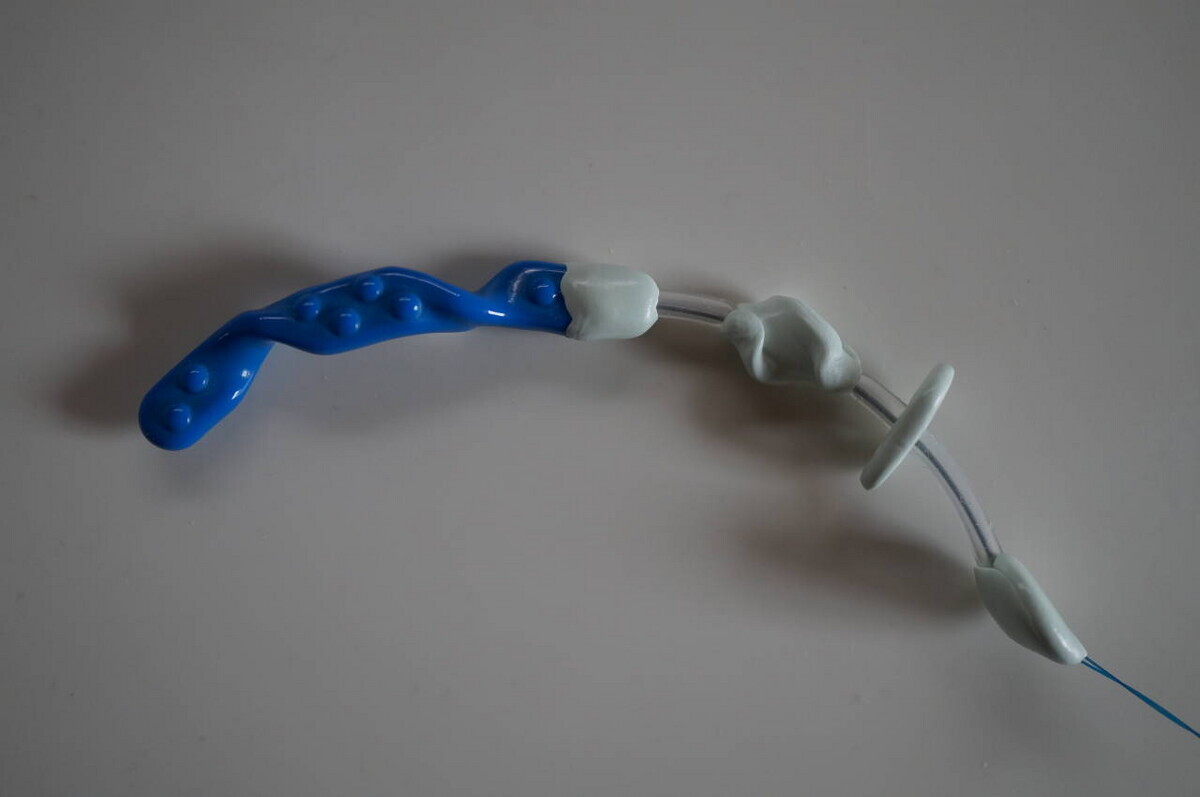
An entry published in April 2024 compared shape-memory alloy (metal that returns toward a preset shape) in medical stents and chip connections. Mr. Okada described a medical stent with spring expansion around 60 degrees, intended to widen the prostatic urethra. The chip's connecting wire, about 0.6 mm thick, reportedly returned to its remembered shape around 10 degrees.
He wrote that this wire therefore retained its remembered shape at room temperature and inside the body. He also described its ability to bend, unlike the rigid connections in earlier long chips. Mr. Okada presented this flexibility as an answer to difficulties with rigid, curved devices.
(Source: ok-lab's diary, published April 2024)
https://ok-lab.hatenablog.com/entry/2024/04/06/122941
Prostatic stents remained a medical-care comparison in the November 2025 account
In an entry published in November 2025, Mr. Okada described helping people with narrowed or blocked urine passages as an original development goal. He connected that motivation to a relative's difficulty urinating and a doctor friend's work on stents. He wrote that prostatic stents could use shape-memory alloy but were available only through advanced medical care.
He also described his own experiments with devices intended for self-placement. These statements explain his development aims; the paragraph does not record medical approval for the resulting devices. He proposed jointed wire as a way to retain springiness while reducing the drawbacks he associated with metal.
(Source: ok-lab's diary, published November 2025)
https://ok-lab.hatenablog.com/entry/2025/11/22/122910
The maker's answer to OK Prostate Chip vs prostatic stent
Mr. Okada's design proposals changed over time, but the retained-chip report has no documented safe outcome.
The prostatic stent comparison highlighted a narrow connector that stayed rigid
In an entry published in October 2017, Mr. Okada contrasted the parts crossing the urinary sphincters (closing structures involved in his anchoring explanation). He described earlier stents as flexible or absent at that point. His chip instead had a narrower section made from material that would not bend.
He also described flattened bulges, with urine passing beside them and washing the device's exterior rather than traveling through an internal tube. The entry distinguished a fuller chip design with a bladder section from the simpler initial sales version, which lacked that section. Mr. Okada favored the externally washed structure as part of his cleanliness argument.
(Source: ok-lab's diary, published October 2017)
https://ok-lab.hatenablog.com/entry/20171018/1508291723
Flexible wire addressed chip slipping out in either direction
In an entry published in April 2024, Mr. Okada described separated chips connected by shape-memory wire supporting one another across a curved span. The bulbar support could sit about 3-5cm from the sphincter, with the assembly bent roughly 90 degrees. He argued that this arrangement reduced direct pressure on the sphincter.
According to his comparison, earlier soft-thread connections resisted movement toward the bladder but did little against movement toward the exit. He claimed the wire connection provided resistance in both directions and allowed finer adjustment of the resting position. Mr. Okada suggested the arrangement for people seeking more precise control over where the chip rested.
(Source: ok-lab's diary, published April 2024)
https://ok-lab.hatenablog.com/entry/2024/04/06/122941
A chip stuck after thread failure had no recorded resolution
An entry published in March 2026 reported a blue two-bulge chip remaining in the prostate after its retrieval thread (the thread for withdrawal) broke. Mr. Okada believed urine pressure would ordinarily expel a chip eventually, provided it had not passed completely into the bladder. He initially suggested continued placement might be harmless, with a doctor considered only if several months passed.
That reassurance was his speculation; the entry supplies no medical assessment supporting it. The diary does not record whether the chip came out or the customer received medical care. No matching product can be confirmed on the current list.
(Source: ok-lab's diary, published March 2026)
https://ok-lab.hatenablog.com/entry/2026/03/28/122908
If you see blood in your urine, even a small amount or for the first time, do not wait and see. See a urologist right away.
If you suddenly cannot urinate, or the device cannot be removed, do not try to fix it yourself. Go to a medical facility, including emergency care, immediately.
How OK Prostate Chip vs prostatic stent changed over time

| Published | What the diary said then |
|---|---|
| Oct 2017 | Mr. Okada identified stone formation as a limit on permanent stent placement. |
| Oct 2017 | Initial chip sales were planned without the fuller design's bladder section. |
| Apr 2018 | A customer's follow-up prompted Mr. Okada to reject a single correct resting position. |
| Jul 2018 | A slipping-chip reply added stopper-based and crossed-neck design possibilities. |
| Apr 2024 | Flexible wire introduced support against movement in both directions, according to Mr. Okada. |
| Nov 2025 | Mr. Okada proposed jointed wire to reduce unwanted effects associated with metal. |
| Mar 2026 | A broken retrieval thread left a chip retained; no resolution was recorded. |
The diary does not say what the current state is.
OK Prostate Chip products related to OK Prostate Chip vs prostatic stent

No current product is directly tied to this topic.
Common worries about OK Prostate Chip vs prostatic stent

The recorded questions concern uncertain position, absent sensation and chips slipping back.
"Does prostate chip position explain why nothing feels different?"
In an entry published in April 2018, a customer using a linked chip asked how to confirm its position. Mr. Okada initially thought the reported movement indicated that the leading chip had reached the prostatic urethra. The customer then clarified a concern that the device had gone too far.
Mr. Okada replied that he did not think there was one correct resting position, and suggested possible explanations involving location or limited sensation. The diary does not record a confirmed position or a later improvement for this customer. Mr. Okada explicitly said he did not recommend the deeper position-checking approach mentioned in his reply because it carried danger.
(Source: ok-lab's diary, published April 2018)
https://ok-lab.hatenablog.com/entry/20180414/1523697398
"Can a prostate chip produce no sensation beyond the sphincter?"
A separate customer in an entry published in April 2018 described losing all awareness of the chip beyond the outer sphincter. The customer reported this with both single-chip and two-chip devices, after previously changing a chip's width to 7 mm. The question raised insufficient size and undeveloped sensation as possible explanations.
Mr. Okada acknowledged limits to what he could answer and recalled having no prostate sensation during his own prolonged catheter use. He suspected that mental circumstances also mattered; the diary does not record a tested explanation or this customer's later outcome. His reply cautioned against treating chip size as the complete explanation for absent sensation.
(Source: ok-lab's diary, published April 2018)
https://ok-lab.hatenablog.com/entry/20180414/1523697398
"Does chip slipping out mean it cannot stay like a stent?"
An entry published in July 2018 describes a customer whose short and semi-long chips slipped back after small movements. Mr. Okada replied that firm anchoring generally depended on a long chip supported between the internal and external urinary sphincters. He said a shorter chip wholly beyond the outer sphincter allowed complete closure, making backward movement harder, as with stents.
His stopper-based alternative addressed bladderward movement, but he warned that absent bladder anchoring still allowed strong urine flow to dislodge the chip. The diary does not record whether the customer's slipping problem improved. Mr. Okada also suggested a crossed-neck chip might resist backward movement better, presenting that possibility cautiously.
(Source: ok-lab's diary, published July 2018)
https://ok-lab.hatenablog.com/entry/20180721/1532152353
Buying from outside Japan

OK Lab ships internationally to countries covered by Japan Post's EMS courier service. Overseas orders are paid in advance by PayPal. Each order carries a ¥400 (about $3 at ¥156 = $1, rate as of 2026-09-04) handling fee, and EMS shipping is charged on top. These terms come from OK Lab's official sales-terms page (written here as plain text, not a link: ok-lab.net/docs/law), checked on September 7, 2026; confirm them on the official store before you order, because they can change.
Summary of this article
| What you wanted to know | The answer |
|---|---|
| What is the short answer? | The diary compares structures and experiences; the latest retained-chip case remains unresolved. |
| What is the product? | A small urethral device made and sold by OK Lab in Japan. |
| Which terms matter? | Stents support urine flow; the diary compares their anchors, materials and flow paths with chips. |
| What happened in these entries? | Medical-stent comparisons developed into chip design claims and a later report of a retained device. |
| What was the maker's answer? | He proposed structural changes, but his retained-chip reassurance had no recorded medical assessment. |
| What changed over time? | Rigid designs gave way to flexible-wire proposals; a thread-failure problem was reported in March 2026. |
| Is there a current product for this comparison? | No current product is directly tied to this topic. |
| What did customers ask? | They asked about position, absent sensation and chips slipping back. |
| How do overseas orders work? | EMS delivery and advance PayPal payment, with a ¥400 (about $3 at ¥156 = $1, rate as of 2026-09-04) handling fee plus shipping. |
Source: ok-lab's diary (Okada Comfortable Life Laboratory). The original entries are in Japanese; quotations on this page are translated. Photos and videos are on the original entries.
This article is a summary of the maker's development diary. The product is not a medical device and no result is guaranteed. If anything feels wrong or worries you, see a doctor. Prices, specifications and cautions change, so confirm the latest information on the official blog and the official site. Questions about ordering and shipping go to the seller.