![Chip stuck despite a thread or loop? | Hospital removal may still be needed [OK Prostate Chip]](/img/a/T0756/eyecatch.svg)
This page is based on entries from "ok-lab's diary" (https://ok-lab.hatenablog.com/), the Japanese development diary written by Mr. Okada, founder of OK Lab, a small company in Japan (Okada Comfortable Life Laboratory). Only the entries about "chip removal with a thread or loop" are summarized here, in order of publication. Past prices and sizes are as written at the time. Current prices come from the official product list (retrieved September 4, 2026). Quotations are translated from Japanese.
Note: This page is a personal reading log by someone with no connection to the maker or the seller. It reflects the source entries as of their publication dates and makes no guarantee of accuracy or safety. The product is not a medical device; talk to a doctor about any health decision. Check the official site for current information. This page contains advertising.
In short
A retrieval thread helped in reported hospital removals, but chips still became stuck.
Mr. Okada emphasizes accessible thread and medical help when removal fails.
The supplied current list includes ceramic chips and stoppers involved in these reports.
If you see blood in your urine, even a small amount or for the first time, do not wait and see. See a urologist right away.
If you suddenly cannot urinate, or the device cannot be removed, do not try to fix it yourself. Go to a medical facility, including emergency care, immediately.
About this product

The OK Prostate Chip is a small device that is placed in the urethra (the urine passage) so that it acts on the prostate; the maker sells it in several shapes, sizes and materials. It is made and sold by OK Lab (Okada Comfortable Life Laboratory), a small company in Japan, through its own online store, and prices are in Japanese yen (JPY). The maker's development diary, "ok-lab's diary", is written in Japanese. This page is an English summary of it, and every quotation is translated. OK Lab ships internationally, so readers outside Japan can order (see "Buying from outside Japan" below). Product names on this page are plain-English descriptions. The official Japanese product name is shown once in the product table so you can find the same item in the store.
Before you read: key terms
| Term | Plain-English meaning |
|---|---|
| Urethra | The urine passage, where the maker intends the chip to sit and act on the prostate. |
| Retrieval thread | Thread connected to a chip, intended to provide an accessible connection for removal. |
| Loop | A loop of thread or cable, discussed as something a clinician could catch during removal. |
| Forceps | Medical gripping tools, used in these reports to hold thread or a device. |
| Endoscopy | Examination with a medical scope, used in these cases to locate and retrieve a chip. |
| Attachment hole | An opening connecting thread to a chip, also described as a possible gripping point. |
| Sphincter stopper | An additional part intended to resist a chip moving farther inward; prevention was not guaranteed. |
| Biocompatible resin | A chip material discussed in connection with attachment holes. The diary does not explain this. |
| Capture basket | A thread-based retrieval prototype intended to hold smooth chips that were hard to grip. |
What happens: a stuck prostate chip
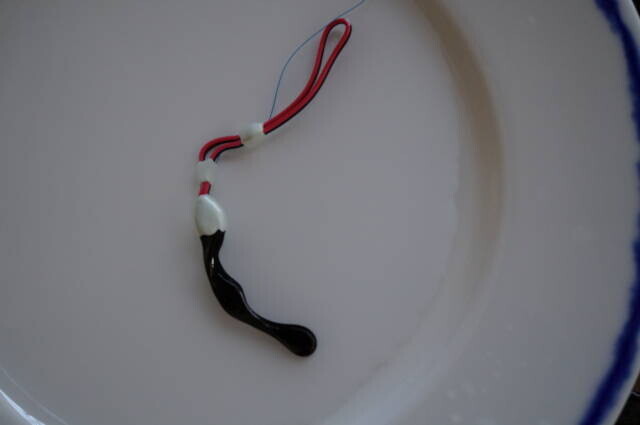
The OK Prostate Chip is a small device placed in the urethra, intended by the maker to act on the prostate. A retrieval thread (a connection intended for removal) attaches to the chip and may extend outside the body. A loop (a curved thread or cable connection) appears in later designs as another possible point of access. The diary describes doctors recovering devices through these features, but also records missing thread, tangles, difficult removals, and injuries.
An attached thread helped doctors retrieve a stuck chip sooner
An entry published in January 2019 described hospital treatment for a thick, sharply curved chip that had entered the bladder. Natural passage had not occurred, and the customer reported removal by endoscopy (examination with a medical scope). Mr. Okada wrote that the attached thread made the actual removal relatively quick.
He contrasted this with an earlier oversized semi-long chip whose detached thread left glass difficult to hold with forceps (medical gripping tools). No matching product can be confirmed on the current list. Mr. Okada urged precautions against the retrieval thread disappearing inside the body.
(Source: ok-lab's diary, published January 2019)
https://ok-lab.hatenablog.com/entry/2019/01/26/152042
A stuck chip remained difficult despite thread outside the body
In an entry published in September 2020, a customer sought help after a sea-slug version 4 chip remained stuck overnight. Some blood appeared, even though thread still extended outside the body. Mr. Okada attributed the difficulty partly to the thread's attachment being off-center.
The customer subsequently reported successful removal. No matching product can be confirmed on the current list. Mr. Okada advised consulting a urologist if the device could not be removed.
(Source: ok-lab's diary, published September 2020)
https://ok-lab.hatenablog.com/entry/2020/09/05/095734
A stuck chip required hospital removal after its entire assembly disappeared
An entry published in December 2021 described a customer seeking help after a custom assembly disappeared inward. Staff initially suspected its end fitting remained outside the bladder, but hospital examination found the whole assembly inside. The doctor consulted a sample supplied by the customer and recovered the device through its thread.
The customer reported a procedure lasting about 10 minutes, with a surgical fee exceeding ¥30,000 (about $192 at ¥156 = $1, rate as of 2026-09-04). No matching product can be confirmed on the current list. Staff advised medical assessment when the customer could not confidently resolve the problem.
(Source: ok-lab's diary, published December 2021)
https://ok-lab.hatenablog.com/entry/2021/12/25/123556
A doctor preserved the thread during this stuck chip removal
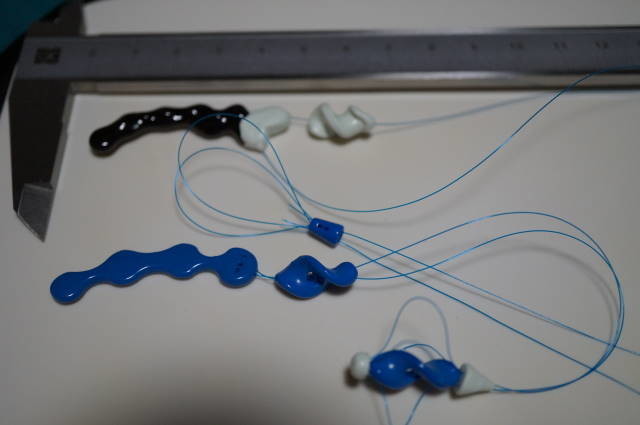
In an entry published in December 2022, a customer asked about cutting a cable on a stuck custom assembly. Staff considered the idea theoretically possible, but their test exposed sharp wire ends and a possible injury risk. The doctor rejected cutting because losing the thread could make removal harder, and completed removal with it intact.
The customer reported a minor urethral injury, 1 week of antibiotics, and a ¥1,760 (about $11 at ¥156 = $1, rate as of 2026-09-04) treatment charge under Japan's public health insurance. No matching product can be confirmed on the current list. Staff had advised medical assessment because cutting near the urethral opening concerned them.
(Source: ok-lab's diary, published December 2022)
https://ok-lab.hatenablog.com/entry/2022/12/24/122944
An accessible thread helped resolve this stuck chip hospital case
An entry published in March 2024 described a long ceramic four-point twist chip entering the bladder despite an attached stopper. The customer asked whether a custom stopper would be needed. The clinic initially considered referral elsewhere because its doctor was unfamiliar with the device.
Once the doctor obtained the thread, removal proceeded without catching; the customer reported less than 30 minutes and a ¥27,000 (about $173 at ¥156 = $1, rate as of 2026-09-04) charge. Mr. Okada offered custom sizing in response to the customer's question. He suggested a larger stopper for unusually wide anatomy, rather than assuming the standard size would work.
(Source: ok-lab's diary, published March 2024)
https://ok-lab.hatenablog.com/entry/2024/03/02/123027
A stuck chip led to surgery after every external connection disappeared
An entry published in February 2025 reported a sea-slug version 5 chip entering the bladder with an L mesh stopper. The external stopper also detached, and all 35cm of thread disappeared inside. Staff identified no reliable self-retrieval method and considered a doctor's access to the thread or silicone tail the appropriate route.
Endoscopic removal succeeded; surgery cost ¥25,000 (about $160 at ¥156 = $1, rate as of 2026-09-04), with reported expenses around ¥35,000 (about $224 at ¥156 = $1, rate as of 2026-09-04), but the customer reported a bacterial infection following injury during removal. No matching product can be confirmed on the current list. Mr. Okada stressed that a sphincter stopper (an additional part intended to resist inward movement) could not guarantee prevention.
(Source: ok-lab's diary, published February 2025)
https://ok-lab.hatenablog.com/entry/2025/02/22/122939
The maker's answer to a stuck prostate chip
Mr. Okada proposed additional retrieval features, while the diary also records limits and difficult hospital cases.
A separate retrieval thread improved Mr. Okada's stuck chip prototype
In the entry published in September 2020, Mr. Okada described testing the sea-slug design after the customer's difficulty. He acknowledged that he had not personally tested version 4 before that report. His revised prototype had 2 independent threads, with the additional connection on the opposite side.
He reported easier retrieval in his own test and said the separate connections would increase the price, without giving an amount. No matching product can be confirmed on the current list. Mr. Okada proposed separate connections for positioning and retrieval.
(Source: ok-lab's diary, published September 2020)
https://ok-lab.hatenablog.com/entry/2020/09/05/095734
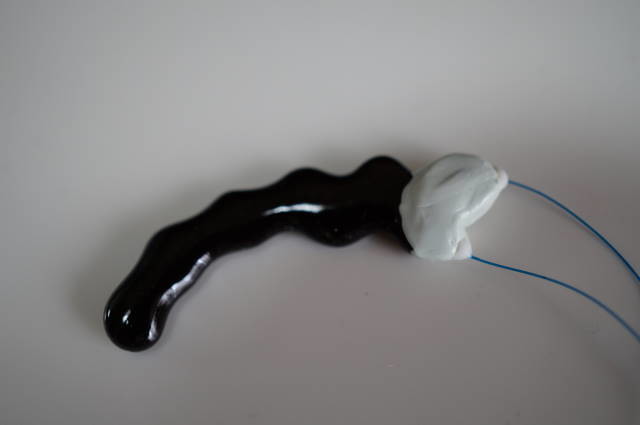
Attachment holes offered doctors another possible grip on a stuck chip
In an entry published in July 2021, Mr. Okada described hospital attempts frustrated by chips slipping from gripping tools. Reports included unsuccessful attempts on separate days and discussion of possible bladder surgery. He identified ceramic, glass, and epoxy-resin chips as difficult to grip.
He contrasted them with titanium and biocompatible resin (a named chip material) containing attachment holes (openings connecting thread to the device). His July 2021 manual described these holes as possible holding points for forceps during endoscopy. Mr. Okada advised hospital involvement with endoscopic equipment for difficult retrievals.
(Source: ok-lab's diary, published July 2021)
https://ok-lab.hatenablog.com/entry/2021/07/24/125923
(Source: ok-lab's diary, published July 2021)
https://ok-lab.hatenablog.com/entry/2021/07/31/125702
The capture basket for a stuck chip remained an untested prototype
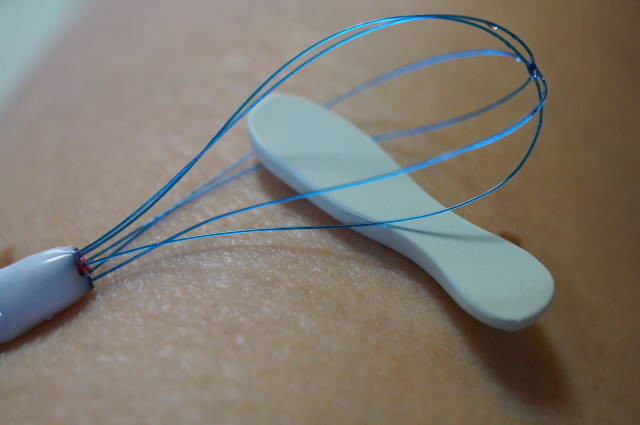
In an entry published in July 2021, Mr. Okada introduced a capture basket (a thread structure for holding a chip). Its 6 threads were intended to grip smooth chips, but the prototype had not been tested inside the bladder. He announced no retail launch, while offering custom manufacture if someone needed it.
No matching product can be confirmed on the current list. Mr. Okada favored hospital involvement because a clinician could see the device with an endoscope.
(Source: ok-lab's diary, published July 2021)
https://ok-lab.hatenablog.com/entry/2021/07/31/125702
If you see blood in your urine, even a small amount or for the first time, do not wait and see. See a urologist right away.
If you suddenly cannot urinate, or the device cannot be removed, do not try to fix it yourself. Go to a medical facility, including emergency care, immediately.
How a stuck prostate chip changed over time
| Published | What the diary said then |
|---|---|
| May 2018 | Mr. Okada warned that 1kg of thread tension could injure the urinary tract. |
| Jan 2019 | An attached thread shortened a reported hospital removal. |
| May 2020 | Mr. Okada suspected tension could worsen tangling between connected chips. |
| Sep 2020 | An independent retrieval connection improved the maker's prototype test. |
| Jul 2021 | A capture basket had no bladder testing or planned retail launch. |
| Aug 2024 | Thread emerging from loop tips became standard across keyring-style designs. |
| Feb 2025 | A mesh stopper failed; hospital removal was followed by infection. |
The diary does not say what the current state is.
OK Prostate Chip products related to a stuck prostate chip
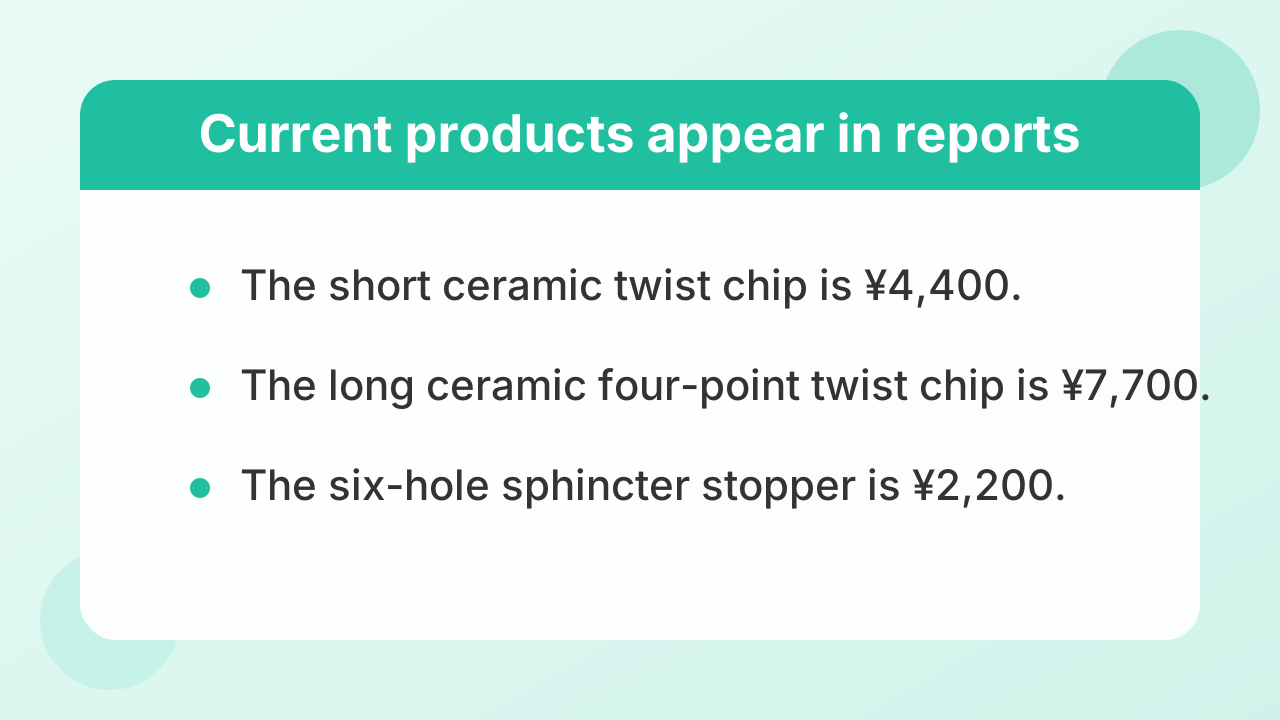
The current list includes ceramic chips and add-ons involved in these reports.
Products that appear in these entries
| Product (official name) | Price incl. tax | Relation to this topic |
|---|---|---|
| Short ceramic twist chip (OKプロステートチップ 陶器素材ショートタイプ ツイスト) | ¥4,400 (about $28 at ¥156 = $1, rate as of 2026-09-04) | The May 2020 customer reported this chip becoming stuck with a screw-shaped auxiliary chip. |
| Screw-shaped auxiliary chip option (スクリュー型補助チップ追加オプション) | ¥3,300 (about $21 at ¥156 = $1, rate as of 2026-09-04) | In May 2020, this addition formed the connected assembly involved in the suspected tangle. |
| Long ceramic four-point twist chip (OKプロステートチップ 陶器素材ロングタイプ 4点ツイスト) | ¥7,700 (about $49 at ¥156 = $1, rate as of 2026-09-04) | The March 2024 customer reported hospital removal after this chip entered the bladder. |
| Six-hole sphincter stopper (六穴方式オプションチップ(括約筋ストッパーチップ)) | ¥2,200 (about $14 at ¥156 = $1, rate as of 2026-09-04) | In March 2024, this stopper was attached to the chip that entered the bladder. |
(Source: ok-lab's diary, published May 2020)
https://ok-lab.hatenablog.com/entry/2020/05/02/131505
(Source: ok-lab's diary, published March 2024)
https://ok-lab.hatenablog.com/entry/2024/03/02/123027
Products the diary mentioned as alternatives
The diary names no alternative.
Common worries about a stuck prostate chip
The diary addresses tangled thread, hidden thread, and whether a loop provides dependable protection.
"Can tangled thread explain a stuck chip?"
In an entry published in May 2020, a customer with a short ceramic twist chip and screw-shaped addition asked whether thread had tangled. Mr. Okada suspected a tangle between the 2 chips could form a V that would not pass through the bladder outlet. He prioritized an externally secured thread end and cautioned that pulling could tighten the tangle.
His first reply expected natural passage; after the next report, he advised early urology care. The customer later reported that the device passed after several days. Mr. Okada then suggested a single chip with a sphincter stopper, while acknowledging that prevention was not certain.
(Source: ok-lab's diary, published May 2020)
https://ok-lab.hatenablog.com/entry/2020/05/02/131505
"Can doctors find hidden thread on a stuck chip?"
An entry published in July 2023 described a customer seeking help after a sea-slug version 4 chip entered the bladder. Staff said that thread remaining in the urethra might still be found and grasped at hospital. The diary does not record whether hospital removal succeeded.
No matching product can be confirmed on the current list. Staff advised telling the hospital that thread might remain inside the urethra.
(Source: ok-lab's diary, published July 2023)
https://ok-lab.hatenablog.com/entry/2023/07/22/120258
"Can retrieval loops prevent a stuck chip?"
In an entry published in August 2024, a customer asked whether a custom cable loop would prevent the device entering the bladder. Staff said protection was uncertain and accepted a request for a slightly larger loop. Mr. Okada then changed all keyring-style designs so nylon thread emerged from the loop tip, including orders awaiting shipment.
He also thought the loop itself could offer clinicians a grip if thread was absent. No matching product can be confirmed on the current list. Staff cautioned against treating the loop as certain protection for someone whose devices tended to move inward.
(Source: ok-lab's diary, published August 2024)
https://ok-lab.hatenablog.com/entry/2024/08/31/122909
Buying from outside Japan

OK Lab ships internationally to countries covered by Japan Post's EMS courier service. Overseas orders are paid in advance by PayPal. Each order carries a ¥400 (about $3 at ¥156 = $1, rate as of 2026-09-04) handling fee, and EMS shipping is charged on top. These terms come from OK Lab's official sales-terms page (written here as plain text, not a link: ok-lab.net/docs/law), checked on September 7, 2026; confirm them on the official store before you order, because they can change.
Summary of this article
| What you wanted to know | The answer |
|---|---|
| Does a thread guarantee removal? | Reported cases include successful hospital retrieval and chips that remained stuck despite accessible thread. |
| What is the product? | A urethral device made by OK Lab in Japan, sold in Japanese yen. |
| What do the key terms mean? | Threads, loops, and attachment holes are discussed as possible access points for retrieval. |
| What happened in the cases? | Hospital treatment sometimes succeeded quickly; other reports included injury, infection, and missing outcomes. |
| What did the maker propose? | Separate retrieval connections, gripping points, and a capture prototype whose bladder testing was incomplete. |
| What changed over time? | Later entries added retrieval features while continuing to report inward movement and hospital care. |
| Which current products appear? | Ceramic twist chips, a screw-shaped addition, and a six-hole stopper appear in documented cases. |
| What questions did customers ask? | They asked about tangling, hidden thread, and whether loops could prevent inward movement. |
| How do overseas orders work? | Advance PayPal payment, a ¥400 (about $3 at ¥156 = $1, rate as of 2026-09-04) handling fee, and additional EMS shipping charges. |
Source: ok-lab's diary (Okada Comfortable Life Laboratory). The original entries are in Japanese; quotations on this page are translated. Photos and videos are on the original entries.
This article is a summary of the maker's development diary. The product is not a medical device and no result is guaranteed. If anything feels wrong or worries you, see a doctor. Prices, specifications and cautions change, so confirm the latest information on the official blog and the official site. Questions about ordering and shipping go to the seller.