![How is a stuck chip removed? | Hospital reports describe scope removal and possible laser treatment [OK Prostate Chip]](/img/a/T0755/eyecatch.svg)
This page is based on entries from "ok-lab's diary" (https://ok-lab.hatenablog.com/), the Japanese development diary written by Mr. Okada, founder of OK Lab, a small company in Japan (Okada Comfortable Life Laboratory). Only the entries about "chip removal at a hospital" are summarized here, in order of publication. Past prices and sizes are as written at the time. Current prices come from the official product list (retrieved September 4, 2026). Quotations are translated from Japanese.
Note: This page is a personal reading log by someone with no connection to the maker or the seller. It reflects the source entries as of their publication dates and makes no guarantee of accuracy or safety. The product is not a medical device; talk to a doctor about any health decision. Check the official site for current information. This page contains advertising.
In short
Hospital reports describe successful removal of stuck chips, sometimes requiring admission.
Mr. Okada suggests discussing another medical opinion when bladder surgery is proposed.
The latest report, published in May 2026, describes successful removal; laser treatment remained a possible backup.
If you see blood in your urine, even a small amount or for the first time, do not wait and see. See a urologist right away. If you suddenly cannot urinate, or the device cannot be removed, do not try to fix it yourself. Go to a medical facility, including emergency care, immediately.
About this product
The OK Prostate Chip is a small device that is placed in the urethra (the urine passage) so that it acts on the prostate; the maker sells it in several shapes, sizes and materials. It is made and sold by OK Lab (Okada Comfortable Life Laboratory), a small company in Japan, through its own online store, and prices are in Japanese yen (JPY).
The maker's development diary, "ok-lab's diary", is written in Japanese. This page is an English summary of it, and every quotation is translated. OK Lab ships internationally, so readers outside Japan can order (see "Buying from outside Japan" below).
Product names on this page are plain-English descriptions. The official Japanese product name is shown once in the product table so you can find the same item in the store.
Before you read: key terms
| Term | Plain-English meaning |
|---|---|
| Urethra | The urine passage, where the maker describes placing the chip to act on the prostate. |
| Endoscope | An instrument for viewing inside the body, used during examination and hospital removal in these accounts. |
| Flexible cystoscope | A flexible bladder-viewing scope; the February 2019 customer was told the clinic's instrument was for observation. |
| Rigid cystoscope | A metal bladder scope; the February 2019 customer was told this equipment was needed for treatment. |
| Forceps | Medical gripping tools, discussed as instruments for retrieving a retained chip. |
| Thread-attachment hole | A hole for connecting thread to a chip; Mr. Okada also described it as a possible gripping point. |
| Epoxy resin | A chip material. The diary does not explain this. |
| Fragmentation | Breaking a device into pieces to enable removal; laser fragmentation refers to using a laser for this. |
| Urinary stones | The diary does not explain this. Equipment for breaking them was reportedly used on a ceramic chip. |
| General anesthesia | The diary does not explain this. It was reported during hospital removal in the June 2024 entry. |
| Urinary catheter | A tube for draining urine, reported as part of care after the May 2026 operation. |
What happens: chip removal at a hospital
The OK Prostate Chip is a device placed in the urethra (urine passage), intended by the maker to act on the prostate. The diary describes hospital care when a chip becomes stuck there or enters the bladder. An endoscope (an instrument for viewing inside the body) lets a doctor observe the retained object. These accounts discuss removal using gripping instruments, possible laser treatment, and surgery when a less extensive approach might fail.
Glass chip damage was reported before hospital removal was considered
In an entry published in February 2019, a customer sought help after a 42mm curved, twisted glass chip lost its tip. They reported a sharp break and severe damage to the bladder lining, even though no blood was detected in their urine. The first clinic reportedly said its flexible cystoscope (a flexible bladder-viewing scope) could observe but could not provide the required treatment.
The customer was referred for treatment with a rigid cystoscope (a metal bladder scope), then found a local clinic offering that equipment. Examination found no fragment; the customer thought it had passed unnoticed, but never recovered the missing tip. Mr. Okada apologized and asked readers to take the report into account.
(Source: ok-lab's diary, published February 2019)
https://ok-lab.hatenablog.com/entry/2019/02/02/153358
Endoscopic chip removal succeeded despite the device's reversed orientation
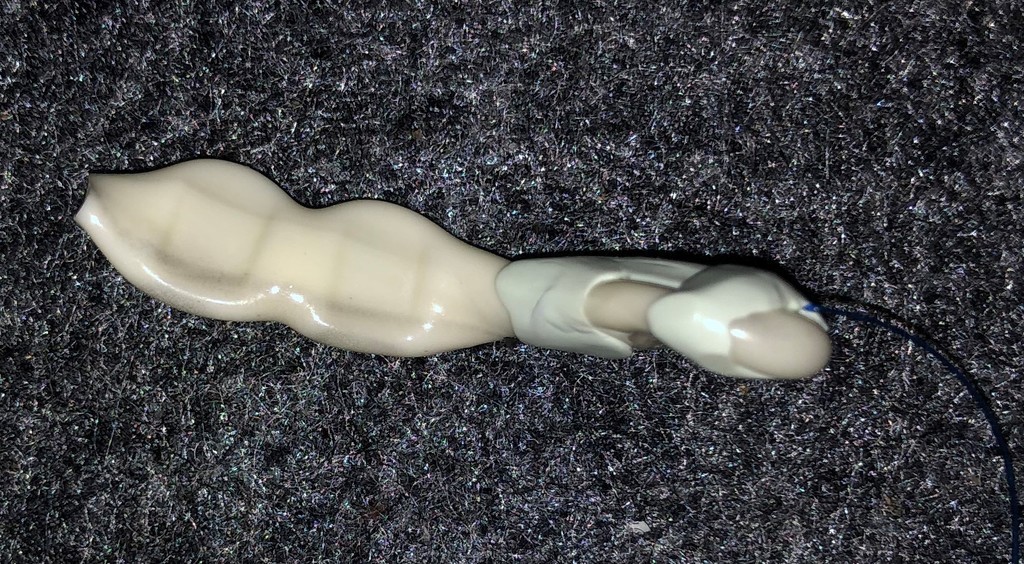
An entry published in August 2022 describes a stuck small chip (Zoro S); a doctor's attempt using its thread failed. Endoscopic removal succeeded after 20 minutes, revealing a 180-degree reversal: the thread end faced the bladder, so pulling caused gouging and inflammation. The doctor reportedly outlined later surgery under general anesthesia (the diary does not explain this) if endoscopy failed, with the chip in the bladder.
The customer reported paying about ¥23,000 (about $147 at ¥156 = $1, rate as of 2026-09-04), the billed 30% patient share, and later said they would stop using chips. No matching product can be confirmed on the current list. Mr. Okada replied that he wanted to develop a safer connection for the added screw-shaped chip.
(Source: ok-lab's diary, published August 2022)
https://ok-lab.hatenablog.com/entry/2022/08/27/123001
Ceramic chip removal required fragmentation after connected pieces became tangled
In an entry published in August 2023, a customer reported overlapping ceramic and added chips, with tangled thread preventing passage through the bladder opening. After referral, a clinic used a scope-like stone-treatment instrument; the diary does not explain the urinary stones it normally treats. The customer reported fragmentation (breaking into pieces) of the ceramic chip, with forceps (medical gripping tools) extracting thread, added chip and larger pieces.
They reported bleeding from small fragments during 5 bladder washings, but said all the pieces were ultimately cleared. Reported charges were ¥48,000 (about $307 at ¥156 = $1, rate as of 2026-09-04) for fragmentation and extraction, ¥2,200 (about $14 at ¥156 = $1, rate as of 2026-09-04) × 5 for bladder washing, and ¥59,000 (about $378 at ¥156 = $1, rate as of 2026-09-04) overall, plus consultation fees. Mr. Okada asked about the planned follow-up examination; the supplied entry does not record its result.
(Source: ok-lab's diary, published August 2023)
https://ok-lab.hatenablog.com/entry/2023/08/05/122956
Hospital chip removal included admission after another brand's thread broke
A May 2024 entry records an advice request about another company's stainless-steel chip, 10mm wide and 30mm long, after its thread broke. OK Lab's staff initially suggested possible natural passage, while acknowledging uncertainty about the product's shape and size. The customer reported that passing urine did not resolve the problem and that hospital endoscopic removal succeeded.
The confirmed follow-up, published in June 2024, says a general hospital admitted the customer on the day of assessment. Removal involved general anesthesia, a stay of 2 nights and 3 days, and a reported charge of ¥110,000 (about $704 at ¥156 = $1, rate as of 2026-09-04) with insurance coverage. Mr. Okada advised discussing treatment preferences with the doctor, while acknowledging that he could not assess the reasons for this patient's care.
(Source: ok-lab's diary, published May 2024)
https://ok-lab.hatenablog.com/entry/2024/05/25/122919
(Source: ok-lab's diary, published June 2024)
https://ok-lab.hatenablog.com/entry/2024/06/01/123036
Successful chip removal followed warnings about possible laser treatment
In a May 2026 entry, a customer visiting from outside Japan reported successful removal of a chip that had entered the bladder. The operation took about 30 minutes, using a spinal injection to numb the lower body. Possible backups included laser cutting for a large object and an abdominal opening of several centimeters if laser treatment injured the bladder wall.
The report does not say laser cutting was used, and the final follow-up found no problem. Breathing discomfort during anesthesia resolved; afterward, the customer reported a difficult night with a urinary catheter (a tube used to drain urine). Pain and frequent urges to urinate had gone by discharge, when a 1-week antibiotic supply was prescribed.
(Source: ok-lab's diary, published May 2026)
https://ok-lab.hatenablog.com/entry/2026/05/30/122914
The maker's answer to chip removal at a hospital
Mr. Okada discusses hospital retrieval and other medical opinions, but his proposed methods and interpretations are not guarantees.
Endoscopic chip removal was proposed for designs with attachment holes
In the July 2021 manual, Mr. Okada claimed a hospital could reliably recover a bladder-retained chip using a retrieval device under endoscopic observation. He also proposed forceps for titanium and body-compatible resin chips with thread-attachment holes. He believed those holes offered a gripping point for hospital retrieval.
These were the maker's claims; the passage does not document a successful clinical test of either proposed method. His advice was to seek a hospital equipped for bladder endoscopy when professional retrieval was needed.
(Source: ok-lab's diary, published July 2021)
https://ok-lab.hatenablog.com/entry/2021/07/24/125923
A chip removal prototype had not yet undergone bladder testing
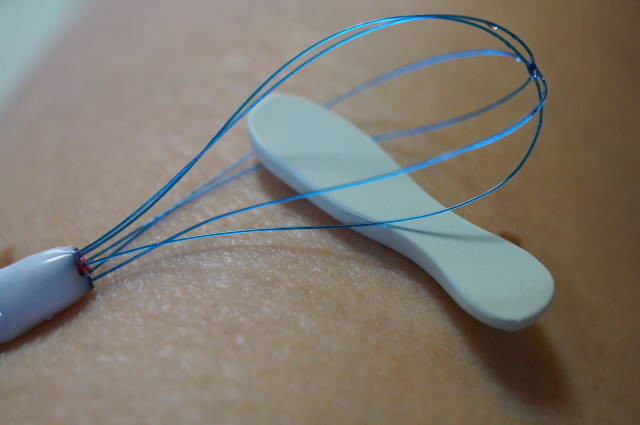
In July 2021, Mr. Okada described ceramic, glass and epoxy-resin chips (the diary does not explain this resin) slipping from forceps. He relayed an unsuccessful retrieval case involving a proposed repeat attempt and possible bladder surgery. His proposed answer was a newly made retrieval prototype; he explicitly said no bladder insertion test had yet taken place.
The prototype was offered only as custom work, with no plan for retail sale at that time. No matching product can be confirmed on the current list. Mr. Okada suggested taking the prototype to a doctor, who could observe the device through a scope.
(Source: ok-lab's diary, published July 2021)
https://ok-lab.hatenablog.com/entry/2021/07/31/125702
Laser chip removal was suggested for discussion before bladder surgery
In his August 2023 reply, Mr. Okada interpreted the customer's stone-treatment account as laser fragmentation (breaking a device into pieces with a laser). The customer had described the equipment's purpose but had not identified its energy source.
Mr. Okada questioned whether steel could be fragmented this way and worried that glass could produce sharp pieces. He suggested a second medical opinion about laser fragmentation when bladder incision surgery was proposed.
(Source: ok-lab's diary, published August 2023)
https://ok-lab.hatenablog.com/entry/2023/08/05/122956
Hospital chip removal referrals depended on another customer's permission
In June 2024, Mr. Okada discussed a separate customer given an operation date about a month after the initial hospital assessment. According to his account, another doctor completed removal with forceps during the visit. Mr. Okada said he could pass on that doctor's details only with permission from the customer who supplied them.
He also acknowledged that the same doctor might still need abdominal surgery if forceps failed. He advised explaining treatment preferences to the doctor, while stressing that OK Lab could provide information but could not judge which treatment was correct.
(Source: ok-lab's diary, published June 2024)
https://ok-lab.hatenablog.com/entry/2024/06/01/123036
If you see blood in your urine, even a small amount or for the first time, do not wait and see. See a urologist right away. If you suddenly cannot urinate, or the device cannot be removed, do not try to fix it yourself. Go to a medical facility, including emergency care, immediately.
How chip removal at a hospital changed over time
| Published | What the diary said then |
|---|---|
| Feb 2019 | Examination found bladder damage despite no blood being detected in urine. |
| Jul 2021 | The manual proposed hospital retrieval using attachment holes or a separate retrieval device. |
| Jul 2021 | A new retrieval prototype had not undergone bladder testing. |
| Aug 2022 | Mr. Okada favored redesigning screw connections over stopping sales. |
| Aug 2023 | Ceramic fragmentation was reported; Mr. Okada interpreted the account as laser treatment. |
| May 2024 | Another brand's broken thread led to hospital removal. |
| Jun 2024 | The follow-up confirmed admission, general anesthesia and the insured charge. |
| May 2026 | Hospital scheduling extended admission from one night/two days to two nights/three days. |
OK Prostate Chip products related to chip removal at a hospital
No current product is directly tied to this topic.
Common worries about chip removal at a hospital
The reader messages raise concerns about fragile glass, broken threads and explaining a hospital stay.
"Could twisted glass complicate chip removal by breaking?"
In February 2019, the customer asked whether the narrower twisted section might be weak. They also suspected the chip's curved shape had experienced excess force; this was their explanation, not a confirmed cause.
Mr. Okada thanked the customer for the detailed report and apologized, without confirming that proposed mechanism. He asked readers to consider the report.
(Source: ok-lab's diary, published February 2019)
https://ok-lab.hatenablog.com/entry/2019/02/02/153358
"Can passing urine resolve a stuck chip?"
In May 2024, the customer asked for help while considering whether urine flow might release the chip. Staff's initial expectation of natural passage did not match the outcome: the customer still needed hospital care.
Mr. Okada later wrote that he had worried about the chip reaching the bladder and proving difficult to grip. He had considered referring the customer to a doctor experienced in difficult removals if the first doctor could not manage it.
(Source: ok-lab's diary, published May 2024)
https://ok-lab.hatenablog.com/entry/2024/05/25/122919
"How did a customer explain hospitalization for chip removal?"
In May 2026, a customer discussed explaining the hospital stay to family and an employer without disclosing the retained chip. The customer said they attributed admission to a blood clot in the bladder.
That was their explanation to others, not a reported medical finding. Mr. Okada presented the account as an example for explaining an inpatient stay to other people.
(Source: ok-lab's diary, published May 2026)
https://ok-lab.hatenablog.com/entry/2026/05/30/122914
Buying from outside Japan
OK Lab ships internationally to countries covered by Japan Post's EMS courier service. Overseas orders are paid in advance by PayPal. Each order carries a ¥400 (about $3 at ¥156 = $1, rate as of 2026-09-04) handling fee, and EMS shipping is charged on top. These terms come from OK Lab's official sales-terms page (written here as plain text, not a link: ok-lab.net/docs/law), checked on September 7, 2026; confirm them on the official store before you order, because they can change.
Summary of this article
| What you wanted to know | The answer |
|---|---|
| What is the short answer? | Hospital removal succeeded in the reported cases, sometimes with admission. |
| What is this product? | A urethral device made by OK Lab in Japan; the company's prices are in JPY. |
| What do the medical terms mean? | Scopes provide an internal view; forceps are gripping instruments. |
| What happened to customers? | Reports include broken glass, reversed orientation, tangled parts and a broken thread. |
| What does the maker suggest? | Hospital retrieval and, in some circumstances, discussion with another doctor. |
| What changed over time? | Later reports added fragmentation, admission details and possible laser backup plans. |
| Which current product is relevant? | No current product is directly tied to this topic. |
| What worries appear in the messages? | Possible glass weakness, failed natural passage and explaining hospitalization. |
| How do overseas orders work? | Advance PayPal payment, a ¥400 (about $3 at ¥156 = $1, rate as of 2026-09-04) handling fee and additional EMS shipping charges. |
Source: ok-lab's diary (Okada Comfortable Life Laboratory). The original entries are in Japanese; quotations on this page are translated. Photos and videos are on the original entries.
This article is a summary of the maker's development diary. The product is not a medical device and no result is guaranteed. If anything feels wrong or worries you, see a doctor. Prices, specifications and cautions change, so confirm the latest information on the official blog and the official site. Questions about ordering and shipping go to the seller.