![Is the urethral sphincter about 5 mm thick? | The diary reports a doctor's estimate [OK Prostate Chip]](/img/a/T0749/eyecatch.svg)
This page is based on entries from "ok-lab's diary" (https://ok-lab.hatenablog.com/), the Japanese development diary written by Mr. Okada, founder of OK Lab, a small company in Japan (Okada Comfortable Life Laboratory). Only the entries about "urethral sphincter thickness around 5 mm" are summarized here, in order of publication. Past prices and sizes are as written at the time. Current prices come from the official product list (retrieved September 4, 2026). Quotations are translated from Japanese.
Note: This page is a personal reading log by someone with no connection to the maker or the seller. It reflects the source entries as of their publication dates and makes no guarantee of accuracy or safety. The product is not a medical device; talk to a doctor about any health decision. Check the official site for current information. This page contains advertising.
In short
- The diary reports a doctor's estimate around 5 mm, alongside customer accounts of discomfort with chip spacing.
- The maker distinguishes stronger pressure from comfortable wear and warns that an overly secure fit could trap a chip.
- The latest supplied entry discusses a custom internal-sphincter gap, rather than revising the earlier external-sphincter estimate.
If you see blood in your urine, even a small amount or for the first time, do not wait and see. See a urologist right away. If you suddenly cannot urinate, or the device cannot be removed, do not try to fix it yourself. Go to a medical facility, including emergency care, immediately.
About this product

The OK Prostate Chip is a small device that is placed in the urethra (the urine passage) so that it acts on the prostate; the maker sells it in several shapes, sizes and materials. It is made and sold by OK Lab (Okada Comfortable Life Laboratory), a small company in Japan, through its own online store, and prices are in Japanese yen (JPY). The maker's development diary, "ok-lab's diary", is written in Japanese. This page is an English summary of it, and every quotation is translated. OK Lab ships internationally, so readers outside Japan can order (see "Buying from outside Japan" below). Product names on this page are plain-English descriptions. The official Japanese product name is shown once in the product table so you can find the same item in the store.
Before you read: key terms
| Term | Plain-English meaning |
|---|---|
| Urethra | The urine passage; it carries urine and is where the maker's device is placed. |
| Prostate | The body structure the device is intended to act on. Its biological purpose: The diary does not explain this. |
| External urethral sphincter | A closing muscle at the prostate entrance in Mr. Okada's explanation; his designs use its grip to hold the chip. |
| Internal urethral sphincter | A muscle at the bladder entrance in the diary's explanation. Its function: The diary does not explain this. |
| Chip spacing | The gap between device parts, discussed as a way to affect pressure on the sphincter. |
| Groove | A recessed section near a chip's rear bulge, intended to engage the sphincter. |
| Stopper | An added part intended to resist the main chip's movement toward the bladder. |
| Screw-shaped auxiliary chip | A twisted additional part used with the main chip to engage the sphincter. |
| Tail | The maker's name for nylon thread covered by silicone tubing, supporting attached parts. |
| Catheter | A tube described in the diary as a means of draining urine from the bladder. |
What happens: urethral sphincter thickness
The OK Prostate Chip is a small device placed in the urethra so that it acts on the prostate. Mr. Okada describes the urethral sphincter (a closing muscle) as normally closed. His replies place the external sphincter at the prostate entrance, where chip grooves and gaps are meant to engage it. He links those dimensions with pressure and stability, but customer reports also describe pain.
A doctor's urethral sphincter thickness estimate came with a warning
In an entry published in June 2018, Mr. Okada described seeking treatment for inflammation of the urine passage. He reports that his doctor put sphincter thickness below 10 mm, but said it was fully 5 mm. This was a conversation reported by Mr. Okada, rather than a measurement recorded for each reader.
Mr. Okada says the doctor initially accepted a hygiene explanation, then questioned the sample chip's size. The doctor thought prolonged wear of the oversized sample might cause strain and contribute to that episode of inflammation. Asked about an extreme groove (a recessed section), the doctor suggested a gentler, gourd-like outline instead.
(Source: ok-lab's diary, published June 2018)
https://ok-lab.hatenablog.com/entry/20180623/1529741851
Shorter chip spacing changed the maker's ceramic prototype preference
In an entry published in September 2019, Mr. Okada reported limited satisfaction with linked ceramic prototypes spaced 4–8 mm apart. He abandoned his earlier assumption that spacing had to match the reported 5 mm muscle thickness. He then favored a 1–2 mm connection that could bend until the gap was nearly 0 mm.
An embedded nylon thread was intended to keep the parts connected if the steel wire broke. No matching product can be confirmed on the current list. Mr. Okada warned that steel wire would eventually break and called for thread replacement because broken wire could damage the nylon.
(Source: ok-lab's diary, published September 2019)
https://ok-lab.hatenablog.com/entry/2019/09/28/140637
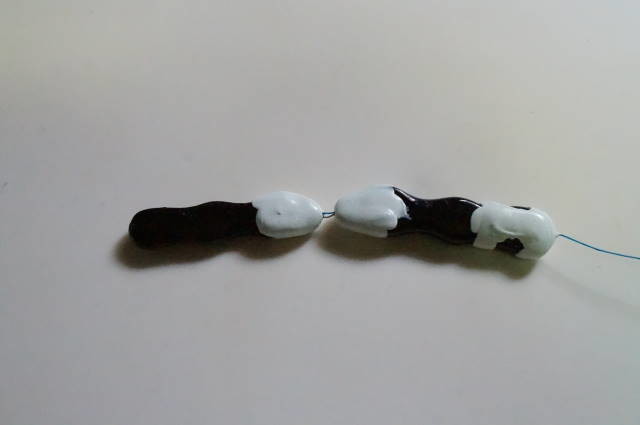
Zero chip spacing prompted a customer's question about painful wear
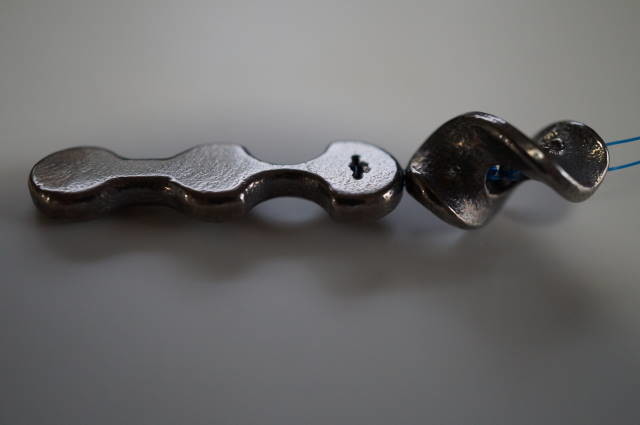
In an entry published in June 2021, a customer wanted several days of wear with a short ceramic twist chip. With a screw-shaped auxiliary chip (an extra twisted part) at 0 mm spacing, they reported muscle pain after about 3 hours.
Mr. Okada replied that this arrangement strongly compressed a sphincter he described as 5–6 mm thick; a few hours might be its limit. No matching product can be confirmed on the current list. The diary does not record whether the customer's discomfort resolved. Mr. Okada favored a less bulky recessed section when discussing longer wear.
(Source: ok-lab's diary, published June 2021)
https://ok-lab.hatenablog.com/entry/2021/06/26/125926
A wider sphincter groove allowed movement in the maker's initial trial
In an entry published in July 2021, Mr. Okada compared groove openings of 6.5 mm and 9 mm. He described the narrower opening as comfortable, while the wider one moved slightly on its first day. His account says the wider version settled by the following day, though he preferred the narrower one when comparing them again.
No matching product can be confirmed on the current list. He had not yet tested the 4 mm version discussed in that entry. Mr. Okada cautioned that this narrower possibility might put more strain on the sphincter.
(Source: ok-lab's diary, published July 2021)
https://ok-lab.hatenablog.com/entry/2021/07/03/125851
Sliding chip spacing required a revised auxiliary-part opening
In an entry published in December 2023, Mr. Okada described a screw attachment that slipped when wet on its tail (silicone-covered nylon thread). With a 2.5 mm opening, he said a 10 mm gap could become 20 mm. A revised 2 mm opening around 2.5 mm tubing reportedly provided enough friction to hold its position while remaining adjustable.
The launch prices were ¥3,000 (about $19 at ¥156 = $1, rate as of 2026-09-04) excluding tax for the attachment and separately ¥2,000 (about $13 at ¥156 = $1, rate as of 2026-09-04) excluding tax for a tail up to 10 cm. No matching product can be confirmed on the current list. Mr. Okada presented adjustable spacing as a way to explore more comfortable wear.
(Source: ok-lab's diary, published December 2023)
https://ok-lab.hatenablog.com/entry/2023/12/02/122648
A wider groove did not prevent this customer's sphincter pain
In an entry published in February 2024, a customer reported pain even with an extended-groove chip. Mr. Okada said his groove widths before the rear bulge reflected an external sphincter thickness estimate of 5–6 mm. He explained that this model alone had a specially widened groove.
His historical estimates were 2–4 mm for tighter spacing and 6–10 mm for looser spacing with a screw-shaped auxiliary chip. The diary does not record how the proposed arrangement felt for this customer. Mr. Okada warned that a long chip entirely beyond the external sphincter could be much more likely to fall into the bladder.
(Source: ok-lab's diary, published February 2024)
https://ok-lab.hatenablog.com/entry/2024/02/10/123023
The maker's answer to urethral sphincter thickness
The maker's replies treat pressure, stability, and comfort as separate concerns, even when they start from a similar thickness estimate.
Sphincter stopper spacing advice distinguished restraint from a tight grip
In an entry published in December 2020, a customer asked about movement and painful inward slipping of a stopper (an added restraining part). Mr. Okada described 3 mm to 7 mm spacing as a tight-grip arrangement for experienced users, not his recommended stopper approach. His reply instead associated approximately 8 mm or more with his concept of safer stopper spacing.
He warned that an unsuitable arrangement could allow the main chip and stopper to travel inward together. The diary does not record whether his reply resolved this customer's slipping problem. Mr. Okada cautioned against treating close spacing as an ordinary stopper setup.
(Source: ok-lab's diary, published December 2020)
https://ok-lab.hatenablog.com/entry/2020/12/12/124126
A catheter experience reinforced the maker's concern about sphincter pressure
In an entry published in June 2021, Mr. Okada recalled a catheter (a urine-drainage tube) remaining in place for a full day during surgery. He reported urinary leakage for about 2 days afterward and suspected sphincter injury. He also mentioned his own handling of the catheter as a possible contributor, leaving the cause uncertain.
His account concerned his own surgical experience, separate from the customer's chip question in that entry. Mr. Okada cautioned that continuing pressure on the sphincter was undesirable.
(Source: ok-lab's diary, published June 2021)
https://ok-lab.hatenablog.com/entry/2021/06/26/125926
A narrower chip section reduced sphincter fatigue in the maker's account
In an entry published in June 2021, Mr. Okada described almost a week of continuous wear with little fatigue from a titanium prototype. He attributed that experience to a narrow section measuring 2 mm, while describing strength requirements around 5 mm for ceramic or glass. For the resin under development, he said at least 3 mm was needed for strength.
Separately, his preferred groove opening was about 4 mm for sensation and 6–7 mm for stability. No matching product can be confirmed on the current list. Mr. Okada advised considering comfortable wear separately from the pursuit of stronger sensation.
(Source: ok-lab's diary, published June 2021)
https://ok-lab.hatenablog.com/entry/2021/06/26/125926
If you see blood in your urine, even a small amount or for the first time, do not wait and see. See a urologist right away. If you suddenly cannot urinate, or the device cannot be removed, do not try to fix it yourself. Go to a medical facility, including emergency care, immediately.
How urethral sphincter thickness changed over time
| Published | What the diary said then |
|---|---|
| Jun 2018 | A reported doctor's estimate accompanied concern about oversized chips and prolonged pressure. |
| Mar 2019 | A roughly 40 mm urethral stimulation prototype was developed with female users in mind. |
| Sep 2019 | Thicker connecting wire remained under comparison before the planned launch. |
| Mar 2020 | Mr. Okada said twisted shapes addressed his concern that rods would prevent urination. |
| Dec 2020 | Mr. Okada suggested absent stopper movement might indicate trapping. |
| Jun 2021 | A 2 mm resin prototype reportedly broke under the fabricator's force. |
| Jul 2021 | The wider groove moved initially, then felt settled the following day. |
| Dec 2023 | A smaller opening addressed the sliding attachment's wet-friction problem. |
| Jan 2025 | Staff's spacing explanation concerned the internal sphincter in a custom loop device. |
The diary does not say what the current state is.
OK Prostate Chip products related to urethral sphincter thickness
No current product is directly tied to this topic.
Common worries about urethral sphincter thickness
The reader questions distinguish material failure, a chip's grip, and spacing around different sphincters.
"Is chip breakage possible with glass and ceramic models?"
In an entry published in March 2020, a customer asked whether the medium-length glass chip could break during insertion, and how ceramic compared. Mr. Okada said both glass and ceramic chips had broken during insertion, although he described such cases as rare. He did not identify sphincter pressure as the cause in that reply.
He said ceramic was the material whose broken surface did not become sharp. The diary does not record a purchase decision or subsequent experience from this questioner. Mr. Okada cautioned that breakage during use could not be ruled out.
(Source: ok-lab's diary, published March 2020)
https://ok-lab.hatenablog.com/entry/2020/03/28/144043
"Can sphincter thickness make a chip stay firmly in place?"
In a separate question published in March 2020, a customer asked about the distance between sphincters and a shape that would remain firmly held. Mr. Okada placed the external sphincter at the prostate entrance and the other sphincter at the bladder entrance. He described the prostate as ordinarily about 30 mm, while giving external sphincter thickness as about 5 mm.
He thought muscle force alone was unlikely to provide the secure hold the customer wanted. The diary does not record a completed custom device resulting from this exchange. Mr. Okada warned that a shape secured by bending might become impossible to remove.
(Source: ok-lab's diary, published March 2020)
https://ok-lab.hatenablog.com/entry/2020/03/28/144043
"Would wider chip spacing change this custom loop device?"
In an entry published in January 2025, a customer asked whether a custom loop device's 5 mm gap could instead be 10 mm. Staff's 5 mm choice reflected their belief that the internal urethral sphincter (the muscle at the bladder entrance) was thin. The customer accepted 5 mm, and manufacture was recorded, though their experience in use was not.
No matching product can be confirmed on the current list. Staff also described a 10 mm screw length and usual width of 6–7 mm. They cautioned that greater width could distort the shape, while expecting little difference between the proposed gap lengths.
(Source: ok-lab's diary, published January 2025)
https://ok-lab.hatenablog.com/entry/2025/01/18/123007

Buying from outside Japan

OK Lab ships internationally to countries covered by Japan Post's EMS courier service. Overseas orders are paid in advance by PayPal. Each order carries a ¥400 (about $3 at ¥156 = $1, rate as of 2026-09-04) handling fee, and EMS shipping is charged on top. These terms come from OK Lab's official sales-terms page (written here as plain text, not a link: ok-lab.net/docs/law), checked on September 7, 2026; confirm them on the official store before you order, because they can change.
Summary of this article
| What you wanted to know | The answer |
|---|---|
| What is the short answer? | The reported thickness estimate did not settle questions about pressure or comfort. |
| What is this product? | A urethral device made and sold by a small Japanese company. |
| Which terms matter? | Muscle thickness, groove dimensions, and spacing between parts describe different things. |
| What happened in these entries? | Doctor feedback, prototype changes, and customer discomfort shaped the maker's explanations. |
| What was the maker's answer? | He distinguished stronger stimulation from comfortable wear and warned about trapping. |
| What changed over time? | Designs and spacing explanations evolved; the latest supplied question concerned the internal sphincter. |
| Is there a current product for this anatomical topic? | No current product is directly tied to this topic. |
| What did customers ask? | They asked about breakage, holding strength, and alternative spacing. |
| How do overseas orders work? | Advance PayPal payment, a ¥400 (about $3 at ¥156 = $1, rate as of 2026-09-04) handling fee, and additional EMS shipping apply under the stated terms. |
Source: ok-lab's diary (Okada Comfortable Life Laboratory). The original entries are in Japanese; quotations on this page are translated. Photos and videos are on the original entries.
This article is a summary of the maker's development diary. The product is not a medical device and no result is guaranteed. If anything feels wrong or worries you, see a doctor. Prices, specifications and cautions change, so confirm the latest information on the official blog and the official site. Questions about ordering and shipping go to the seller.