![What problems can a nitinol wire chip have? | Strong stimulation, uneven spacing, and difficult positioning [OK Prostate Chip]](/img/a/T0601/eyecatch.svg)
This page is based on entries from "ok-lab's diary" (https://ok-lab.hatenablog.com/), the Japanese development diary written by Mr. Okada.
He founded OK Lab, a small company in Japan (Okada Comfortable Life Laboratory).
Only the entries about "nitinol wire chips" are summarized here, in order of publication. Past prices and sizes are as written at the time. Current prices come from the official product list (retrieved September 4, 2026). Quotations are translated from Japanese.
Note: This page is a personal reading log by someone with no connection to the maker or the seller. It reflects the source entries as of their publication dates and makes no guarantee of accuracy or safety. The product is not a medical device; talk to a doctor about any health decision. Check the official site for current information. This page contains advertising.
In short
- Customers reported excessive stimulation, uneven spacing, and difficulty positioning some nitinol wire chips.
- Mr. Okada responded with altered spacing, different wire thicknesses, and finer-wire designs.
- No matching product can be confirmed on the current list.
About this product
The OK Prostate Chip is a small device that is placed in the urethra (the urine passage) so that it acts on the prostate; the maker sells it in several shapes, sizes and materials. It is made and sold by OK Lab (Okada Comfortable Life Laboratory), a small company in Japan, through its own online store, and prices are in Japanese yen (JPY). The maker's development diary, "ok-lab's diary", is written in Japanese. This page is an English summary of it, and every quotation is translated. OK Lab ships internationally, so readers outside Japan can order (see "Buying from outside Japan" below). Product names on this page are plain-English descriptions. The official Japanese product name is shown once in the product table so you can find the same item in the store.
Before you read: key terms
| Term | Plain-English meaning |
|---|---|
| Nitinol | Shape-memory wire used for the central support and projecting parts of these designs. |
| Shaft | The central support carrying the wire loops or legs. |
| Legs and wings | Wire projections along the shaft, intended to stimulate several places in the urethra. |
| Guide loop | A leading wire loop that Mr. Okada intended to help the device pass narrowed sections. |
| Stopper | A loop or additional part intended to help keep a device in place. |
| Outer urethral sphincter | A muscle beside the prostate, discussed here as a site of pressure from the device. |
| Catheter | A tube described in the April customer's account as a placement aid. |
| Jointed design | Separate resin-covered sections joined along a wire support, allowing the structure to bend. |
What happens: nitinol wire chip problems
The OK Prostate Chip is a device placed in the urethra, the urine passage, to act on the prostate. The nitinol (shape-memory wire) versions have projecting loops or fine legs along a shaft (central support). Mr. Okada designed these parts to stimulate several places inside the urethra near the prostate at once. The entries describe flexible prototypes, jointed builds, and later fine-wire models with different dimensions and handling limits.
Early nitinol wire chip prices depended on the number of loop pairs
In an entry published in October 2025, Mr. Okada introduced a flexible design with paired wire loops. His prototypes used 0.1mm wire with 10 pairs, 0.15mm with 8, and 0.1mm with 6. The ¥2,000 (about $13 at ¥156 = $1, rate as of 2026-09-04) base, excluding tax, combined a 0.15mm guide loop (leading loop), nylon thread, and supporting wire of the same thickness.
For 4 or more pairs, each pair cost ¥1,500 (about $10 at ¥156 = $1, rate as of 2026-09-04), excluding tax. For 3 or fewer pairs, each pair cost ¥2,000 (about $13 at ¥156 = $1, rate as of 2026-09-04), excluding tax. Mr. Okada described 0.1mm wire as gentler and suggested 0.15mm for those wanting stronger stimulation.
(Source: ok-lab's diary, published October 2025)
https://ok-lab.hatenablog.com/entry/2025/10/18/122911
Excessive nitinol wire chip stimulation prompted wider spacing and mixed thicknesses
In an entry published in November 2025, a customer said the previous build felt too strong and distracting. The request combined wider spacing with mostly 0.1mm loops. Only the first and fourth loops, intended to sit on opposite sides of the prostate, were specified as 0.15mm.
Mr. Okada reported making that mixed-wire specification. The diary does not record how the revised version felt.
(Source: ok-lab's diary, published November 2025)
https://ok-lab.hatenablog.com/entry/2025/11/08/122932
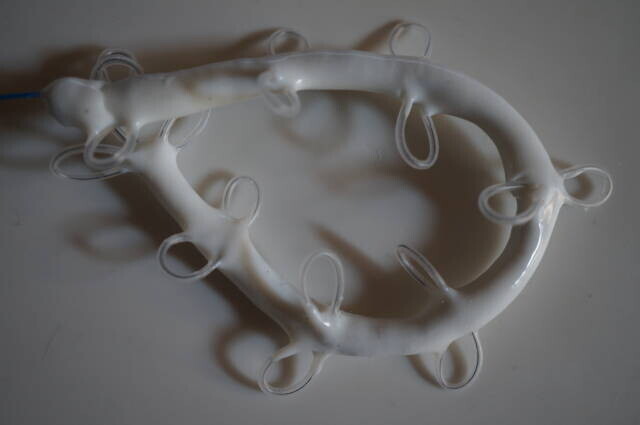
A nitinol wire chip request received a ¥15,400 (about $99 at ¥156 = $1, rate as of 2026-09-04) custom quote
In an entry published in January 2026, a customer requested prototype 2 with 0.15mm wire and a 70mm overall length. The request also specified two threads, each 25cm long, and a central support made as thin as possible.
The quoted chip price was ¥15,400 (about $99 at ¥156 = $1, rate as of 2026-09-04). The diary does not record the finished dimensions or the customer's experience with this specification.
(Source: ok-lab's diary, published January 2026)
https://ok-lab.hatenablog.com/entry/2026/01/17/122907
A nitinol wire chip extension request included an unconfirmed proposed price
A separate entry published in January 2026 included a request for an extended prototype 2. The customer specified 0.1mm wire, 8 pairs, and 195mm from the chip's tip to the extension's end.
The customer's message proposed ¥3,300 (about $21 at ¥156 = $1, rate as of 2026-09-04) for the rear extension, alongside a ¥15,400 (about $99 at ¥156 = $1, rate as of 2026-09-04) chip price. The supplied paragraph does not record whether OK Lab confirmed that proposed extension charge.
(Source: ok-lab's diary, published January 2026)
https://ok-lab.hatenablog.com/entry/2026/01/31/122917
One nitinol wire chip user reported uneven spacing and handling difficulties
In an entry published in April 2026, a prototype user requested changes after several months of use. The customer described strong sensations about every 30 seconds, sometimes throughout a night, but reported uneven spacing. Although the stated interval was 12mm, measurements reportedly ranged from 8mm–15mm, with 20mm also noted; 10mm felt best to that customer.
Hand placement had proved impractical, and the 35cm thread was too short for the customer's catheter (tube) arrangement. Requested changes included extending the 110mm shaft to 130mm–140mm, increasing 8 pairs to 12, and providing 60cm thread. OK Lab accepted the nickname for the longer looped wire build (Skyfish Ver. 1); its later performance is not recorded.
(Source: ok-lab's diary, published April 2026)
https://ok-lab.hatenablog.com/entry/2026/04/04/122916
A nitinol wire chip redesign separated parts after excessive pressure
In an entry published in July 2026, a customer liked a short looped chip's sensations but wanted its structure changed. The customer reported extremely high pressure on the outer urethral sphincter (a muscle beside the prostate). The chip was connected directly to an apple-shaped stopper (a part intended to help keep it in place).
Mr. Okada made a version with a much wider gap between the wire assembly and that stopper. The diary does not record whether the altered gap reduced the customer's discomfort.
(Source: ok-lab's diary, published July 2026)
https://ok-lab.hatenablog.com/entry/2026/07/25/123012
A jointed nitinol wire chip used resin instead of full rubber coverage
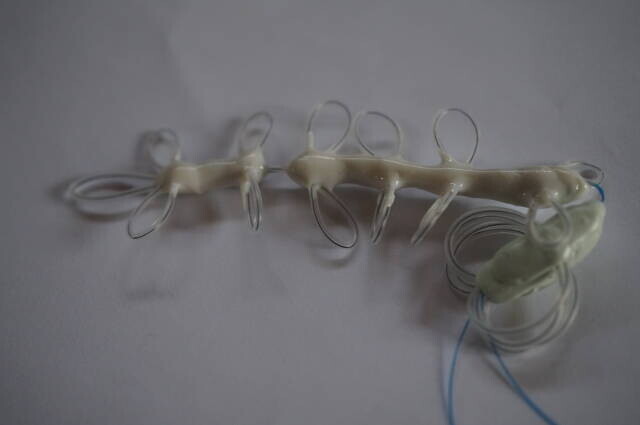
In an entry published in August 2026, a customer requested a jointed design (separate sections connected along a wire support). Mr. Okada wrote that he reconstructed it after consulting older diary entries.
The jointed build had a resin covering, while the flexible version had rubber over its whole shaft. Both designs used doubled 0.15mm wire inside the shaft. Tubing covered the wire and thread at the joints; the portions inside the resin sections were not enclosed in tubing.
(Source: ok-lab's diary, published August 2026)
https://ok-lab.hatenablog.com/entry/2026/08/15/122912
A longer fine-wire chip received separate shaft and structure quotes
In an entry published in August 2026, a customer requested a fine-wire chip matching an earlier custom example. The requested shaft measured 35cm.
The quote listed ¥4,400 (about $28 at ¥156 = $1, rate as of 2026-09-04) for that shaft and ¥4,400 (about $28 at ¥156 = $1, rate as of 2026-09-04) for the projecting wire structure. The diary does not record how this particular build performed.
(Source: ok-lab's diary, published August 2026)
https://ok-lab.hatenablog.com/entry/2026/08/29/122931
The maker's answer to nitinol wire chip problems
Mr. Okada proposed design changes while acknowledging removal resistance, difficult positioning, and manufacturing limits.
Additional nitinol wire chip loops offered retention with greater removal resistance
In an entry published in October 2025, a customer wanted a rear attachment to help a semi-long chip stay in place. Staff first requested a clearer design. Mr. Okada later explained that bent-wire attachments had length limits, while straight-wire versions allowed more freedom.
He suggested the looped wire design as another possibility because its numerous stopper-like loops could help it stay in place. The reply contains no performance result for that proposed combination. He also cautioned that the same stopper effect produced considerable resistance during removal.
(Source: ok-lab's diary, published October 2025)
https://ok-lab.hatenablog.com/entry/2025/10/18/122911
A finer nitinol wire chip was intended to ease positioning difficulties
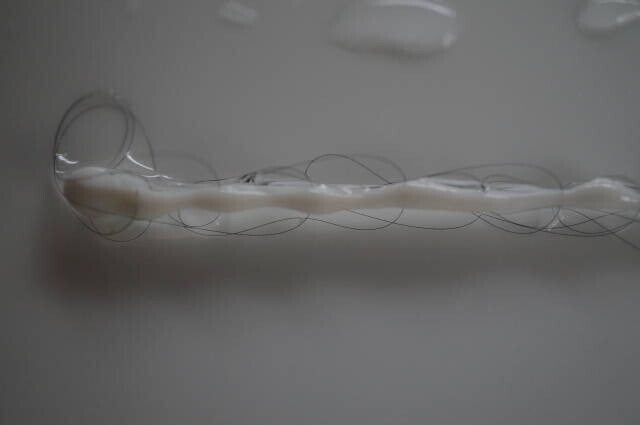
In an entry published in May 2026, Mr. Okada said the earlier looped designs were difficult to position, slide, or rotate. His new prototype used 30-micron (0.03mm) wire, supported by a 1mm tube containing 0.2mm wire. He reported that the finer design could move or turn with little force.
The 25cm shaft included 8cm of wings (looped wire projections) and a remaining 17cm support section. May 2026 prices excluded tax: ¥3,000 (about $19 at ¥156 = $1, rate as of 2026-09-04) for the shaft and ¥8,000 (about $51 at ¥156 = $1, rate as of 2026-09-04) for 8 wing pairs, with a stated total of ¥11,000 (about $70 at ¥156 = $1, rate as of 2026-09-04). Mr. Okada asked buyers to accept approximate dimensions and 7–10 pairs, despite the target of 8.
(Source: ok-lab's diary, published May 2026)
https://ok-lab.hatenablog.com/entry/2026/05/23/122904
Straight legs made the later fine-wire chip less costly to produce
In an entry published in May 2026, Mr. Okada proposed straight legs to reduce the demanding work of making tiny loops. He used 0.04mm wire with rubber-covered tips because he was concerned about irritation from exposed wire ends. Specifications listed a 25cm shaft, an 8cm leg section, and 16 target pairs, each leg about 20mm long.
The May 2026 prices excluded tax: ¥3,000 (about $19 at ¥156 = $1, rate as of 2026-09-04) for the shaft and ¥4,000 (about $26 at ¥156 = $1, rate as of 2026-09-04) for the leg structure. The stated total was ¥7,000 (about $45 at ¥156 = $1, rate as of 2026-09-04). Mr. Okada asked buyers to accept uneven lengths and 15–18 pairs because exact results were difficult to produce.
(Source: ok-lab's diary, published May 2026)
https://ok-lab.hatenablog.com/entry/2026/05/30/122914
How nitinol wire chip problems changed over time
| Published | What the diary said then |
|---|---|
| Oct 2025 | Rubber covering was intended to moderate the wire's return toward its remembered shape. |
| Nov 2025 | A complaint of excessive stimulation prompted wider spacing and mixed wire thicknesses. |
| Dec 2025 | Precise loop directions and dimensions could not be guaranteed. |
| Apr 2026 | A user requested a longer shaft, more pairs, and different spacing. |
| May 2026 | Fine-wire wings were proposed after positioning difficulties with earlier designs. |
| May 2026 | Rubber-tipped straight legs offered a less demanding manufacturing method. |
| Jul 2026 | A wider gap separated the wire assembly from its stopper after a pressure complaint. |
| Aug 2026 | A requested jointed resin construction was distinguished from the fully rubber-covered design. |
| Aug 2026 | A longer fine-wire build received separate quotes for its shaft and wire structure. |
The diary does not say what the current state is.
OK Prostate Chip products related to nitinol wire chip problems
No current product is directly tied to this topic.
Common worries about nitinol wire chip problems
The replies explain construction limits and possible sensations, but several requested designs have no recorded follow-up.
"Can nitinol wire chip loops have exact sizes and directions?"
In an entry published in December 2025, a customer requested controlled loop directions and precise dimensions. OK Lab replied that the soft shaft could not fix directions or support 6mm and 12mm specifications in 1mm steps.
The customer accepted looser spacing requirements, and Mr. Okada attempted the revised build without achieving a uniform result. He explained that flowing rubber and room temperature affected how each piece set. Staff advised considering roughly larger or smaller loops than the standard 10mm, rather than exact measurements.
(Source: ok-lab's diary, published December 2025)
https://ok-lab.hatenablog.com/entry/2025/12/20/123000
"Can a jointed wire chip include an apple-shaped stopper?"
In an entry published in March 2026, a customer requested an apple-shaped stopper on a jointed wire chip. After revising the request, the customer specified 6 wire-loop positions across 5 units. Mr. Okada reported making the combination, describing the stopper request as a first for that jointed design.
The customer had asked for a separate stopper if possible; the text does not confirm that detail. The diary contains no account of how the finished combination felt.
(Source: ok-lab's diary, published March 2026)
https://ok-lab.hatenablog.com/entry/2026/03/14/122910
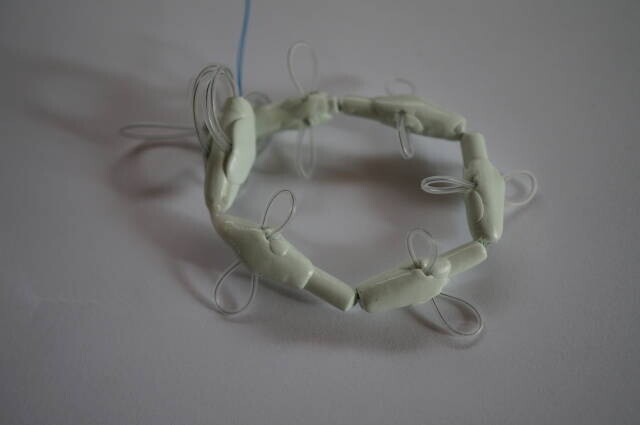
"Can a nitinol wire chip keep sensations from fading?"
In an entry published in August 2026, a customer described fading sensations in some positions and asked about the looped wire design. Mr. Okada said he could not identify a definite recommendation.
He nevertheless described the nitinol wire chip as staying in place well and stimulating multiple parts of the urethra simultaneously. He thought this might keep sensations from fading, but the entry records no customer trial of that suggestion.
(Source: ok-lab's diary, published August 2026)
https://ok-lab.hatenablog.com/entry/2026/08/08/122906
Buying from outside Japan
OK Lab ships internationally to countries covered by Japan Post's EMS courier service. Overseas orders are paid in advance by PayPal. Each order carries a ¥400 (about $3 at ¥156 = $1, rate as of 2026-09-04) handling fee, and EMS shipping is charged on top. These terms come from OK Lab's official sales-terms page (written here as plain text, not a link: ok-lab.net/docs/law), checked on September 7, 2026; confirm them on the official store before you order, because they can change.
Summary of this article
| What you wanted to know | The answer |
|---|---|
| In short: what were the main problems? | Excessive stimulation, uneven spacing, and difficult positioning appeared in the diary. |
| About this product: who makes it? | OK Lab in Japan makes the urethral device; prices are in Japanese yen. |
| Key terms: what are the projecting parts? | Wire loops or legs intended to stimulate several locations. |
| What happens: did custom changes settle the problems? | The diary records changes, but several builds have no later user report. |
| The maker's answer: what changed? | Wire thickness, spacing, support construction, and manufacturing methods. |
| Changed over time: was there one fixed design? | The entries describe several flexible, jointed, and fine-wire designs. |
| Related products: is there a confirmed current match? | No current product is directly tied to this topic. |
| Common worries: could exact specifications be guaranteed? | OK Lab explained limits on loop direction, dimensions, and consistency. |
| Buying from outside Japan: what are the stated terms? | Advance PayPal payment, an additional handling fee, and EMS shipping charges. |
Source: ok-lab's diary (Okada Comfortable Life Laboratory). The original entries are in Japanese; quotations on this page are translated. Photos and videos are on the original entries.
This article is a summary of the maker's development diary. The product is not a medical device and no result is guaranteed. If anything feels wrong or worries you, see a doctor. Prices, specifications and cautions change, so confirm the latest information on the official blog and the official site. Questions about ordering and shipping go to the seller.