![Why is the Prostate Alien S-shaped? | The curves changed after prototype problems [OK Prostate Chip]](/img/a/T0598/eyecatch.svg)
This page is based on entries from "ok-lab's diary" (https://ok-lab.hatenablog.com/), the Japanese development diary written by Mr. Okada, founder of OK Lab, a small company in Japan (Okada Comfortable Life Laboratory). Only the entries about "Prostate Alien shape" are summarized here, in order of publication. Past prices and sizes are as written at the time. Current prices come from the official product list (retrieved September 4, 2026). Quotations are translated from Japanese.
Note: This page is a personal reading log by someone with no connection to the maker or the seller. It reflects the source entries as of their publication dates and makes no guarantee of accuracy or safety. The product is not a medical device; talk to a doctor about any health decision. Check the official site for current information. This page contains advertising.
In short
- Early prototypes caused urinary blockage or unwanted pressure; the maker later adopted an S-shaped design.
- Mr. Okada recommended covered wire and later developed a custom curved model with rubber joints.
- The current list includes a related tail clamp, but neither named chip has a confirmed match.
If you see blood in your urine, even a small amount or for the first time, do not wait and see. See a urologist right away. If you suddenly cannot urinate, or the device cannot be removed, do not try to fix it yourself. Go to a medical facility, including emergency care, immediately.
About this product

The OK Prostate Chip is a small device that is placed in the urethra (the urine passage) so that it acts on the prostate; the maker sells it in several shapes, sizes and materials. It is made and sold by OK Lab (Okada Comfortable Life Laboratory), a small company in Japan, through its own online store, and prices are in Japanese yen (JPY). The maker's development diary, "ok-lab's diary", is written in Japanese. This page is an English summary of it, and every quotation is translated. OK Lab ships internationally, so readers outside Japan can order (see "Buying from outside Japan" below). Product names on this page are plain-English descriptions. The official Japanese product name is shown once in the product table so you can find the same item in the store.
Before you read: key terms
| Term | Plain-English meaning |
|---|---|
| Shape-memory wire | Wire that returns toward a preset curve; it connects the chip sections and provides their springiness. |
| Bulbar section | The rear chip piece in the urethra outside the prostate; it supports the curved assembly. |
| Tube cover | A sleeve around wire or threads; it covers these connections and changes their contact with the urine passage. |
| Internal urethral sphincter | The structure discussed at the bladder end of the prostate passage. Its normal function: The diary does not explain this. |
| Epoxy resin | The hard material used for chip pieces and connections; it forms shapes and secures other components. |
| Base shaft | The central support carrying the chip pieces; its dimensions determine their spacing and the assembly's curve. |
| Covered tail | A flexible tube around threads behind the chip; it provides the covering requested for otherwise exposed threads. |
| Curved cable connector | A rear attachment called Lock-on; a customer proposed it as a replacement for the rear support section. |
| Tail clamp | A sliding attachment called Gatekeeper; the diary describes it gripping a covered tail. |
What happens: Prostate Alien shape
The OK Prostate Chip is a small device placed in the urethra, the urine passage, to act on the prostate. The S-shaped chip (Prostate Alien) connects pieces intended for the bladder, the prostate passage, and the urethra farther outward. Mr. Okada developed its curves to hold the assembly in position, while later designs allowed more choices of length, width and angle. The diary records both design changes and unsuccessful prototypes.
A rounded Prostate Alien head blocked urine during an early test
In an entry published in February 2024, Mr. Okada described testing a spherical bladder section instead of a flatter head. He reported that the sphere acted as a plug and prevented urination entirely. He reported poor flow with one opening and described later prototypes with at least two drainage openings.
He thought those openings made the head resemble an alien. He wrote that urination resumed after the spherical prototype was taken out. His favorable assessment of the earlier spherical version was limited to short-duration use, since normal urination remained a problem.
(Source: ok-lab's diary, published February 2024)
https://ok-lab.hatenablog.com/entry/2024/02/17/123013
Paired pieces gave the Prostate Alien an adjustable central section
In an entry published in April 2024, Mr. Okada proposed paired screw-shaped pieces for the section within the prostate. Their spacing allowed that section's overall length to vary. His examples represented prostate passages roughly 28 mm and 35 mm long.
The other proposed shape was a single flattened, curved piece. Mr. Okada proposed tailoring the paired pieces' spacing to the length of the prostate passage.
(Source: ok-lab's diary, published April 2024)
https://ok-lab.hatenablog.com/entry/2024/04/06/122941
The Prostate Alien name came to identify a connected bladder section
In an entry published in April 2024, Mr. Okada distinguished the bladder-connected design from the broader family using shape-memory wire (wire retaining a preset curve). The rear support, or bulbar section, was described as a short, roughly disc-shaped resin piece about 10 mm across. Proposed wire spans between the prostate piece and rear support were 4 cm, 5 cm or 6 cm.
The proposed bends ranged from about 70 degrees to 90 degrees. For shorter spans, Mr. Okada favored the smaller bend because the sharper curve would produce excessive springiness.
(Source: ok-lab's diary, published April 2024)
https://ok-lab.hatenablog.com/entry/2024/04/13/123053
Abdominal irritation prompted a reverse curve in the S-shaped chip
In an entry published in May 2024, Mr. Okada said the C-shaped prototype sometimes caused irritation by pressing toward his abdomen. He changed the bladder section to bend toward his back, creating the S shape. The standard bladder section was 20 mm long; the prostate section was 25 mm, with a 6 mm gap between them.
The bulbar section was 25 mm long, separated from the prostate section by 30 mm. With the prostate section straight, the diagram showed the bladder section about 30 degrees right and the bulbar section about 80 degrees left. Mr. Okada treated changes to these lengths and angles as custom requests.
(Source: ok-lab's diary, published May 2024)
https://ok-lab.hatenablog.com/entry/2024/05/18/122913
Continuous wire and threads linked all three S-shaped chip pieces
In an entry published in May 2024, the specified assembly used one shape-memory wire connecting all three chip pieces. Two nylon threads also continued from the bladder piece, through the assembly, to outside the body. Mr. Okada described these continuous connections as protection against an individual piece coming loose.
He also described connections combining flexible silicone rubber with epoxy resin (the hard outer material securing the joint). In his explanation, the rubber absorbed movement while the resin limited how far it could move.
(Source: ok-lab's diary, published May 2024)
https://ok-lab.hatenablog.com/entry/2024/05/25/122919
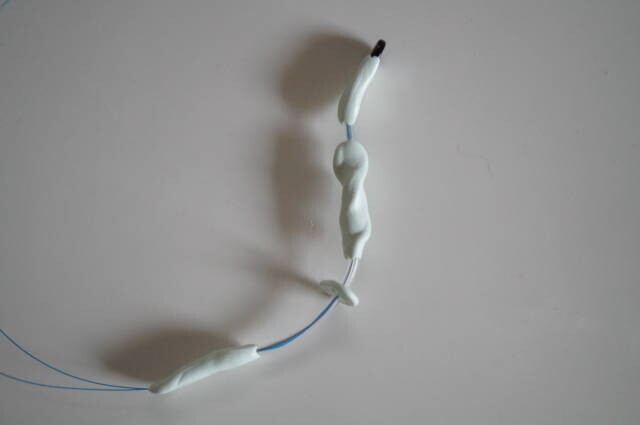
Inward movement influenced the S-shaped chip's reversed bladder curve
In an entry published in August 2024, a customer asked about a fully internal version of a long, curved chip. Mr. Okada was reluctant because the shape could keep moving farther into the bladder. He explained that long, arc-shaped prototypes had shown this tendency during development of the S-shaped chip.
He connected that finding to the finished design's reverse curve at the bladder section. The diary does not record whether this customer's proposed order was completed.
(Source: ok-lab's diary, published August 2024)
https://ok-lab.hatenablog.com/entry/2024/08/17/122842
The maker's answer to Prostate Alien shape
Mr. Okada favored covered connections, specified dimensions and revised joints, while continuing to report problems found during testing.
Damaged outer connections prompted a warning for the Prostate Alien family
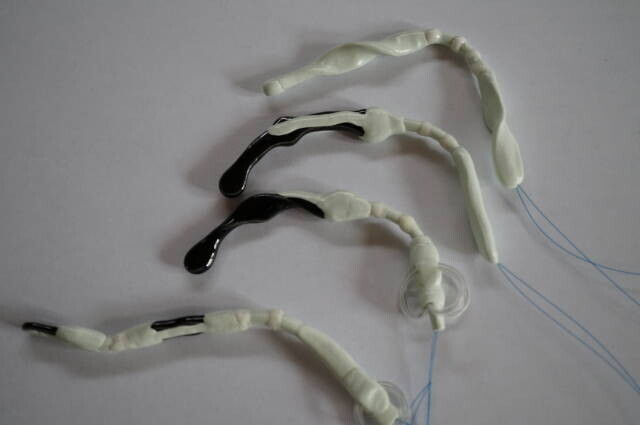
In an entry published in April 2024, Mr. Okada described connections that combined bonding with hooked wire ends. He believed the inner connections would remain attached even if the outer resin cracked. Despite that confidence, he advised stopping use if the outer resin at a connection was damaged.
(Source: ok-lab's diary, published April 2024)
https://ok-lab.hatenablog.com/entry/2024/04/13/123053
Standard S-shaped chip pricing covered the assembly and its wire sleeve
In an entry published in May 2024, the standard assembly cost ¥13,000, (about $83 at ¥156 = $1, rate as of 2026-09-04) excluding tax, including three chips, their wire connection and tube cover. Standard widths for all three sections were SS = 7 mm, S = 8 mm, M = 9 mm, L = 10 mm. A flat prostate section reduced the price by ¥1,000 (about $6 at ¥156 = $1, rate as of 2026-09-04), while a screw-shaped bulbar section added ¥1,000 (about $6 at ¥156 = $1, rate as of 2026-09-04).
Omitting the tube cover reduced the price by ¥1,000 (about $6 at ¥156 = $1, rate as of 2026-09-04). Mr. Okada asked customers to specify nonstandard dimensions when requesting a custom build.
(Source: ok-lab's diary, published May 2024)
https://ok-lab.hatenablog.com/entry/2024/05/18/122913
The S-shaped chip carried a specific recommendation for covered wire
In an entry published in May 2024, Mr. Okada recommended a tube cover (a sleeve over the wire) for this design. He wrote that bare wire was particularly uncomfortable at the internal urethral sphincter (the boundary described between prostate and bladder). Although the options allowed the cover to be omitted, his advice for the S-shaped chip was to retain it.
(Source: ok-lab's diary, published May 2024)
https://ok-lab.hatenablog.com/entry/2024/05/18/122913
Rubber joints became standard for the custom curved chip in January
In an entry published in January 2026, Mr. Okada reported that the earlier custom curved prototype felt comfortable but shifted during prolonged wear. He attributed the movement to low friction across its resin surfaces. The revised construction used rubber-filled joints instead of a cracked-resin bend.
The new standard was four joints across roughly 20 mm, with a base shaft (central support) about 4 mm in diameter. Published prices, excluding tax, were ¥3,000 (about $19 at ¥156 = $1, rate as of 2026-09-04) for the base shaft, ¥2,000 (about $13 at ¥156 = $1, rate as of 2026-09-04) per flat resin end, and ¥3,000 (about $19 at ¥156 = $1, rate as of 2026-09-04) per twisted resin end. Mr. Okada asked customers to specify the resin pieces' length and width.
(Source: ok-lab's diary, published January 2026)
https://ok-lab.hatenablog.com/entry/2026/01/03/122924
If you see blood in your urine, even a small amount or for the first time, do not wait and see. See a urologist right away. If you suddenly cannot urinate, or the device cannot be removed, do not try to fix it yourself. Go to a medical facility, including emergency care, immediately.
How Prostate Alien shape changed over time
| Published | What the diary said then |
|---|---|
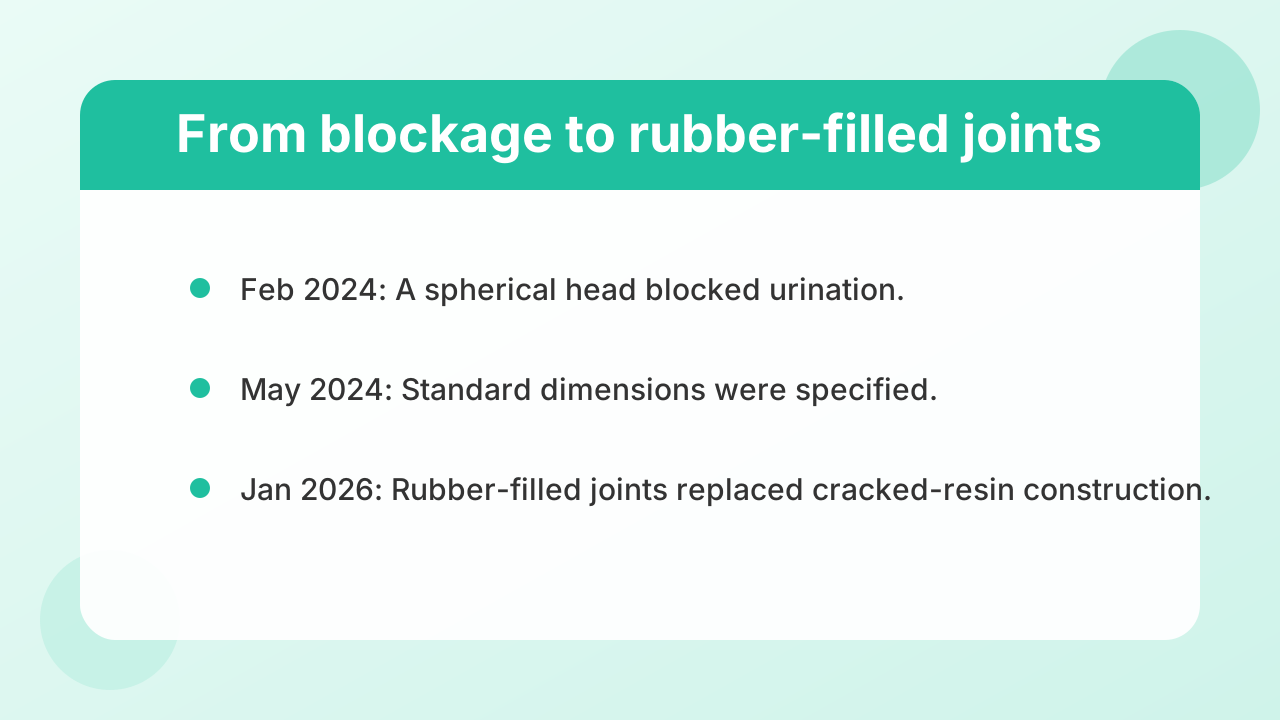
| Feb 2024 | A spherical head blocked urination; subsequent prototypes gained drainage openings. |
| Apr 2024 | Paired screw-shaped pieces allowed different prostate-section lengths. |
| Apr 2024 | Prices and sales conditions for the bladder-connected design remained undecided. |
| May 2024 | The S shape and standard dimensions were specified. |
| May 2024 | The specification confirmed continuous nylon threads through the assembly. |
| Aug 2024 | Long curved prototypes' inward movement explained another reason for the reverse curve. |
| Sep 2024 | Replacing the rear support with a cable-based curve was discouraged. |
| Dec 2025 | A custom curved design expanded control over length, width and angle. |
| Jan 2026 | Rubber-filled joints replaced the earlier cracked-resin construction. |
The diary does not say what the current state is.
OK Prostate Chip products related to Prostate Alien shape
A related tail clamp appears on the current list; the two named chip designs have no confirmed current match.
Products that appear in these entries
| Product (official name) | Price incl. tax | Relation to this topic |
|---|---|---|
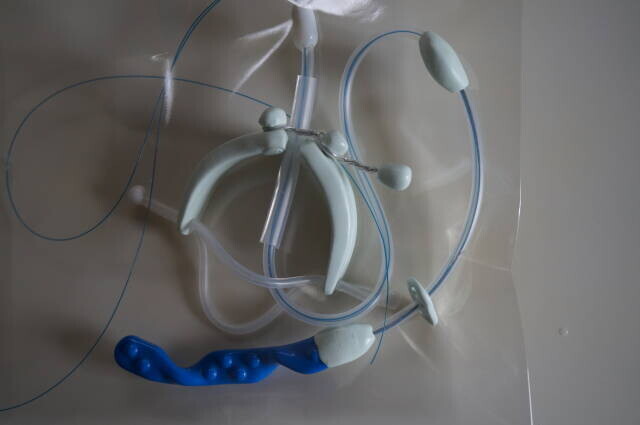
| Sliding tail clamp (スライドロック式尿道ゲートキーパー) | ¥6,600 (about $42 at ¥156 = $1, rate as of 2026-09-04) | In May 2024, Mr. Okada described this clamp gripping a covered tail with an additional sleeve. |
The sliding tail clamp is listed in OK Lab's own online store.

(Source: ok-lab's diary, published May 2024)
https://ok-lab.hatenablog.com/entry/2024/05/25/122919
Products the diary mentioned as alternatives
The diary names no alternative.
The S-shaped chip (Prostate Alien) and custom curved chip (Apple Alien) are the diary names for the designs discussed here. No matching product can be confirmed on the current list.
Common worries about Prostate Alien shape
The recorded requests concern covered threads, a different rear connector, and a chip that is both narrow and long.
"Can an S-shaped chip have a covered tail?"
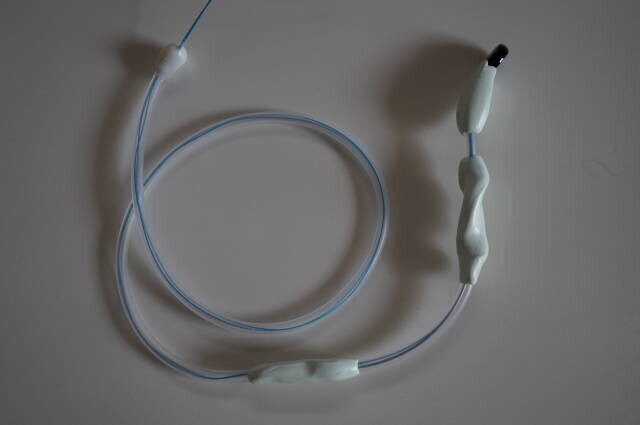
In an entry published in May 2024, a customer asked whether the S-shaped chip's exposed threads could have a tube covering. Mr. Okada made a covered tail (a flexible tube around those threads) with the requested 25 cm length.
He continued the tubing from the bladder section, producing an assembly about 35 cm long. The diary does not record how this customer's completed build felt in use.
(Source: ok-lab's diary, published May 2024)
https://ok-lab.hatenablog.com/entry/2024/05/25/122919
"Can an S-shaped chip use a different rear connector?"
In an entry published in September 2024, a customer wanted a motorized S-shaped chip with a prostate section about 10 mm wide. Staff replied that a 6 mm motor would fit; even an 8 mm motor could just fit within 10 mm. The motor housing would be flat; the customer also proposed replacing the rear support with a curved cable connector (Lock-on).
Mr. Okada opposed that replacement because cable springiness would replace the shape-memory wire's stronger hold on the curve. He said adding the connector behind the intact assembly was possible, although it duplicated an existing bend. The diary does not record whether the revised order was completed.
(Source: ok-lab's diary, published September 2024)
https://ok-lab.hatenablog.com/entry/2024/09/21/122907
"Can a custom curved chip be both long and narrow?"
In an entry published in December 2025, Mr. Okada revisited requests for a chip that was both slim and long. He presented the custom curved chip (Apple Alien), with length, width and bend angle designed to order. He said resin around the wire core made widths of 5 mm or 6 mm possible.
The proposed base length was 60 mm to 80 mm, with resin sections 20 mm to 40 mm long. Bend angles could be specified within the range of 60 to 90 degrees; he thought uncovered versions might need an angle of about 60 degrees to pass through the straight section of the urethra. Mr. Okada asked customers to specify the dimensions and positions of the chip sections.
(Source: ok-lab's diary, published December 2025)
https://ok-lab.hatenablog.com/entry/2025/12/27/122915
Buying from outside Japan

OK Lab ships internationally to countries covered by Japan Post's EMS courier service. Overseas orders are paid in advance by PayPal. Each order carries a ¥400 (about $3 at ¥156 = $1, rate as of 2026-09-04) handling fee, and EMS shipping is charged on top. These terms come from OK Lab's official sales-terms page (written here as plain text, not a link: ok-lab.net/docs/law), checked on September 7, 2026; confirm them on the official store before you order, because they can change.
Summary of this article
| What you wanted to know | The answer |
|---|---|
| In short: why the shape changed | Early blockage and pressure problems led to changes in the bladder section. |
| About this product | A Japanese company's urethral device, with different shapes, materials and sizes. |
| Key terms | Wire supplies springiness; covers, resin and support pieces have different roles. |
| What happens | The diary describes a progression from spherical heads to a connected S-shaped assembly. |
| The maker's answer | Covered wire, specified dimensions and later rubber joints were his design responses. |
| Changes over time | The entries run from February 2024 prototypes to January 2026 joint specifications. |
| Related products | The tail clamp is listed at ¥6,600 (about $42 at ¥156 = $1, rate as of 2026-09-04) including tax; neither named chip has a confirmed match. |
| Common worries | The diary records replies about covered tails, cable connectors and custom dimensions. |
| Buying outside Japan | The stated terms use PayPal, EMS shipping and a ¥400 (about $3 at ¥156 = $1, rate as of 2026-09-04) handling fee. |
Source: ok-lab's diary (Okada Comfortable Life Laboratory). The original entries are in Japanese; quotations on this page are translated. Photos and videos are on the original entries.
This article is a summary of the maker's development diary. The product is not a medical device and no result is guaranteed. If anything feels wrong or worries you, see a doctor. Prices, specifications and cautions change, so confirm the latest information on the official blog and the official site. Questions about ordering and shipping go to the seller.