![What is this wire urethral insert? | Custom loops with reported breakage [OK Prostate Chip]](/img/a/T0600/eyecatch.svg)
This page is based on entries from "ok-lab's diary" (https://ok-lab.hatenablog.com/), the Japanese development diary written by Mr. Okada, founder of OK Lab, a small company in Japan (Okada Comfortable Life Laboratory). Only the entries about "urethral centipede" are summarized here, in order of publication. Past prices and sizes are as written at the time. Current prices come from the official product list (retrieved September 4, 2026). Quotations are translated from Japanese.
Note: This page is a personal reading log by someone with no connection to the maker or the seller. It reflects the source entries as of their publication dates and makes no guarantee of accuracy or safety. The product is not a medical device; talk to a doctor about any health decision. Check the official site for current information. This page contains advertising.
In short
Urethral centipede reports include broken ears and an injury to the urethral lining.
The maker responded with different shapes, revised joints, and repair offers.
The current product list includes the nylon extension thread suggested in October 2025.
If you see blood in your urine, even a small amount or for the first time, do not wait and see. See a urologist right away. If you suddenly cannot urinate, or the device cannot be removed, do not try to fix it yourself. Go to a medical facility, including emergency care, immediately.
About this product
The OK Prostate Chip is a small device that is placed in the urethra (the urine passage) so that it acts on the prostate; the maker sells it in several shapes, sizes and materials. It is made and sold by OK Lab (Okada Comfortable Life Laboratory), a small company in Japan, through its own online store, and prices are in Japanese yen (JPY). The maker's development diary, "ok-lab's diary", is written in Japanese. This page is an English summary of it, and every quotation is translated. OK Lab ships internationally, so readers outside Japan can order (see "Buying from outside Japan" below). Product names on this page are plain-English descriptions. The official Japanese product name is shown once in the product table so you can find the same item in the store.
Before you read: key terms
| Term | Plain-English meaning |
|---|---|
| Urethra | The urine passage, where the maker's devices are placed. |
| Electrode | A chip with an electrical connection, intended to carry current. |
| Ears or petals | Side loops intended to provide stimulation or limit movement. |
| Main wire | The central wire supporting the device's end loops and ears. |
| Parallel cable | The prototype's cable, preferred by Mr. Okada between the chips for strength and limited bulk. |
| Horn | A wire extension connected at an end loop to add length. |
| Antenna | A thin wire extension; these entries include a version intended for length adjustment. |
What happens: wire urethral insert problems
The OK Prostate Chip is a device placed in the urethra to stimulate the prostate. The wire design called a urethral centipede has end loops and repeated side loops, which the diary calls ears or petals. Mr. Okada describes these as providing stimulation or helping the device stay in place. His examples involve the urethra and, in some configurations, the bladder.
Early urethral centipede electrodes carried separate chip and assembly charges
In an entry published in August 2024, Mr. Okada priced paired stainless-steel chips as an electrode (a device with electrical connections). Each chip needed ¥2,000 (about $13 at ¥156 = $1, rate as of 2026-09-04) electrical work; routing one cable alongside the second chip added ¥1,000 (about $6 at ¥156 = $1, rate as of 2026-09-04). Bundling a 20 cm cable section added ¥2,000 (about $13 at ¥156 = $1, rate as of 2026-09-04), with all these charges excluding tax.
The chip prices were separate. His minimum was the chip prices plus ¥2,000 (about $13 at ¥156 = $1, rate as of 2026-09-04) × 2 for electrical connections and ¥1,000 (about $6 at ¥156 = $1, rate as of 2026-09-04) for cable routing, excluding tax. Mr. Okada offered that minimum when the cables did not need bundling.
(Source: ok-lab's diary, published August 2024)
https://ok-lab.hatenablog.com/entry/2024/08/03/122758
Wire urethral centipede options included individually specified ears and loops
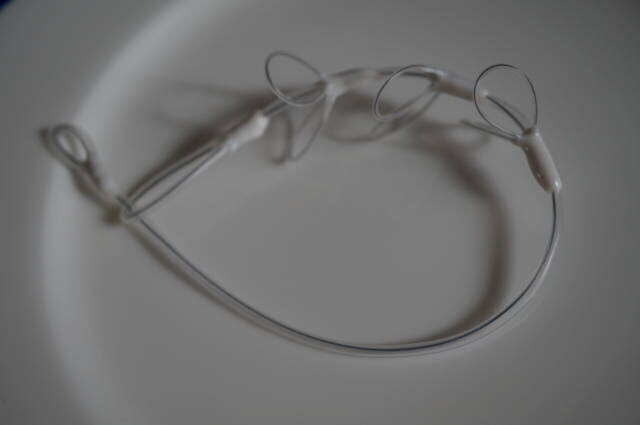
In an entry published in May 2025, Mr. Okada introduced a wire device with repeated side loops. Published dimensions were 20 cm–40 cm overall, with a 20 mm–50 mm front loop and 10 mm–20 mm rear loop. Ears measured 10 mm–30 mm, with spacing of at least the ear length plus 10 mm.
Main wire options were 0.3 mm or 0.4 mm; ear wire was 0.2 mm. Prices excluding tax were ¥5,000 (about $32 at ¥156 = $1, rate as of 2026-09-04) up to 30 cm, ¥6,000 (about $38 at ¥156 = $1, rate as of 2026-09-04) up to 40 cm, and ¥2,000 (about $13 at ¥156 = $1, rate as of 2026-09-04) per ear pair. Mr. Okada offered a rear thread connection for ¥1,000, (about $6 at ¥156 = $1, rate as of 2026-09-04) excluding tax, and allowed individual ear sizes and spacing to be specified.
(Source: ok-lab's diary, published May 2025)
https://ok-lab.hatenablog.com/entry/2025/05/17/122914
Large urethral centipede petals caused excessive irritation during personal testing
An entry published in May 2025 describes Mr. Okada's test of 25 mm petals as an internal stopper. He stopped after about 3 hours, saying the irritation was too strong. He subsequently tested petals of about 18 mm and reported less discomfort.
The later prototype was priced at ¥7,000 (about $45 at ¥156 = $1, rate as of 2026-09-04), excluding tax, compared with ¥6,000 (about $38 at ¥156 = $1, rate as of 2026-09-04) for the standard loop-only design. Mr. Okada suggested about 20 mm as an upper size around the tested location, based on his own experience.
(Source: ok-lab's diary, published May 2025)
https://ok-lab.hatenablog.com/entry/2025/05/24/122958
Urethral centipede ears interfered with each other in one customer's report
In an entry published in June 2025, a customer reported overly flexible wire and interference between neighboring ears. The message describes the ordered wire as 3 mm. Staff initially had no solution.
The customer proposed alternating ears along opposite sides of the main wire, and OK Lab produced that arrangement. The linked quote listed ¥5,500 (about $35 at ¥156 = $1, rate as of 2026-09-04) for the body, ¥4,400 (about $28 at ¥156 = $1, rate as of 2026-09-04) for a bladder loop, and ¥2,200 (about $14 at ¥156 = $1, rate as of 2026-09-04) per ear pair. The diary does not record how the revised arrangement performed in use.
(Source: ok-lab's diary, published June 2025)
https://ok-lab.hatenablog.com/entry/2025/06/14/122936
Curved urethral centipede pricing separated the base, petals, and extension
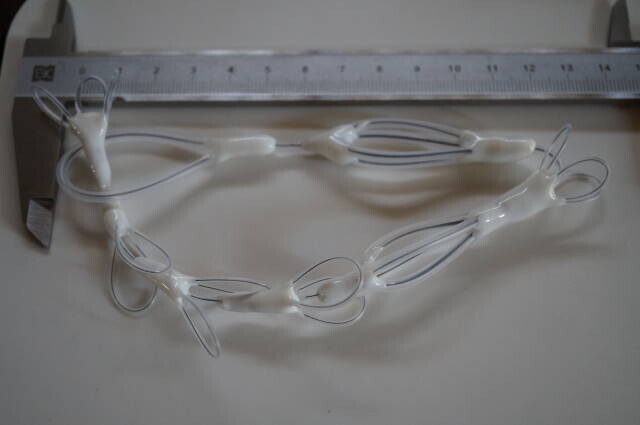
In an entry published in June 2025, Mr. Okada priced the curved wire centipede base at ¥5,000 (about $32 at ¥156 = $1, rate as of 2026-09-04), excluding tax. His prototype had 3 pairs, or 6 petals, priced at ¥6,000, (about $38 at ¥156 = $1, rate as of 2026-09-04) excluding tax. A horn (an end-loop wire extension) cost ¥3,000 (about $19 at ¥156 = $1, rate as of 2026-09-04) up to 10 cm, excluding tax.
The base consisted of the front and rear loops, without petals. Mr. Okada allowed additional loops and extensions within the design's manufacturing limits.
(Source: ok-lab's diary, published June 2025)
https://ok-lab.hatenablog.com/entry/2025/06/21/122934
Urethral centipede breakage reports included a cut to the lining
In an entry published in August 2025, a customer reported that a petal stopper's glued base failed after about 2 weeks. Staff offered inspection and repair, and the customer later confirmed receiving the repaired item. The same customer also reported losing both sides of the second ear on another wire centipede.
The customer said an internal wire caught and cut the lining; the diary does not record whether there was bleeding. The customer planned to send the second damaged device back, but its repair outcome is not recorded. OK Lab offered another repair.
(Source: ok-lab's diary, published August 2025)
https://ok-lab.hatenablog.com/entry/2025/08/30/122943
The maker's answer to wire urethral insert problems
The maker proposed design changes, but the supplied entries do not establish lasting results for the revised joints.
Staff favored a T-shaped urethral centipede electrode to preserve electrical contact
In an entry published in August 2024, a customer wanted a cross-shaped electrode to change stimulation and make urination easier. Staff warned that raised resin on both sides would sharply reduce the electrical contact area. The customer chose a T-shaped version; the entry shows the result but gives no report of its feel in use. Staff considered reinforcement limited to the back acceptable for this design.
(Source: ok-lab's diary, published August 2024)
https://ok-lab.hatenablog.com/entry/2024/08/31/122909
The maker favored curved urethral centipede designs for staying in place
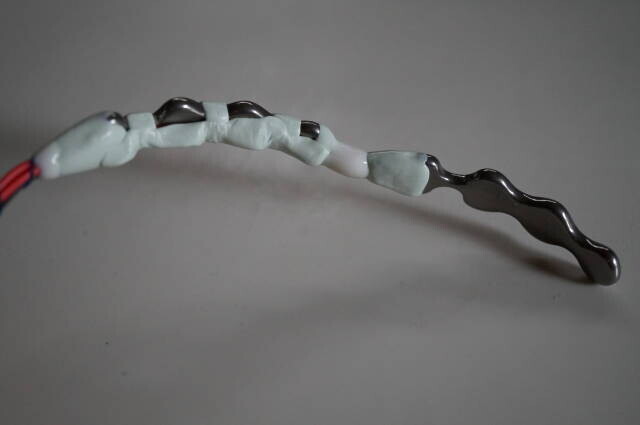
In an entry published in June 2025, Mr. Okada described the curved version as staying positioned much better than the straight version. He also described the ordinary loop-only design as staying in place well, without settling which design was better. He declined to explain differences in sensation around the bend because individual differences could make his explanation misleading. For longer periods in place, his preference was the curved centipede.
(Source: ok-lab's diary, published June 2025)
https://ok-lab.hatenablog.com/entry/2025/06/21/122934
Urethral centipede joint changes followed breakage reports and a conditional sales warning
In an entry published in August 2025, the production staff linked breakage to permanently bent wire repeatedly flexing. They said further breakage reports could lead to petal sales stopping; the entry does not announce a discontinuation. Mr. Okada then described revised petals using straight wire and larger rubber-covered joints.
He reported extra production work for this design. The diary does not record long-term breakage results for the revision. The staff offered thicker rubber covering as the immediate repair response.
(Source: ok-lab's diary, published August 2025)
https://ok-lab.hatenablog.com/entry/2025/08/30/122943
If you see blood in your urine, even a small amount or for the first time, do not wait and see. See a urologist right away. If you suddenly cannot urinate, or the device cannot be removed, do not try to fix it yourself. Go to a medical facility, including emergency care, immediately.
How wire urethral insert problems changed over time
| Published | What the diary said then |
|---|---|
| Aug 2024 | Optional plug and inter-chip rubber coating each cost ¥1,000, (about $6 at ¥156 = $1, rate as of 2026-09-04) excluding tax. |
| Sep 2024 | Work stopped because the requested larger snap connector was unavailable. |
| May 2025 | The repeated side loops inspired the wire device's centipede name. |
| Jun 2025 | Factory-bent wires were commissioned at 90°, 105°, 120°, and 150°. |
| Jul 2025 | Custom quote: ¥5,500 (about $35 at ¥156 = $1, rate as of 2026-09-04) base; ¥8,800 (about $56 at ¥156 = $1, rate as of 2026-09-04) for four petal pairs; ¥2,200 (about $14 at ¥156 = $1, rate as of 2026-09-04) rear petal loop. |
| Aug 2025 | Revised petals remained ¥1,000 (about $6 at ¥156 = $1, rate as of 2026-09-04) each despite extra production work. |
| Sep 2025 | An antenna (thin wire extension) gained centipede feet at 2 cm intervals. |
| Sep 2025 | Feet cost ¥2,000 (about $13 at ¥156 = $1, rate as of 2026-09-04) per pair; wings ¥3,000 (about $19 at ¥156 = $1, rate as of 2026-09-04) per location, excluding tax. |
| Oct 2025 | Staff specified extra reinforcement for front stoppers, without requiring it for rear attachments. |
The diary does not say what the current state is.
OK Prostate Chip products related to wire urethral insert problems
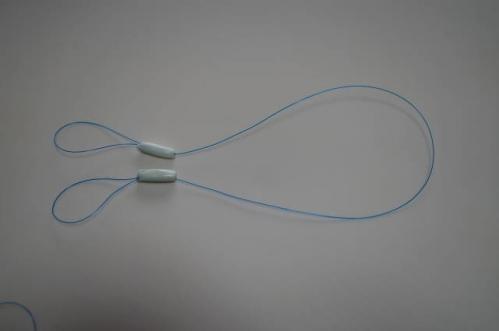
The diary names a current nylon extension thread for a connection concern.
Products that appear in these entries
No current product appears in these entries.
Products the diary mentioned as alternatives
| Product (official name) | Price incl. tax | Relation to this topic |
|---|---|---|
| Loop-ended nylon thread (両端ループナイロン糸) | ¥550 (about $4 at ¥156 = $1, rate as of 2026-09-04) | In October 2025, staff suggested this instead of directly knotted nylon loops, which they warned could become impossible to untie. |
The loop-ended nylon thread is listed in OK Lab's own online store.
(Source: ok-lab's diary, published October 2025)
https://ok-lab.hatenablog.com/entry/2025/10/18/122911
Custom centipede builds and the earlier loop-only and two-chip designs: No matching product can be confirmed on the current list.
Common worries about wire urethral insert problems
The replies address inward movement, cable flexibility, and limits on curved builds.
"Why did urethral centipede discussions raise concerns about inward movement?"
In an entry published in August 2024, a customer asked about a fully internal version of an earlier long, curved two-chip design. Mr. Okada expressed concern because development tests suggested that this shape could continue moving deeper toward the bladder. He said that movement could happen without being noticed.
Mr. Okada also suggested a different rear-end design for fully internal placement. In a follow-up published in August 2024, the customer said they were still considering that possibility. Mr. Okada cautioned against leaving the long, curved shape beyond external control.
(Source: ok-lab's diary, published August 2024)
https://ok-lab.hatenablog.com/entry/2024/08/17/122842
(Source: ok-lab's diary, published August 2024)
https://ok-lab.hatenablog.com/entry/2024/08/31/122909
"Will rubber make urethral centipede electrodes too stiff?"
In an entry published in September 2024, a customer asked whether rubber coating would make the electrode connection almost rigid. Mr. Okada said flexibility depended on the core: thread-based cable stayed soft, while a tube-covered cable became firmer but still bent. He worried that bare thread-based cable lacked strength between the chips.
A protective tube added bulk at the second chip. The diary does not record a use result for this proposed combination. He preferred parallel cable (the prototype's cable) through the chip section for strength and limited bulk.
(Source: ok-lab's diary, published September 2024)
https://ok-lab.hatenablog.com/entry/2024/09/14/123119
"Can a curved urethral centipede be made longer?"
In an entry published in October 2025, a customer wanted a curved centipede behind a chip to help it stay positioned. Staff requested a clearer design and initially said they could not settle which arrangement would work best. Mr. Okada then explained that the available bent wire limited the finished section beyond the bend to about 9 cm.
The diary does not record the completed result for this request. He described straight-wire versions as having no length limit and offered an end-loop extension for longer curved builds.
(Source: ok-lab's diary, published October 2025)
https://ok-lab.hatenablog.com/entry/2025/10/18/122911
Buying from outside Japan
OK Lab ships internationally to countries covered by Japan Post's EMS courier service. Overseas orders are paid in advance by PayPal. Each order carries a ¥400 (about $3 at ¥156 = $1, rate as of 2026-09-04) handling fee, and EMS shipping is charged on top. These terms come from OK Lab's official sales-terms page (written here as plain text, not a link: ok-lab.net/docs/law), checked on September 7, 2026; confirm them on the official store before you order, because they can change.
Summary of this article
| What you wanted to know | The answer |
|---|---|
| In short: what is the concern? | The diary records irritation, breakage, and an injury alongside development work. |
| About this product: who makes it? | OK Lab makes the urethral device in Japan; prices are in Japanese yen. |
| Key terms: what are ears? | Side loops intended for stimulation or limiting movement. |
| What happens: what did testing reveal? | Reports prompted changes to petal size, arrangement, and construction. |
| The maker's answer: what changed? | The maker proposed different shapes and revised joints, and offered repairs. |
| Changes over time: was it one fixed design? | The entries describe electrodes, wire devices, curved builds, and later additions. |
| Related products: what is on the current list? | The suggested loop-ended nylon thread costs ¥550 (about $4 at ¥156 = $1, rate as of 2026-09-04) including tax. |
| Common worries: what remained uncertain? | Several proposed custom builds lack recorded results in use. |
| Buying abroad: what are the stated terms? | Advance PayPal payment, EMS shipping, and a ¥400 (about $3 at ¥156 = $1, rate as of 2026-09-04) handling fee. |
Source: ok-lab's diary (Okada Comfortable Life Laboratory). The original entries are in Japanese; quotations on this page are translated. Photos and videos are on the original entries.
This article is a summary of the maker's development diary. The product is not a medical device and no result is guaranteed. If anything feels wrong or worries you, see a doctor. Prices, specifications and cautions change, so confirm the latest information on the official blog and the official site. Questions about ordering and shipping go to the seller.