![How much do lock-on and shell-type chips cost? | The base chip and custom work have separate prices [OK Prostate Chip]](/img/a/T0314/eyecatch.svg)
This page is based on entries from "ok-lab's diary" (https://ok-lab.hatenablog.com/), the Japanese development diary
written by Mr. Okada, founder of OK Lab, a small company in Japan (Okada Comfortable Life Laboratory). Only the entries about "lock-on and shell-type chip prices"
are summarized here, in order of publication. Past prices and sizes are as written at the time. Current prices come from
the official product list (retrieved September 4, 2026). Quotations are translated from Japanese.
Note: This page is a personal reading log by someone with no connection to the maker or the seller. It reflects the source entries as of their publication dates and makes no guarantee of accuracy or safety. The product is not a medical device; talk to a doctor about any health decision. Check the official site for current information. This page contains advertising.
In short
Lock-on charges vary by design, and shell reinforcement can carry a separate fee.
OK Lab, a small company in Japan, quotes the base chip and custom connection work separately.
Current base-chip prices appear below; custom attachments are documented through dated diary quotes.
About this product

The OK Prostate Chip is a small device that is placed in the urethra (the urine passage) so that it acts on the prostate; the maker sells it in several shapes, sizes and materials. It is made and sold by OK Lab (Okada Comfortable Life Laboratory), a small company in Japan, through its own online store, and prices are in Japanese yen (JPY).
The maker's development diary, "ok-lab's diary", is written in Japanese. This page is an English summary of it, and every quotation is translated. OK Lab ships internationally, so readers outside Japan can order (see "Buying from outside Japan" below).
Product names on this page are plain-English descriptions. The official Japanese product name is shown once in the product table so you can find the same item in the store.
Before you read: key terms
| Term | Plain-English meaning |
|---|---|
| Urethra | The urine passage, which carries urine; it is where this device is placed. |
| Lock-on loop | A curved attachment behind the chip, intended by Mr. Okada to help hold it in position. |
| Bulbar urethra | A wider part of the urine passage; the maker targets this area with loops intended to support the chip. |
| Parallel cable | Paired electrical cord used to form loops or carry power to motorized chips. |
| Shape-memory wire | Wire that returns toward a set shape, used to support a loop or curve. |
| Four-hole cable stopper | A small resin part that holds paired cables, used to set the adjustable loop's shape. |
| Shell reinforcement | A ceramic-chip treatment the maker labels as breakage protection. The diary does not explain this. |
| Electrode | An electrical-contact chip, used in versions intended to carry electric current. |
| Mesh stopper | A stop fitted between the chip and wire loop, offered as an additional stopping part. |
What happens: lock-on and shell-type chip prices
The OK Prostate Chip is a small device placed in the urethra (the urine passage) to act on the prostate. A lock-on loop (a curved attachment behind the chip) is intended by Mr. Okada to help keep it in position. It sits in the bulbar urethra (a wider area of that passage), according to his descriptions. Shell reinforcement is a separately priced treatment he labels as protection against ceramic-chip breakage.
Key-ring loop prices covered attachment work beyond the base chip
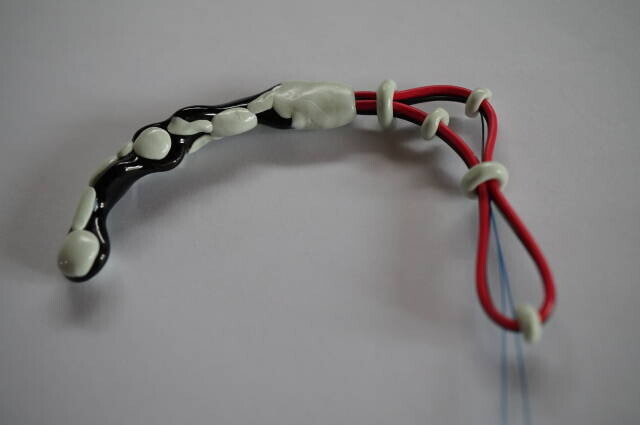
In an entry published in August 2024, Mr. Okada introduced a key-ring-style loop made from parallel cable (paired electrical cord). Its price was the ordinary chip price plus ¥2,000 (about $13 at ¥156 = $1, rate as of 2026-09-04), tax excluded, for a loop section up to 10 cm. Each additional 5 cm cost ¥500 (about $3 at ¥156 = $1, rate as of 2026-09-04), tax excluded.
The example used a slim ceramic chip, and the listed charge covered the attachment rather than the complete device. Mr. Okada says ceramic, resin, and stainless-steel chips can accept this connection, while glass chips cannot.
(Source: ok-lab's diary, published August 2024)
https://ok-lab.hatenablog.com/entry/2024/08/17/122842
The curved lock-on price introduced a different cable attachment
In an entry published in August 2024, Mr. Okada added a curved bulge to the cable loop. This version cost the chip price plus ¥3,000 (about $19 at ¥156 = $1, rate as of 2026-09-04), tax excluded, through 10 cm, with ¥500 (about $3 at ¥156 = $1, rate as of 2026-09-04) for each additional 5 cm. He described a bend of roughly 60–80 degrees in the attachment.
Mr. Okada believed this curved bulge could provide support closer to the chip. He suggested shorter versions might be more convenient because the design relied less on the loop near the penile tip.
(Source: ok-lab's diary, published August 2024)
https://ok-lab.hatenablog.com/entry/2024/08/24/122906
A motorized lock-on price included cable, thread, and assembly charges
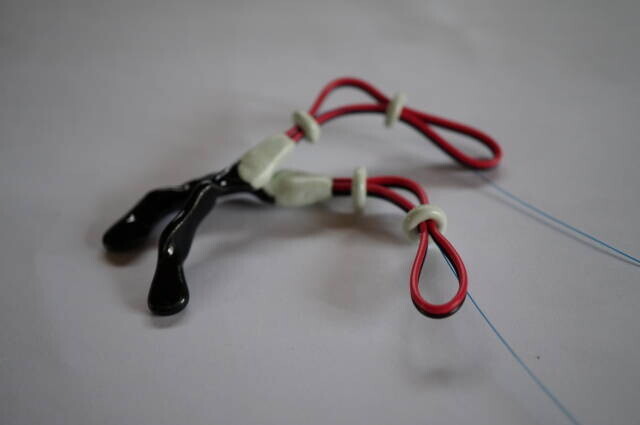
In an entry published in September 2024, Mr. Okada described separate charges for a motorized cable lock-on. Beyond the motorized chip, the quote added ¥1,000 (about $6 at ¥156 = $1, rate as of 2026-09-04) for cable and ¥1,000 (about $6 at ¥156 = $1, rate as of 2026-09-04) for nylon thread, both tax excluded. Assembly through 10 cm cost ¥2,000 (about $13 at ¥156 = $1, rate as of 2026-09-04), tax excluded.
Each additional 5 cm of joined cable added ¥500 (about $3 at ¥156 = $1, rate as of 2026-09-04), tax excluded. The stated maximum was 20 cm, with assembly priced at ¥3,000, (about $19 at ¥156 = $1, rate as of 2026-09-04) tax excluded. Mr. Okada cautioned that exact loop widths were difficult to promise because the cable changed shape.
(Source: ok-lab's diary, published September 2024)
https://ok-lab.hatenablog.com/entry/2024/09/07/123204
The wire lock-on price introduced another connection with approximate dimensions
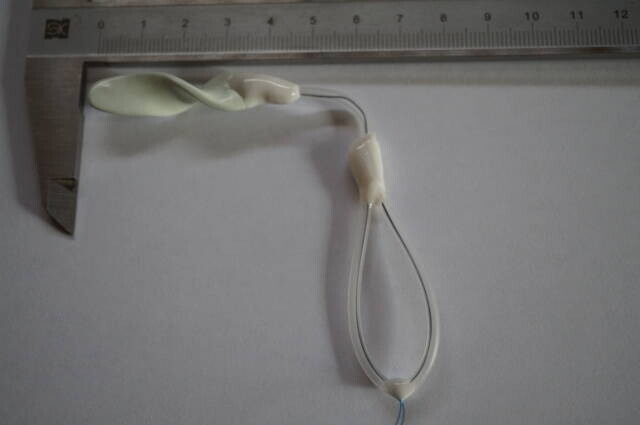
In an entry published in November 2024, Mr. Okada introduced a silicone-covered wire lock-on. It used shape-memory wire (wire that returns toward a set shape), with a ¥4,000 (about $26 at ¥156 = $1, rate as of 2026-09-04) surcharge, tax excluded. A mesh stopper (an additional stop between chip and loop) cost ¥2,000 (about $13 at ¥156 = $1, rate as of 2026-09-04), tax excluded.
An order required the chip-to-loop distance, loop length, and bend angle. A requested 20 mm distance could finish around 15–25 mm, so Mr. Okada asked customers to accept approximate dimensions.
(Source: ok-lab's diary, published November 2024)
https://ok-lab.hatenablog.com/entry/2024/11/16/122924
The hybrid lock-on price accompanied a shorter revised design
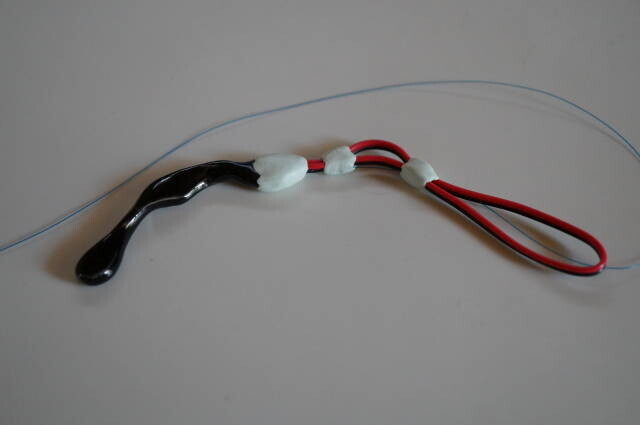
In an entry published in February 2025, Mr. Okada reported that his earlier hybrid prototype was too long. This hybrid lock-on combined cable and shape-memory wire and carried a ¥5,000 (about $32 at ¥156 = $1, rate as of 2026-09-04) surcharge, tax excluded. He attributed earlier discomfort to a hardened thread joint and changed that joint's covering to rubber.
His suggested attachment length was 4–5 cm, with about 2 cm needed for the curved section. Mr. Okada recommended shorter hybrids, but also said orders of 4 cm or less would not be accepted.
(Source: ok-lab's diary, published February 2025)
https://ok-lab.hatenablog.com/entry/2025/02/08/122932
Adjustable lock-on prices bundled resin stoppers with cable connection work
In an entry published in July 2026, a customer wanted a firm cable stopper for a twin-electrode chip. Mr. Okada considered a single long resin part impractical and instead made a stack of separate stoppers. That trial led to an adjustable lock-on using four-hole cable stoppers (resin parts that hold paired cables).
For an ordinary chip, his minimum addition was ¥5,000 (about $32 at ¥156 = $1, rate as of 2026-09-04), tax excluded, covering two stoppers and a loop-cable connection. Each stopper cost ¥1,500 (about $10 at ¥156 = $1, rate as of 2026-09-04), and the connection cost ¥2,000 (about $13 at ¥156 = $1, rate as of 2026-09-04), both tax excluded. He cautioned that cable length could add charges, and extremely short versions might be impossible.
(Source: ok-lab's diary, published July 2026)
https://ok-lab.hatenablog.com/entry/2026/07/25/123012
The adjustable hybrid lock-on price added more parts and connection work
In an entry published in August 2026, Mr. Okada described an adjustable hybrid prototype with shell reinforcement. Its attachment required two four-hole stoppers at ¥1,500 (about $10 at ¥156 = $1, rate as of 2026-09-04) each, tax excluded, plus three two-hole stoppers at ¥1,000 (about $6 at ¥156 = $1, rate as of 2026-09-04) each, tax excluded. The two-hole parts fixed the wire in place and were about 5 mm wide.
The chip-connection charge was ¥3,000 (about $19 at ¥156 = $1, rate as of 2026-09-04), tax excluded. Mr. Okada described that charge as provisional because the assembly took substantial work. He cautioned that excessive demand might force him to stop offering this version.
(Source: ok-lab's diary, published August 2026)
https://ok-lab.hatenablog.com/entry/2026/08/29/122931
The maker's answer to lock-on and shell-type chip prices
Mr. Okada's quotes depend on connection requirements, chip material, and the requested dimensions.
Electrical lock-on prices required an individual quote for stainless steel
In an entry published in December 2024, a customer requested a stainless-steel electrode (an electrical-contact chip) with a lock-on attachment. Staff acknowledged having no previous experience making that combination, then accepted the request for development. Mr. Okada reported completing a connection intended to carry current.
He explained that electrical work added charges beyond an ordinary ceramic-chip lock-on connection. Mr. Okada said staff would quote each requested configuration individually.
(Source: ok-lab's diary, published December 2024)
https://ok-lab.hatenablog.com/entry/2024/12/07/122832
The resin lock-on price included separately charged connection preparation
In an entry published in November 2025, a customer requested a single resin screw chip with a wire lock-on. The estimate listed ¥4,400 (about $28 at ¥156 = $1, rate as of 2026-09-04) for the chip, ¥1,100 (about $7 at ¥156 = $1, rate as of 2026-09-04) for connection preparation, and ¥4,400 (about $28 at ¥156 = $1, rate as of 2026-09-04) for the lock-on. No tax status was stated in that quote.
The diary does not record how this custom build felt in use. Mr. Okada explained that the resin chip required an additional connection hole, adding ¥1,100 (about $7 at ¥156 = $1, rate as of 2026-09-04) compared with the ceramic-chip arrangement.
(Source: ok-lab's diary, published November 2025)
https://ok-lab.hatenablog.com/entry/2025/11/15/122921
Adjustable lock-on orders allowed different stopper sizes within the assembly
In an entry published in August 2026, Mr. Okada introduced stopper size choices for the adjustable lock-on. The width bands were S: 6–7 mm, M: 7–8 mm, and L: 8–9 mm, with thickness around 2.5–3 mm. He explained that finished parts were measured and sorted because resin could spread during manufacture.
The existing chip thread carried no additional fee for this attachment. Mr. Okada asked buyers to identify the base chip, each stopper size, and the full cable length, or provide approximate section lengths.
(Source: ok-lab's diary, published August 2026)
https://ok-lab.hatenablog.com/entry/2026/08/01/122916
How lock-on and shell-type chip prices changed over time
| Published | What the diary said then |
|---|---|
| Aug 2024 | Plain cable-loop pricing depended on attachment length. |
| Aug 2024 | A curved cable bulge introduced a separate lock-on design. |
| Aug 2024 | Thread attachment moved to the loop tip after a customer's concern. |
| Sep 2024 | The motorized design used a 35 cm cable instead of the earlier 70 cm. |
| Nov 2024 | The wire version allowed approximately 10 degrees of variation in its finished angle. |
| Feb 2025 | The hybrid received a shorter length recommendation and a revised thread-joint covering. |
| Jul 2026 | Separate resin stoppers allowed an adjustable cable curve. |
| Aug 2026 | Four-hole stoppers gained S, M, and L size choices. |
| Aug 2026 | Shell reinforcement appeared as a separate charge alongside the adjustable attachment. |
| Aug 2026 | The adjustable hybrid added wire-fixing stoppers and a higher connection fee. |
OK Prostate Chip products related to lock-on and shell-type chip prices
These are current base-product prices, with custom-work charges documented separately in the diary.
Products that appear in these entries
| Product (official name) | Price incl. tax | Relation to this topic |
|---|---|---|
| Short motorized ceramic chip (OKプロステート核振チップ 陶器素材ショートタイプ) | ¥5,500 (about $35 at ¥156 = $1, rate as of 2026-09-04) | In April 2025, the customer initially named this base when requesting a motorized wire lock-on. |
| Single resin screw chip (OKプロステートチップ 樹脂素材1チップタイプ スクリュー) | ¥4,400 (about $28 at ¥156 = $1, rate as of 2026-09-04) | A November 2025 custom quote separated this chip from connection preparation and a wire lock-on. |
| Medium-length stainless-steel chip (OKプロステートチップ セミロングタイプ(サージカルステンレス)) | ¥9,900 (about $63 at ¥156 = $1, rate as of 2026-09-04) | An August 2026 request named this base with a ¥5,500 (about $35 at ¥156 = $1, rate as of 2026-09-04) adjustable attachment, including its stoppers. |
| Long ceramic chip with four twists (OKプロステートチップ 陶器素材ロングタイプ 4点ツイスト) | ¥7,700 (about $49 at ¥156 = $1, rate as of 2026-09-04) | An August 2026 quote listed this base separately from ¥4,400 (about $28 at ¥156 = $1, rate as of 2026-09-04) shell reinforcement and a ¥5,500 (about $35 at ¥156 = $1, rate as of 2026-09-04) adjustable lock-on. |
(Source: ok-lab's diary, published April 2025)
https://ok-lab.hatenablog.com/entry/2025/04/26/122909
(Source: ok-lab's diary, published November 2025)
https://ok-lab.hatenablog.com/entry/2025/11/15/122921
(Source: ok-lab's diary, published August 2026)
https://ok-lab.hatenablog.com/entry/2026/08/15/122912
(Source: ok-lab's diary, published August 2026)
https://ok-lab.hatenablog.com/entry/2026/08/22/122905
Products the diary mentioned as alternatives
The diary names no alternative.
For the custom attachments and shell-treated assemblies described above:
No matching product can be confirmed on the current list. The diary does not say what the current state is.
Common worries about lock-on and shell-type chip prices
The customer questions show how fit and construction requirements affected what Mr. Okada could quote.
"Can lock-on loops replace a wire-linked model's rear chip?"
In an entry published in September 2024, a customer proposed replacing a wire-linked model's rear chip with a cable lock-on. Mr. Okada expected the cable loop to hold its shape less firmly than the original wire-supported chip. He also considered adding a lock-on behind the complete assembly a duplication of its curve, though not necessarily impossible.
For the customer's non-locking cable-loop proposal, staff quoted fixing work at ¥1,650 (about $11 at ¥156 = $1, rate as of 2026-09-04) through 10 cm, plus ¥550 (about $4 at ¥156 = $1, rate as of 2026-09-04) per additional 5 cm. The diary does not record how that requested arrangement felt in use. Mr. Okada did not recommend replacing that rear chip with a cable lock-on.
(Source: ok-lab's diary, published September 2024)
https://ok-lab.hatenablog.com/entry/2024/09/21/122907
"Can a motorized lock-on price include different chip materials?"
In an entry published in April 2025, a customer wanted a curved motorized chip for short sessions. Staff initially said the proposed cable-and-wire combination would be difficult; Mr. Okada then developed a design with partly independent sections. His minimum short-ceramic configuration was quoted at ¥11,000 (about $70 at ¥156 = $1, rate as of 2026-09-04), tax excluded, including the base and connection work.
In the confirmed follow-up published in June 2025, the customer asked to omit a stopper and change the chip material. Mr. Okada accepted omitting the stopper, but the diary does not record a completed revised order. He confirmed ceramic was workable, but second-generation resin was untested; stainless steel appeared beyond his equipment's cutting ability.
(Source: ok-lab's diary, published April 2025)
https://ok-lab.hatenablog.com/entry/2025/04/26/122909
(Source: ok-lab's diary, published June 2025)
https://ok-lab.hatenablog.com/entry/2025/06/07/122954

"Does a longer hybrid lock-on cost more?"
In an entry published in December 2025, a customer asked whether a 5 cm hybrid attachment would be preferable to 4 cm. A previous larger chip's bulge had prevented insertion, although the customer had managed the smaller version. The new quote listed ¥5,500 (about $35 at ¥156 = $1, rate as of 2026-09-04) for each hybrid attachment.
Staff accepted 5 cm at the quoted modification price. The diary does not record whether the new builds resolved the fit problem. Staff favored that length because its curved section could be made more flexible.
(Source: ok-lab's diary, published December 2025)
https://ok-lab.hatenablog.com/entry/2025/12/13/122917
Buying from outside Japan

OK Lab ships internationally to countries covered by Japan Post's EMS courier service. Overseas orders are paid in advance by PayPal.
Each order carries a ¥400 (about $3 at ¥156 = $1, rate as of 2026-09-04) handling fee, and EMS shipping is charged on top. These terms come from OK Lab's official sales-terms page (written here as plain text, not a link: ok-lab.net/docs/law), checked on September 7, 2026; confirm them on the official store before you order, because they can change.
Summary of this article
| What you wanted to know | The answer |
|---|---|
| What drives the price? | The base chip, attachment design, and separately quoted custom work. |
| What is the product? | A urethral device made by OK Lab in Japan. |
| What do the attachment names describe? | Cable loops, wire-supported loops, adjustable stoppers, or ceramic-chip reinforcement. |
| What did the historical prices cover? | Different combinations of connection work, cable, thread, stoppers, and reinforcement. |
| How does the maker handle custom requests? | Staff quote the configuration; material and dimension limits can affect what is possible. |
| What changed over time? | Cable designs expanded into wire, hybrid, and adjustable versions with different parts. |
| Which prices come from the current list? | The base-product prices in the product table. |
| Can size or material changes be accepted? | Some were accepted; other material changes remained uncertain or impractical. |
| How do orders outside Japan work? | Advance PayPal payment, a ¥400 (about $3 at ¥156 = $1, rate as of 2026-09-04) handling fee, and separate EMS shipping. |
Source: ok-lab's diary (Okada Comfortable Life Laboratory). The original entries are in Japanese; quotations on this page are translated. Photos and videos are on the original entries.
This article is a summary of the maker's development diary. The product is not a medical device and no result is guaranteed. If anything feels wrong or worries you, see a doctor. Prices, specifications and cautions change, so confirm the latest information on the official blog and the official site. Questions about ordering and shipping go to the seller.