![Can I buy auxiliary chips separately? | Yes, but assembly options have limits [OK Prostate Chip]](/img/a/T0312/eyecatch.svg)
This page is based on entries from "ok-lab's diary" (https://ok-lab.hatenablog.com/), the Japanese development diary written by Mr. Okada, founder of OK Lab, a small company in Japan (Okada Comfortable Life Laboratory). Only the entries about "buying auxiliary chips separately" are summarized here, in order of publication. Past prices and sizes are as written at the time. Current prices come from the official product list (retrieved September 4, 2026). Quotations are translated from Japanese.
Note: This page is a personal reading log by someone with no connection to the maker or the seller. It reflects the source entries as of their publication dates and makes no guarantee of accuracy or safety. The product is not a medical device; talk to a doctor about any health decision. Check the official site for current information. This page contains advertising.
In short
- Auxiliary chips have been sold separately, but some proposed connections raised removal concerns.
- Mr. Okada offered separate parts and paid assembly, with limits that varied by design.
- The current list includes auxiliary and safety chips; some historical assemblies were discontinued.
If you see blood in your urine, even a small amount or for the first time, do not wait and see. See a urologist right away. If you suddenly cannot urinate, or the device cannot be removed, do not try to fix it yourself. Go to a medical facility, including emergency care, immediately.
About this product

The OK Prostate Chip is a small device that is placed in the urethra (the urine passage) so that it acts on the prostate; the maker sells it in several shapes, sizes and materials. It is made and sold by OK Lab (Okada Comfortable Life Laboratory), a small company in Japan, through its own online store, and prices are in Japanese yen (JPY). The maker's development diary, "ok-lab's diary", is written in Japanese. This page is an English summary of it, and every quotation is translated. OK Lab ships internationally, so readers outside Japan can order (see "Buying from outside Japan" below). Product names on this page are plain-English descriptions. The official Japanese product name is shown once in the product table so you can find the same item in the store.
Before you read: key terms
| Term | Plain-English meaning |
|---|---|
| Urethra | The urine passage; the diary describes it as the location for the main chip and some auxiliary parts. |
| Auxiliary chip | An extra component intended to support positioning or limit movement of the main device. |
| Stopper chip | A component intended to resist unwanted movement of the device or thread. |
| Safety chip | A small part on the retrieval thread intended to preserve access to it outside the body. |
| Retrieval thread | Thread attached to a chip so the device can be retrieved. |
| Bougie | A rod or tube for exploring or widening a passage, here paired with a chip. |
| Resin adhesion | Resin sticking to tissue; a term for the diary's prolonged-contact concern. |
What happens: buying auxiliary chips separately
The OK Prostate Chip is a small device placed in the urethra (the urine passage) to act on the prostate. Auxiliary chips (extra support parts) help position the main chip or limit movement, depending on the design. The diary describes auxiliary parts inside the urethra near the penis head, plus stopper parts outside the opening. Separate sales let customers buy individual components, although some fittings required assembly by the maker before shipment.
Separate parts avoided assembly fees, but trial threads lacked durability assurances
In an entry published in October 2017, Mr. Okada proposed separate main and auxiliary parts, while withholding complete assemblies. Resin main and auxiliary parts cost ¥1,000 (about $6 at ¥156 = $1, rate as of 2026-09-04) each; the glass main part cost ¥2,000 (about $13 at ¥156 = $1, rate as of 2026-09-04), all excluding tax. Embedding nylon thread cost ¥1,000 (about $6 at ¥156 = $1, rate as of 2026-09-04) per part, excluding tax.
Parts-only purchases avoided that labor charge and included free sewing thread for customers arranging their own connections. Mr. Okada warned that thread durability and knots meant long-term use of the trial arrangement was not guaranteed. He did not recommend it for continued use.
(Source: ok-lab's diary, published October 2017)
https://ok-lab.hatenablog.com/entry/20171020/1508465071
Adjustable auxiliary chips did not guarantee protection against bladder migration
In an entry published in June 2018, Mr. Okada described version 3, with individually sold chips and customer-selected spacing. Buyers could choose the chip's length, width, and thickness, with assembly assigned to the customer. The stopper chip (a part intended to limit movement) could not reliably prevent a chip from slipping into the bladder.
Mr. Okada acknowledged that the stopper could become tangled with the main chip. He considered smaller stoppers less hazardous if tangling occurred.
(Source: ok-lab's diary, published June 2018)
https://ok-lab.hatenablog.com/entry/20180616/1529136608
Three-hole auxiliary chips reduced charges and could outlast main-chip replacements
In another entry published in June 2018, the three-hole auxiliary chip's proposed price fell from ¥2,000 (about $13 at ¥156 = $1, rate as of 2026-09-04) to ¥1,500 (about $10 at ¥156 = $1, rate as of 2026-09-04), excluding tax. The earlier price included thread connection.
Mr. Okada also said the auxiliary part could remain useful after replacement of the main chip. Launch was planned for July 2018, with customer assembly as the default. He offered free connection when the auxiliary part and main chip were bought together.
(Source: ok-lab's diary, published June 2018)
https://ok-lab.hatenablog.com/entry/20180630/1530342059
DIY assembly proposals raised removal concerns for the chip designer
An entry published in June 2021 carried the designer's response to a customer's reversible-chip proposal. The customer wanted lower costs and shorter production times; Mr. Okada initially welcomed the idea. The designer said the holes were technically possible, but predicted difficult removal if one side of the thread loop broke.
A simpler connection also raised concerns about loose knots and possible urethral damage. Separate parts remained possible for customers with suitable manual skills. The designer considered the loop unsuitable for sale and advised against either proposed connection.
(Source: ok-lab's diary, published June 2021)
https://ok-lab.hatenablog.com/entry/2021/06/19/125845
(Source: ok-lab's diary, published June 2021)
https://ok-lab.hatenablog.com/entry/2021/06/26/125926
Ceramic linking parts carried separate manufacturing and connection charges
In an entry published in July 2022, Mr. Okada showed ceramic parts made for linked assemblies. These linking parts cost the usual chip price plus ¥1,000 (about $6 at ¥156 = $1, rate as of 2026-09-04) excluding tax, because making holes at both ends was difficult.
The rubber connection between chips carried another ¥1,000 (about $6 at ¥156 = $1, rate as of 2026-09-04) excluding tax charge. Mr. Okada offered any ceramic chip as the leading part in these assemblies.
(Source: ok-lab's diary, published July 2022)
https://ok-lab.hatenablog.com/entry/2022/07/23/123014
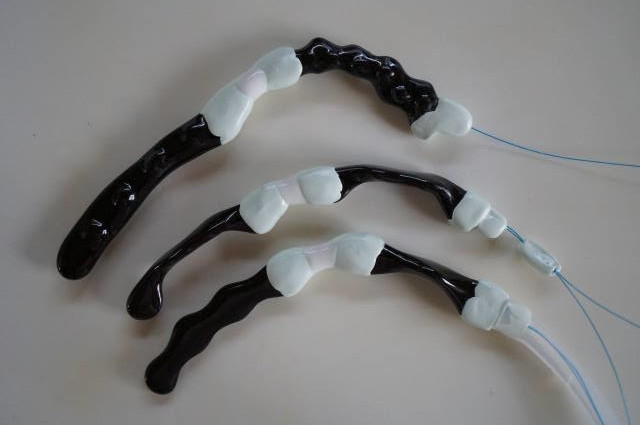
Separate loop parts could not be added after shipment
In an entry published in August 2022, Mr. Okada introduced an adjustable loop holder for a silicone-tube assembly. The holder allowed changes to the loop's position and size.
Each loop part cost ¥1,000 (about $6 at ¥156 = $1, rate as of 2026-09-04) excluding tax, but separate purchase did not provide a later fitting option. Mr. Okada required fitting before shipment because the tube's finished end secured the internal wire.
(Source: ok-lab's diary, published August 2022)
https://ok-lab.hatenablog.com/entry/2022/08/13/122909
Replacement parts remained available when new concealment-device orders temporarily stopped
In an entry published in April 2023, Mr. Okada temporarily stopped new orders for the penis-concealment device called Ein de Flat. He wanted time to handle questions and problems from existing customers before accepting further orders.
Parts sales for size changes continued during that pause. Mr. Okada invited existing customers to send questions for follow-up support.
(Source: ok-lab's diary, published April 2023)
https://ok-lab.hatenablog.com/entry/2023/04/08/122508
Short thread-linked assemblies were discontinued after chips folded and tangled
In an entry published in August 2026, a customer requested a closely spaced pair of chips connected by thread. Staff explained that this early design had been discontinued after chips folded together or tangled, preventing removal. The customer acknowledged those risks and renewed the request.
Staff then agreed that a custom order was possible, while asking for time to consider its construction. Mr. Okada presented a safety-chip connection as a proposal, but the diary does not record the customer's subsequent experience. Staff characterized the requested arrangement as high risk.
(Source: ok-lab's diary, published August 2026)
https://ok-lab.hatenablog.com/entry/2026/08/22/122905
The maker's answer to buying auxiliary chips separately
The maker's options depended on the connection, the thread arrangement, and whether fitting had to happen before delivery.
Buying separate safety chips reduced one specialized connection charge
In an entry published in March 2023, Mr. Okada discussed a bougie (a rod or tube for exploring or widening passages). He proposed a safety chip as the connector between the main chip and that separate component.
The specialized connection service cost ¥2,500 (about $16 at ¥156 = $1, rate as of 2026-09-04) excluding tax, compared with ¥1,500 (about $10 at ¥156 = $1, rate as of 2026-09-04) excluding tax for the safety part alone. He attributed the higher assembly charge to unusually difficult work. Mr. Okada favored this connector for the pairing, while describing customer assembly as an alternative to the paid service.
(Source: ok-lab's diary, published March 2023)
https://ok-lab.hatenablog.com/entry/2023/03/04/123042

Four-thread auxiliary chip compatibility expanded beyond the original safety part
In an entry published in May 2023, Mr. Okada said only the blue safety chip supported the new 4-thread arrangement. He declined later conversions of products originally sold with 1 or 2 threads.
The 4-thread option cost ¥2,500 (about $16 at ¥156 = $1, rate as of 2026-09-04) excluding tax, comprising the ¥1,500 (about $10 at ¥156 = $1, rate as of 2026-09-04) safety part and ¥1,000 (about $6 at ¥156 = $1, rate as of 2026-09-04) for extra threads and bundling. In an entry published in July 2023, he introduced 12-hole stoppers intended for this arrangement. The internal stopper cost ¥3,000 (about $19 at ¥156 = $1, rate as of 2026-09-04) excluding tax, and the external stopper cost ¥2,500 (about $16 at ¥156 = $1, rate as of 2026-09-04) excluding tax. Mr. Okada said those new stopper parts could also be purchased later.
(Source: ok-lab's diary, published May 2023)
https://ok-lab.hatenablog.com/entry/2023/05/13/123004
(Source: ok-lab's diary, published July 2023)
https://ok-lab.hatenablog.com/entry/2023/07/15/123004
Standard safety chips gained extra exposed thread in August 2026
In an entry published in August 2026, Mr. Okada changed the standard safety chip on single-thread products. The new specification added approximately 5-10cm of retrieval thread (thread for bringing the device back out) beyond the safety chip.
His stated aim was to leave thread outside if the safety chip slipped into the urethral opening. One standard safety chip remained free; additional ones cost ¥500 (about $3 at ¥156 = $1, rate as of 2026-09-04) excluding tax each. Mr. Okada retained the previous end-stop arrangement for orders specifying the maximum 35cm thread length. He suggested additional safety chips for judging the device's position.
(Source: ok-lab's diary, published August 2026)
https://ok-lab.hatenablog.com/entry/2026/08/15/122912
If you see blood in your urine, even a small amount or for the first time, do not wait and see. See a urologist right away. If you suddenly cannot urinate, or the device cannot be removed, do not try to fix it yourself. Go to a medical facility, including emergency care, immediately.
How buying auxiliary chips separately changed over time

| Published | What the diary said then |
|---|---|
| Oct 2017 | Separate parts and thread-embedding labor received separate prices. |
| Jun 2018 | Version 3 allowed different chip dimensions and spacing. |
| Jun 2021 | The designer opposed proposed connections because of removal and knot concerns. |
| Aug 2022 | Adjustable loop holders required fitting before shipment. |
| Mar 2023 | A specialized safety-chip connection carried a higher assembly charge. |
| Apr 2023 | Concealment-device orders paused, while replacement-parts support continued. |
| May 2023 | Existing single- and double-thread products were excluded from four-thread conversions. |
| Jul 2023 | New 12-hole stoppers expanded four-thread options. |
| Aug 2026 | Standard single-thread safety chips gained an exposed thread extension, with a maximum-length exception. |
| Aug 2026 | Staff confirmed early short thread-linked assemblies had been discontinued after removal problems. |
OK Prostate Chip products related to buying auxiliary chips separately

The current list includes auxiliary and safety parts, plus the ceramic alternative discussed below.
Products that appear in these entries
| Product (official name) | Price incl. tax | Relation to this topic |
|---|---|---|
| Three-hole auxiliary chip (三穴方式オプションチップ(補助チップ)) | ¥1,650 (about $11 at ¥156 = $1, rate as of 2026-09-04) | June 2018 introduced separate-part pricing and described retaining this auxiliary part after replacing the main chip. |
| Separate two-thread safety chip (二本糸用セーフティチップ(生体適合樹脂)単体) | ¥1,650 (about $11 at ¥156 = $1, rate as of 2026-09-04) | October 2022 recorded a customer accidentally ordering this part separately and receiving it unattached. |
(Source: ok-lab's diary, published June 2018)
https://ok-lab.hatenablog.com/entry/20180630/1530342059
(Source: ok-lab's diary, published October 2022)
https://ok-lab.hatenablog.com/entry/2022/10/01/122944
Products the diary mentioned as alternatives
| Product (official name) | Price incl. tax | Relation to this topic |
|---|---|---|
| Medium-length ceramic chip (OKプロステートチップ 陶器素材セミロングタイプ) | ¥4,400 (about $28 at ¥156 = $1, rate as of 2026-09-04) | June 2019 suggested waiting for this planned ceramic release instead of commissioning a resin counterpart. |
(Source: ok-lab's diary, published June 2019)
https://ok-lab.hatenablog.com/entry/2019/06/01/155432
The early separate-parts arrangements, adjustable stopper, threadless custom builds, ceramic linking assemblies, and 12-hole stoppers above were historical configurations. No matching product can be confirmed on the current list.
Common worries about buying auxiliary chips separately

Separate-part orders could change both the price and what arrived already assembled.
"Can threadless chips be supplied without the usual connection charge?"
In an entry published in June 2019, a customer asked about threadless resin and ceramic chips because of thread-breakage concerns. Mr. Okada quoted ¥3,000 (about $19 at ¥156 = $1, rate as of 2026-09-04) excluding tax for a threadless resin screw chip, removing the ¥1,000 (about $6 at ¥156 = $1, rate as of 2026-09-04) thread-embedding charge, also excluding tax. He also agreed to supply ceramic chips without thread, including an uncoated hole if requested.
On resin adhesion (sticking to tissue), he said problems could occur after about half a day or longer, but considered shorter use unproblematic. The diary does not record whether these custom orders were completed. Mr. Okada suggested waiting for the planned ceramic medium-length chip instead of commissioning its resin counterpart.
(Source: ok-lab's diary, published June 2019)
https://ok-lab.hatenablog.com/entry/2019/06/01/155432
"Does coated wire make DIY assembly more secure?"
In an entry published in October 2021, a customer requested ceramic chips without attached thread for a personal wire-based arrangement. The proposed wire was 0.6mm nylon-coated stranded stainless steel; the diary does not record how this particular arrangement performed.
Mr. Okada said an earlier experiment with thinner coated wire had not produced a favorable report. He warned that broken wire could also cut its nylon coating. Mr. Okada favored an independent nylon thread as backup, rather than relying on the coated wire alone.
(Source: ok-lab's diary, published October 2021)
https://ok-lab.hatenablog.com/entry/2021/10/23/125707
"Will a separately purchased safety chip arrive already connected?"
In an entry published in October 2022, a customer expected an assembled product but accidentally ordered the safety chip separately. It arrived unattached, with a partly threaded sample; the customer reported completing the connection after roughly 3 hours.
Staff supplied a replacement link after the customer reported that the explanatory video was unavailable. The customer later found that the published method differed from their interpretation. Mr. Okada explained that partial threading served both as a hole-blockage check and a sample for separate-part buyers.
(Source: ok-lab's diary, published October 2022)
https://ok-lab.hatenablog.com/entry/2022/10/01/122944
Buying from outside Japan

OK Lab ships internationally to countries covered by Japan Post's EMS courier service. Overseas orders are paid in advance by PayPal. Each order carries a ¥400 (about $3 at ¥156 = $1, rate as of 2026-09-04) handling fee, and EMS shipping is charged on top. These terms come from OK Lab's official sales-terms page (written here as plain text, not a link: ok-lab.net/docs/law), checked on September 7, 2026; confirm them on the official store before you order, because they can change.
Summary of this article
| What you wanted to know | The answer |
|---|---|
| Can parts be bought separately? | Yes, with design-specific assembly limits. |
| What is the product? | A urethral device from OK Lab in Japan. |
| What do the terms mean? | Auxiliary, stopper, and safety parts serve different purposes. |
| What happened to separate parts? | Prices, fittings, and available assemblies changed. |
| What did the maker offer? | Separate purchases and paid connection services. |
| What changed most recently? | August 2026 added exposed thread, with a maximum-length exception. |
| What do current parts cost? | The listed auxiliary and separate safety parts each cost ¥1,650 (about $11 at ¥156 = $1, rate as of 2026-09-04) including tax. |
| What confused customers? | Threadless pricing, coated wire, and whether parts arrived fitted. |
| How do overseas orders work? | Advance PayPal payment, a ¥400 (about $3 at ¥156 = $1, rate as of 2026-09-04) handling fee, and additional EMS shipping. |
Source: ok-lab's diary (Okada Comfortable Life Laboratory). The original entries are in Japanese; quotations on this page are translated. Photos and videos are on the original entries.
This article is a summary of the maker's development diary. The product is not a medical device and no result is guaranteed. If anything feels wrong or worries you, see a doctor. Prices, specifications and cautions change, so confirm the latest information on the official blog and the official site. Questions about ordering and shipping go to the seller.