![What do custom connectors and sheaths cost? | Charges depend on the design [OK Prostate Chip]](/img/a/T0306/eyecatch.svg)
This page is based on entries from "ok-lab's diary" (https://ok-lab.hatenablog.com/), the Japanese development diary written by Mr. Okada, founder of OK Lab, a small company in Japan (Okada Comfortable Life Laboratory). Only the entries about custom connector and sheath costs are summarized here, in order of publication. Past prices and sizes are as written at the time. Current prices come from the official product list (retrieved September 4, 2026). Quotations are translated from Japanese.
Note: This page is a personal reading log by someone with no connection to the maker or the seller. It reflects the source entries as of their publication dates and makes no guarantee of accuracy or safety. The product is not a medical device; talk to a doctor about any health decision. Check the official site for current information. This page contains advertising.
In short
Connector and sheath charges varied with construction, length, and the parts involved.
Mr. Okada set separate charges and design limits, including paid repairs for one failed connection.
The current list includes the screw-shaped auxiliary chip at ¥3,300 (about $21 at ¥156 = $1, rate as of 2026-09-04) including tax.
If you see blood in your urine, even a small amount or for the first time, do not wait and see. See a urologist right away. If you suddenly cannot urinate, or the device cannot be removed, do not try to fix it yourself. Go to a medical facility, including emergency care, immediately.
About this product

The OK Prostate Chip is a small device that is placed in the urethra (the urine passage) so that it acts on the prostate; the maker sells it in several shapes, sizes and materials. It is made and sold by OK Lab (Okada Comfortable Life Laboratory), a small company in Japan, through its own online store, and prices are in Japanese yen (JPY). The maker's development diary, "ok-lab's diary", is written in Japanese. This page is an English summary of it, and every quotation is translated. OK Lab ships internationally, so readers outside Japan can order (see "Buying from outside Japan" below). Product names on this page are plain-English descriptions. The official Japanese product name is shown once in the product table so you can find the same item in the store.
Before you read: key terms
| Term | Plain-English meaning |
|---|---|
| Horn (connector or wire extension) | The maker's name for a coated connection or projecting wire section, intended to support connected parts or transmit movement. |
| Connection gap (spacing between chips) | The distance between connected chips, used to specify the length of the connecting section. |
| Sheath (outer sleeve) | A sleeve surrounding an extension or shaft, intended to guide movement of the connected device. |
| Shape-memory wire (wire that recovers its shape) | Wire used in later extensions because it can recover its shape after bending. |
| Nylon thread (backup connection) | Thread connecting device parts, included in several designs as a backup against connector failure. |
| Sphincter stopper (position-holding chip) | A separate chip intended to help hold the device near the muscles around the urine passage. |
| Piston-style device (moving shaft and chip) | A chip attached to a shaft within a sheath, designed for sliding and rotating movement. |
What happens: custom connector and sheath costs
The OK Prostate Chip is a device placed in the urethra (urine passage) to act on the prostate. A horn is a coated connector between chips or, in later entries, a projecting wire extension. The later extension sits within the penis's urine passage and is intended to transmit movement to the device. A sheath is a sleeve around that extension or a shaft, designed to guide the connected device's movement.
Straight connector costs began with free work for very short lengths
In an entry published in October 2020, straight horn coating up to 2mm was free. At 3-10mm, the charge was ¥500 (about $3 at ¥156 = $1, rate as of 2026-09-04) excluding tax. Each additional 10mm added ¥500 (about $3 at ¥156 = $1, rate as of 2026-09-04) excluding tax; the published 11-20mm example cost ¥1,000 (about $6 at ¥156 = $1, rate as of 2026-09-04) excluding tax.
Two nylon threads did not change the coating charge. However, two separate horns meant two charges. Mr. Okada asked customers to specify the requested horn length in their order comments.
(Source: ok-lab's diary, published October 2020)
https://ok-lab.hatenablog.com/entry/2020/10/31/121353
Bent connector costs covered limited spacing and excluded some stopper connections
In an entry published in November 2020, a 90-degree rubber-coated connection cost ¥1,000 (about $6 at ¥156 = $1, rate as of 2026-09-04) excluding tax. Accepted connection gaps were limited to 3-5mm. Mr. Okada explained that each connection required more than 30 minutes of close attention during fabrication.
He said 90-degree connections to sphincter stoppers were beyond his technical capability at that time. Straight connections remained free through 2mm, while 3mm or more cost ¥500 (about $3 at ¥156 = $1, rate as of 2026-09-04) excluding tax. For connections between two chips, Mr. Okada advised a gap of 5mm or less because he questioned the strength of longer connections.
(Source: ok-lab's diary, published November 2020)
https://ok-lab.hatenablog.com/entry/2020/11/21/130647
Connector repair costs depended on what survived the rubber failure
In an entry published in December 2020, a customer reported cracked coating after about 10 sessions of roughly 1 hour each. The customer wanted a stronger connection; Mr. Okada suspected weakness where rubber layers had hardened at different times.
He quoted ¥1,100 (about $7 at ¥156 = $1, rate as of 2026-09-04) if the old rubber could be detached, or ¥5,500 (about $35 at ¥156 = $1, rate as of 2026-09-04) if the remaining assembly needed rebuilding. The diary does not record whether this repair was completed. Mr. Okada proposed limiting the replacement connection gap to 3mm.
(Source: ok-lab's diary, published December 2020)
https://ok-lab.hatenablog.com/entry/2020/12/19/132929
Stainless wire connectors removed gap limits but left durability unresolved
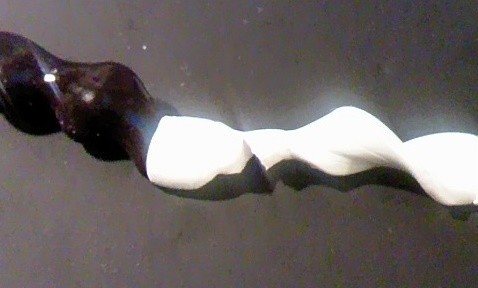
In an entry published in January 2021, Mr. Okada described stainless wire connections between chips. Their spacing was no longer limited by the short gaps workable with rubber coating. He said long-term durability remained unknown.
Mr. Okada included a parallel nylon thread because metal fatigue could eventually break the wire. He favored 0.5mm wire, judging 0.7mm wire too resistant to bending for prolonged use.
(Source: ok-lab's diary, published January 2021)
https://ok-lab.hatenablog.com/entry/2021/01/23/130107
Long wire extensions created retrieval trouble during a January trial
In an entry published in January 2021, Mr. Okada reported trouble with an extension whose surplus wire was inside the urethra. He wrote that the device advanced farther inward than expected and became difficult to retrieve. The trial did not establish a price-related solution to that problem. Mr. Okada explicitly rejected the arrangement with surplus wire inside the urethra.
(Source: ok-lab's diary, published January 2021)
https://ok-lab.hatenablog.com/entry/2021/01/30/122153
Wire extension costs accompanied a retreat from continuous use
In an entry published in March 2025, Mr. Okada abandoned continuous use of a design with wire extending outside the body. He worried that contact with clothing could contaminate the wire and then the urethra. His conclusion limited that arrangement to short use.
Mr. Okada also reported heart failure during sleep after a separate 9cm prototype was held under downward pressure. He responded by shortening its shaft to a few centimeters. For the revised short extension, his preferred lengths were 3cm, 4cm, and 5cm.
(Source: ok-lab's diary, published March 2025)
https://ok-lab.hatenablog.com/entry/2025/03/15/122925
Looped wire extension costs included a discount for omitted thread
In an entry published in March 2025, Mr. Okada described an end loop intended to support retrieval without an exposed thread. The loop measured about 20mm long and 8mm wide. The complete extension, including that loop, had a minimum length of 4cm.
The price was ¥4,000 (about $26 at ¥156 = $1, rate as of 2026-09-04) excluding tax, with a ¥1,000 (about $6 at ¥156 = $1, rate as of 2026-09-04) reduction when the chip no longer had nylon thread. He offered a free 20cm nylon backup thread, while warning that it lacked a permanent resin attachment. Mr. Okada's suggested extension lengths were 4cm, 5cm, and 6cm.
(Source: ok-lab's diary, published March 2025)
https://ok-lab.hatenablog.com/entry/2025/03/29/122912
Sheath costs remained provisional while inconsistent movement forced a redesign
In an entry published in April 2026, a customer's piston-style device was delayed because sheath movement varied between units. Mr. Okada replaced the internal resin structure with closely spaced, short aluminum tubes. He reported smooth sliding and rotation through bends of 180-270 degrees after the change.
The planned sheath prices were ¥5,000 (about $32 at ¥156 = $1, rate as of 2026-09-04) excluding tax for 20cm and ¥7,000 (about $45 at ¥156 = $1, rate as of 2026-09-04) excluding tax for 25cm. The diary does not record whether the customer's order was completed. Mr. Okada specified that the tip chip required a separate charge.
(Source: ok-lab's diary, published April 2026)
https://ok-lab.hatenablog.com/entry/2026/04/18/122906
The maker's answer to custom connector and sheath costs
Mr. Okada's answers tied charges to fabrication work, while setting limits on repairs, materials, and dimensions.
Early connector repair terms excluded service for peeling rubber
In an entry published in October 2020, Mr. Okada stated that peeling rubber would not qualify for repair. He questioned whether rubber would match the durability of ceramic or hardened resin. His stated fallback was continued use of the remaining product in its original, uncoated form.
(Source: ok-lab's diary, published October 2020)
https://ok-lab.hatenablog.com/entry/2020/10/31/121353
Three-chip connector costs included an additional nylon backup thread
In an entry published in January 2021, Mr. Okada presented a three-chip prototype with cord supporting its flexible connections. Its estimate charged ¥1,000 (about $6 at ¥156 = $1, rate as of 2026-09-04) × 2 excluding tax for the two bent connections. Both cord and nylon thread were limited to 30cm because fabrication was difficult. Mr. Okada specified a nylon thread through all three chips as a precaution because the rubber connections lacked an established strength record.
(Source: ok-lab's diary, published January 2021)
https://ok-lab.hatenablog.com/entry/2021/01/02/123619
Stainless connector costs followed the number of embedded chip connections
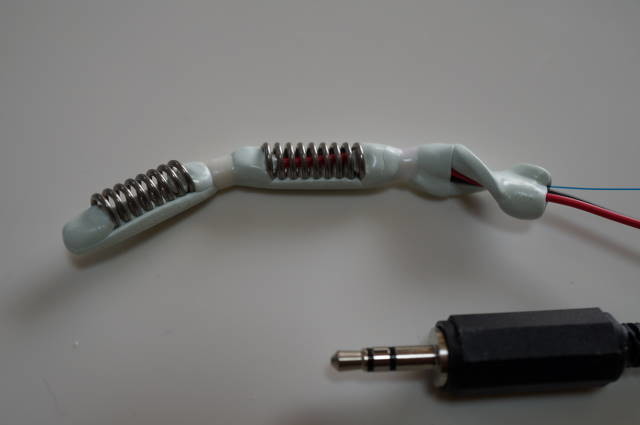
The entry published in February 2021 gave the charge for adding stainless wire alongside nylon thread as ¥1,000 (about $6 at ¥156 = $1, rate as of 2026-09-04) per chip containing embedded wire. Mr. Okada explained that embedding the wire in each chip created the work. A two-chip arrangement still involved work on both chips even when the wire ended inside the second chip. Mr. Okada stated that subsequent bills would follow the embedded-chip count.
(Source: ok-lab's diary, published February 2021)
https://ok-lab.hatenablog.com/entry/2021/02/27/130152
Narrower tubing increased wire extension costs because fabrication was harder
In an entry published in April 2025, Mr. Okada described extensions containing 0.2mm shape-memory wire together with nylon thread. Through 10cm, the 2.5mm tube version cost ¥3,000 (about $19 at ¥156 = $1, rate as of 2026-09-04) excluding tax, while the 1mm version cost ¥4,000 (about $26 at ¥156 = $1, rate as of 2026-09-04) excluding tax. He attributed the narrower version's higher price to fabrication difficulty.
A double end loop added ¥1,000 (about $6 at ¥156 = $1, rate as of 2026-09-04) excluding tax. The 1mm tube version could not be made longer than 20cm. Mr. Okada accepted the 2.5mm version through 30cm, with another ¥1,000 (about $6 at ¥156 = $1, rate as of 2026-09-04) excluding tax for that extension.
(Source: ok-lab's diary, published April 2025)
https://ok-lab.hatenablog.com/entry/2025/04/12/122910
If you see blood in your urine, even a small amount or for the first time, do not wait and see. See a urologist right away. If you suddenly cannot urinate, or the device cannot be removed, do not try to fix it yourself. Go to a medical facility, including emergency care, immediately.
How custom connector and sheath costs changed over time

| Published | What the diary said then |
|---|---|
| Nov 2020 | Bent connections were expected to cost more because fabrication was harder. |
| Dec 2020 | New ceramic two-chip design required bumps and a separate ¥1,000 (about $6 at ¥156 = $1, rate as of 2026-09-04) connection fee, excluding tax. |
| Jan 2021 | Stainless connections accepted ceramic first chips; later chips had to be stainless rings. |
| Mar 2021 | Simple rubber coating: ¥500 (about $3 at ¥156 = $1, rate as of 2026-09-04) excluding tax; bent connections: ¥1,000 (about $6 at ¥156 = $1, rate as of 2026-09-04) excluding tax per joint. |
| Mar 2025 | Extensions through 20cm: ¥3,000 (about $19 at ¥156 = $1, rate as of 2026-09-04) excluding tax; above 20cm through 30cm: ¥4,000 (about $26 at ¥156 = $1, rate as of 2026-09-04) excluding tax. |
| Apr 2025 | Extending either tube version beyond 10cm, through 20cm, added ¥1,000 (about $6 at ¥156 = $1, rate as of 2026-09-04) excluding tax. |
| Jan 2026 | A ¥3,300, (about $21 at ¥156 = $1, rate as of 2026-09-04) 20cm extension was described as stiff and suited only to short use. |
| Apr 2026 | A 0.5mm shaft carried an additional ¥1,000 (about $6 at ¥156 = $1, rate as of 2026-09-04) charge, excluding tax. |
The diary does not say what the current state is.
OK Prostate Chip products related to custom connector and sheath costs

The screw-shaped auxiliary chip appears in a priced custom-connection order and remains on the supplied current list.
Products that appear in these entries
| Product (official name) | Price incl. tax | Relation to this topic |
|---|---|---|
| Screw-shaped auxiliary chip (スクリュー型補助チップ追加オプション) | ¥3,300 (about $21 at ¥156 = $1, rate as of 2026-09-04) | A November 2020 custom order paired this auxiliary chip with a separately charged bent connector. |
(Source: ok-lab's diary, published November 2020)
https://ok-lab.hatenablog.com/entry/2020/11/28/121505
Products the diary mentioned as alternatives
The diary names no alternative.
Custom wire extensions, rubber-connected assemblies, and the piston-style device:
No matching product can be confirmed on the current list.
Common worries about custom connector and sheath costs

The replies distinguish charges for individual chips, separate components, and additional coating work.
"Can stainless connector costs apply to a single chip?"
In an entry published in December 2021, a customer wanted a 35cm stainless extension alongside nylon thread on one ceramic chip. Mr. Okada confirmed that the single-chip request could be accepted. The diary does not record how the finished item felt in use. Mr. Okada's stated charge was ¥1,100 (about $7 at ¥156 = $1, rate as of 2026-09-04) for each chip connected to stainless wire, including that single-chip request.
(Source: ok-lab's diary, published December 2021)
https://ok-lab.hatenablog.com/entry/2021/12/04/124140
"Do sheath costs include the shaft and tip?"
In an entry published in May 2026, a customer requested a piston-style device with a stainless screw tip. The quote listed a 0.4mm shaft, 30cm long, at ¥3,300 (about $21 at ¥156 = $1, rate as of 2026-09-04), and a 20cm sheath at ¥5,500 (about $35 at ¥156 = $1, rate as of 2026-09-04). The diary does not record performance after delivery. OK Lab's reply treated the requested tip as a separate ¥5,500 (about $35 at ¥156 = $1, rate as of 2026-09-04) item.
(Source: ok-lab's diary, published May 2026)
https://ok-lab.hatenablog.com/entry/2026/05/30/122914
"How much does resin coating over rubber cost?"
In an entry published in June 2026, a customer asked whether resin could replace rubber and how that would affect dimensions and cost. Mr. Okada proposed resin over the existing rubber, increasing thickness by 1-2mm.
The quote was ¥1,100 (about $7 at ¥156 = $1, rate as of 2026-09-04) per location, with ¥2,200 (about $14 at ¥156 = $1, rate as of 2026-09-04) stated for the illustrated two-location example. The diary does not record the customer's response to that proposal. Mr. Okada said the rubber needed to remain because it provided waterproofing.
(Source: ok-lab's diary, published June 2026)
https://ok-lab.hatenablog.com/entry/2026/06/13/122909
Buying from outside Japan

OK Lab ships internationally to countries covered by Japan Post's EMS courier service. Overseas orders are paid in advance by PayPal. Each order carries a ¥400 (about $3 at ¥156 = $1, rate as of 2026-09-04) handling fee, and EMS shipping is charged on top. These terms come from OK Lab's official sales-terms page (written here as plain text, not a link: ok-lab.net/docs/law), checked on September 7, 2026; confirm them on the official store before you order, because they can change.
Summary of this article
| What you wanted to know | The answer |
|---|---|
| What is the short answer? | Charges depend on the construction and the work involved. |
| What is the product? | A urethral device made and sold by OK Lab in Japan. |
| What do the terms mean? | Horns connect or extend parts; sheaths surround shafts to guide movement. |
| What happened in the diary? | Prices developed alongside connection failures, wire experiments, and sheath redesigns. |
| What was the maker's answer? | Separate fabrication charges, restricted dimensions, backup threads, and conditional paid repairs. |
| How did charges change? | Early coating fees developed into per-chip wire charges and separate shaft-and-sheath estimates. |
| Which related product is listed today? | The screw-shaped auxiliary chip; the custom assemblies have no confirmed matching listing. |
| What did customers ask? | Whether single-chip work was possible, which components were included, and what resin coating would cost. |
| How does international buying work? | Advance PayPal payment, a handling fee, and additional EMS shipping charges. |
Source: ok-lab's diary (Okada Comfortable Life Laboratory). The original entries are in Japanese; quotations on this page are translated. Photos and videos are on the original entries.
This article is a summary of the maker's development diary. The product is not a medical device and no result is guaranteed. If anything feels wrong or worries you, see a doctor. Prices, specifications and cautions change, so confirm the latest information on the official blog and the official site. Questions about ordering and shipping go to the seller.