![Why did my safety thread change? | Attachments, markers, and fees changed over time [OK Prostate Chip]](/img/a/T0297/eyecatch.svg)
This page is based on entries from "ok-lab's diary" (https://ok-lab.hatenablog.com/), the Japanese development diary written by Mr. Okada, founder of OK Lab, a small company in Japan (Okada Comfortable Life Laboratory). Only the entries about "thread and safety chip specification changes" are summarized here, in order of publication. Past prices and sizes are as written at the time. Current prices come from the official product list (retrieved September 4, 2026). Quotations are translated from Japanese.
Note: This page is a personal reading log by someone with no connection to the maker or the seller. It reflects the source entries as of their publication dates and makes no guarantee of accuracy or safety. The product is not a medical device; talk to a doctor about any health decision. Check the official site for current information. This page contains advertising.
In short
Thread detachment, breakage, and rough attachments prompted several revisions.
Mr. Okada changed attachments, introduced two threads, and offered returns or repairs for reported faults.
Current listings include separate safety chips; August 2026 brought longer tails on standard single-thread assemblies.
If you see blood in your urine, even a small amount or for the first time, do not wait and see. See a urologist right away. If you suddenly cannot urinate, or the device cannot be removed, do not try to fix it yourself. Go to a medical facility, including emergency care, immediately.
About this product
The OK Prostate Chip is a small device that is placed in the urethra (the urine passage) so that it acts on the prostate; the maker sells it in several shapes, sizes and materials. It is made and sold by OK Lab (Okada Comfortable Life Laboratory), a small company in Japan, through its own online store, and prices are in Japanese yen (JPY). The maker's development diary, "ok-lab's diary", is written in Japanese. This page is an English summary of it, and every quotation is translated. OK Lab ships internationally, so readers outside Japan can order (see "Buying from outside Japan" below). Product names on this page are plain-English descriptions. The official Japanese product name is shown once in the product table so you can find the same item in the store.
Before you read: key terms
| Term | Plain-English meaning |
|---|---|
| Urethra | The urine passage, where the chip is placed to act on the prostate. |
| Safety thread | Nylon line attached to the main chip for retrieval. |
| Safety chip | A small part on the thread, used as a marker or to match two thread lengths. |
| Resin / epoxy resin | Material forming small parts and covering the thread attachment, where it helps secure the connection. |
| Loop attachment | A loop securing the thread at the main chip, introduced to prevent complete detachment. |
| End loop | A loop at the thread's outer end, requested for handling convenience. |
| Three-hole / six-hole safety chip | Separate markers with thread openings; the six-hole version accommodates two strands. |
What happens: safety thread problems
The OK Prostate Chip is a small device placed in the urethra (the urine passage) to act on the prostate. The safety thread (nylon attached for retrieval) extends from the device toward the urine passage's opening. A safety chip (a small part on that thread) marks its position or helps match two strands' lengths. These entries cover changes at the main chip's attachment and at the thread's outer end.
A loose safety thread prompted changes limited to the main chip
In an entry published in May 2018, Mr. Okada reported 2 customers whose threads detached from two-chip devices. Both failures occurred during attempts to widen the spacing between the chips. After the second report, he changed the buried thread section to give it more grip.
Mr. Okada wrote that stretched nylon became thinner and could slip free more easily. He cautioned that the improvement covered only the main chip: safety chips supplied then could still detach under strong pulling.
(Source: ok-lab's diary, published May 2018)
https://ok-lab.hatenablog.com/entry/20180513/1526181573
A separate three-hole safety chip introduced an additional processing charge
In an entry published in June 2018, the three-hole safety chip (a separate marker with thread openings) received a new price structure. The part itself was free, but three-hole processing cost ¥500 (about $3 at ¥156 = $1, rate as of 2026-09-04), making it ¥500 (about $3 at ¥156 = $1, rate as of 2026-09-04) more expensive than before. The entry presented this price schedule as excluding tax.
For purchases made alongside a main chip, OK Lab offered assembly before delivery without an extra assembly charge. Mr. Okada advised buyers considering these parts to allow additional thread length when ordering.
(Source: ok-lab's diary, published June 2018)
https://ok-lab.hatenablog.com/entry/20180630/1530342059
Safety thread breakage reports brought forward an option with two strands
In an entry published in April 2019, Mr. Okada reported 2 thread breakage complaints in the same week. The two-thread option began with orders placed on April 27, 2019, excluding the vibrating-chip range. Embedding one thread or two cost the same.
The included safety chip was dropped because, Mr. Okada explained, fixing both threads together would not accommodate unequal stretching. Six-hole parts (accessories with six thread openings) cost ¥500 (about $3 at ¥156 = $1, rate as of 2026-09-04) more, excluding tax, than three-hole parts; the safety chip cost ¥1,000 (about $6 at ¥156 = $1, rate as of 2026-09-04) excluding tax. Mr. Okada pointed buyers toward that separate safety chip for matching the two thread lengths.
(Source: ok-lab's diary, published April 2019)
https://ok-lab.hatenablog.com/entry/2019/04/27/153239
A looped safety thread could still concern buyers bothered by rough surfaces
In an entry published in August 2019, Mr. Okada acknowledged 2 recent complaints about rough edges on safety chips. He questioned whether the customers' term accurately described the hand-shaped resin (the material forming these small parts). Mr. Okada nevertheless cautioned that the new looped safety chip could also trouble customers concerned about such surface irregularities.
(Source: ok-lab's diary, published August 2019)
https://ok-lab.hatenablog.com/entry/2019/08/17/132641
Exposed metal at the safety thread attachment prompted a repair offer
In an entry published in August 2019, a customer asked about a silver protrusion where a ceramic chip met its resin attachment. The customer reported substantial irritation during a trial, despite initially thinking the small protrusion would be harmless.
Mr. Okada confirmed that metal secured the thread and acknowledged overlooking its exposure. The diary does not record whether the repair was completed. Mr. Okada requested a return so he could repair the fault.
(Source: ok-lab's diary, published August 2019)
https://ok-lab.hatenablog.com/entry/2019/08/31/131337
Standard safety thread ends became longer beyond the fixed marker
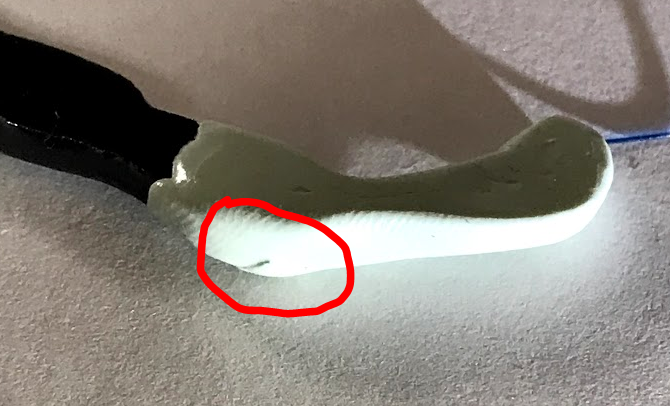
In an entry published in August 2026, the standard single-thread safety chip gained approximately 5-10cm of thread beyond its fixed position. The diary's example kept the safety chip at 20cm, with extra thread extending beyond it. Mr. Okada intended this tail to remain outside if the safety chip slipped into the head of the penis.
The maximum thread length was 35cm; that specification retained the earlier fastening at the end. The standard specification still included 1 free safety chip; each extra one cost ¥500 (about $3 at ¥156 = $1, rate as of 2026-09-04) excluding tax. Mr. Okada also suggested additional markers could help indicate changes in the chip's position.
(Source: ok-lab's diary, published August 2026)
https://ok-lab.hatenablog.com/entry/2026/08/15/122912
The maker's answer to safety thread problems
Mr. Okada's responses addressed attachment failure, exposed metal, and thread-end design separately.
A stronger safety thread attachment was still experimental in May 2018
In an entry published in May 2018, Mr. Okada considered a thicker resin covering over the thread attachment. His proposed covering was approximately twice its previous thickness, combined with a thread section designed to resist slipping.
He estimated that this arrangement might withstand approximately 2kg of pulling force; this was a development expectation. He reported no resin cracking in test areas where the covering exceeded an unspecified thickness. Mr. Okada warned that strong pulling could injure the urine passage before bleeding made the damage apparent.
(Source: ok-lab's diary, published May 2018)
https://ok-lab.hatenablog.com/entry/20180515/1526348315
Looped safety thread attachments started shipping with replacement packaging
In an entry published in May 2018, OK Lab announced loop attachments for shipments from May 24, 2018. These loop attachments (loops securing thread at the main chip) received new packaging to distinguish them from earlier connections. Requests to convert older attachments were also accepted, with possible delays if demand was high.
Some product sales had been suspended on May 10, 2018. For unmodified products shipped from May 10 through May 23, 2018, Mr. Okada offered returns and refunds because repair demand might exceed capacity.
(Source: ok-lab's diary, published May 2018)
https://ok-lab.hatenablog.com/entry/20180524/1527153380
Aluminum reinforcement targeted peeling around the safety thread attachment
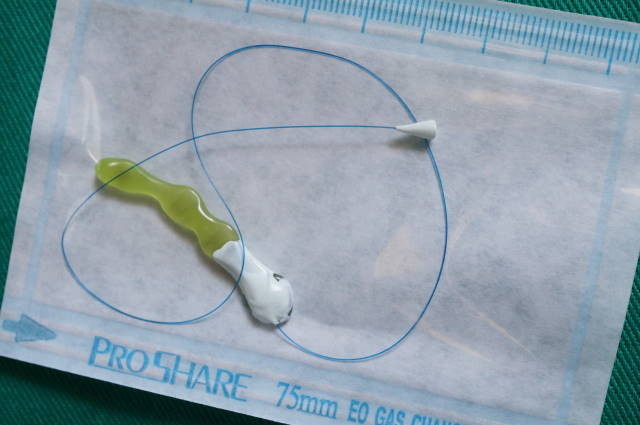
In an entry published in August 2019, Mr. Okada announced an attachment combining aluminum reinforcement with epoxy resin (the material coating the connection). He reported less peeling during trial production and planned to adopt this attachment across all products. Mr. Okada acknowledged that exposed aluminum could escape inspection and asked customers to report any visible protrusion.
(Source: ok-lab's diary, published August 2019)
https://ok-lab.hatenablog.com/entry/2019/08/31/131337
Custom safety thread end treatments received separate prices in July 2026
In an entry published in July 2026, Mr. Okada set charges for requested end treatments, including end loops (outer thread loops). A resin fastening for two nylon threads cost ¥500 (about $3 at ¥156 = $1, rate as of 2026-09-04) excluding tax; a resin-fixed end loop cost ¥1,000 (about $6 at ¥156 = $1, rate as of 2026-09-04) excluding tax. An end loop for one nylon thread also cost ¥1,000 (about $6 at ¥156 = $1, rate as of 2026-09-04) excluding tax.
The normal two-thread specification still omitted resin fastening at the end. Mr. Okada said difficult custom work required a separate quote, even when it resembled an earlier order.
(Source: ok-lab's diary, published July 2026)
https://ok-lab.hatenablog.com/entry/2026/07/25/123012
If you see blood in your urine, even a small amount or for the first time, do not wait and see. See a urologist right away. If you suddenly cannot urinate, or the device cannot be removed, do not try to fix it yourself. Go to a medical facility, including emergency care, immediately.
How safety thread problems changed over time
| Published | What the diary said then |
|---|---|
| May 2018 | Loop attachments entered shipment; resin peeling remained unresolved. |
| Jun 2018 | Loop attachments brought thicker end coatings and a thread outline detectable through the resin. |
| Jun 2018 | The three-hole range was scheduled for July release. |
| Apr 2019 | Completed, unshipped products required a paid thread repair for conversion to two threads. |
| Aug 2019 | Orders opened for safety chips with an end loop. |
| Aug 2019 | Mr. Okada warned aluminum could rise while the resin dried. |
| Feb 2021 | Doubled terminal loops remained free, with reservations about uneven appearance. |
| Jul 2026 | Specific prices were established for custom resin thread-end treatments. |
| Aug 2026 | Standard single-thread assemblies gained a tail beyond the safety marker. |
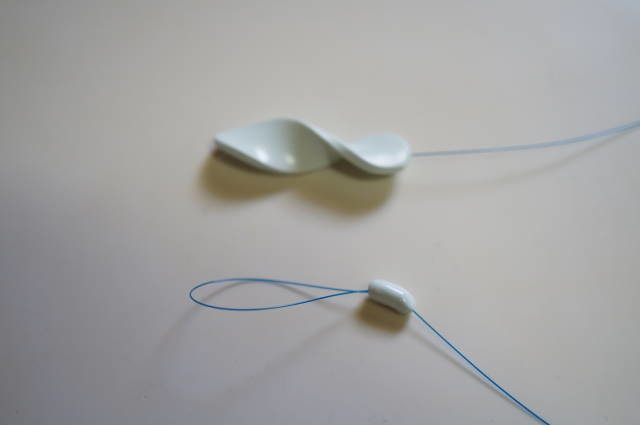
OK Prostate Chip products related to safety thread problems
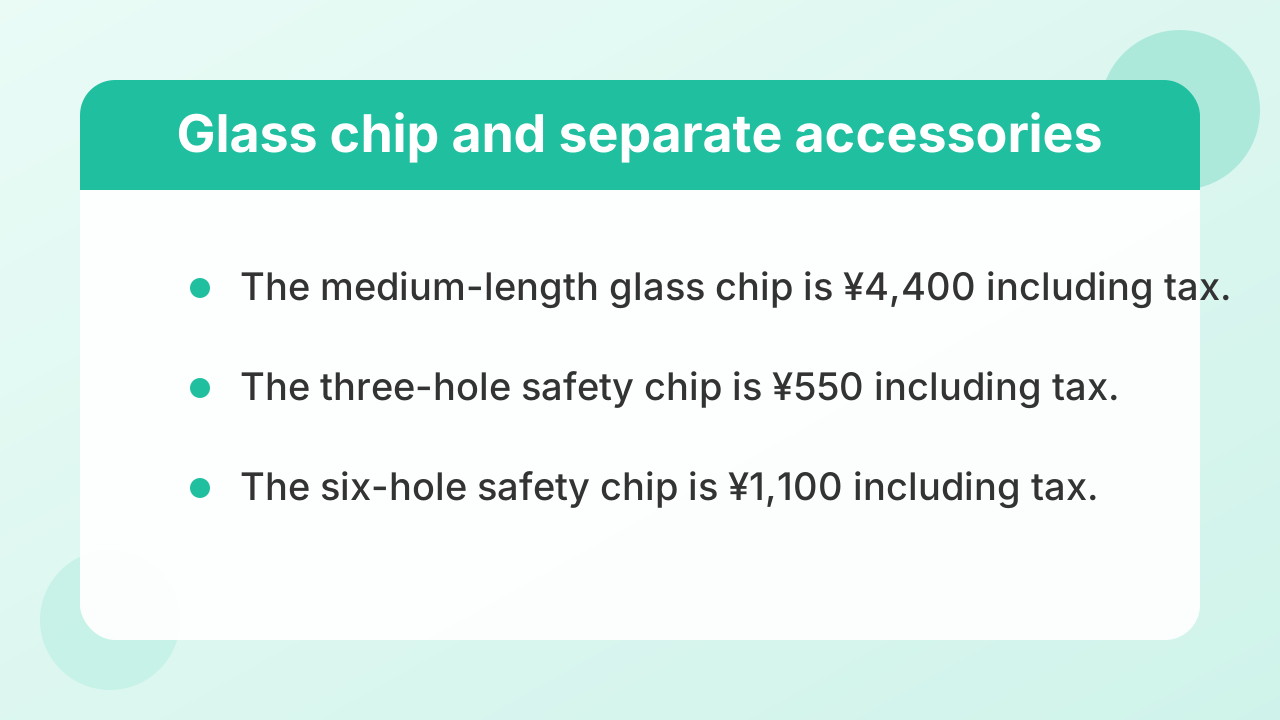
The current list includes a glass model and separate thread accessories discussed in these entries.
Products that appear in these entries
| Product (official name) | Price incl. tax | Relation to this topic |
|---|---|---|
| Medium-length glass chip (OKプロステートチップ ガラス素材セミロングタイプ) | ¥4,400 (about $28 at ¥156 = $1, rate as of 2026-09-04) | In May 2018, a customer reported peeling resin around this model's thread attachment after first use. |
| Three-hole safety chip (三穴方式オプションチップ(セーフティチップ)) | ¥550 (about $4 at ¥156 = $1, rate as of 2026-09-04) | In June 2018, its planned release introduced a separate processing charge for the three-hole design. |
The three-hole safety chip is listed in the company's own online store.

(Source: ok-lab's diary, published May 2018)
https://ok-lab.hatenablog.com/entry/20180524/1527153380
(Source: ok-lab's diary, published June 2018)
https://ok-lab.hatenablog.com/entry/20180630/1530342059
Products the diary mentioned as alternatives
| Product (official name) | Price incl. tax | Relation to this topic |
|---|---|---|
| Six-hole safety chip (六穴方式オプションチップ(セーフティチップ)) | ¥1,100 (about $7 at ¥156 = $1, rate as of 2026-09-04) | In April 2019, Mr. Okada proposed this separate part for matching two threads after dropping the included safety chip. |
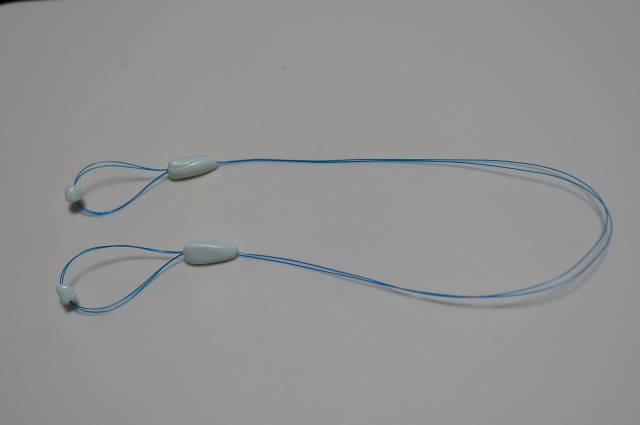
| Nylon thread with loops at both ends (両端ループナイロン糸) | ¥550 (about $4 at ¥156 = $1, rate as of 2026-09-04) | In February 2021, Mr. Okada suggested separate loop-ended threads might provide better strength than a joined, doubled version. |
The six-hole safety chip is listed in the company's own online store.
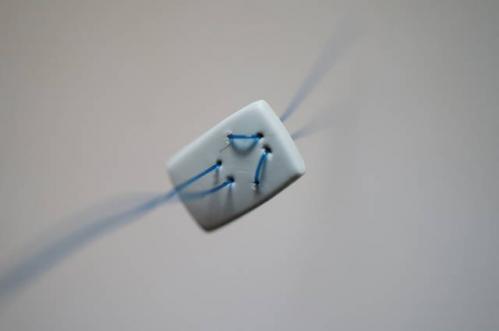
(Source: ok-lab's diary, published April 2019)
https://ok-lab.hatenablog.com/entry/2019/04/27/153239
(Source: ok-lab's diary, published February 2021)
https://ok-lab.hatenablog.com/entry/2021/02/27/130152
Older attachment versions and custom thread-end builds: No matching product can be confirmed on the current list.
Common worries about safety thread problems
"Is peeling resin around the safety thread acceptable?"
In an entry published in May 2018, a customer asked about resin lifting from a medium-length glass chip after first use. The customer feared the thread might detach. Mr. Okada believed loop attachments had resolved complete detachment, but said resin peeling remained unresolved.
Surface treatments were still being tested. The diary does not record whether the refund was completed. Mr. Okada advised a return for a refund and reconsidering purchase after a product addressing the problem became available.
(Source: ok-lab's diary, published May 2018)
https://ok-lab.hatenablog.com/entry/20180524/1527153380
"Could the safety thread end in a loop?"
In an entry published in August 2019, a customer requested a safety chip at 27cm, followed by a loop. Mr. Okada considered declining and suggesting a six-hole safety chip, then made the requested version and found it convenient. The diary does not record how the customer's loop performed in use.
The resulting specification allowed up to 27cm excluding the loop, which measured approximately 3cm when extended. Mr. Okada asked buyers to specify thread length without counting the loop.
(Source: ok-lab's diary, published August 2019)
https://ok-lab.hatenablog.com/entry/2019/08/17/132641
"Can both safety thread loops contain two strands?"
In an entry published in February 2021, a customer requested doubled loops with the strands held together. Mr. Okada agreed to investigate and produced a prototype with unequal strand lengths. He found nylon difficult to align; the diary does not record how the prototype performed in use.
Doubling the separately sold thread with loops at both ends added ¥500 (about $3 at ¥156 = $1, rate as of 2026-09-04) excluding tax. Mr. Okada suggested two separate loop-ended threads might provide better strength than a joined pair.
(Source: ok-lab's diary, published February 2021)
https://ok-lab.hatenablog.com/entry/2021/02/27/130152
Buying from outside Japan
OK Lab ships internationally to countries covered by Japan Post's EMS courier service. Overseas orders are paid in advance by PayPal. Each order carries a ¥400 (about $3 at ¥156 = $1, rate as of 2026-09-04) handling fee, and EMS shipping is charged on top. These terms come from OK Lab's official sales-terms page (written here as plain text, not a link: ok-lab.net/docs/law), checked on September 7, 2026; confirm them on the official store before you order, because they can change.
Summary of this article
| What you wanted to know | The answer |
|---|---|
| Main answer | Thread attachments, safety markers, and custom charges changed at different times. |
| What the product is | A urethral device made and sold by OK Lab in Japan. |
| What the terms mean | The retrieval thread, safety chip, and end loop are distinct parts. |
| What went wrong | The diary records detachment, broken threads, rough surfaces, and exposed metal. |
| How the maker responded | Attachment revisions, extra threads, returns, repairs, and changed end treatments. |
| How specifications developed | Changes progressed from attachment fixes to revised safety-marker placement. |
| Which current products are related | The list includes the medium-length glass chip and separate safety and loop-thread accessories. |
| What customers asked | Questions concerned peeling resin, end loops, and doubled loop construction. |
| Buying abroad | EMS coverage, advance PayPal payment, a handling fee, and additional shipping charges apply. |
Source: ok-lab's diary (Okada Comfortable Life Laboratory). The original entries are in Japanese; quotations on this page are translated. Photos and videos are on the original entries.
This article is a summary of the maker's development diary. The product is not a medical device and no result is guaranteed. If anything feels wrong or worries you, see a doctor. Prices, specifications and cautions change, so confirm the latest information on the official blog and the official site. Questions about ordering and shipping go to the seller.