![How much do chip coatings and covers cost? | Charges depend on the part and length [OK Prostate Chip]](/img/a/T0310/eyecatch.svg)
This page is based on entries from "ok-lab's diary" (https://ok-lab.hatenablog.com/), the Japanese development diary written by Mr. Okada, founder of OK Lab, a small company in Japan (Okada Comfortable Life Laboratory). Only the entries about "coating and cover costs" are summarized here, in order of publication. Past prices and sizes are as written at the time. Current prices come from the official product list (retrieved September 4, 2026). Quotations are translated from Japanese.
Note: This page is a personal reading log by someone with no connection to the maker or the seller. It reflects the source entries as of their publication dates and makes no guarantee of accuracy or safety. The product is not a medical device; talk to a doctor about any health decision. Check the official site for current information. This page contains advertising.
In short
Coating and cover charges varied by the part, length, and work involved.
In September 2025, thin nitinol (nickel-titanium alloy) coating carried no extra charge; thicker coating cost extra.
The current product list includes base chips, but no separately named coating service.
About this product

The OK Prostate Chip is a small device that is placed in the urethra (the urine passage) so that it acts on the prostate; the maker sells it in several shapes, sizes and materials. It is made and sold by OK Lab (Okada Comfortable Life Laboratory), a small company in Japan, through its own online store, and prices are in Japanese yen (JPY). The maker's development diary, "ok-lab's diary", is written in Japanese. This page is an English summary of it, and every quotation is translated. OK Lab ships internationally, so readers outside Japan can order (see "Buying from outside Japan" below). Product names on this page are plain-English descriptions. The official Japanese product name is shown once in the product table so you can find the same item in the store.
Before you read: key terms
| Term | Plain-English meaning |
|---|---|
| Rubber coating | An added surface layer, used on wires, connections, or chip sections for cushioning or protection. |
| Silicone tube | A flexible sleeve surrounding a wire or cable, used to cover that component. |
| Nitinol | A nickel-titanium alloy used for flexible wires and connections that return toward a set shape. |
| Resin | Material used to join parts, cover connections, or form chip bodies. |
| Parallel cable | Two electrical wires running alongside each other, used to connect powered components. |
| Electrode | A conductive component used to deliver electrical stimulation. |
| Retrieval thread | A strand attached to a chip, intended to allow its retrieval. |
What happens: coating and cover costs
The OK Prostate Chip is a small device placed in the urethra (the urine passage) to act on the prostate. Coatings and covers add a layer to connecting wires, cables, or parts of the chip. Mr. Okada describes these layers as ways to cushion contact, protect connections, or limit contact between metal and the urethral lining. Silicone tubes (flexible sleeves) enclose wires or cables, while rubber coatings form a layer on their surfaces.
Aluminum cover costs were quoted per sheet for a custom prototype
In an entry published in April 2019, a customer wanted a three-motor chip and asked whether an aluminum cover would affect its size. Mr. Okada agreed to attempt the build, without guaranteeing success, and subsequently reported completing it. The proposed aluminum-cover charge was ¥1,000 (about $6 at ¥156 = $1, rate as of 2026-09-04) per sheet, tax excluded.
The long prototype used one sheet, which Mr. Okada said produced noticeable wrinkles. He suggested separate cover pieces when a less wrinkled finish was wanted.
(Source: ok-lab's diary, published April 2019)
https://ok-lab.hatenablog.com/entry/2019/04/06/151323
Rubber coating costs followed the coated length of the wire
In an entry published in February 2021, Mr. Okada described testing rubber coating on a stainless-steel wire alongside nylon thread. Prices were ¥500, (about $3 at ¥156 = $1, rate as of 2026-09-04) tax excluded, for coating up to 10cm, and ¥1,000, (about $6 at ¥156 = $1, rate as of 2026-09-04) tax excluded, for 11–20cm. These were charges for the coated length, rather than a price for every wire configuration.
Mr. Okada reported a more comfortable feel during his own test, but said durability remained unknown. He also acknowledged uneven coverage and cautioned that extreme bending could damage the rubber.
(Source: ok-lab's diary, published February 2021)
https://ok-lab.hatenablog.com/entry/2021/02/13/121440
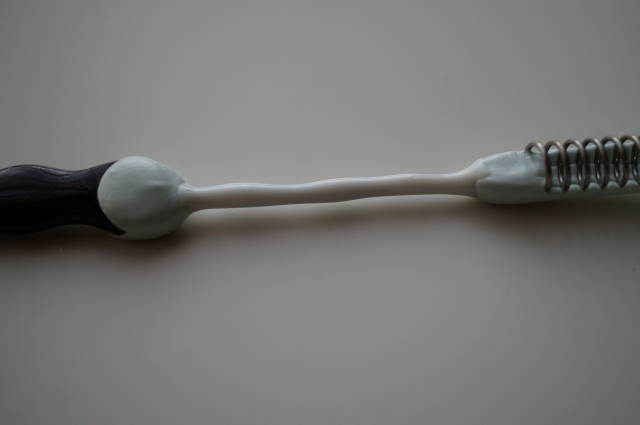
Thinner silicone tubes brought higher connection charges for the revised design
In an entry published in August 2022, Mr. Okada replaced the previous 3mm outer-diameter tube with a 2mm version. He said the revised connection required more work, so its price schedule replaced the previous week's figures. Connection processing became ¥2,000 (about $13 at ¥156 = $1, rate as of 2026-09-04) for ceramic chips and ¥2,500 (about $16 at ¥156 = $1, rate as of 2026-09-04) for blue chips, tax excluded.
Tube attachment cost ¥1,000 (about $6 at ¥156 = $1, rate as of 2026-09-04) up to 20cm, with ¥500 (about $3 at ¥156 = $1, rate as of 2026-09-04) for each additional 10cm, tax excluded. A separate loop component cost ¥1,000, (about $6 at ¥156 = $1, rate as of 2026-09-04) tax excluded. Mr. Okada limited tube length to 40cm because longer assemblies were too difficult for him to make.
(Source: ok-lab's diary, published August 2022)
https://ok-lab.hatenablog.com/entry/2022/08/13/122909
A larger tube cover became possible after an initial refusal
In an entry published in October 2023, a customer wanted a reinforced electrical cable enclosed in a silicone tube. Staff initially refused because the existing tube was too small and they had not resolved how to secure the assembly. Mr. Okada reconsidered and completed a prototype using a tube approximately 4mm across.
The cover added ¥2,000, (about $13 at ¥156 = $1, rate as of 2026-09-04) tax excluded, to the existing stainless-steel electrode (a conductive component for electrical stimulation) price. Mr. Okada attributed the extra work partly to drying periods across approximately five days. He left compatibility with twin electrodes for further testing.
(Source: ok-lab's diary, published October 2023)
https://ok-lab.hatenablog.com/entry/2023/10/07/123003
Twin-electrode cover costs reflected especially difficult work on both cables
In a later entry published in October 2023, Mr. Okada reported completing the covered twin-electrode prototype. Its tube-cover charge was ¥4,000, (about $26 at ¥156 = $1, rate as of 2026-09-04) tax excluded, added to the existing twin-electrode price. He described securing both cables as substantially harder than making separate covers for individual electrodes.
Mr. Okada felt the finished assembly was sturdier. However, he warned that another attempt might not come together as successfully.
(Source: ok-lab's diary, published October 2023)
https://ok-lab.hatenablog.com/entry/2023/10/14/122718
An optional cable cover added to a redesigned vibrating chip's cost
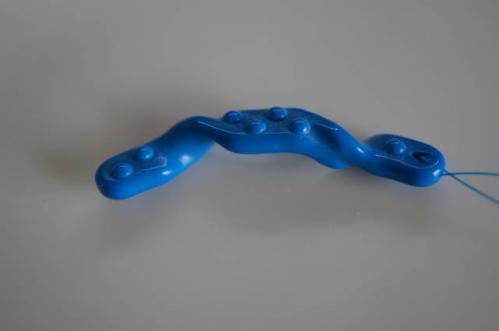
In an entry published in April 2025, a customer proposed combining a short ceramic vibrating chip with a curved wire support. Staff initially said the proposed materials were difficult to combine, but Mr. Okada developed a different arrangement and completed a prototype. A 20cm silicone cable cover was an optional ¥2,000 (about $13 at ¥156 = $1, rate as of 2026-09-04) addition, tax excluded.
The revised motor connection also required approximately 15mm of resin (material used to join and cover parts) behind the motor. This changed the chip's construction as well as its price. Mr. Okada suggested a shorter front chip to accommodate the longer connection area.
(Source: ok-lab's diary, published April 2025)
https://ok-lab.hatenablog.com/entry/2025/04/26/122909
Custom cover costs reached ¥4,400 (about $28 at ¥156 = $1, rate as of 2026-09-04) for either electrode arrangement
In an entry published in February 2026, one customer requested two covered electrode assemblies: one arranged side by side and another end to end. Each quotation listed ¥4,400 (about $28 at ¥156 = $1, rate as of 2026-09-04) for tube coating, separately from cables and chip connections. No tax description accompanied those figures.
Mr. Okada reported completing both assemblies. He described the end-to-end arrangement as particularly demanding because it used reinforced twisted cables where he normally used parallel cables.
(Source: ok-lab's diary, published February 2026)
https://ok-lab.hatenablog.com/entry/2026/02/07/122919
The maker's answer to coating and cover costs
Mr. Okada priced the specific covering work separately, with different conditions for wires, electrical cables, and thicker finishes.
Rubber coating became mandatory for one particular connecting core
In an entry published in March 2021, Mr. Okada introduced a connecting core containing stainless-steel wire inside a cable sleeve. Its rubber coating cost ¥500 (about $3 at ¥156 = $1, rate as of 2026-09-04) per connecting section, tax excluded. This price applied specifically to that core.
The charge was separate from the chip and core-attachment prices. Mr. Okada specified that this unfinished component required coating and was not intended to remain exposed.
(Source: ok-lab's diary, published March 2021)
https://ok-lab.hatenablog.com/entry/2021/03/27/130138
Tube cover replacement was generally unavailable for the early wire assembly
In an entry published in August 2022, Mr. Okada addressed replacement of the early wire-filled silicone tube. He said OK Lab generally could not provide that service because separating the attachment could damage the chip. Replacement work therefore could not be priced like ordinary thread replacement.
He distinguished this from the existing service for standard nylon retrieval thread (the attached strand intended for retrieval). Mr. Okada invited individual inquiries about unusually valued or specially modified chips, without promising acceptance.
(Source: ok-lab's diary, published August 2022)
https://ok-lab.hatenablog.com/entry/2022/08/06/123150
Parallel cable cover costs stayed unchanged when customers chose shorter lengths
In an entry published in October 2023, Mr. Okada introduced a covered parallel cable (two electrical wires running alongside each other). Enclosing it added ¥2,000, (about $13 at ¥156 = $1, rate as of 2026-09-04) tax excluded, with up to 25cm covered and 40cm overall. Choosing shorter lengths did not reduce the charge.
He also reported withdrawing the earlier four-wire, six-wire, and silicone support designs because of durability problems. Mr. Okada specified that the new covered-cable design could not exceed its stated length limits.
(Source: ok-lab's diary, published October 2023)
https://ok-lab.hatenablog.com/entry/2023/10/14/122718
A shape-memory wire cover added cost alongside a friction tradeoff
In an entry published in April 2024, a tube cover added ¥1,000, (about $6 at ¥156 = $1, rate as of 2026-09-04) tax excluded, to a shape-memory wire connection. Mr. Okada described the cover as reducing concentrated pressure while increasing friction against the urethral lining. In his own tests, covered and uncovered versions felt broadly similar.
He treated the choice as dependent on the individual's experience with the material. Mr. Okada also advised stopping use if the connection's outer resin became damaged.
(Source: ok-lab's diary, published April 2024)
https://ok-lab.hatenablog.com/entry/2024/04/13/123053
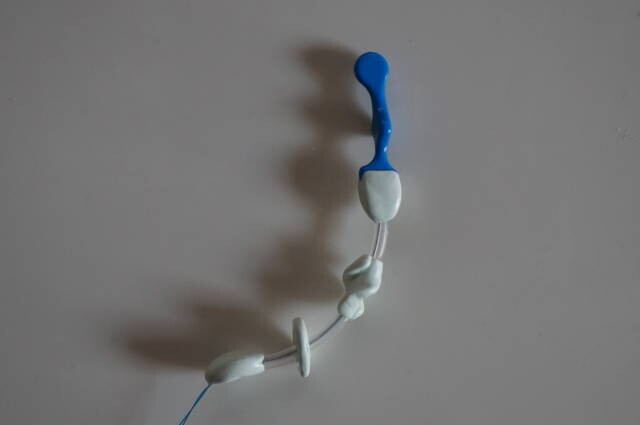
Thin nitinol coating carried no surcharge, while thicker coverage cost extra
In an entry published in September 2025, Mr. Okada announced plans to avoid supplying products with nitinol directly contacting skin. He introduced thin silicone coating over the thread without an extra charge, describing it as a protective measure. Optional thick coating cost ¥500 (about $3 at ¥156 = $1, rate as of 2026-09-04) per 5cm, tax excluded.
He noted that thicker areas could become uneven and would not pass through auxiliary-chip holes. Mr. Okada therefore advised considering those compatibility limits when choosing whether to request thicker coverage.
(Source: ok-lab's diary, published September 2025)
https://ok-lab.hatenablog.com/entry/2025/09/06/122911
How coating and cover costs changed over time

| Published | What the diary said then |
|---|---|
| Apr 2019 | Aluminum covering received a proposed price per sheet. |
| Mar 2021 | A new connecting core required rubber coating charged per section. |
| Aug 2022 | A thinner tube brought revised connection processing and charges. |
| Jun 2023 | A tube-covered core's planned price rose to ¥2,000 (about $13 at ¥156 = $1, rate as of 2026-09-04) per chip, tax excluded. |
| Oct 2023 | Twin-electrode covering became possible; earlier support designs were withdrawn over durability concerns. |
| Apr 2024 | Shape-memory connections offered an optional cover with a separate charge. |
| May 2025 | Extra coating on a narrow ceramic-chip section cost ¥500, (about $3 at ¥156 = $1, rate as of 2026-09-04) tax excluded. |
| Sep 2025 | Thin nitinol coating carried no surcharge; thick coating had length-based fees. |
| Feb 2026 | Covered twisted cables were completed for both side-by-side and end-to-end electrode assemblies. |
| Jun 2026 | Resin over rubber required extra payment and increased thickness. |
The diary does not say what the current state is.
OK Prostate Chip products related to coating and cover costs

These base chips appear in the coating discussions and remain on the supplied current product list.
Products that appear in these entries
| Product (official name) | Price incl. tax | Relation to this topic |
|---|---|---|
| Notched resin chip (OKプロステートチップ 凶悪ゾロ(生体適合樹脂)) | ¥5,500 (about $35 at ¥156 = $1, rate as of 2026-09-04) | In July 2024, a customer outside Japan requested this chip with a tube arrangement replacing its thread. |
| Short ceramic vibrating chip (OKプロステート核振チップ 陶器素材ショートタイプ) | ¥5,500 (about $35 at ¥156 = $1, rate as of 2026-09-04) | In April 2025, a customer proposed this base model for a custom build that received an optional cable-cover quotation. |
The resin chip named in the table below is listed in OK Lab's own online store.
The short ceramic vibrating chip is listed in OK Lab's own online store.
(Source: ok-lab's diary, published July 2024)
https://ok-lab.hatenablog.com/entry/2024/07/13/123018
(Source: ok-lab's diary, published April 2025)
https://ok-lab.hatenablog.com/entry/2025/04/26/122909
Products the diary mentioned as alternatives
The diary names no alternative.
Historical custom covered assemblies and coating options
No matching product can be confirmed on the current list.
Common worries about coating and cover costs

Customers asked about extra charges, compatibility, and the thickness added by covering work.
"Why does filling twin-chip gaps increase the coating cost?"
In an entry published in October 2023, a customer asked whether filling gaps between twin electrodes would make cleaning easier. Mr. Okada explained that leaving metal exposed was intentional, because resin would cover part of the conductive surface. He nevertheless offered gap filling for an additional ¥2,000, (about $13 at ¥156 = $1, rate as of 2026-09-04) tax excluded.
He said the work required substantially more finishing than ordinary twin joining. The diary states that the gaps remained unfilled at that point. Mr. Okada offered the requested finish only with the additional processing charge.
(Source: ok-lab's diary, published October 2023)
https://ok-lab.hatenablog.com/entry/2023/10/21/123054
"Can a tube cover replace the chip's retrieval thread?"
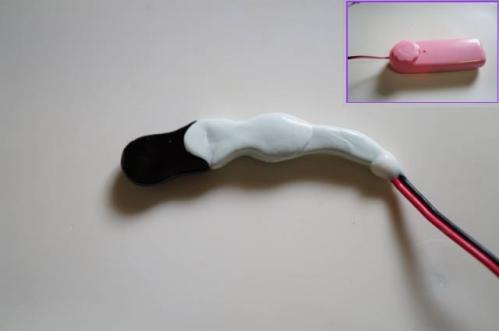
In an entry published in July 2024, a customer outside Japan wanted a tube arrangement to make placement of the resin chip named in the table below easier. Mr. Okada suggested a red-and-black electrical cable enclosed in a tube as a simple option for that request. The additional charge was ¥2,200 (about $14 at ¥156 = $1, rate as of 2026-09-04), with tube length limited to 25cm.
The diary does not record the outcome. Mr. Okada recommended that specific cable-and-cover arrangement for the customer's stated purpose.
(Source: ok-lab's diary, published July 2024)
https://ok-lab.hatenablog.com/entry/2024/07/13/123018
"Would a resin cover cost more or add thickness?"
In an entry published in June 2026, a customer asked to replace rubber sections on a wire-loop device with resin. OK Lab replied that the rubber served a waterproofing purpose and could not simply be replaced. Its proposed solution retained the rubber beneath an added resin layer.
The quotation was ¥1,100 (about $7 at ¥156 = $1, rate as of 2026-09-04) per location, and the reply said thickness would increase by approximately 1–2mm. The diary does not record the outcome. OK Lab specified an overlay as the available response to this request.
(Source: ok-lab's diary, published June 2026)
https://ok-lab.hatenablog.com/entry/2026/06/13/122909
Buying from outside Japan

OK Lab ships internationally to countries covered by Japan Post's EMS courier service. Overseas orders are paid in advance by PayPal. Each order carries a ¥400 (about $3 at ¥156 = $1, rate as of 2026-09-04) handling fee, and EMS shipping is charged on top. These terms come from OK Lab's official sales-terms page (ok-lab.net/docs/law), checked on September 7, 2026; confirm them on the official store before you order, because they can change.
Summary of this article
| What you wanted to know | The answer |
|---|---|
| What is the short answer? | Historical charges depended on the covered part, length, and processing required. |
| What is this product? | A small urethral device made by OK Lab in Japan, with prices in Japanese yen. |
| What do the terms mean? | Coatings form surface layers; tube covers surround wires or cables. |
| What did covering work cost? | Different dated quotations applied to aluminum sheets, wire sections, and electrical cable assemblies. |
| What was the maker's approach? | Mr. Okada distinguished included thin coating from optional work and described limits on length and replacement. |
| How did the options change? | New tube sizes, cable arrangements, and coating methods brought different charges and restrictions. |
| Which related base chips are listed today? | The resin chip in the table and the short ceramic vibrating chip each cost ¥5,500 (about $35 at ¥156 = $1, rate as of 2026-09-04) incl. tax. |
| What did customers question? | Additional charges, covered-cable compatibility, gap filling, and thickness added by resin. |
| How are overseas orders handled? | Advance PayPal payment, a ¥400 (about $3 at ¥156 = $1, rate as of 2026-09-04) handling fee, and additional EMS shipping charges. |
Source: ok-lab's diary (Okada Comfortable Life Laboratory). The original entries are in Japanese; quotations on this page are translated. Photos and videos are on the original entries.
This article is a summary of the maker's development diary. The product is not a medical device and no result is guaranteed. If anything feels wrong or worries you, see a doctor. Prices, specifications and cautions change, so confirm the latest information on the official blog and the official site. Questions about ordering and shipping go to the seller.