![How much do bumps and dots cost? | The finish and design determine the extra charge [OK Prostate Chip]](/img/a/T0308/eyecatch.svg)
This page is based on entries from "ok-lab's diary" (https://ok-lab.hatenablog.com/), the Japanese development diary written by Mr. Okada, founder of OK Lab, a small company in Japan (Okada Comfortable Life Laboratory). Only the entries about "bump and dot decoration costs" are summarized here, in order of publication. Past prices and sizes are as written at the time. Current prices come from the official product list (retrieved September 4, 2026). Quotations are translated from Japanese.
Note: This page is a personal reading log by someone with no connection to the maker or the seller. It reflects the source entries as of their publication dates and makes no guarantee of accuracy or safety. The product is not a medical device; talk to a doctor about any health decision. Check the official site for current information. This page contains advertising.
In short
Ceramic bumps, resin dots, and rubber loop bumps had different charges, specifications, and limits.
Mr. Okada sometimes offered dot decoration when the requested ceramic bumps were unavailable.
The current product list includes the bump-change option at ¥1,100 (about $7 at ¥156 = $1, rate as of 2026-09-04) including tax.
About this product
The OK Prostate Chip is a small device that is placed in the urethra (the urine passage) so that it acts on the prostate; the maker sells it in several shapes, sizes and materials. It is made and sold by OK Lab (Okada Comfortable Life Laboratory), a small company in Japan, through its own online store, and prices are in Japanese yen (JPY). The maker's development diary, "ok-lab's diary", is written in Japanese. This page is an English summary of it, and every quotation is translated. OK Lab ships internationally, so readers outside Japan can order (see "Buying from outside Japan" below). Product names on this page are plain-English descriptions. The official Japanese product name is shown once in the product table so you can find the same item in the store.
Before you read: key terms
| Term | Plain-English meaning |
|---|---|
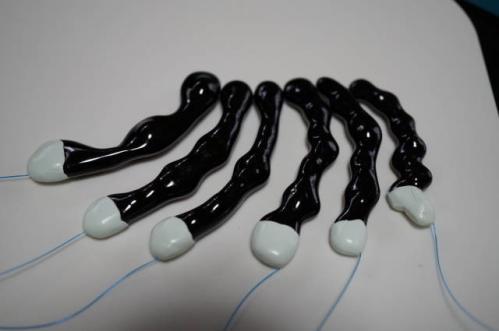
| Ceramic bumps | Raised features on ceramic chips, intended by the maker to change the sensation. |
| Epoxy dots | Small raised spots made from shaping resin, added to a chip for surface texture. |
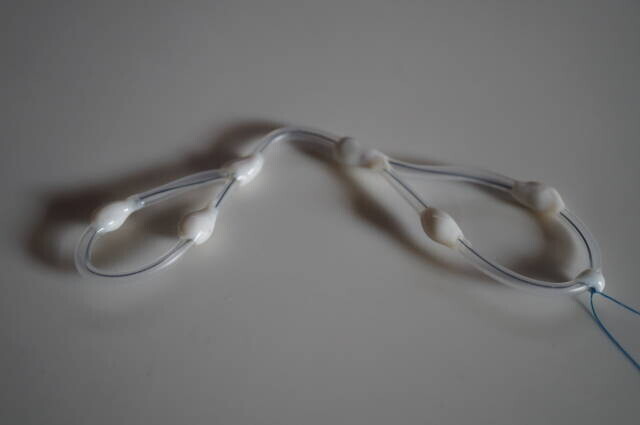
| Six-line support cable | A cable joined by small resin beads; the diary discusses enlarging those beads to change its texture. |
| Chipless loops | Wire-and-tube loops used instead of solid chips; the maker describes them as another way to provide stimulation. |
| Rubber loop bumps | Small silicone-rubber additions on chipless loops, proposed as a milder alternative to a twisted resin attachment. |
What happens: Prostate Chip bump and dot costs
The OK Prostate Chip is a device placed in the urethra to act on the prostate. These entries discuss ceramic bumps, epoxy dots (raised resin spots), and rubber additions on parts of the device. Mr. Okada presents these features as ways to change sensation, although appearance also matters to some customers. The charges depend on the type of addition and the particular design requested.
Ceramic bumps launched with a separate surcharge in September 2020
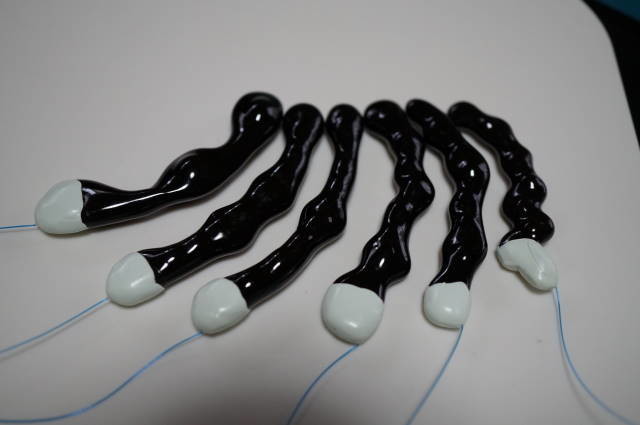
In an entry published in September 2020, Mr. Okada introduced six newly finished ceramic designs with raised bumps. He announced that orders would open the following week. The surcharge was ¥1,000 (about $6 at ¥156 = $1, rate as of 2026-09-04) excluding tax compared with the version without bumps.
This was an additional finish charge, rather than the price of a complete chip. At that stage, the offer covered only the six designs introduced in the entry. Mr. Okada directed customers to a temporary bump-addition listing for those designs.
(Source: ok-lab's diary, published September 2020)
https://ok-lab.hatenablog.com/entry/2020/09/19/123115
Ceramic bumps added a separate fee to a June 2021 request
In an entry published in June 2021, a customer requested a bumpy custom version of a ceramic chip. Mr. Okada explained that the bumpy version required an additional ¥1,100 (about $7 at ¥156 = $1, rate as of 2026-09-04). The charge concerned the requested bumps, while the order also contained other items.
The paragraph does not identify the tax treatment of that explanatory price. The diary does not record how this customer's bumpy chip felt in use.
(Source: ok-lab's diary, published June 2021)
https://ok-lab.hatenablog.com/entry/2021/06/05/125933
Ceramic bumps were standard on both parts of one paired design
In an entry published in April 2022, a customer requested the paired ceramic design (Sea Slug ver.5). Mr. Okada explained that both chips came with bumps as standard for that design. An additional ¥2,200 (about $14 at ¥156 = $1, rate as of 2026-09-04) for the bumps therefore applied to the listed order.
The explanation concerned this paired build, rather than a universal price for decorating any device. The diary does not record the customer's experience with the completed order.
(Source: ok-lab's diary, published April 2022)
https://ok-lab.hatenablog.com/entry/2022/04/09/123458
Textured cable prices increased with the length of the requested section
In an entry published in August 2022, a customer requested larger, alternating beads on the six-line support cable (a cable joined by resin beads). Mr. Okada changed the spacing from two beads per 15 mm to one per 15 mm. The resulting beads were approximately 10 mm wide, 12 mm long, and 5 mm thick, alternating by 90 degrees.
His prices, excluding tax, were ¥5,000 (about $32 at ¥156 = $1, rate as of 2026-09-04) up to 10 cm, ¥7,500 (about $48 at ¥156 = $1, rate as of 2026-09-04) up to 15 cm, and ¥10,000 (about $64 at ¥156 = $1, rate as of 2026-09-04) up to 20 cm. He wrote that longer versions did not appear feasible. Mr. Okada also cautioned that he considered this bead size too demanding for his own urethra and those of other customers.
(Source: ok-lab's diary, published August 2022)
https://ok-lab.hatenablog.com/entry/2022/08/20/122920
Dot decoration introduced smaller raised features with an individual layout
In an entry published in October 2024, Mr. Okada introduced dot decoration on ceramic chips. He described projections of just under 1 mm, which he thought added resistance and a modest change in sensation. His prototypes used S versions of the short, medium-length, and Awakening-type ceramic chips.
The finish had approximately 5–7 dots per side, or 10–14 across both sides. The price was ¥1,000 (about $6 at ¥156 = $1, rate as of 2026-09-04) excluding tax, with the arrangement left to Mr. Okada as an individual art treatment. He thought the decoration might strengthen the ceramic, but explicitly gave no guarantee against breakage.
(Source: ok-lab's diary, published October 2024)
https://ok-lab.hatenablog.com/entry/2024/10/05/122923
Dot decoration appeared beside ceramic bumps as a separate quoted item
In an entry published in December 2024, a customer requested a slim double-twist ceramic chip with both bumps and dot decoration. The quotation listed ¥1,100 (about $7 at ¥156 = $1, rate as of 2026-09-04) for the bumps and a separate ¥1,100 (about $7 at ¥156 = $1, rate as of 2026-09-04) for the dots. Other requested changes appeared as their own items in the same quotation.
Neither of these additions was described as included in the other. The diary does not record the customer's experience with that combination.
(Source: ok-lab's diary, published December 2024)
https://ok-lab.hatenablog.com/entry/2024/12/28/122907
Custom resin bumps could match the price of a twisted chip
In entries published in January 2025, a customer explored a bumpy resin design partly for its appearance. Mr. Okada offered dots on a flat chip for ¥1,000 (about $6 at ¥156 = $1, rate as of 2026-09-04) excluding tax, matching the ceramic-dot charge. He stated that replacing the twisted shape reduced the price by ¥1,000 (about $6 at ¥156 = $1, rate as of 2026-09-04) excluding tax, leaving the same quoted price as the standard twisted chip.
Later, staff questioned whether fine bumps and hollows could be made neatly within the requested space, and the customer withdrew that proposal. After reviewing a drawing at actual size, Mr. Okada said a flat design with four added bumps appeared feasible at the twisted-chip price. He invited the customer to consider this revised proposal; the diary does not record whether it was completed.
(Source: ok-lab's diary, published January 2025)
https://ok-lab.hatenablog.com/entry/2025/01/04/122911
(Source: ok-lab's diary, published January 2025)
https://ok-lab.hatenablog.com/entry/2025/01/18/123007
Rubber loop bumps were individually priced in an April 2025 quotation
In an entry published in April 2025, a customer requested two bumps on a custom chipless device. Staff asked whether the bumps could sit slightly offset on opposite sides of the main loop, and the customer agreed. The quotation recorded the addition as ¥550 (about $4 at ¥156 = $1, rate as of 2026-09-04) × 2.
The device was still being made when the entry was published. Mr. Okada specifically noted that the bumps had not yet been added.
(Source: ok-lab's diary, published April 2025)
https://ok-lab.hatenablog.com/entry/2025/04/12/122910
The maker's answer to Prostate Chip bump and dot costs
Mr. Okada's replies tied each charge to a particular finish, with separate limits on shape, size, and placement.
Ceramic bumps did not explain the largest model's fitting problem
In an entry published in April 2022, Mr. Okada introduced bumpy versions of the large ceramic series (Mokushi). The standard thread-connected version cost the underlying chip price plus ¥1,000 (about $6 at ¥156 = $1, rate as of 2026-09-04) excluding tax. He also reported several complaints that the largest model (Mokushi A) would not fit.
He wrote that most reported difficulty concerned the end section, which had no bumps and had not changed size. He described this model as larger than the long L four-point twist. Mr. Okada cautioned that adding bumps made the already large chip larger still.
(Source: ok-lab's diary, published April 2022)
https://ok-lab.hatenablog.com/entry/2022/04/23/123121
Rubber loop bumps offered a proposed alternative with placement limits
In an entry published in January 2025, a customer asked about softer additions to chipless loops (wire-and-tube loops replacing solid chips). Mr. Okada initially hesitated because of manufacturing difficulties, then made prototypes and described their sensation as milder than the twisted resin attachment. His observations came from short tests.
The price was ¥500 (about $3 at ¥156 = $1, rate as of 2026-09-04) per bump excluding tax; his example listed a ¥6,000 (about $38 at ¥156 = $1, rate as of 2026-09-04) chipless device plus four bumps costing ¥2,000 (about $13 at ¥156 = $1, rate as of 2026-09-04), excluding tax. The stated limit was two bumps per loop, one inside and one outside, although loops of 25 mm or less might accommodate only one. Mr. Okada asked customers to specify placement near the loop's tip, middle, or joining point.
(Source: ok-lab's diary, published January 2025)
https://ok-lab.hatenablog.com/entry/2025/01/25/122940
Dot decoration replaced unavailable bumps on a four-point twist
In an entry published in January 2026, a customer selected the bump option for a long four-point twist ceramic chip. Mr. Okada explained that there was no bumpy version of that chip. He proposed dots on its tip instead, at ¥1,100 (about $7 at ¥156 = $1, rate as of 2026-09-04), the same charge as the bump option.
The customer accepted that substitution. Mr. Okada's offered alternative was tip decoration on the requested chip.
(Source: ok-lab's diary, published January 2026)
https://ok-lab.hatenablog.com/entry/2026/01/24/122909
How Prostate Chip bump and dot costs changed over time
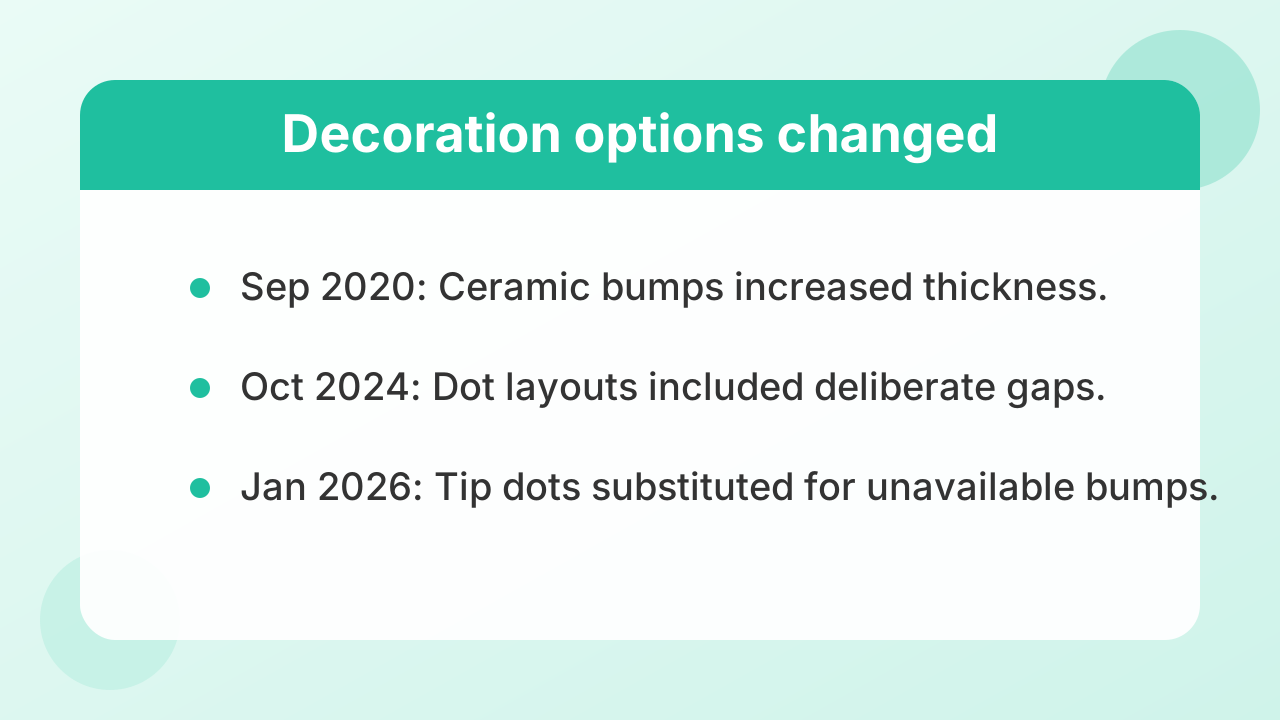
| Published | What the diary said then |
|---|---|
| Sep 2020 | Ceramic bumps increased thickness without changing the existing length or width. |
| Oct 2020 | Six further bumpy designs brought the announced ceramic range to 12. |
| Apr 2022 | The largest ceramic model's reported fitting problem usually involved its unchanged, unbumped end. |
| Aug 2022 | Enlarged, alternating cable beads received prices based on section length. |
| Mar 2023 | A customer reported ceramic breakage after the chip struck a toilet bowl. |
| Oct 2024 | Dot layouts included deliberate gaps rather than an uninterrupted pattern. |
| Jan 2025 | Rubber loop bumps measured approximately 7–8 mm long and 5–6 mm across. |
| Mar 2025 | Loop bumps appeared among options for chipless and wire-supported chip configurations. |
| Jan 2026 | Tip dots substituted for unavailable bumps on the four-point twist. |
| Jun 2026 | A bumpy short-twist request changed from SS to S because of the size restriction. |
OK Prostate Chip products related to Prostate Chip bump and dot costs
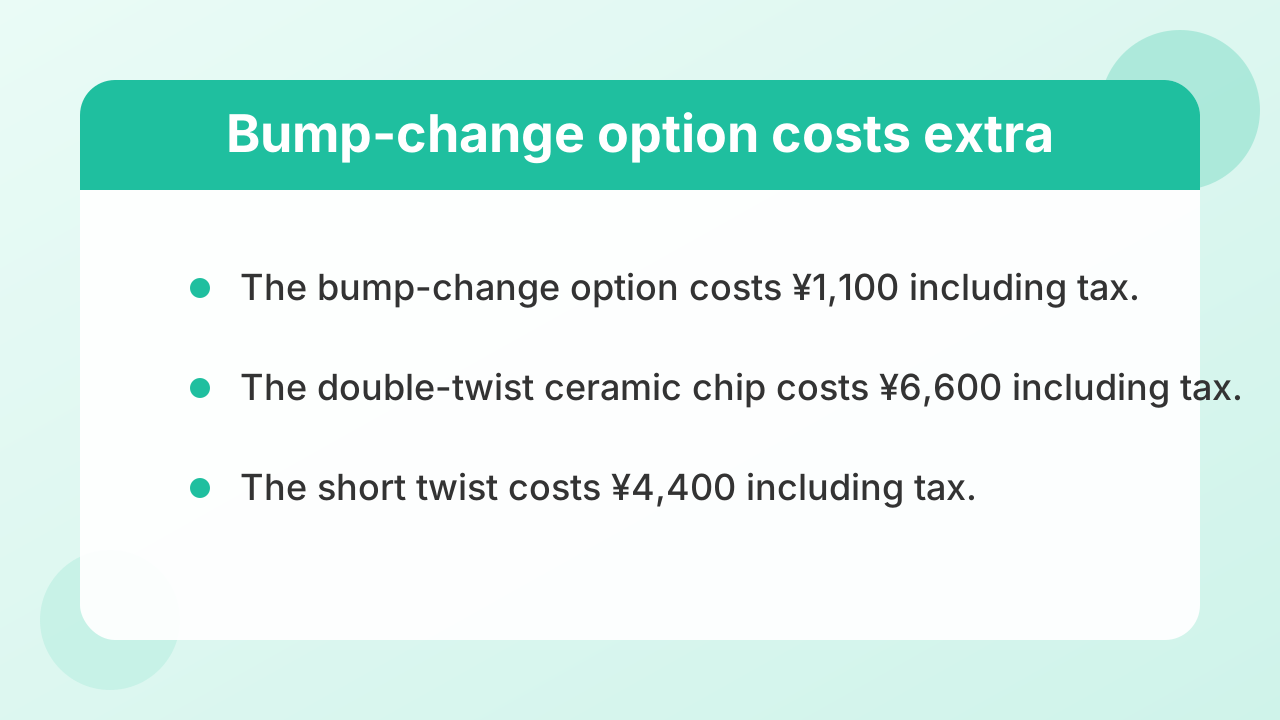
The current bump-change option costs ¥1,100 (about $7 at ¥156 = $1, rate as of 2026-09-04) including tax, separately from the ceramic chip itself.
Products that appear in these entries
| Product (official name) | Price incl. tax | Relation to this topic |
|---|---|---|
| Bump-change option (イボ付きチップに変更オプション) | ¥1,100 (about $7 at ¥156 = $1, rate as of 2026-09-04) | The June 2021 entry records this option in requests for bumpy ceramic designs. |
| Double-twist ceramic chip (OKプロステートチップ 陶器素材覚醒タイプ ダブルツイスト(ラブカチップ)) | ¥6,600 (about $42 at ¥156 = $1, rate as of 2026-09-04) | A December 2024 quotation used this chip with separately priced bumps and dots. |
| Long four-point twist ceramic chip (OKプロステートチップ 陶器素材ロングタイプ 4点ツイスト) | ¥7,700 (about $49 at ¥156 = $1, rate as of 2026-09-04) | The January 2026 case concerned this chip when tip dots replaced the unavailable bumpy version. |
| Short twist ceramic chip (OKプロステートチップ 陶器素材ショートタイプ ツイスト) | ¥4,400 (about $28 at ¥156 = $1, rate as of 2026-09-04) | The June 2026 case involved this chip when a bumpy SS request changed to S. |
(Source: ok-lab's diary, published June 2021)
https://ok-lab.hatenablog.com/entry/2021/06/05/125933
(Source: ok-lab's diary, published December 2024)
https://ok-lab.hatenablog.com/entry/2024/12/28/122907
(Source: ok-lab's diary, published January 2026)
https://ok-lab.hatenablog.com/entry/2026/01/24/122909
(Source: ok-lab's diary, published June 2026)
https://ok-lab.hatenablog.com/entry/2026/06/27/122906
The bump-change option is listed in OK Lab's own online store.
Products the diary mentioned as alternatives
The diary names no alternative.
Historical paired ceramic builds, the large ceramic series, crossed-bead cables, custom dotted resin builds, and chipless loop builds:
No matching product can be confirmed on the current list.
Common worries about Prostate Chip bump and dot costs
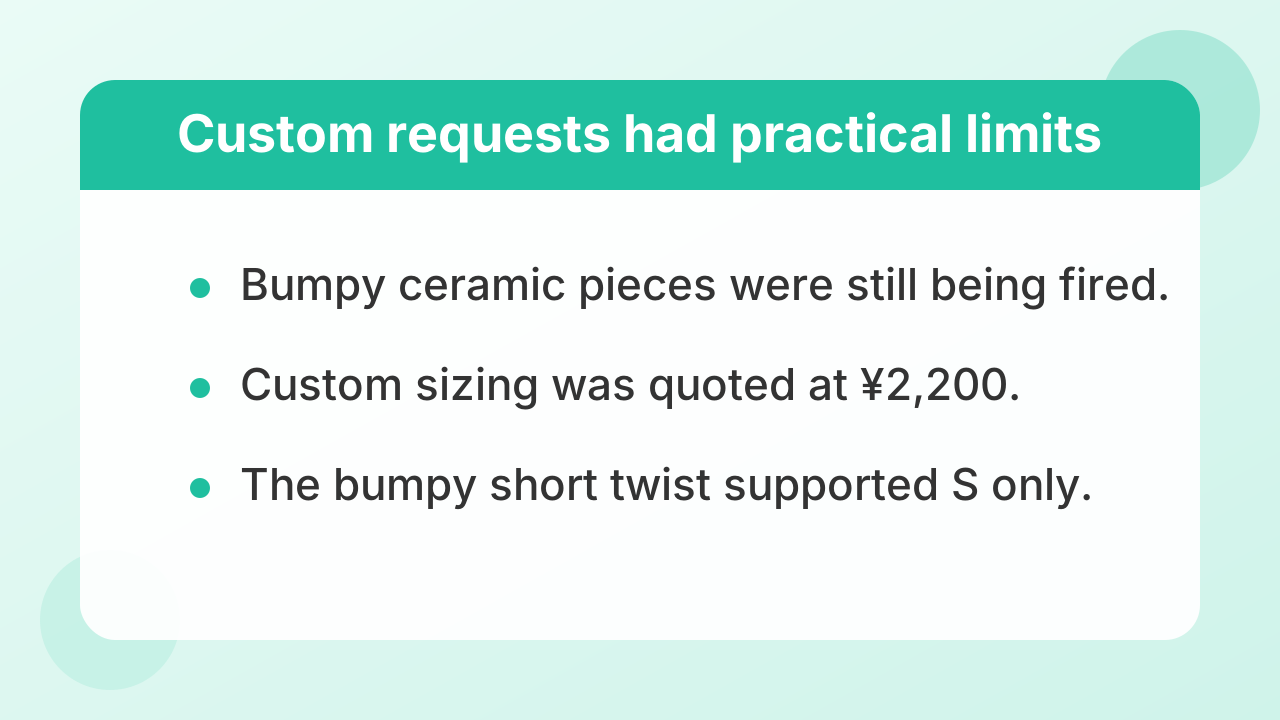
The recorded questions concern production delays, custom dimensions, and whether the requested size supports bumps.
"Can ceramic bumps delay a custom order?"
In an entry published in April 2022, a customer requested a vibrating version of the largest ceramic model with bumps. Mr. Okada replied that the first batch of bumpy ceramic pieces was still being fired. He expected it to arrive 10 days later, with assembly following afterward.
The customer then chose the version without bumps. Mr. Okada's reply made clear that waiting for the ceramic pieces was necessary for the originally requested finish.
(Source: ok-lab's diary, published April 2022)
https://ok-lab.hatenablog.com/entry/2022/04/09/123458
"Do custom bump dimensions cost extra?"
In an entry published in July 2022, a customer requested particular dimensions for the white bumps on a support cable. The requested measurements were 12 mm long, 8 mm wide, and 5 mm thick. The quotation assigned ¥2,200 (about $14 at ¥156 = $1, rate as of 2026-09-04) to that custom sizing, separately from the chip and cable.
This was a quotation for the specified build. The diary does not record whether the finished bumps matched every requested measurement.
(Source: ok-lab's diary, published July 2022)
https://ok-lab.hatenablog.com/entry/2022/07/02/123119
"Are ceramic bumps available on an SS short twist?"
In an entry published in June 2026, a customer requested an SS short twist ceramic chip with bumps. Mr. Okada explained that the bumpy short twist supported S only. The customer changed the request to S.
That response concerned the bumpy short twist specifically. Mr. Okada's stated size limit required a change to the customer's original specification.
(Source: ok-lab's diary, published June 2026)
https://ok-lab.hatenablog.com/entry/2026/06/27/122906
Buying from outside Japan
OK Lab ships internationally to countries covered by Japan Post's EMS courier service. Overseas orders are paid in advance by PayPal. Each order carries a ¥400 (about $3 at ¥156 = $1, rate as of 2026-09-04) handling fee, and EMS shipping is charged on top. These terms come from OK Lab's official sales-terms page (written here as plain text, not a link: ok-lab.net/docs/law), checked on September 7, 2026; confirm them on the official store before you order, because they can change.
Summary of this article
| What you wanted to know | The answer |
|---|---|
| What is the short answer about cost? | Different finishes and custom designs had separate charges. |
| What is the product? | A device made by OK Lab in Japan and placed in the urethra to act on the prostate. |
| What do the finish names mean? | Ceramic bumps, resin dots, and rubber loop bumps describe different additions. |
| What did the historical cases show? | Charges depended on the finish, number of decorated parts, or cable length. |
| What did the maker offer when a request could not work? | His replies included dot substitutions and limits on bump placement or size. |
| What changed over time? | Ceramic bumps were followed by crossed cable beads, dots, and rubber loop additions. |
| What is listed today? | The bump-change option and the ceramic base products shown above appear on the current list. |
| What practical questions came up? | Customers asked about production timing, custom dimensions, and supported sizes. |
| How do overseas orders work? | The stated terms require advance PayPal payment, a handling fee, and additional EMS shipping. |
Source: ok-lab's diary (Okada Comfortable Life Laboratory). The original entries are in Japanese; quotations on this page are translated. Photos and videos are on the original entries.
This article is a summary of the maker's development diary. The product is not a medical device and no result is guaranteed. If anything feels wrong or worries you, see a doctor. Prices, specifications and cautions change, so confirm the latest information on the official blog and the official site. Questions about ordering and shipping go to the seller.