![Do loops and birdcages cost extra? | The design determines the fee [OK Prostate Chip]](/img/a/T0307/eyecatch.svg)
This page is based on entries from "ok-lab's diary" (https://ok-lab.hatenablog.com/), the Japanese development diary written by Mr. Okada, founder of OK Lab, a small company in Japan (Okada Comfortable Life Laboratory). Only the entries about "extra charges for loops and birdcages" are summarized here, in order of publication. Past prices and sizes are as written at the time. Current prices come from the official product list (retrieved September 4, 2026). Quotations are translated from Japanese.
Note: This page is a personal reading log by someone with no connection to the maker or the seller. It reflects the source entries as of their publication dates and makes no guarantee of accuracy or safety. The product is not a medical device; talk to a doctor about any health decision. Check the official site for current information. This page contains advertising.
In short
- Loop and birdcage charges depend on the structure, and some designs brought reported failures.
- Mr. Okada prices added parts and difficult custom work separately.
- The latest diary revision, published in July 2026, introduced specific charges for nylon end fittings.
About this product

The OK Prostate Chip is a small device that is placed in the urethra (the urine passage) so that it acts on the prostate; the maker sells it in several shapes, sizes and materials. It is made and sold by OK Lab (Okada Comfortable Life Laboratory), a small company in Japan, through its own online store, and prices are in Japanese yen (JPY).
The maker's development diary, "ok-lab's diary", is written in Japanese. This page is an English summary of it, and every quotation is translated. OK Lab ships internationally, so readers outside Japan can order (see "Buying from outside Japan" below). Product names on this page are plain-English descriptions. The official Japanese product name is shown once in the product table so you can find the same item in the store.
Before you read: key terms
| Term | Plain-English meaning |
|---|---|
| End loop | A loop at a thread's free end, providing a retrieval point. |
| Birdcage loop | A cage-shaped nylon ending intended to remain open inside the urine passage for retrieval. |
| Chipless design | A device using wire-and-tube loops instead of a solid chip to act around the prostate. |
| Petals | Small projecting loops intended to limit movement or provide pressure, depending on their position. |
| Sphincter | A muscle that closes the urine passage and helps control urine flow. |
| J-hook | A hooked stainless-steel wire described by the maker as a retrieval tool. |
| Loop holder | A sliding part that forms a loop in silicone tubing or covered cord. |
| Guide loop | A small leading loop intended to help a larger loop pass the sphincter. |
What happens: loop and birdcage costs
The OK Prostate Chip is a small device placed in the urethra to act on the prostate. Birdcage loops (cage-shaped nylon endings) replace end loops (loops at the thread's free end), providing an internal retrieval point. Other designs place loops in the bladder or petals (small projecting loops) near the head of the penis. These are different structures, with published charges tied to their construction and intended positions.
End loop fees were waived even for two threads
In an entry published in February 2021, a customer requested doubled nylon loops with the threads held together. Mr. Okada made a prototype, but the threads differed slightly in length. He expected bending and stretching during use to make them less evenly matched.
End loops remained free, including two-thread versions, with a warning that the finish might look uneven. Doubling the separate cord with loops at both ends carried an additional ¥500 (about $3 at ¥156 = $1, rate as of 2026-09-04) excluding tax. Mr. Okada suggested separate loop-ended cords when strength was the main concern.
(Source: ok-lab's diary, published February 2021)
https://ok-lab.hatenablog.com/entry/2021/02/27/130152
Birdcage loop costs reflected difficult construction and a two-thread requirement
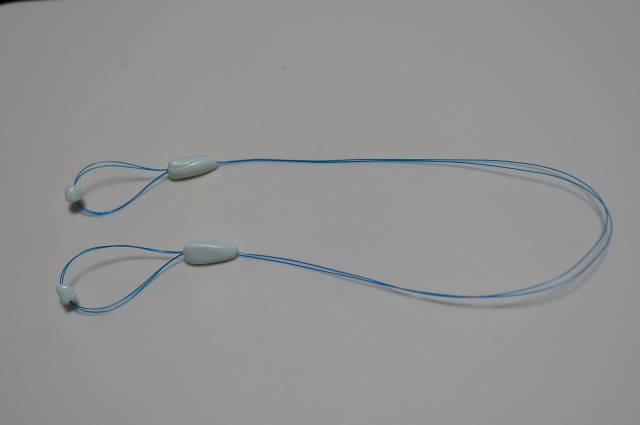
In an entry published in August 2021, Mr. Okada introduced a cage-shaped replacement for the ordinary end loop. He reported that its three-dimensional shape stayed open within the available space, making it easier for his retrieval tool to catch. The birdcage work cost ¥2,000 (about $13 at ¥156 = $1, rate as of 2026-09-04) excluding tax, which he attributed to its manufacturing difficulty. Mr. Okada specified that this option required two threads.
(Source: ok-lab's diary, published August 2021)
https://ok-lab.hatenablog.com/entry/2021/08/07/125807
Bladder loop costs covered an addition with limited chip compatibility
In an entry published in November 2024, Mr. Okada described a silicone-covered wire loop intended to extend into the bladder. The addition cost ¥2,000 (about $13 at ¥156 = $1, rate as of 2026-09-04) excluding tax above the existing chip-and-wire configuration. Compatible chips needed connections at both ends.
He named short and medium-length twisted chips, plus the second chip of his paired-chip design. His testing did not deliver the stable positioning he had hoped for. Mr. Okada cautioned against expecting the bladder loop to hold the prostate chip steadily.
(Source: ok-lab's diary, published November 2024)
https://ok-lab.hatenablog.com/entry/2024/11/02/122858
Double-loop fees accompanied a prototype that raised leakage concerns
In an entry published in January 2025, a customer requested a more three-dimensional chipless design (wire-and-tube loops replacing a solid chip). Mr. Okada produced a crossed double-loop prototype. The additional charge was ¥2,000 (about $13 at ¥156 = $1, rate as of 2026-09-04) excluding tax for each location changed.
He reported urine leakage when the sphincter (the muscle closing the urine passage) caught the doubled loops. He also warned that prolonged pressure in that position might damage the muscle. Mr. Okada offered custom manufacture only with an understanding of these problems.
(Source: ok-lab's diary, published January 2025)
https://ok-lab.hatenablog.com/entry/2025/01/11/122910
Petal loop costs covered separate projections near the penis head
In an entry published in April 2025, Mr. Okada added two sideways petals across a main loop near the head of the penis. Each added petal cost ¥1,000 (about $6 at ¥156 = $1, rate as of 2026-09-04), with the published total ¥2,000 (about $13 at ¥156 = $1, rate as of 2026-09-04), excluding tax. He intended these projections to resist outward movement.
In his testing, an extension about 3cm longer than the contracted urethra remained inside, while one 5cm longer protruded. Mr. Okada cautioned that the petal ending could still emerge when the extension was too long.
(Source: ok-lab's diary, published April 2025)
https://ok-lab.hatenablog.com/entry/2025/04/19/122913
Petal stopper costs covered three flexible loops intended to limit movement
In an entry published in April 2025, Mr. Okada introduced a three-petal stopper intended to prevent passage across the sphincter. It used 0.2mm wire and cost ¥3,000 (about $19 at ¥156 = $1, rate as of 2026-09-04) excluding tax for three petals. He described compatibility with structures containing wire inside tubing.
In his testing, the petals acted as a stopper during ordinary wear. However, he warned that force could reverse them and allow passage beyond the muscle. Mr. Okada considered stiffer petals unsuitable for prolonged wear because their pressure was too strong.
(Source: ok-lab's diary, published April 2025)
https://ok-lab.hatenablog.com/entry/2025/04/26/122909
Loop-mounted petal costs came with restrictions and difficult test removal
In an entry published in May 2025, Mr. Okada revisited his initial rejection of petals in the prostate region. He produced a prototype with petals along the loop rather than at its joint. His four-petal test required substantial force during removal.
He warned that a J-hook (a hooked stainless-steel retrieval wire) might bend open under that load. Loop-mounted petals cost ¥1,500 (about $10 at ¥156 = $1, rate as of 2026-09-04) each excluding tax. Mr. Okada restricted these additions to single loops measuring at least 35mm long.
(Source: ok-lab's diary, published May 2025)
https://ok-lab.hatenablog.com/entry/2025/05/31/122940
Integrated loop fees increased with the length of the nylon structure
In an entry published in October 2025, a customer requested a nylon loop returning directly to the chip. Mr. Okada made it and reported better shape retention than ordinary loose threads. The design combined two threads into one loop structure.
The fees, excluding tax, were ¥1,000 (about $6 at ¥156 = $1, rate as of 2026-09-04) up to 10cm, ¥1,500 (about $10 at ¥156 = $1, rate as of 2026-09-04) up to 20cm, and ¥3,000 (about $19 at ¥156 = $1, rate as of 2026-09-04) up to 30cm. These were additions to the price of a device with ordinary nylon thread. Mr. Okada recommended a stopper built into the chip because separate auxiliary chips were difficult to attach to this loop.
(Source: ok-lab's diary, published October 2025)
https://ok-lab.hatenablog.com/entry/2025/10/25/122907
The maker's answer to loop and birdcage costs
The maker specifies manufacturing limits, offers repairs after failures, and quotes difficult custom work separately.
Loop holder costs applied to parts fitted before shipment
In an entry published in August 2022, Mr. Okada priced a loop holder (a sliding part forming a loop) at ¥1,000 (about $6 at ¥156 = $1, rate as of 2026-09-04) excluding tax. This part belonged to his silicone-tube system. Its position could be changed after purchase.
However, he said the holder could not be bought separately for later attachment. The finished tube's end required secure fixing, which prevented that arrangement. Mr. Okada specified that holders had to be fitted before shipment.
(Source: ok-lab's diary, published August 2022)
https://ok-lab.hatenablog.com/entry/2022/08/13/122909
Petal loop failures prompted repairs and a change in construction
An entry published in August 2025 records a customer's petal stopper losing its bonded attachment after about 2 weeks. The same customer later reported both ears of the second pair detaching on a separate multi-petal device, nicknamed the urethral centipede. The exposed wire reportedly caught and cut the urethral lining.
The customer confirmed receiving the first repair and planned to return the other device. Mr. Okada considered stopping petal sales if failures increased, then announced revised construction without a price increase. He offered repairs with thicker rubber protection, acknowledging that repeated bending could break the petal wires.
(Source: ok-lab's diary, published August 2025)
https://ok-lab.hatenablog.com/entry/2025/08/30/122943
End loop fees became explicit in the July 2026 revision
In an entry published in July 2026, Mr. Okada set prices for nylon thread end fittings. A resin end stop for two threads cost ¥500 (about $3 at ¥156 = $1, rate as of 2026-09-04) excluding tax. Resin-secured end loops on two threads, and end loops on one thread, each cost ¥1,000 (about $6 at ¥156 = $1, rate as of 2026-09-04) excluding tax.
He explained that two-thread devices normally did not include resin end fixing. Initial experimental orders sometimes reflected his interest in exploring new ideas. His notice warned that difficult work could attract separately quoted technical fees, even for requests matching previous custom examples.
(Source: ok-lab's diary, published July 2026)
https://ok-lab.hatenablog.com/entry/2026/07/25/123012
How loop and birdcage costs changed over time
| Published | What the diary said then |
|---|---|
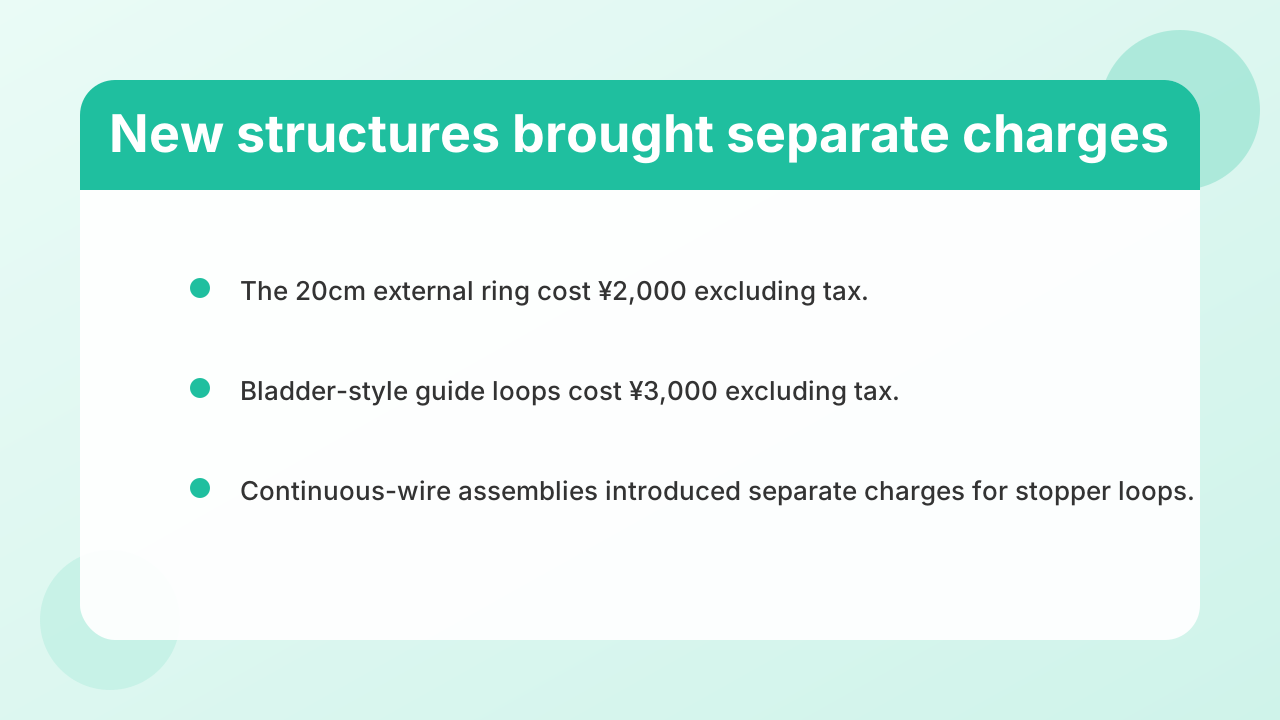
| Sep 2022 | Silicone-covered nylon cord cost ¥1,000 (about $6 at ¥156 = $1, rate as of 2026-09-04) per section, excluding tax. |
| Oct 2022 | A 20cm external ring with loop holder cost ¥2,000 (about $13 at ¥156 = $1, rate as of 2026-09-04) excluding tax. |
| Feb 2025 | Bladder-style guide loops cost ¥3,000 (about $19 at ¥156 = $1, rate as of 2026-09-04); direct versions cost ¥2,000, (about $13 at ¥156 = $1, rate as of 2026-09-04) excluding tax. |
| May 2025 | A flexible rear extension gained a ¥3,000 (about $19 at ¥156 = $1, rate as of 2026-09-04) tier up to 5cm, excluding tax. |
| Jun 2025 | Linked soft-wire loops cost ¥4,000 (about $26 at ¥156 = $1, rate as of 2026-09-04) per 12cm loop, excluding tax. |
| Nov 2025 | Continuous-wire assemblies introduced separate charges for the main shaft and stopper loops. |
OK Prostate Chip products related to loop and birdcage costs
The current list includes the loop-ended cord and a safety-chip component discussed in these cases.
Products that appear in these entries
| Product (official name) | Price incl. tax | Relation to this topic |
|---|---|---|
| Loop-ended nylon cord (両端ループナイロン糸) | ¥550 (about $4 at ¥156 = $1, rate as of 2026-09-04) | The February 2021 entry distinguished this separately sold cord from free end-loop work and charged extra for doubling it. |
| Two-thread resin safety chip with attachment (二本糸用セーフティチップ(生体適合樹脂)接続オプション込み) | ¥2,200 (about $14 at ¥156 = $1, rate as of 2026-09-04) | In December 2021, a customer proposed these components for a filled cage, but Mr. Okada explained why that arrangement was unsuitable. |
The loop-ended nylon cord is listed in OK Lab's own online store.
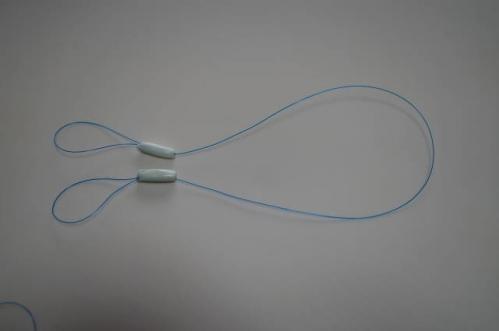
(Source: ok-lab's diary, published February 2021)
https://ok-lab.hatenablog.com/entry/2021/02/27/130152
(Source: ok-lab's diary, published December 2021)
https://ok-lab.hatenablog.com/entry/2021/12/04/124140
Products the diary mentioned as alternatives
The diary names no alternative.
Custom loop assemblies, birdcages, petal designs, and prototypes
No matching product can be confirmed on the current list.
Common worries about loop and birdcage costs
The diary's replies distinguish the requested structure from the parts needed to make it.
"Can a birdcage loop hold an extra chip?"
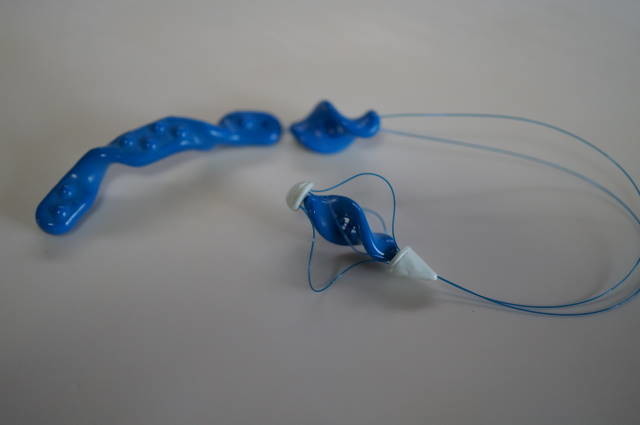
In an entry published in August 2021, a customer asked whether a chip could sit inside the cage. Mr. Okada built a prototype using a small blue resin screw-shaped auxiliary chip, nicknamed the blue bird. He said this was the only chip that could fit inside.
The auxiliary chip cost ¥3,000 (about $19 at ¥156 = $1, rate as of 2026-09-04), with a separate ¥1,000 (about $6 at ¥156 = $1, rate as of 2026-09-04) fitting charge, both excluding tax. The cage itself was priced separately. Mr. Okada specified two-thread construction for this arrangement.
(Source: ok-lab's diary, published August 2021)
https://ok-lab.hatenablog.com/entry/2021/08/28/125823
"Can two-thread safety chips replace a filled birdcage loop?"
In an entry published in December 2021, a customer proposed holding a screw-shaped auxiliary chip between two-thread resin safety chips. Mr. Okada replied that the filled cage required four threads, making those two-thread components unsuitable substitutes. The customer accepted a conventional filled cage, with the quotation reduced by ¥1,100 (about $7 at ¥156 = $1, rate as of 2026-09-04).
The diary does not record how the finished arrangement felt in use. Mr. Okada's proposed solution was the established filled-cage construction.
(Source: ok-lab's diary, published December 2021)
https://ok-lab.hatenablog.com/entry/2021/12/04/124140
"Can double loops be parallel instead of crossed?"
In an entry published in January 2025, a customer proposed a two-loop structure intended to reduce pressure around the sphincter. Mr. Okada said the exact proposal required externally shaped wire and could not be prototyped with his existing equipment. He instead offered a parallel version with the secondary loop about 2mm shorter.
The fronts remained separate, with the loops joined only at the rear. The additional charge was ¥2,000 (about $13 at ¥156 = $1, rate as of 2026-09-04) per modified loop, excluding tax, matching the crossed-loop fee published that month. Mr. Okada asked customers to identify the required loop locations and any nonstandard offset.
(Source: ok-lab's diary, published January 2025)
https://ok-lab.hatenablog.com/entry/2025/01/18/123007
Buying from outside Japan

OK Lab ships internationally to countries covered by Japan Post's EMS courier service. Overseas orders are paid in advance by PayPal. Each order carries a ¥400 (about $3 at ¥156 = $1, rate as of 2026-09-04) handling fee, and EMS shipping is charged on top.
These terms come from OK Lab's official sales-terms page (written here as plain text, not a link: ok-lab.net/docs/law), checked on September 7, 2026; confirm them on the official store before you order, because they can change.
Summary of this article
| What you wanted to know | The answer |
|---|---|
| What is the short answer? | Charges depend on the structure and manufacturing work. |
| What is the base product? | A urethral device made and sold by OK Lab in Japan. |
| What do the terms mean? | End loops, cages, petals, and holders describe different structures with different purposes. |
| What happened with these additions? | The diary records separate fees, compatibility limits, difficult retrieval, and prototype problems. |
| How did the maker respond? | He specified limits, offered repairs, revised construction, and introduced separate technical quotes. |
| How did pricing develop? | New loop structures gained their own charging rules over time. |
| Which current products appear here? | The loop-ended nylon cord and the two-thread resin safety chip with attachment. |
| Can requested parts always be combined? | No; the diary records rejected combinations and revised proposals. |
| How do overseas purchases work? | Advance PayPal payment, a handling fee, and additional EMS shipping apply. |
Source: ok-lab's diary (Okada Comfortable Life Laboratory). The original entries are in Japanese; quotations on this page are translated. Photos and videos are on the original entries.
This article is a summary of the maker's development diary. The product is not a medical device and no result is guaranteed. If anything feels wrong or worries you, see a doctor. Prices, specifications and cautions change, so confirm the latest information on the official blog and the official site. Questions about ordering and shipping go to the seller.