![How much does adding or replacing a motor cost? | Charges depend on the build [OK Prostate Chip]](/img/a/T0304/eyecatch.svg)
This page is based on entries from "ok-lab's diary" (https://ok-lab.hatenablog.com/), the Japanese development diary written by Mr. Okada, founder of OK Lab (Okada Comfortable Life Laboratory). Only the entries about "motor upgrade costs" are summarized here, in order of publication. Past prices and sizes are as written at the time. Current prices come from the official product list (retrieved September 4, 2026). Quotations are translated from Japanese.
Note: This page is a personal reading log by someone with no connection to the maker or the seller. It reflects the source entries as of their publication dates and makes no guarantee of accuracy or safety. The product is not a medical device; talk to a doctor about any health decision. Check the official site for current information. This page contains advertising.
In short
Motor upgrade costs varied with the device, motor count, and extra parts.
OK Lab, a small company in Japan, offered paid replacements and charged separately for custom work.
The current list includes vibrating chips and options, but does not confirm every custom build.
About this product

The OK Prostate Chip is a small device that is placed in the urethra (the urine passage) so that it acts on the prostate; the maker sells it in several shapes, sizes and materials. It is made and sold by OK Lab (Okada Comfortable Life Laboratory), a small company in Japan, through its own online store, and prices are in Japanese yen (JPY).
The maker's development diary, "ok-lab's diary", is written in Japanese. This page is an English summary of it, and every quotation is translated. OK Lab ships internationally, so readers outside Japan can order (see "Buying from outside Japan" below).
Product names on this page are plain-English descriptions. The official Japanese product name is shown once in the product table so you can find the same item in the store.
Before you read: key terms
| Term | Plain-English meaning |
|---|---|
| Motor housing | The resin covering around a vibration motor, used to enclose and attach it. |
| Electronic controller | An external unit for controlling the motor's vibration. |
| Nylon retrieval thread | A thread attached to a chip, intended for retrieval. |
| USB connector | An electrical connection used between the chip cable and its power source or controller. |
| Shape-memory wire | Wire used for curved supports and connections between chip sections. |
| Lock-on support | A curved support behind the chip, intended to help maintain its position. |
| Jointed device | A flexible assembly with jointed sections, used as a base for a vibrating tip. |
| Six-wire cable | An earlier cable construction for supporting and powering connected chips. |
| Floating-wire cable | A cable with wires loose inside tubing, designed to allow curves in more directions. |
What happens: motor upgrade costs
The OK Prostate Chip is a small device placed in the urethra to act on the prostate. The vibrating versions add a small motor, enclosed in a motor housing (its resin covering), to provide vibration. Depending on the design, the motor sits at the front, at the rear, or behind a separate wire-linked chip. Quotes cover different combinations of the chip, motor attachment, cables, and optional controls, with separate charges for additional work.
Adding motors brought separate charges for each installation configuration
An entry published in February 2019 set motor installation charges by motor count. Installing 1 motor added ¥3,000 (about $19 at ¥156 = $1, rate as of 2026-09-04); 2 motors added ¥5,000 (about $32 at ¥156 = $1, rate as of 2026-09-04), all excluding tax. Mr. Okada cautioned that this twin-motor design was intended for brief use.
(Source: ok-lab's diary, published February 2019)
https://ok-lab.hatenablog.com/entry/2019/02/09/152257
Long-chip motor upgrade costs changed when provisional sales ended
In an entry published in March 2019, Mr. Okada set the glass long vibrating chip at ¥8,000 (about $51 at ¥156 = $1, rate as of 2026-09-04) excluding tax. The earlier provisional ¥6,000 (about $38 at ¥156 = $1, rate as of 2026-09-04) excluding tax offer had ended. Regular sales of the revised range were planned for early April. Mr. Okada kept the twin-motor resin design available only by custom order because it could not support every Version 2 feature.
(Source: ok-lab's diary, published March 2019)
https://ok-lab.hatenablog.com/entry/2019/03/23/173222
Ceramic twist motor upgrades became available through custom orders
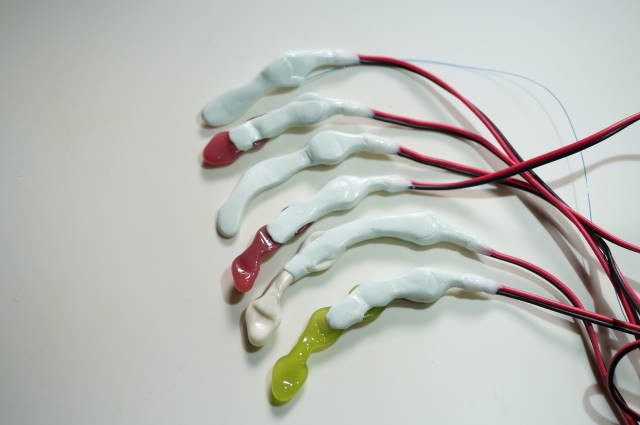
An entry published in February 2020 describes a request for a vibrating ceramic long chip with four twists. Mr. Okada initially needed to investigate how a motor could be attached, then presented examples using a different attachment design. The announced charge was the base chip price plus ¥2,000 (about $13 at ¥156 = $1, rate as of 2026-09-04) excluding tax for motor conversion. He asked interested customers to contact OK Lab by email for these custom orders.
(Source: ok-lab's diary, published February 2020)
https://ok-lab.hatenablog.com/entry/2020/02/01/151232
Rear-mounted motor upgrades preserved the chip's original rear bump
In an entry published in January 2022, Mr. Okada introduced a motor positioned behind an otherwise intact chip. Earlier construction generally replaced the chip's rear bump with the motor. The new arrangement cost the ordinary chip price plus ¥2,000 (about $13 at ¥156 = $1, rate as of 2026-09-04) excluding tax. Mr. Okada noted that an electronic controller (an external vibration-control unit) and other accessories carried separate costs.
(Source: ok-lab's diary, published January 2022)
https://ok-lab.hatenablog.com/entry/2022/01/29/123455
A jointed device carried separate motor upgrade and connector costs
An entry published in January 2023 introduced a two-line jointed device (a flexible assembly) with a tip motor for bladder-area vibration. Mr. Okada priced this bladder massager as the jointed base device plus motor and connector work. The additions were ¥2,000 (about $13 at ¥156 = $1, rate as of 2026-09-04) excluding tax for the motor and ¥500 (about $3 at ¥156 = $1, rate as of 2026-09-04) excluding tax for a USB connector (electrical power connection). Mr. Okada identified a 6mm motor or thin 8mm motor as options for a smaller motor section.
(Source: ok-lab's diary, published January 2023)
https://ok-lab.hatenablog.com/entry/2023/01/28/122843
Three-part motor upgrades cost more for a bladder-side installation
An entry published in June 2024 introduced a vibrating three-part chip linked by shape-memory wire (wire used for curved connections). Motor conversion cost ¥4,000 (about $26 at ¥156 = $1, rate as of 2026-09-04) excluding tax. The published prices were ¥13,000 (about $83 at ¥156 = $1, rate as of 2026-09-04) for the standard device and ¥17,000 (about $109 at ¥156 = $1, rate as of 2026-09-04) for its vibrating form, both excluding tax.
Mr. Okada attributed the extra work to positioning the motor in the bladder-side tip and carrying power through the linked structure. He recommended the thin 8mm motor, which was 2mm thick; its covered section measured 9mm wide.
(Source: ok-lab's diary, published June 2024)
https://ok-lab.hatenablog.com/entry/2024/06/08/123008
A prostate-side motor upgrade carried the same charge as bladder-side installation
In another entry published in June 2024, Mr. Okada offered the three-part chip with its motor in the prostate-side section. This carried the same charge as the bladder-side installation. He described his prototype's vibration as milder, using a 6mm motor. Mr. Okada said buyers could choose either location, with only 1 motor fitted at that stage.
(Source: ok-lab's diary, published June 2024)
https://ok-lab.hatenablog.com/entry/2024/06/15/123132
Curved-support motor upgrades required separate preparation, support, and connection charges
An entry published in April 2025 describes a customer seeking a vibrating chip with a curved support to help maintain its position. OK Lab first said the proposed wire-and-cable combination was difficult, then Mr. Okada produced a design keeping those parts largely separate. The lock-on support (a curved support behind the chip) required a motor chip priced ¥1,000 (about $6 at ¥156 = $1, rate as of 2026-09-04) above the usual vibrating version, excluding tax.
Support work cost ¥4,000, (about $26 at ¥156 = $1, rate as of 2026-09-04) and cable-to-support connections cost ¥1,000, (about $6 at ¥156 = $1, rate as of 2026-09-04) both excluding tax. The published ceramic-short example was ¥11,000 (about $70 at ¥156 = $1, rate as of 2026-09-04) excluding tax for the minimum configuration; the fully equipped prototype was ¥16,500 (about $106 at ¥156 = $1, rate as of 2026-09-04) excluding tax. Mr. Okada advised allowing for the longer rear connection section when choosing the front chip's length.
(Source: ok-lab's diary, published April 2025)
https://ok-lab.hatenablog.com/entry/2025/04/26/122909
Front-motor resin upgrade quotes separated the chip from its accessories
In an entry published in October 2025, a customer requested a front-motor short resin chip with a screw-shaped support. The quote listed the chip at ¥6,600 (about $42 at ¥156 = $1, rate as of 2026-09-04), the support at ¥3,300 (about $21 at ¥156 = $1, rate as of 2026-09-04), and an electronic-controller upgrade at ¥2,200 (about $14 at ¥156 = $1, rate as of 2026-09-04). The diary does not record whether this order was completed. The quote treated the support and controller as separate paid options.
(Source: ok-lab's diary, published October 2025)
https://ok-lab.hatenablog.com/entry/2025/10/25/122907
Wire-linked motor upgrade costs depended on the connection's length
An entry published in February 2026 introduced a ceramic chip linked to a motor by parallel wires, without a tube covering. Mr. Okada reported that tubing had reduced vibration in an earlier long prototype. The published additions to the ordinary vibrating-chip price were ¥5,000 (about $32 at ¥156 = $1, rate as of 2026-09-04) up to 10cm, ¥6,000 (about $38 at ¥156 = $1, rate as of 2026-09-04) up to 15cm, and ¥8,000 (about $51 at ¥156 = $1, rate as of 2026-09-04) up to 20cm, excluding tax.
The offer covered ceramic chips, with motor and wire choices subject to shape restrictions. Mr. Okada cautioned that the exposed-wire design was unsuitable for people with metal allergies.
(Source: ok-lab's diary, published February 2026)
https://ok-lab.hatenablog.com/entry/2026/02/21/122935
The maker's answer to motor upgrade costs
The diary distinguishes motor replacement, size-related work, and optional connections, with limits on what OK Lab would undertake.
Motor replacement carried a fee and warnings about component durability
In an entry published in January 2019, Mr. Okada offered replacement of a failed motor and its cable for ¥3,000 (about $19 at ¥156 = $1, rate as of 2026-09-04) excluding tax. He blamed poorly made terminal connections on Chinese-made motors after 2 connection failures during testing. Mr. Okada advised treating the vibration parts as consumables and considering the continuing expense before buying.
(Source: ok-lab's diary, published January 2019)
https://ok-lab.hatenablog.com/entry/20190105/1546673405
Motor replacement remained possible after used-chip reshaping requests were refused
An entry published in March 2019 records a customer whose vibrating chip's rear section would not fit. Mr. Okada refused reshaping of a chip already used in the urethra, but offered motor-unit replacement on glass chips for ¥3,000 (about $19 at ¥156 = $1, rate as of 2026-09-04) excluding tax. He identified an 8mm motor as the available alternative; the diary does not record whether the customer accepted. Mr. Okada cautioned that a 10mm motor became 11mm–12mm wide after its resin covering was added.
(Source: ok-lab's diary, published March 2019)
https://ok-lab.hatenablog.com/entry/2019/03/09/150813
Smaller-motor quotes separated the chip price from optional controller charges
An entry published in March 2019 showed a 44mm medium-length glass chip among builds with 8mm motors. The medium-length quote separated ¥3,000 (about $19 at ¥156 = $1, rate as of 2026-09-04) for glass from ¥3,000 (about $19 at ¥156 = $1, rate as of 2026-09-04) for motor connection, totaling ¥6,000 (about $38 at ¥156 = $1, rate as of 2026-09-04), all excluding tax. An electronic controller added ¥2,000, (about $13 at ¥156 = $1, rate as of 2026-09-04) while a nylon retrieval thread (an attached thread intended for retrieval) added ¥1,000 (about $6 at ¥156 = $1, rate as of 2026-09-04). The diary presented these as optional additions to the chip-and-motor price.
(Source: ok-lab's diary, published March 2019)
https://ok-lab.hatenablog.com/entry/2019/03/16/165528
Exposed-metal motor upgrades were ruled out over uncertainty about material safety
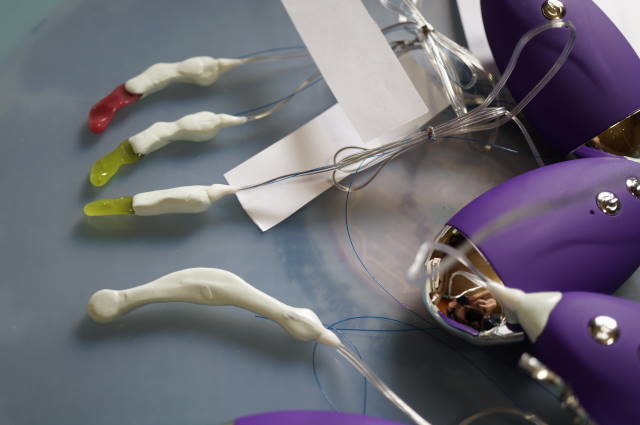
An entry published in February 2020 records a customer's request for a narrower motor housing on a ceramic chip. Mr. Okada initially considered the proposed construction, and the customer placed an order after his reply.
He later ruled out products exposing any motor metal. The diary does not record whether the customer's order was completed. Mr. Okada said he could not guarantee that the motor's metal was safe for contact with the body.
(Source: ok-lab's diary, published February 2020)
https://ok-lab.hatenablog.com/entry/2020/02/22/145216
A smaller housing carried different charges from replacing the motor
An entry published in May 2020 describes a customer whose ceramic vibrating chip's 10mm motor section would not fit. Mr. Okada quoted ¥1,100 (about $7 at ¥156 = $1, rate as of 2026-09-04) for a smaller housing, approximately 10.4mm wide and 4.6mm thick. Alternatively, an 8mm motor replacement cost ¥3,300 (about $21 at ¥156 = $1, rate as of 2026-09-04).
The diary does not record which option the customer chose. Mr. Okada cautioned that he could not guarantee the smaller housing's durability.
(Source: ok-lab's diary, published May 2020)
https://ok-lab.hatenablog.com/entry/2020/05/02/131505
How motor upgrade costs changed over time
| Published | What the diary said then |
|---|---|
| Dec 2018 | Anal-chip rear vibrator attachment: vibrator price plus ¥2,000 (about $13 at ¥156 = $1, rate as of 2026-09-04) excluding tax. |
| Mar 2019 | Existing-owner Version 2 upgrades were offered at ¥3,000 (about $19 at ¥156 = $1, rate as of 2026-09-04) excluding tax. |
| Sep 2019 | A 50mm S-size resin chip could accommodate three motors. |
| Dec 2021 | A compact twin-motor prototype was priced at ¥6,000 (about $38 at ¥156 = $1, rate as of 2026-09-04) excluding tax. |
| Aug 2022 | A thin 8mm motor, 2mm thick, became an available choice. |
| Oct 2022 | Floating-wire cable replaced discontinued six-wire designs; some informed custom orders remained possible. |
| Jun 2024 | A separate two-chip, wire-linked prototype supported two motors, priced at ¥14,000 (about $90 at ¥156 = $1, rate as of 2026-09-04) excluding tax. |
The diary does not say what the current state is.
OK Prostate Chip products related to motor upgrade costs
The current list includes the short ceramic vibrating chip and separately priced controller and connector options.
Products that appear in these entries
| Product (official name) | Price incl. tax | Relation to this topic |
|---|---|---|
| Short ceramic vibrating chip (OKプロステート核振チップ 陶器素材ショートタイプ) | ¥5,500 (about $35 at ¥156 = $1, rate as of 2026-09-04) | In April 2025, a customer named this model as the starting point for a custom curved-support request. |
| Electronic-controller upgrade (ICコントローラに変更(核振チップオプション)) | ¥2,200 (about $14 at ¥156 = $1, rate as of 2026-09-04) | In October 2025, a customer requested this option with a front-motor resin chip. |
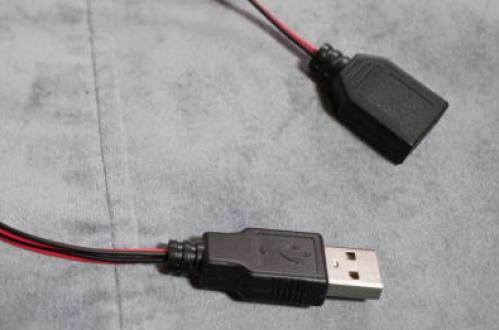
| USB connector work (USB端子付け加工(核振チップオプション)) | ¥550 (about $4 at ¥156 = $1, rate as of 2026-09-04) | In January 2020, a customer's quote prompted clarification that chip-side connectors were free with new vibrating chips. |
The short ceramic vibrating chip is listed in OK Lab's own online store.
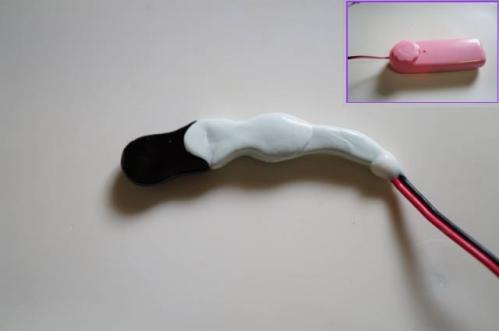
The electronic-controller upgrade is listed in OK Lab's own online store.

USB connector work is listed in OK Lab's own online store.
(Source: ok-lab's diary, published January 2020)
https://ok-lab.hatenablog.com/entry/2020/01/25/150127
(Source: ok-lab's diary, published April 2025)
https://ok-lab.hatenablog.com/entry/2025/04/26/122909
(Source: ok-lab's diary, published October 2025)
https://ok-lab.hatenablog.com/entry/2025/10/25/122907
Products the diary mentioned as alternatives
The diary names no alternative.
Historical custom assemblies, wire-linked prototypes, and the front-motor short resin build: No matching product can be confirmed on the current list.
Common worries about motor upgrade costs
Reader questions distinguish connector charges, motor performance, and material limits.
"Are USB connectors included in motor upgrade costs?"
An entry published in January 2020 records a customer asking whether the chip-side USB connector was free. Mr. Okada confirmed it was free with a newly purchased vibrating chip.
Adding the connector to an existing chip during a repair was chargeable. He also quoted ¥1,000 (about $6 at ¥156 = $1, rate as of 2026-09-04) more for the requested front-motor resin chip than for the motor-only version. The diary does not record whether that order was completed.
(Source: ok-lab's diary, published January 2020)
https://ok-lab.hatenablog.com/entry/2020/01/25/150127
"Would adding motors weaken vibration from a shared controller?"
An entry published in January 2025 records questions about weaker vibration when two motors share one controller. Mr. Okada expected little reduction with two motors, although he thought about five could cause some loss. He also warned that purchased motors varied in durability, electrical connections, and noise.
He said his vibration comparisons were subjective, and ultimately declined this customer's entire custom request. Instead, he suggested considering a simple, standard vibrating product from the company's own online store.
(Source: ok-lab's diary, published January 2025)
https://ok-lab.hatenablog.com/entry/2025/01/25/122940
"Can motor upgrade costs include a different chip material?"
An entry published in June 2025 records a follow-up about the curved-support design: the customer wanted one optional stopper omitted and asked about other materials. Mr. Okada agreed that the stopper could be omitted. He confirmed ceramic construction but was uncertain about the newer resin material and considered stainless steel difficult with his equipment. He asked the customer to consider those manufacturing limits.
(Source: ok-lab's diary, published June 2025)
https://ok-lab.hatenablog.com/entry/2025/06/07/122954
Buying from outside Japan

OK Lab ships internationally to countries covered by Japan Post's EMS courier service. Overseas orders are paid in advance by PayPal. Each order carries a ¥400 (about $3 at ¥156 = $1, rate as of 2026-09-04) handling fee, and EMS shipping is charged on top. These terms come from OK Lab's official sales-terms page (written here as plain text, not a link: ok-lab.net/docs/law), checked on September 7, 2026; confirm them on the official store before you order, because they can change.
Summary of this article
| What you wanted to know | The answer |
|---|---|
| What is the short answer? | Charges depend on the build and quoted work. |
| What is this product? | A urethral device made by OK Lab in Japan. |
| What do the terms mean? | The terms distinguish motors, covers, controls, connections, and supports. |
| What did motor upgrades cost? | Dated quotes cover ordinary, multi-motor, and wire-linked designs. |
| What could the maker do? | Paid repairs and size-related work had construction and durability limits. |
| How did things change? | Designs, connector terms, and motor choices changed; earlier offers ended. |
| What is listed today? | The ceramic vibrating chip and listed options have current catalog prices. |
| What did readers ask? | Connector charges, shared controllers, and material changes. |
| How can overseas customers buy? | Advance PayPal payment, a handling fee, and additional EMS shipping. |
Source: ok-lab's diary (Okada Comfortable Life Laboratory). The original entries are in Japanese; quotations on this page are translated. Photos and videos are on the original entries.
This article is a summary of the maker's development diary. The product is not a medical device and no result is guaranteed. If anything feels wrong or worries you, see a doctor. Prices, specifications and cautions change, so confirm the latest information on the official blog and the official site. Questions about ordering and shipping go to the seller.