![How much does nitinol wire cost? | The price depends on the build [OK Prostate Chip]](/img/a/T0303/eyecatch.svg)
This page is based on entries from "ok-lab's diary" (https://ok-lab.hatenablog.com/), the Japanese development diary written by Mr. Okada, founder of OK Lab, a small company in Japan (Okada Comfortable Life Laboratory). Only the entries about "wire and nitinol prices" are summarized here, in order of publication. Past prices and sizes are as written at the time. Current prices come from the official product list (retrieved September 4, 2026). Quotations are translated from Japanese.
Note: This page is a personal reading log by someone with no connection to the maker or the seller. It reflects the source entries as of their publication dates and makes no guarantee of accuracy or safety. The product is not a medical device; talk to a doctor about any health decision. Check the official site for current information. This page contains advertising.
In short
Wire prices depend on material, length, and assembly work, with separate charges for some connections and options.
Mr. Okada explains charges by component and describes designs that reduce material costs or manufacturing work.
The current list prices the standard stainless steel wire at ¥550 (about $4 at ¥156 = $1, rate as of 2026-09-04) including tax; custom nitinol builds lack confirmed matches.
About this product

The OK Prostate Chip is a small device that is placed in the urethra (the urine passage) so that it acts on the prostate; the maker sells it in several shapes, sizes and materials. It is made and sold by OK Lab (Okada Comfortable Life Laboratory), a small company in Japan, through its own online store, and prices are in Japanese yen (JPY).
The maker's development diary, "ok-lab's diary", is written in Japanese. This page is an English summary of it, and every quotation is translated. OK Lab ships internationally, so readers outside Japan can order (see "Buying from outside Japan" below).
Product names on this page are plain-English descriptions. The official Japanese product name is shown once in the product table so you can find the same item in the store.
Before you read: key terms
| Term | Plain-English meaning |
|---|---|
| Nitinol | A shape-memory alloy: metal that returns toward a preset shape, used for flexible connections and loops. |
| Silicone-covered nylon cord | Nylon thread enclosed in silicone tubing, used as a connection extending from a chip. |
| Wire reinforcement | Wire added to a ceramic chip body, intended by the maker to strengthen it. |
| Epoxy resin | Material used to secure connections and form parts around wire. |
| Double wire | Two wire strands within a tube, used to change the structure's stiffness and provide an additional strand. |
| Nylon-and-nitinol extension | A tube containing nylon thread and nitinol wire, used as a trailing connection on custom devices. |
| Sleeve | A tube surrounding a wire shaft, used to guide its movement in the sliding-wire prototype. |
What happens: nitinol wire prices
The OK Prostate Chip is a small device placed in the urethra to act on the prostate. These entries discuss stainless steel wire, nitinol (a shape-memory alloy), and silicone-covered nylon cord (nylon thread enclosed in silicone tubing). Some connections extend behind a chip inside the urethra, while other wires are separate tools intended to help move the device. Prices cover different materials, lengths, and assembly work, sometimes in addition to the chip itself.
Stainless steel wire cost no extra in the September 2019 ceramic-chip offer
In an entry published in September 2019, stainless steel wire was offered at the same price as nylon thread. The steel measured 0.29 mm, while the nylon then in use measured about 0.25 mm.
This offer concerned the connection attached to a ceramic chip. Mr. Okada limited it to ceramic models and a single wire because he had not tested a two-wire version. He asked customers seeking this option to state their preference in the order comments.
(Source: ok-lab's diary, published September 2019)
https://ok-lab.hatenablog.com/entry/2019/09/14/143710
Connection wire prices were charged per chip after the February 2021 correction
In an entry published in February 2021, Mr. Okada corrected the billing rule for stainless steel added alongside nylon thread. The charge was ¥1,000 (about $6 at ¥156 = $1, rate as of 2026-09-04) per chip receiving embedded wire.
A connection between two chips still required work on both chips, even when the wire did not extend beyond the second. He acknowledged that the earlier wording had also led staff to issue some bills incorrectly. His corrected pricing instruction was to count the chips receiving wire when preparing the charge.
(Source: ok-lab's diary, published February 2021)
https://ok-lab.hatenablog.com/entry/2021/02/27/130152
Silicone-covered nylon costs included separate cord sections and loop parts in September 2022
In an entry published in September 2022, the new covered nylon cord was priced by sections. Each 10 cm section cost ¥1,000 (about $6 at ¥156 = $1, rate as of 2026-09-04) excluding tax, with a maximum of four sections. The published three-section example cost ¥3,000 (about $19 at ¥156 = $1, rate as of 2026-09-04) excluding tax.
Adding the loop component involved another ¥1,000 (about $6 at ¥156 = $1, rate as of 2026-09-04) excluding tax for assembly. Mr. Okada did not offer this cord as a thread-replacement conversion for existing chips. He directed buyers toward new purchases and offered replacement in the same specification for chips originally bought with this cord.
(Source: ok-lab's diary, published September 2022)
https://ok-lab.hatenablog.com/entry/2022/09/24/122837
Covered nitinol wire prices followed length bands after the October 2024 redesign
In an entry published in October 2024, Mr. Okada withdrew bare 0.3 mm wire from his intended standard offering after discomfort during testing. He also changed the silicone covering from 1 mm to 2 mm, citing concerns about strength and cushioning.
The covered connection added ¥4,000 (about $26 at ¥156 = $1, rate as of 2026-09-04) excluding tax for wire up to 30 cm, or ¥5,000 (about $32 at ¥156 = $1, rate as of 2026-09-04) excluding tax up to 40 cm. These were additions to the chip price; auxiliary chips and stoppers carried their usual separate charges. He specified a loop at the wire's end because he did not know a reliable way to secure a straight end. Mr. Okada made full covering his standard choice, although he fulfilled bare-wire requests already accepted.
(Source: ok-lab's diary, published October 2024)
https://ok-lab.hatenablog.com/entry/2024/10/19/122847
Ceramic wire reinforcement cost less after the August 2025 material change
In an entry published in August 2025, Mr. Okada described cheaper wire reinforcement (wire added to strengthen a ceramic chip body). Using 0.1 mm nitinol thread reduced the published charge to ¥1,000 (about $6 at ¥156 = $1, rate as of 2026-09-04) excluding tax.
The previous reinforcement using 0.2 mm wire had cost ¥2,000 (about $13 at ¥156 = $1, rate as of 2026-09-04) excluding tax. He attributed the reduction to a substantial saving in manufacturing work. He said reinforcement could also be added to ceramic chips with raised bumps. Mr. Okada recommended reinforcement as his first safety option for ceramic chips.
(Source: ok-lab's diary, published August 2025)
https://ok-lab.hatenablog.com/entry/2025/08/30/122943
Silicone-covered nylon cost ¥2,200 (about $14 at ¥156 = $1, rate as of 2026-09-04) for a February 2026 custom cord
In an entry published in February 2026, a customer wanted a covered cord because their existing thread had shrunk after touching a heated pan. They asked about 30 cm of silicone-covered nylon on a custom ceramic-chip assembly. OK Lab quoted ¥2,200 (about $14 at ¥156 = $1, rate as of 2026-09-04) for that cord, separately from the other components.
Mr. Okada recorded making the requested assembly. He thought the covering could tolerate light contact with a pan, but cautioned that excessive heat could still shrink the nylon inside.
(Source: ok-lab's diary, published February 2026)
https://ok-lab.hatenablog.com/entry/2026/02/21/122935
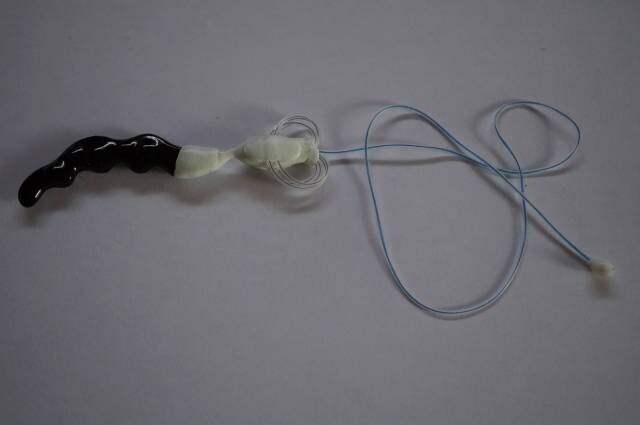
The maker's answer to nitinol wire prices
Mr. Okada separates material, connection work, length, and extra components when explaining a wire assembly's price.
Wire costs included assembly charges that did not buy replacement coverage
In an entry published in August 2022, replacing nylon with stainless steel itself did not increase the chip price. Preparing the chip for a covered-wire connection cost ¥1,000 (about $6 at ¥156 = $1, rate as of 2026-09-04) for ceramic or ¥1,500 (about $10 at ¥156 = $1, rate as of 2026-09-04) for the blue resin material, excluding tax. Tube attachment cost ¥1,000 (about $6 at ¥156 = $1, rate as of 2026-09-04) excluding tax up to 20 cm, then ¥500 (about $3 at ¥156 = $1, rate as of 2026-09-04) excluding tax for each additional 10 cm.
Mr. Okada generally declined replacement of these wire-filled tubes because separating the bonded assembly could damage the chip. He also said wire breakage marked the product's end of life. For specially modified chips with particular personal value, he invited individual enquiries.
(Source: ok-lab's diary, published August 2022)
https://ok-lab.hatenablog.com/entry/2022/08/06/123150
Shape-memory wire prices included costly material and work securing the joints
In an entry published in April 2024, Mr. Okada reported paying about ¥2,000 (about $13 at ¥156 = $1, rate as of 2026-09-04) per gram for his shape-memory wire. He described it as the most expensive material he had purchased for his products.
The proposed wire-and-support-chip connection cost ¥3,000 (about $19 at ¥156 = $1, rate as of 2026-09-04) excluding tax, with a tube cover adding ¥1,000 (about $6 at ¥156 = $1, rate as of 2026-09-04) excluding tax. He explained that securing the connections involved several stages and took considerable time. The joints used epoxy resin (a material used to secure the connection). Mr. Okada advised stopping use if the outer resin covering a joint became damaged.
(Source: ok-lab's diary, published April 2024)
https://ok-lab.hatenablog.com/entry/2024/04/13/123053
Nylon reinforcement increased nitinol wire costs for each separate tube
In an entry published in April 2025, a customer requested nylon inside the tubing of a custom nitinol assembly. OK Lab quoted ¥1,100 (about $7 at ¥156 = $1, rate as of 2026-09-04) per tube, explaining that separately attached sections each carried their own charge. The main pair of body loops shared one tube, so that portion required one charge.
The customer selected reinforcement for the main structure and its trailing extension. The diary does not record the outcome. Mr. Okada considered reinforcement around the connection between the main loops worth offering to customers concerned about breakage.
(Source: ok-lab's diary, published April 2025)
https://ok-lab.hatenablog.com/entry/2025/04/19/122913

Mixed connections reduced nitinol costs by keeping nylon outside the body
In an entry published in September 2025, Mr. Okada proposed combining an internal nitinol section with an external nylon section. He said this shortened the expensive nitinol portion while retaining nylon's handling advantages outside the body.
For 20 cm, the extra charge was ¥2,000 (about $13 at ¥156 = $1, rate as of 2026-09-04) for two nitinol strands or ¥2,500 (about $16 at ¥156 = $1, rate as of 2026-09-04) for four, excluding tax. For 30 cm, the corresponding charges were ¥2,500 (about $16 at ¥156 = $1, rate as of 2026-09-04) and ¥3,000 (about $19 at ¥156 = $1, rate as of 2026-09-04), excluding tax. Auxiliary-chip prices stayed the same whether attached to nylon or nitinol. Mr. Okada recommended choosing the mixed connection to use each material where he considered it more suitable.
(Source: ok-lab's diary, published September 2025)
https://ok-lab.hatenablog.com/entry/2025/09/13/122925
How nitinol wire prices changed over time

| Published | What the diary said then |
|---|---|
| Sep 2019 | Stainless steel thread carried no premium over nylon in the ceramic-chip offer. |
| Feb 2021 | Added-wire billing was corrected to count chips receiving wire. |
| Aug 2022 | Covered-wire tube replacement was generally declined because separation could damage the chip. |
| Oct 2022 | Six-wire sales were discontinued; a subsequent custom request was accepted with problems acknowledged. |
| Oct 2024 | Standard covered nitinol changed to 2 mm tubing, with length-based charges. |
| Aug 2025 | Finer nitinol reduced the ceramic reinforcement charge to ¥1,000 (about $6 at ¥156 = $1, rate as of 2026-09-04) excluding tax. |
| Sep 2025 | Mixed nitinol-and-nylon connections received separate length and strand-count prices. |
| Apr 2026 | A sliding-wire prototype replaced internal resin sleeves with aluminum sleeves. |
| May 2026 | A new fine-wire model cost ¥7,000 (about $45 at ¥156 = $1, rate as of 2026-09-04) excluding tax, including shaft and projection section. |
| Aug 2026 | Custom angle changed from 150° to 120°; a misplaced extension required remaking. |
OK Prostate Chip products related to nitinol wire prices

The current list confirms the standard multipurpose stainless steel wire at ¥550 (about $4 at ¥156 = $1, rate as of 2026-09-04) including tax.
Products that appear in these entries
| Product (official name) | Price incl. tax | Relation to this topic |
|---|---|---|
| Multipurpose stainless steel wire (多目的ステンレスワイヤー) | ¥550 (about $4 at ¥156 = $1, rate as of 2026-09-04) | In January 2022, a customer requested changes to this standard tool, prompting Mr. Okada's explanation of custom pricing. |
The multipurpose stainless steel wire is listed in the company's own online store.
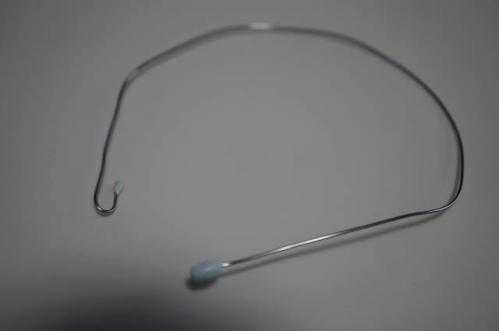
(Source: ok-lab's diary, published January 2022)
https://ok-lab.hatenablog.com/entry/2022/01/29/123455
Products the diary mentioned as alternatives
The diary names no alternative.
Custom nitinol assemblies, reinforced builds, covered cords, and extensions described on this page:
No matching product can be confirmed on the current list.
Common worries about nitinol wire prices
The replies show that thickness, added coverings, and difficult lengths affected quotes differently.
"Why did custom stainless steel wire cost more?"
In an entry published in January 2022, a customer requested a wire with a larger end and greater stiffness. Mr. Okada explained that the basic tool cost ¥500 (about $3 at ¥156 = $1, rate as of 2026-09-04) excluding tax because its ends required little shaping. Custom work would cost ¥2,000 (about $13 at ¥156 = $1, rate as of 2026-09-04) excluding tax, matching his short resin-chip price.
He refused the requested 2–3 mm wire, which he considered dangerously rigid. The diary does not record the outcome. Mr. Okada limited the custom wire thickness to 1 mm.
(Source: ok-lab's diary, published January 2022)
https://ok-lab.hatenablog.com/entry/2022/01/29/123455
"Does thicker nitinol cost more in a doubled build?"
In an entry published in April 2025, a customer asked about 0.3 mm versus 0.4 mm in a double-wire build (two strands within a tube). They wanted to understand the force and possible discomfort. OK Lab quoted the same ¥2,200 (about $14 at ¥156 = $1, rate as of 2026-09-04) addition for doubling either thickness.
The reply said Mr. Okada had found two 0.4 mm strands too intense for prolonged use, while some customers specifically wanted that strength. The customer chose 0.3 mm; the diary does not record their experience afterward. OK Lab's advice was that individual reactions differed, so it could not name one thickness as the better choice.
(Source: ok-lab's diary, published April 2025)
https://ok-lab.hatenablog.com/entry/2025/04/12/122910
"Why did a longer nitinol extension cost ¥9,900 (about $63 at ¥156 = $1, rate as of 2026-09-04)?"
In an entry published in July 2025, a customer questioned the quote for a 27 cm nylon-and-nitinol extension (both materials enclosed in tubing). They asked whether a different length or pricing interval would make it cheaper. OK Lab explained that it could not manufacture one continuous section longer than 20 cm.
The quote therefore used a 20 cm section at ¥5,500 (about $35 at ¥156 = $1, rate as of 2026-09-04) and a 7 cm section at ¥4,400 (about $28 at ¥156 = $1, rate as of 2026-09-04), with the stated price of ¥9,900 (about $63 at ¥156 = $1, rate as of 2026-09-04). The customer proceeded with the joined extension. OK Lab advised that choosing an adjustable-length design would not remove this construction-related cost.
(Source: ok-lab's diary, published July 2025)
https://ok-lab.hatenablog.com/entry/2025/07/26/122909
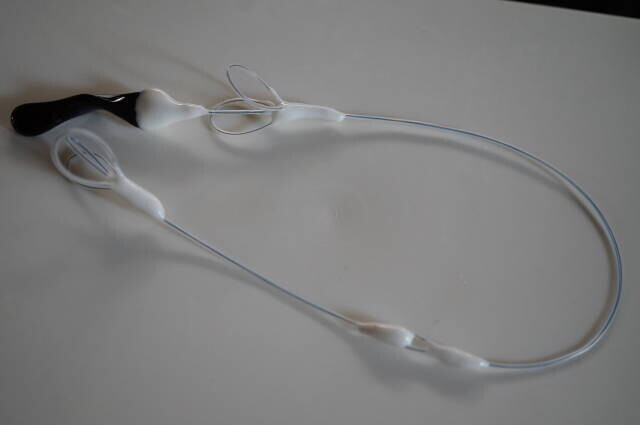
"Would resin change my double-wire chip's price?"
In an entry published in June 2026, a customer asked whether rubber sections could be replaced with resin. OK Lab replied that rubber served a waterproofing purpose, so resin would have to cover it. The stated increase in thickness was 1–2 mm.
The charge was ¥1,100 (about $7 at ¥156 = $1, rate as of 2026-09-04) per treated location, with two locations in the example. The diary does not record the outcome. OK Lab's response limited the proposed change to an additional covering, retaining the rubber underneath.
(Source: ok-lab's diary, published June 2026)
https://ok-lab.hatenablog.com/entry/2026/06/13/122909
Buying from outside Japan

OK Lab ships internationally to countries covered by Japan Post's EMS courier service. Overseas orders are paid in advance by PayPal. Each order carries a ¥400 (about $3 at ¥156 = $1, rate as of 2026-09-04) handling fee, and EMS shipping is charged on top. These terms come from OK Lab's official sales-terms page (ok-lab.net/docs/law), checked on September 7, 2026; confirm them on the official store before you order, because they can change.
Summary of this article
| What you wanted to know | The answer |
|---|---|
| What is the short answer? | Wire charges vary with material, length, assembly, and options. |
| What is the product? | A small urethral device made and sold by OK Lab in Japan. |
| What do the terms mean? | Bare wire, covered nylon cord, reinforced connections, and doubled wire describe different constructions. |
| What happened to prices? | Some early substitutions were free; later covered and reinforced assemblies carried distinct charges. |
| How did the maker explain costs? | Quotes separated materials and manufacturing work; some designs reduced either expense. |
| What changed over time? | Billing rules, coverings, repair limits, manufacturing methods, and custom specifications changed. |
| What current product is confirmed? | The listed multipurpose stainless steel wire costs ¥550 (about $4 at ¥156 = $1, rate as of 2026-09-04) including tax. |
| What did customers ask? | Questions concerned custom work, thickness, longer extensions, and additional coverings. |
| How are overseas orders handled? | Advance PayPal payment, a ¥400 (about $3 at ¥156 = $1, rate as of 2026-09-04) handling fee, and additional EMS shipping charges. |
Source: ok-lab's diary (Okada Comfortable Life Laboratory). The original entries are in Japanese; quotations on this page are translated. Photos and videos are on the original entries.
This article is a summary of the maker's development diary. The product is not a medical device and no result is guaranteed. If anything feels wrong or worries you, see a doctor. Prices, specifications and cautions change, so confirm the latest information on the official blog and the official site. Questions about ordering and shipping go to the seller.