![How much does electrode modification cost? | The chip, wiring and connectors are priced separately [OK Prostate Chip]](/img/a/T0298/eyecatch.svg)
This page is based on entries from "ok-lab's diary" (https://ok-lab.hatenablog.com/), the Japanese development diary written by Mr. Okada, founder of OK Lab (Okada Comfortable Life Laboratory). Only the entries about "electrode modification costs" are summarized here, in order of publication. Past prices and sizes are as written at the time. Current prices come from the official product list (retrieved September 4, 2026). Quotations are translated from Japanese.
Note: This page is a personal reading log by someone with no connection to the maker or the seller. It reflects the source entries as of their publication dates and makes no guarantee of accuracy or safety. The product is not a medical device; talk to a doctor about any health decision. Check the official site for current information. This page contains advertising.
In short
- Electrode modification from OK Lab, a small company in Japan, costs extra beyond the base chip.
- The maker itemizes electrode work, cables, connectors and optional additions in custom quotes.
- The current product list includes base products but no separately priced electrode modification service.
About this product

The OK Prostate Chip is a small device that is placed in the urethra (the urine passage) so that it acts on the prostate; the maker sells it in several shapes, sizes and materials. It is made and sold by OK Lab (Okada Comfortable Life Laboratory), a small company in Japan, through its own online store, and prices are in Japanese yen (JPY).
The maker's development diary, "ok-lab's diary", is written in Japanese. This page is an English summary of it, and every quotation is translated. OK Lab ships internationally, so readers outside Japan can order (see "Buying from outside Japan" below).
Product names on this page are plain-English descriptions. The official Japanese product name is shown once in the product table so you can find the same item in the store.
Before you read: key terms
| Term | Plain-English meaning |
|---|---|
| Urethra | The urine passage; it is also where the maker's urethral chips are placed. |
| Electrode | An electrical contact on a device, intended to carry electrical stimulation. |
| Low-frequency stimulator | A separate electrical pulse device that supplies stimulation through the chip's contacts. |
| Mini plug | A small connector joining the electrode cable to the separate stimulator. |
| Snap connector | A press-stud connector providing an electrical connection for an individual contact. |
| Inline electrode pair | Two electrode chips arranged end to end, allowing separate chips to provide the contacts. |
| Stacked electrode pair | Two chips arranged against each other to form a two-contact assembly. |
| Twisted cable | A cable incorporating twisted thread and wiring, used for the electrical connection. |
What happens: electrode modification costs
The OK Prostate Chip is a small device placed in the urethra (the urine passage) to act on the prostate. Electrode modification adds electrodes (electrical contacts) for stimulation from a separate low-frequency stimulator (an electrical pulse device). The diary describes aluminum contacts on resin chips and stainless steel chips serving as contacts. The work also involves cables and connectors between the chip and the external stimulator.
Electrode modification costs started with a ¥8,000 (about $51 at ¥156 = $1, rate as of 2026-09-04) two-contact resin quote
In an entry published in February 2019, a customer requested a custom resin chip with electrical contacts. Mr. Okada made a revised design and listed two-contact electrode work at ¥8,000, (about $51 at ¥156 = $1, rate as of 2026-09-04) tax excluded. That price applied when each contact was no longer than 30mm.
A single contact was ¥5,000, (about $32 at ¥156 = $1, rate as of 2026-09-04) tax excluded, under the same contact-length limit. The diary does not record the outcome. Mr. Okada asked the customer to specify the cable length as part of the custom request.
(Source: ok-lab's diary, published February 2019)
https://ok-lab.hatenablog.com/entry/2019/02/23/142754
Electrode modification costs fell after the maker changed the production method
In an entry published in March 2019, a customer asked whether an electrode design commissioned by someone else could also be ordered. Mr. Okada said custom production was possible and announced revised charges.
He attributed the reduction to attaching contacts and wires to finished chips instead of embedding them while the resin remained soft. The new prices were ¥3,000 (about $19 at ¥156 = $1, rate as of 2026-09-04) for one contact and ¥5,000 (about $32 at ¥156 = $1, rate as of 2026-09-04) for two, tax excluded; he said the appearance would be less tidy. Mr. Okada offered free samples only when a request matched something he wanted to test.
(Source: ok-lab's diary, published March 2019)
https://ok-lab.hatenablog.com/entry/2019/03/16/165528
Electrode modification costs became itemized, with separate connector attachment fees
In an entry published in May 2019, Mr. Okada reorganized the price schedule because different connectors produced different quotes. The starting point was the chip's price without thread.
Electrode attachment and cable attachment were each ¥1,000 (about $6 at ¥156 = $1, rate as of 2026-09-04) per contact. A mini plug (a small connector) serving both contacts cost ¥1,000 (about $6 at ¥156 = $1, rate as of 2026-09-04) to attach. Snap connectors (press-stud connectors) shaped like short chips cost ¥2,000 (about $13 at ¥156 = $1, rate as of 2026-09-04) per contact. Mr. Okada explained that the connector choice determined which attachment charge applied.
(Source: ok-lab's diary, published May 2019)
https://ok-lab.hatenablog.com/entry/2019/05/11/152432
Electrode modification costs matched for inline and stacked stainless steel pairs
In an entry published in July 2024, Mr. Okada described an inline electrode pair (two chips arranged end to end). Previously, his stainless steel two-contact design used a stacked electrode pair (two chips arranged against each other).
He priced the inline arrangement the same as the stacked arrangement because he considered the production difficulty similar. The prototype combined a smaller medium-length chip with a short chip, and the design allowed different chips at the front and rear. Mr. Okada suggested a flat rear chip because more complicated shapes could make the cable attachment difficult.
(Source: ok-lab's diary, published July 2024)
https://ok-lab.hatenablog.com/entry/2024/07/27/122927
Electrode modification costs for the centipede design separated connections from cable bundling
In an entry published in August 2024, Mr. Okada introduced another inline stainless steel pair, nicknamed the centipede electrode. His tax-excluded schedule charged ¥2,000 (about $13 at ¥156 = $1, rate as of 2026-09-04) per chip for its electrical connection, alongside each chip's price. Attaching the first cable alongside the rear chip cost ¥1,000 (about $6 at ¥156 = $1, rate as of 2026-09-04).
Bundling the trailing cables over 20cm cost ¥2,000 (about $13 at ¥156 = $1, rate as of 2026-09-04), while a shared plug cost ¥1,000 (about $6 at ¥156 = $1, rate as of 2026-09-04). Optional coating between the chips cost ¥1,000 (about $6 at ¥156 = $1, rate as of 2026-09-04), and snap connectors cost ¥1,000 (about $6 at ¥156 = $1, rate as of 2026-09-04) per contact. Mr. Okada offered an unbundled cable version to reduce the price.
(Source: ok-lab's diary, published August 2024)
https://ok-lab.hatenablog.com/entry/2024/08/03/122758
Electrode modification costs remained separate within an August 2026 linked-chip quote
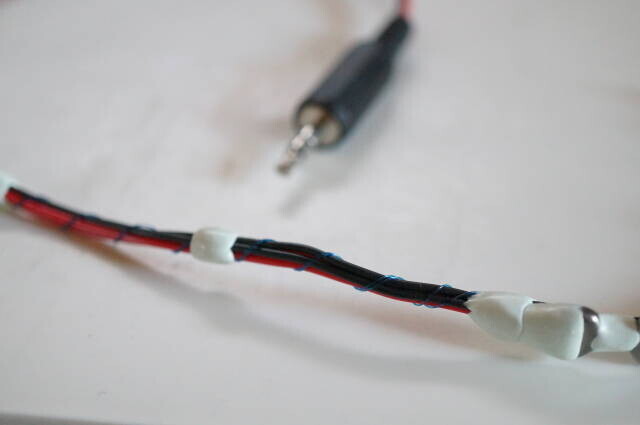
In an entry published in August 2026, a custom quote covered two medium-length resin electrode chips. Each chip's listed ¥5,500 (about $35 at ¥156 = $1, rate as of 2026-09-04) combined its body, cable connection and electrode work.
The quote separately listed ¥2,200 (about $14 at ¥156 = $1, rate as of 2026-09-04) for snap connectors and ¥1,100 (about $7 at ¥156 = $1, rate as of 2026-09-04) for the coating between chips. Four-hole cable stoppers were another ¥3,300 (about $21 at ¥156 = $1, rate as of 2026-09-04) for two. The diary does not record the outcome.
(Source: ok-lab's diary, published August 2026)
https://ok-lab.hatenablog.com/entry/2026/08/08/122906
The maker's answer to electrode modification costs
The maker changed construction methods, offered a cheaper resin design and priced extra cable work separately.
Electrode modification requests depended on which cable construction the maker accepted
In an entry published in May 2022, a customer requested a two-contact modification of a two-lobed resin anal chip. Mr. Okada quoted the body, electrode work and cable separately.
He also explained that an older arrangement connecting urethral and anal chips through single wires had been abandoned over strength concerns. He said that concern had led to a previous request being declined. For the customer's proposed two-contact anal chip, Mr. Okada said the modification could be accepted.
(Source: ok-lab's diary, published May 2022)
https://ok-lab.hatenablog.com/entry/2022/05/07/123013
Electrode modification costs could start lower with two short resin chips
In an entry published in August 2024, Mr. Okada proposed a linked aluminum-electrode pair based on short resin chips. He had previously declined thin, long chip requests because he considered that form dangerous for beginners.
His new proposal used a flexible connection between separate chips, following an earlier linked prototype whose wire had failed. The published minimum was ¥10,000, (about $64 at ¥156 = $1, rate as of 2026-09-04) tax excluded, including the plug connection. Coating between the chips added ¥1,000 (about $6 at ¥156 = $1, rate as of 2026-09-04), and stitching the trailing cables together cost ¥500 (about $3 at ¥156 = $1, rate as of 2026-09-04) per 5cm. Mr. Okada identified two short resin chips as the least expensive base for this design.
(Source: ok-lab's diary, published August 2024)
https://ok-lab.hatenablog.com/entry/2024/08/10/122913
Electrode modification quotes charged separately for covered twisted cable assemblies
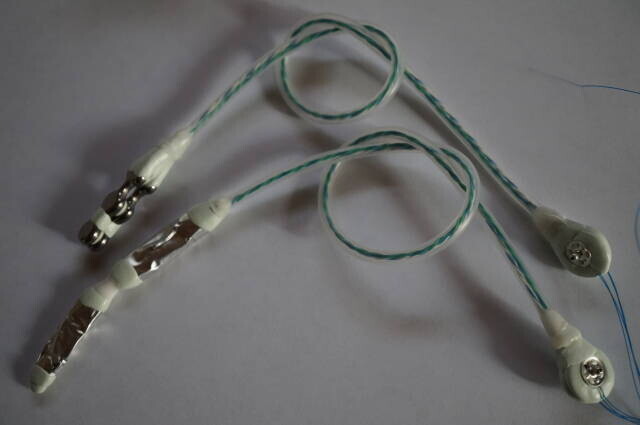
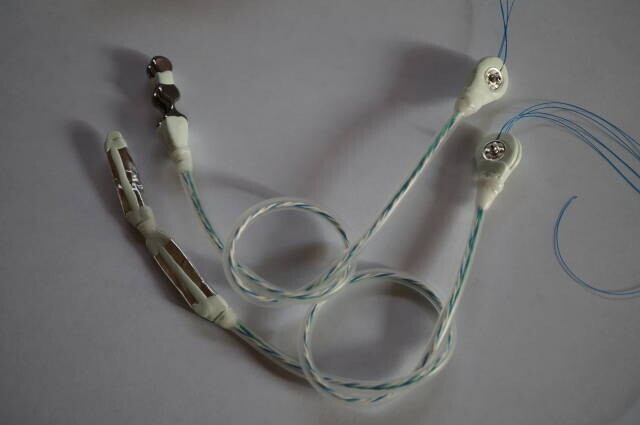
In an entry published in February 2026, a customer requested both inline and stacked electrode pairs with covered twisted cables. A twisted cable incorporates thread and wiring for the electrical connection.
For each assembly, the quote listed two twisted cables at ¥4,400 (about $28 at ¥156 = $1, rate as of 2026-09-04) each, plus ¥4,400 (about $28 at ¥156 = $1, rate as of 2026-09-04) for tube covering. The stacked assembly also had a ¥1,100 (about $7 at ¥156 = $1, rate as of 2026-09-04) joining charge, separate from the chips. Mr. Okada writes that he completed both assemblies despite the demanding cable work.
(Source: ok-lab's diary, published February 2026)
https://ok-lab.hatenablog.com/entry/2026/02/07/122919
Electrode modification quotes treated silicone cable covering as an additional charge
In an entry published in June 2026, a customer requested a long resin electrode chip with a silicone-covered cable. The request replaced the cable stopper with covering and asked for the longest possible cable.
The quote listed ¥2,200 (about $14 at ¥156 = $1, rate as of 2026-09-04) for silicone covering alongside a separate ¥1,100 (about $7 at ¥156 = $1, rate as of 2026-09-04) cable charge. The customer requested no end connector, and the quote contained no plug attachment charge. Mr. Okada limited this build's cable length to 35cm because the covering work made a longer cable difficult to produce.
(Source: ok-lab's diary, published June 2026)
https://ok-lab.hatenablog.com/entry/2026/06/13/122909
How electrode modification costs changed over time
| Published | What the diary said then |
|---|---|
| Feb 2019 | Two-contact resin electrode work cost ¥8,000, (about $51 at ¥156 = $1, rate as of 2026-09-04) tax excluded, with contact-length limits. |
| Mar 2019 | A simpler production method reduced two-contact work to ¥5,000, (about $32 at ¥156 = $1, rate as of 2026-09-04) tax excluded. |
| May 2019 | Electrode attachment, cable attachment and connector attachment received separate prices. |
| May 2022 | The maker explained that an older single-wire arrangement had been abandoned over strength concerns. |
| Jul 2024 | Inline stainless steel pairs received the same pricing as stacked pairs. |
| Aug 2024 | A linked short-resin aluminum-electrode design started at ¥10,000, (about $64 at ¥156 = $1, rate as of 2026-09-04) tax excluded. |
| Feb 2026 | Covered twisted-cable assemblies listed cable and tube-covering charges separately. |
| Jun 2026 | Silicone covering added ¥2,200 (about $14 at ¥156 = $1, rate as of 2026-09-04); that custom build's cable was limited to 35cm. |
| Aug 2026 | A linked medium-length build listed ¥5,500 (about $35 at ¥156 = $1, rate as of 2026-09-04) per chip before connectors and other additions. |
OK Prostate Chip products related to electrode modification costs

The current list prices the base anal chip separately; it does not list a complete electrode modification service.
The table gives the current base-product price. In the June 2026 diary quote, electrode work, the cable and the plug were additional charges.
Products that appear in these entries
| Product (official name) | Price incl. tax | Relation to this topic |
|---|---|---|
| Two-lobed resin anal chip (OKプロステートお尻チップ 樹脂素材2コブUターン型) | ¥6,600 (about $42 at ¥156 = $1, rate as of 2026-09-04) | In June 2026, a custom request separately priced this base product, two-contact electrode work, cable and plug attachment. |
The two-lobed resin anal chip is listed in OK Lab's own online store.

(Source: ok-lab's diary, published June 2026)
https://ok-lab.hatenablog.com/entry/2026/06/27/122906
Products the diary mentioned as alternatives
The diary names no alternative.
Custom electrode assemblies described above: No matching product can be confirmed on the current list.
Common worries about electrode modification costs

Customers asked about separate equipment, shorter chips, connector compatibility and confirmation of an earlier price.
"Does electrode modification include the electrical stimulator?"
In an entry published in March 2019, a customer seeking stronger stimulation asked for a price including the electrical stimulator. Mr. Okada offered a research prototype free of charge.
He explained that he could not personally test electrical stimulation because of his heart condition. The diary does not record the outcome. Mr. Okada said the customer would need to purchase the separate electrical stimulator themselves.
(Source: ok-lab's diary, published March 2019)
https://ok-lab.hatenablog.com/entry/2019/03/16/165528
"Is electrode modification possible on a shorter resin chip?"
In an entry published in April 2020, a customer asked whether a medium-length resin chip could receive electrode modification. Mr. Okada accepted the idea but explained that its electrical contact area would be smaller than the example discussed.
He requested a length within 42–48mm, saying two-contact work below 42mm was difficult. The customer selected 44mm and accepted the quote. The published total was ¥8,100 (about $52 at ¥156 = $1, rate as of 2026-09-04), including a ¥400 (about $3 at ¥156 = $1, rate as of 2026-09-04) handling fee. Mr. Okada cautioned that he could not verify the effects beforehand.
(Source: ok-lab's diary, published April 2020)
https://ok-lab.hatenablog.com/entry/2020/04/04/152310
"Will electrode modification work with an Omron stimulator?"
In an entry published in December 2022, a customer asked whether the plug on a requested electrode chip would work with an Omron stimulator. The request also included a cable stopper, and the quote treated the plug and stopper as separate items.
The diary does not record the outcome. Mr. Okada's reply identified the Omron Elepuls HV-F127 as the model used to check his electrode chips.
(Source: ok-lab's diary, published December 2022)
https://ok-lab.hatenablog.com/entry/2022/12/03/122846
"Was the cheaper electrode modification price confirmed again?"
In an entry published in October 2025, a customer asked for a quote for the linked aluminum-electrode design introduced in August 2024. The customer referred directly to that earlier entry.
The reply quoted ¥10,000 (about $64 at ¥156 = $1, rate as of 2026-09-04) (¥11,000 (about $70 at ¥156 = $1, rate as of 2026-09-04) including tax). The diary does not record the outcome. Mr. Okada referred the customer to the price already stated in the earlier article.
(Source: ok-lab's diary, published October 2025)
https://ok-lab.hatenablog.com/entry/2025/10/04/122910
Buying from outside Japan

OK Lab ships internationally to countries covered by Japan Post's EMS courier service. Overseas orders are paid in advance by PayPal. Each order carries a ¥400 (about $3 at ¥156 = $1, rate as of 2026-09-04) handling fee, and EMS shipping is charged on top. These terms come from OK Lab's official sales-terms page (ok-lab.net/docs/law), checked on September 7, 2026; confirm them on the official store before you order, because they can change.
Summary of this article
| What you wanted to know | The answer |
|---|---|
| What is the main cost issue? | Electrode modification adds charges beyond the base chip. |
| What is the product? | A small urethral device made by OK Lab in Japan. |
| What do the electrical terms mean? | Contacts provide stimulation; cables and connectors link them to a separate electrical pulse device. |
| Why do published quotes differ? | Contact construction, chip arrangement, connectors and cable work differ between builds. |
| What did the maker offer? | Revised construction methods, a cheaper linked resin design and separately priced cable options. |
| How did prices change? | Early whole-job charges developed into itemized quotes with different additions. |
| What is currently listed? | The two-lobed resin anal base chip costs ¥6,600 (about $42 at ¥156 = $1, rate as of 2026-09-04) including tax; its electrode modification is separate. |
| What did customers need clarified? | Equipment inclusion, shorter-chip feasibility, the checked stimulator model and confirmation of earlier pricing. |
| How do overseas orders work? | Advance PayPal payment, a ¥400 (about $3 at ¥156 = $1, rate as of 2026-09-04) handling fee and additional EMS shipping. |
| What does a dated quote establish? | The price and configuration recorded for that entry, rather than a current complete-product price. |
Source: ok-lab's diary (Okada Comfortable Life Laboratory). The original entries are in Japanese; quotations on this page are translated. Photos and videos are on the original entries.
This article is a summary of the maker's development diary. The product is not a medical device and no result is guaranteed. If anything feels wrong or worries you, see a doctor. Prices, specifications and cautions change, so confirm the latest information on the official blog and the official site. Questions about ordering and shipping go to the seller.